 News & Media
What Ketamine Therapy Gave Me
A personal reflection from Mystic Health co-founder Kabir Ali on what clinician-led ketamine therapy gave him and how it shaped his work in mental health.
Kabir Ali
 4 min read
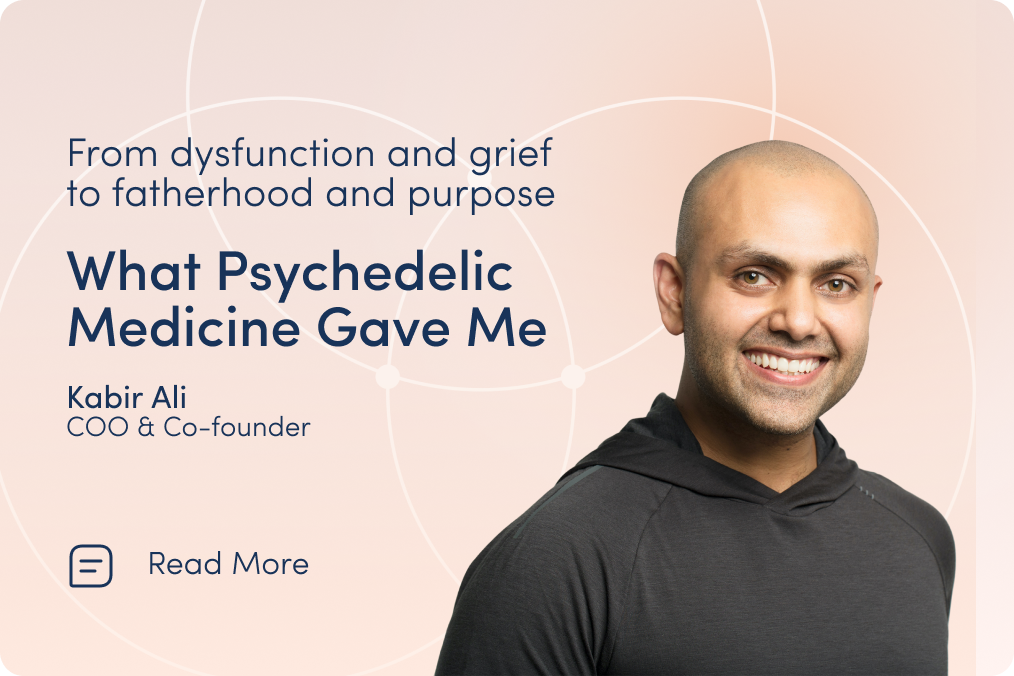
From dysfunction and grief to fatherhood and purpose, how I found peace through clinician-led ketamine care
There’s no blueprint for how someone finds themselves doing the kind of work we do at Mystic Health. It’s not linear. I certainly didn’t see myself ending up here. But here I am, and I think it’s important to share how I arrived here.
Like many, I grew up in a household where mental illness wasn’t something you read about but something you saw on a daily basis. Addiction, depression, PTSD from sexual abuse, alcoholism: they were part of my world, up close. For years I felt trapped in cycles I didn’t have language for, patterns I didn’t completely understand. I thought functioning meant I was fine.
My shift began in late 2018. That’s when I first started really turning inward. I had known for a long time that I was living with addiction, that my relationships weren’t healthy, and that my mind was often a hostile place. I was a high-functioning addict. On the surface, things looked OK. Underneath, not so much.
My first ketamine session was in a post-operative room at a pain management clinic in Florida, given and monitored by the clinical team there. Not exactly where you expect to begin a spiritual reset. But that’s what it was for me. I’d read the research and knew what ketamine was being studied for. But it wasn’t until I experienced it in a clinical setting that I understood its potential. That session gave me something I hadn’t had in years: space. Space to breathe, to reflect, to grieve. It gave me an opening that led to gratitude, to valuing life, and to a shift in perspective that I desperately needed.
Since then, I’ve had a fair share of sessions, all of them led by clinicians. Each one was different. Some brought clarity. Some didn’t. But the biggest shift was having the courage to act on what I knew needed to change. I ended a relationship that wasn’t serving either of us. I learned to spot the people and environments that were pulling me under. And I finally started therapy in a way that wasn’t just about surviving, but about working on what sat underneath my addiction and depression, and addressing my trauma.
I want to be clear: this isn’t a miracle story. It’s not all light and breakthrough moments. Ketamine therapy can be powerful, but it’s also hard. It brings things to the surface you might not be ready to face. It can leave you raw, tired, overwhelmed. That part often doesn’t get talked about enough. One or two sessions can feel profound, but for many of us they’re just the beginning. The work that follows, in therapy and in daily life, is where the real change happens.
I had one of the biggest breakthroughs of my life during a ketamine-assisted psychotherapy session with Dr. Carolina Pataky. What surfaced in that session was something I had buried deep: a realization of how painful it was to be without my family during a traumatic event over a decade ago. I lost the safety of home, the stability of love and the feeling of being held. That fracture of family, and of self, was a wound I carried silently for years. I now understand that seeking relief from that pain is what fuelled my addiction. I wasn’t just numbing. I was searching for safety, for connection and community, for something to hold on to. It wasn’t until I had the tools, the support and the courage to process that trauma that I was able to feel free. That session didn’t just give me insight. It gave me space to grieve, to feel, and to finally let go.
Today, I’m in a healthy place. I get to show up as a husband, as a father and as a leader in my work, and that still humbles me every day. I feel a deep sense of gratitude for the clinicians I’ve worked with and for the opportunities I’ve had along the way. I’m no longer in therapy, and addiction no longer runs my life. I just feel at peace. I know that if I ever need this work again, it’s there, but for now I’m taking a pause. Healing is a demanding process, and it requires space. So I’m giving myself that space, and choosing to simply enjoy this chapter of my life with my family, my colleagues and my health. That, in itself, feels like a gift.
That’s why I believe in this work. That’s why I am on this journey with Houman. That’s why Mystic Health exists: because there needs to be a place where healing is taken seriously, and where people can explore treatment with medical screening, support, structure and care.
This work helped me get my life back. Now I get to be part of offering care like it to others. If you’re reading this and considering this path, I hope something in here resonates.
A note on my story: this is my own experience, not a promise of what treatment will do for anyone else. Results vary from person to person, and ketamine is not right for everyone. Ketamine is prescribed off-label for depression; Spravato (esketamine) is the FDA-approved form. Whether either fits you is decided with a clinician in a medical consultation. If you are in crisis, call or text 988.
This isn’t about selling a treatment. It’s about sharing what’s possible when you decide to finally show up for yourself.
Kabir
This article is for educational purposes only and does not constitute medical advice, diagnosis, or treatment. Always consult a qualified healthcare provider about your own care.
Looking for support?
Our team can help you understand your options and build a plan that fits your values.
Schedule a consultation