How family support drives real mental health recovery
TL;DR:
- Family involvement significantly reduces relapse and enhances recovery outcomes in mental health treatment. Structured programs like psychoeducation and family therapy empower families to support their loved ones effectively, while healthy dynamics foster resilience. Conversely, harmful relationships and unresolved patterns can hinder progress, making honest communication and boundary-setting essential.
Recovery isn’t something that happens in a vacuum. Many of us carry the quiet belief that getting better is a solo endeavor, something fought out in therapy offices and private journals. But that picture is incomplete., hospitalizations, improves medication adherence, and enhances quality of life in mental health recovery. The science is clear, even if the practice lags behind. This article is for anyone who’s wondered whether their presence at a loved one’s side truly makes a difference, and for those seeking recovery who wonder whether letting family in might help or hurt.
Table of Contents
- Why family matters in mental health recovery
- How families support recovery: Key strategies and programs
- Positive and negative family dynamics: The double-edged sword
- Integrating families into holistic care: The future of mental health recovery
- What most guides miss: Real-world lessons on family involvement
- Explore holistic support programs for your family’s journey
- Frequently asked questions
Key Takeaways
| Point | Details |
|---|---|
| Family changes outcomes | Active family involvement reduces relapses, hospitalizations, and improves quality of life. |
| Structured support works | Programs like NAMI Family-to-Family and family therapy equip families for impactful support. |
| Dynamics can harm or help | Negative family environments increase anxiety and depression; positive ties offer some protection. |
| Holistic care includes families | Integrating families into professional care and holistic programs leads to better, more resilient recovery. |
Why family matters in mental health recovery
There’s something profound about being known deeply by someone, about being seen even when you’re at your most fragile. Family, when it shows up well, creates exactly that kind of holding space. And research backs this up with numbers that are hard to ignore.
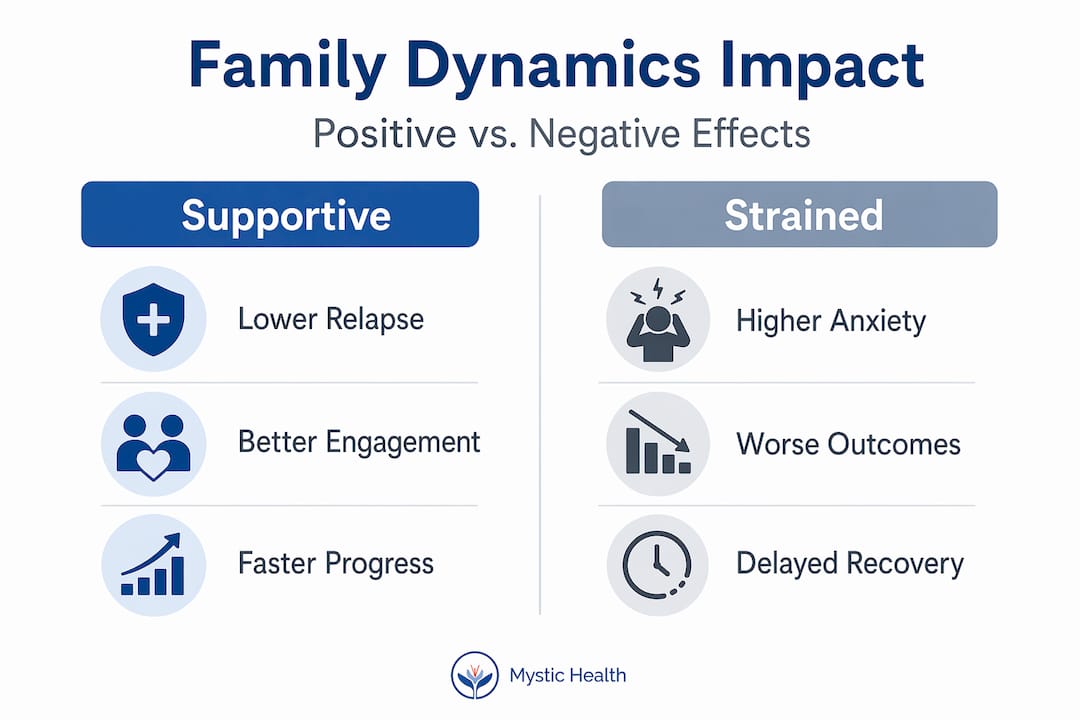
Studies show that family involvement yields up to 60% lower relapse rates and up to 80% better medication adherence compared to individuals navigating recovery without that layer of support. Those aren’t small margins. For someone living with schizophrenia, bipolar disorder, or severe depression, those numbers represent hospitalizations avoided, jobs kept, relationships preserved.
“Recovery doesn’t end when the therapy session does. It continues in the kitchen, during dinner conversations, during silences. That’s where family either holds someone up or, without meaning to, pulls them under.”
Clinical research on early psychosis specifically found that family interventions show significant effects on carer psychological distress (Hedges g = 0.35), reduced carer burden (g = -0.20), and meaningful relapse prevention for patients. What that means in plain terms: the people doing the caregiving are also hurting, and structured family programs help everyone in the equation, not just the person diagnosed.
Here’s what we know about the specific ways family involvement shapes outcomes:
- Reduced relapse rates because families help monitor warning signs and encourage consistent care
- Better medication adherence because someone at home is watching, gently reminding, and not letting it slip
- Improved emotional support outcomes since family can provide comfort between clinical appointments
- Greater treatment engagement because individuals feel less alone in the process
- Lower risk of crisis escalation since early changes are often noticed first at home
But it’s also true that not all family involvement is helpful. Strained relationships, high criticism, or emotional chaos in the home can work against recovery. We’ll get into that. For now, what matters is that the potential is real, and it’s being underused.
Now that we’ve established that family plays a pivotal role, let’s investigate how structured approaches transform this potential into results.
How families support recovery: Key strategies and programs
Wanting to help is not the same as knowing how to help. That gap is where a lot of well-meaning family members get stuck. They love deeply, but they don’t have a map. Fortunately, evidence-based programs exist to provide exactly that.
Psychoeducation is typically the first tool. It’s education designed for both individuals and their families about a given mental health condition, including what triggers look like, how to respond to symptoms without reinforcing them, and what recovery realistically involves. It helps families stop personalizing symptoms and start responding with strategy rather than fear.
Family therapy goes a step further by inviting the whole unit into the healing process. A trained therapist works with the family together, addressing communication breakdowns, old wounds, and patterns that might be feeding the problem rather than solving it. This kind of work requires courage, but it often creates the most lasting change.
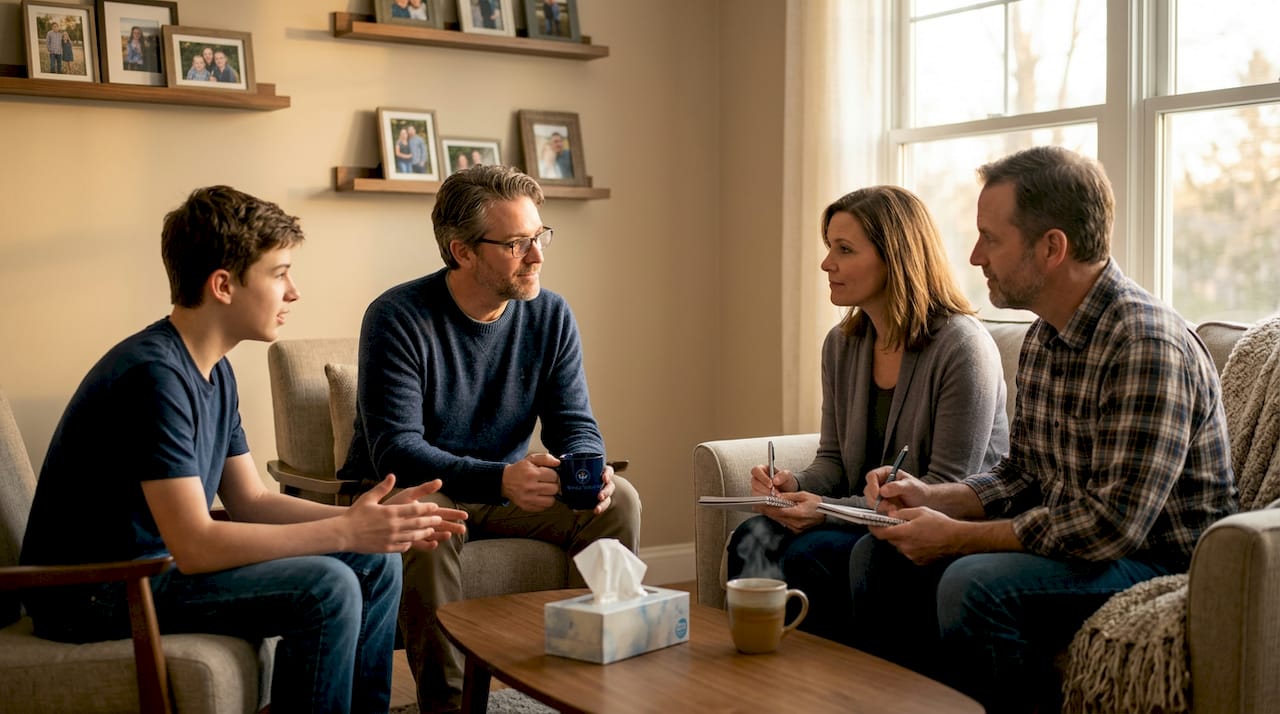
Peer support groups like NAMI Family-to-Family offer something therapy sometimes can’t: the lived experience of others who’ve been exactly where you are. NAMI’s Family-to-Family program is a free, eight-week evidence-based course that improves coping and problem-solving skills for family members of people living with mental health conditions. It is not clinical, it’s community, and that matters.
Here’s a practical view of how these programs compare:
| Program type | Format | Focus | Best for |
|---|---|---|---|
| Psychoeducation | Group or individual | Disease literacy, skill-building | Newly diagnosed families |
| Family therapy | Clinical sessions | Relationship repair, communication | Ongoing family conflict |
| NAMI Family-to-Family | 8-week peer group | Coping, problem-solving | Caregivers needing community |
| Family support services | Individualized | Practical care coordination | Complex or long-term needs |
What does a supportive family actually do differently, day to day? Here’s a realistic breakdown:
- They learn about the specific condition, not just from lived experience but from credible education for families
- They practice non-reactive listening, staying present without jumping to fix or minimize
- They maintain healthy routines in the household, since structure supports stability
- They attend scheduled appointments when invited, demonstrating that recovery matters to them
- They build their own support network rather than making their loved one’s recovery the center of their entire world
- They learn to recognize early warning signs specific to their loved one’s patterns
- They read resources on tips for family resilience to sustain their own wellbeing
Pro Tip: If conversations about mental health at home keep escalating or shutting down, that’s a sign the family system itself needs outside help. It doesn’t mean the relationship is broken. It means the patterns are bigger than one person can fix alone. Reaching for a family emotional relief guide or a therapist is the wise move, not a sign of failure.
Understanding these interventions raises an important question: What are the real-world effects of positive and negative family dynamics?
Positive and negative family dynamics: The double-edged sword
Family is not inherently healing. That’s one of the most important, and often uncomfortable, truths we need to sit with. The same relationships that can anchor someone in recovery can also pull them under, depending on the dynamics at play.
Research published in 2025 found that negative family relationships correlate with higher anxiety (r=0.075) and depression (r=0.111), while positive relationships showed weaker or sometimes no protective associations. In plain terms: harm from family dysfunction can be stronger than the benefit of family closeness. That asymmetry is significant.
“Being in a high-conflict household can feel like trying to heal a wound while someone keeps reopening it. The intention behind the conflict doesn’t change its effect on the nervous system.”
Here’s a practical breakdown of dynamics that help versus dynamics that harm:
Signs a family dynamic may be helping recovery:
- Conversations about mental health are calm, curious, and non-shaming
- Boundaries are respected, including the individual’s need for space
- The family member in recovery feels seen rather than monitored
- Crisis plans are discussed openly before a crisis happens
- Family members seek their own coping strategies so they’re not depleted
Signs a family dynamic may be hurting recovery:
- Criticism is frequent, even if framed as concern
- There’s a pattern of dismissing or minimizing symptoms
- Conversations regularly escalate into arguments or emotional withdrawal
- The person in recovery feels responsible for managing everyone else’s feelings
- Enabling behaviors allow avoidance of treatment or accountability
What do you do when the family dynamic is genuinely harmful? This is where boundaries become a form of care, not rejection. Sometimes a recovering individual needs therapeutic distance from a model, learning to build chosen family and supportive community while working through the biological one in structured therapy.
The goal isn’t to cut people off. The goal is to make the healing environment safe enough to actually heal. With risks and benefits clearer, let’s look at the system-wide importance of integrating family across recovery journeys.
Integrating families into holistic care: The future of mental health recovery
The healthcare system has historically treated mental health recovery as something that happens between a clinician and a patient, with family waiting in the lobby. That model is changing, slowly, but it’s changing. And it needs to change faster.
SAMHSA emphasizes that family support helps detect early changes, connects individuals to treatment, and improves outcomes through therapy and community groups. SAMHSA also recognizes that genetic and environmental family factors significantly influence a person’s risk. In other words, families aren’t just bystanders. They’re part of the clinical picture.
Despite this, family-focused care remains under-implemented. Research shows that parental mental illness increases a child’s risk 1.5 to 3 times, and bidirectional influences between family members and individuals in recovery are well documented. Yet families are still frequently left out of formal care planning.
Here’s how you can begin to change that, step by step:
- Request inclusion from the start. When a loved one enters treatment, ask directly: “How can our family be involved in the care plan?” Many clinicians welcome this but wait to be asked.
- Participate in intake and screening processes when possible, since families often hold crucial context about history, triggers, and patterns.
- Access psychoeducation early. Don’t wait until crisis. Understanding a condition before it escalates gives everyone more options.
- Ask about the Individualized Support Plan (ISP). This is the roadmap of recovery goals. Families who understand it can reinforce progress at home instead of accidentally working against it.
- Attend family therapy at key transitions, such as after a hospitalization or when a new medication is introduced.
- Build a long-term relationship with integrative mental health care that sees the whole person, not just the diagnosis.
- Stay connected to a community of other families navigating similar paths, because isolation is one of the biggest obstacles caregivers face.
Pro Tip: If your loved one’s care team doesn’t have a clear answer about how family can be involved, that’s useful information. A truly holistic program will have thought about this. It’s okay to advocate loudly for family integration. You’re not overstepping. You’re participating in the recovery.
We’ve mapped the evidence and approaches. Now let’s talk about what most guides still miss.
What most guides miss: Real-world lessons on family involvement
Most articles on this topic stop at “be supportive.” Show up, listen, don’t judge. That’s a foundation, not a strategy.
Here’s what I’ve seen, and what the evidence quietly confirms: boundaries are just as important as closeness. In fact, poorly managed closeness can become its own form of harm. When a family member sacrifices their own stability to be endlessly available, they often end up burned out, resentful, or inadvertently enabling the avoidance that holds someone back from real healing. Support without structure isn’t support. It’s exhaustion wearing a kind face.
I also want to name something that rarely gets addressed directly: intergenerational patterns. Mental health conditions don’t arrive in a vacuum. They often echo through family lines, shaped by unresolved trauma, modeled coping behaviors, and inherited biology. Families that are willing to look honestly at their own history, not to assign blame, but to understand, tend to create far more powerful conditions for healing than families focused solely on the person who received the diagnosis.
The hard conversations matter. Sitting with a clinician and saying “our communication tends to escalate” or “I think my caretaking might be enabling avoidance” is not easy. But those moments of honesty are where real transformation begins. Check out these lasting mental health tips for both individuals and families navigating the long road of sustained recovery.
Personalized approaches will always beat generic ones. A family with decades of trauma and high conflict needs a very different roadmap than a family with strong communication skills and just a learning curve about mental health. Any guide that doesn’t acknowledge that difference is leaving something important out.
Explore holistic support programs for your family’s journey
Recovery truly does work best together. If you’re reading this and feeling the pull to do more, to show up differently, to build something more intentional for your family, that instinct is worth following.
At Mystic Health, we offer family-focused programs designed to integrate the whole family into the healing process, not as an afterthought, but as a core part of the work. Our integrative mental health services bring together evidence-based therapies, holistic modalities, and compassionate care coordination so that every person in the family system has a place in the story of recovery. We also offer a mindfulness program for families that builds the kind of regulated, grounded presence that makes all the other support possible. Reach out to us and let’s build a plan together.
Frequently asked questions
Can family involvement really lower relapse rates in mental health recovery?
Yes, up to 60% lower relapse rates are associated with strong family involvement, along with significantly improved medication adherence in structured programs. These outcomes depend on the quality of involvement, not just the presence of family.
What are some structured ways families can help with mental health recovery?
Families can participate in psychoeducation, attend therapy sessions, and join peer support programs like NAMI Family-to-Family, an eight-week evidence-based course that improves coping and problem-solving skills for caregivers. Crisis management training is another powerful tool when combined with regular involvement.
Do negative family dynamics affect mental health outcomes significantly?
Yes, negative family relationships correlate with measurably higher anxiety and depression, sometimes more strongly than positive ties offer protection. This asymmetry means harmful dynamics need to be addressed, not just balanced with good intentions.
How can families advocate for better integration in care plans?
By directly requesting inclusion in care discussions, attending therapy when invited, and accessing community resources recommended by SAMHSA’s Family Support guidelines, families can move from passive observers to active participants in recovery. Asking clear questions about care goals is a powerful first step.
Recommended

Mystic Health Blog







FAQs
1. Am I eligible for ketamine therapy?
2. Does insurance cover the cost of ketamine therapy?
3. How many ketamine treatments will I need?
We recommend two initial treatments to determine suitability and adjust dosage. After these sessions, additional treatments are available based on your progress and specific requirements.