Palliative Care Workflow: A Practical Guide for Teams
TL;DR:
- Effective palliative care workflows enhance patient outcomes by promoting coordinated, holistic management across specialties and settings. Automating patient identification, using standardized assessment tools, and continuously refining processes improve symptom relief and reduce care fragmentation. Building adaptable, human-centered protocols ensures sustained, compassionate support for seriously ill patients and their families.
Fragmented care is one of the most painful realities in serious illness management. Patients move between specialists, hospitals, and home settings, and too often, the coordination falls apart. A well-designed palliative care workflow changes that. It creates a structure where symptom management, goals-of-care conversations, and family support all happen on purpose, not by chance. This guide walks you through everything you need to build, execute, and refine a palliative care process that genuinely serves patients and gives your team clarity at every stage.
Table of Contents
- Key takeaways
- What an effective palliative care workflow requires
- Step-by-step execution of the palliative care process
- Common challenges in palliative care workflows
- Outcomes you can expect from a structured workflow
- My honest take on building these workflows
- How Mystic Health supports your palliative care work
- FAQ
Key takeaways
| Point | Details |
|---|---|
| Start with the right team | An interdisciplinary team including physicians, nurses, social workers, chaplains, and pharmacists forms the backbone of any effective workflow. |
| Use EHR algorithms for identification | Automated triggers significantly increase consultation rates and reduce delays in reaching eligible patients. |
| Treat the workflow as a living process | Iterative updates based on real clinical events, not just initial design, keep workflows effective over time. |
| Symptom relief is interconnected | Pain reduction drives measurable improvements in sleep and depression, making symptom clusters the right unit of focus. |
| Documentation reduces care chaos | Standardized EMR phrases and advance care planning records protect continuity across care settings and provider handoffs. |
What an effective palliative care workflow requires
Before you can execute anything, you need the right foundation. The components that support a reliable palliative care workflow are not complicated, but they do need to be intentional.
The interdisciplinary team
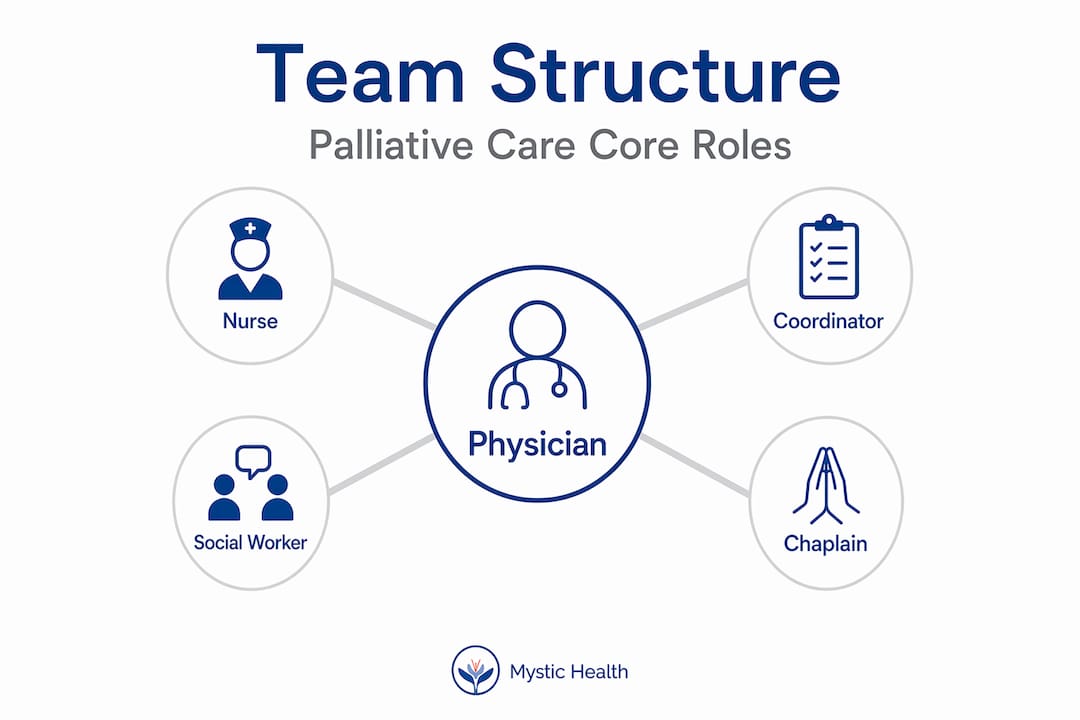
The palliative care interdisciplinary team is the engine of the whole process. At minimum, you need physicians managing symptom control and prognosis, nurses providing day-to-day monitoring and family education, social workers addressing psychosocial needs and resource navigation, chaplains supporting spiritual distress, and pharmacists reviewing medication safety. Each role has a defined lane. When those lanes blur or go unfilled, patients fall through the gaps.
Consider also involving a palliative care coordinator who acts as the connective tissue between all disciplines. This role is often underestimated, but it directly reduces the fragmentation that derails care plans.
Communication frameworks and assessment tools
Structured communication protocols, particularly SPIKES and VitalTalk, are to align care with patient values. These frameworks give providers a repeatable method for navigating emotionally charged conversations without losing clinical precision.
For symptom assessment, the Edmonton Symptom Assessment System (ESAS) is the standard. It captures patient-reported intensity for pain, fatigue, nausea, depression, anxiety, drowsiness, appetite, wellbeing, and shortness of breath on a single form. When used consistently, it creates a data trail that supports treatment adjustments and team communication.
Technology and documentation infrastructure
Your electronic health record (EHR) system needs to do more than store notes. Embedded decision support algorithms help flag patients who meet criteria for palliative consultation. Advance care planning documentation should live in a location every provider can find, not buried three clicks deep. Care coordination platforms that allow cross-setting communication, between inpatient, outpatient, and home teams, are worth the investment.

| Component | Purpose |
|---|---|
| Interdisciplinary team | Shared decision-making and holistic symptom management |
| ESAS assessment tool | Standardized, patient-reported symptom tracking |
| SPIKES/VitalTalk frameworks | Structured goals-of-care conversations |
| EHR decision support algorithms | Proactive patient identification |
| Advance care planning documentation | Continuity across settings and providers |
Step-by-step execution of the palliative care process
With your foundation in place, the workflow itself follows a clear arc. Each stage builds on the last.
-
Identify eligible patients early. Reactive referrals, triggered only by crisis, produce worse outcomes than proactive identification. Automated EHR algorithms have been shown in a meta-analysis of 7 trials involving 125,666 patients to increase consultation rates at a relative risk of 2.67 compared to usual care. Set clinical triggers for diagnoses like advanced cancer, heart failure, COPD, and renal failure. Integrate these triggers into your admission and outpatient workflows so no eligible patient is missed. The Cross-PALL model, which starts navigation at diagnosis, offers a useful framework for that proactive entry point.
-
Conduct a comprehensive intake assessment. Once a patient is identified, the first formal touchpoint should cover physical symptom burden using ESAS, psychosocial status, caregiver support capacity, spiritual or existential concerns, and functional status. This is not a checklist to rush through. It is the data set that shapes everything downstream. Involve the whole team in reviewing results, not just the referring physician.
-
Set goals of care with the patient and family. This is where the palliative care process becomes deeply human. Use SPIKES or VitalTalk to open the conversation. Explore what the patient values most, what they fear, and what quality of life means to them specifically. Document those goals in a format all providers can access and act on. Effective palliative care teams function best when they serve as coordinating resources that actively align care decisions with patient values, not just symptom managers.
-
Develop and implement the treatment plan. Symptom management takes center stage here. For pain, follow your institution’s opioid prescribing guidelines with palliative-specific adaptations. Complex cases, particularly patients with substance use disorders, require specialized protocols. Provider comfort with opioid management increased from 19% to 52% after one locally adapted workflow was implemented, which demonstrates what structured guidance does for clinical confidence. Beyond pain, address nausea, anxiety, sleep disturbance, and depression as a cluster, not in isolation.
-
Coordinate care across settings. Patients move. Your workflow has to move with them. Schedule follow-up contacts at defined intervals, not just when problems arise. Use transition consultations when patients are discharged from inpatient settings. Assign ownership of each referral step clearly, because successful intake teams track referral status actively to prevent delays and lost handoffs. The cancer and palliative care population is especially vulnerable during these transitions, so build in explicit check-ins at every care boundary.
Pro Tip: Map your existing patient pathways on paper before digitizing them. Seeing the handoff points visually almost always reveals gaps that no one on the team had formally noticed.
Common challenges in palliative care workflows
Even the most carefully designed workflows run into friction. Knowing where it usually appears helps you prepare.
-
Provider discomfort with complex cases. Not every clinician on your team will feel equally confident managing opioids in patients with substance use histories, or delivering a prognosis under diagnostic uncertainty. Locally adapted training tied directly to the workflow, not just general education, addresses this gap more effectively. Iterative workflow refinements made after unexpected clinical events, like ambiguous toxicology results, produce better outcomes than static protocols.
-
Documentation gaps and EMR inconsistencies. Palliative care documentation errors often appear at transitions. A note written in the oncology chart does not automatically reach the home health nurse. Standardized EMR phrases, agreed upon by the whole team, reduce that chaos. Advance care planning documents need a consistent location that every provider across every setting knows to check.
-
Unclear referral ownership. Who is responsible for following up on a consult request? If the answer is unclear, the patient waits. High-performing hospice intake teams make referral step ownership explicit, tracking each handoff so nothing stalls between providers.
-
Resistance to workflow adoption. Change is hard in clinical environments, especially when teams are stretched. Frame the workflow as reducing burden, not adding it. Show the data. When providers see that structured processes lower their cognitive load and improve patient outcomes, adoption follows more naturally.
Pro Tip: Designate one team member as the workflow steward for the first six months. This person tracks adoption, collects feedback, and brings recommended updates to the group. Without that role, early momentum tends to fade.
Outcomes you can expect from a structured workflow
The evidence for improving palliative care delivery through structured workflows is real and specific.
A study of 119 patients receiving early outpatient palliative care showed statistically significant symptom improvements in pain, nausea, and anxiety at follow-up. What makes those findings especially meaningful is the downstream effect: pain reduction is associated with improved sleep scores (β = 0.31) and lower depression scores (β = 0.20). Treating one symptom well creates relief in others. That interconnection is why a holistic symptom assessment matters from day one.
Beyond individual symptom relief, structured workflows increase palliative care consultation rates and improve advance directive documentation. Both of those outcomes reduce crisis-driven care and support smoother transitions. Families report less confusion and greater trust in the care team when care feels coordinated rather than reactive. Providers report higher confidence, particularly when workflows include explicit guidance for complex populations.
| Outcome | Evidence |
|---|---|
| Symptom relief (pain, nausea, anxiety) | Significant improvement in 119 outpatient palliative care patients |
| Increased consultation rates | RR 2.67 with automated EHR algorithms vs. usual care |
| Improved advance directive documentation | DNR documentation RR 1.22 with algorithm-supported workflows |
| Provider confidence with complex cases | Opioid management comfort rose from 19% to 52% post-workflow |
The emotional support dimension of these outcomes should not be overlooked. Patients who feel heard and coordinated around have measurably better wellbeing scores, not just symptom scores.
“Effective palliative care coordination requires managing the patient journey longitudinally across settings, not just episodic hospitalization management.” —
My honest take on building these workflows
What I’ve learned from working in and around palliative care is that the biggest mistake teams make is treating workflow design as a one-time event. You build it, you train on it, and then it sits there while the patients you serve get more complex and the clinical realities shift.
The teams I’ve seen do this well treat their workflows as living documents. They build in a quarterly review, they pay attention to near-misses, and they ask frontline nurses, not just physicians, what is actually breaking down. That humility in the process is what separates good outcomes from great ones.
I’ve also watched how much it matters to preserve the human texture inside a structured process. Automated EHR triggers are genuinely useful. They catch patients who would otherwise be missed. But they cannot replace the moment when a social worker sits with a family and gives them space to grieve what is coming. The workflow creates the conditions for that conversation. It does not replace it.
If I had one piece of encouragement for any team implementing or refining a palliative care workflow right now, it would be this: start imperfect and iterate. The integrative mental health dimension of serious illness is often the last thing teams formalize, but it shapes everything else. Build it in from the beginning.
— Kabir
How Mystic Health supports your palliative care work
At Mystic, we understand that the palliative care process is as much about emotional and psychological healing as it is about symptom control. Our integrated palliative care programs combine evidence-based clinical support with integrative mental health modalities, including ketamine-assisted therapy and mindfulness practices, designed to address the full weight of serious illness.
Whether you are a healthcare professional looking to expand your team’s support options or a caregiver seeking more for the person you love, Mystic Health offers personalized programs that complement and deepen your existing workflow. Explore our care programs to see how integrative approaches can bring more relief, more meaning, and more connection to the people in your care.
FAQ
What is a palliative care workflow?
A palliative care workflow is a structured, step-by-step process that guides how interdisciplinary teams identify patients, assess symptoms, set care goals, and coordinate support across care settings. It standardizes the palliative care process to reduce fragmentation and improve patient outcomes.
How does EHR automation improve palliative care?
Automated EHR algorithms identify eligible patients earlier and increase consultation rates. A meta-analysis of 7 trials with 125,666 patients found that algorithm-driven identification produced a consultation rate relative risk of 2.67 compared to usual care.
What assessment tools should palliative care teams use?
The Edmonton Symptom Assessment System (ESAS) is the most widely used standardized tool, capturing patient-reported severity across nine symptoms in a single assessment. It creates a consistent data trail that supports treatment decisions and team communication.
How do you handle complex patients in a palliative care workflow?
Locally adapted protocols with built-in provider training are the most effective approach, particularly for patients with substance use disorders. Provider comfort with opioid management has been shown to more than double after a structured workflow is implemented.
Why is care coordination so critical in palliative care?
Patients with serious illness move frequently between care settings, and each transition is a moment where critical information can be lost. Clear referral ownership, standardized documentation, and scheduled follow-up contacts are the three practices that prevent the most common coordination failures.
Recommended

Mystic Health Blog







FAQs
1. Am I eligible for ketamine therapy?
2. Does insurance cover the cost of ketamine therapy?
3. How many ketamine treatments will I need?
We recommend two initial treatments to determine suitability and adjust dosage. After these sessions, additional treatments are available based on your progress and specific requirements.