Your Guide to Assessing Therapy Readiness in 2026
TL;DR:
- Most people hesitate to start therapy, believing they must be “bad enough” or have a crisis, but curiosity itself indicates readiness. Emotional signs like persistent sadness or curiosity about oneself are valid reasons to seek support, and ambivalence signals progress rather than doubt. Trauma readiness depends on nervous system regulation and basic stability, not just willingness, emphasizing the importance of safety before processing past wounds.
Somewhere between “I think I need help” and actually making that first call, most people stop. They tell themselves they’re not bad enough yet, that someone else needs the therapist more, or that they wouldn’t even know what to talk about. This guide to assessing therapy readiness exists precisely for that in-between space. Readiness isn’t a threshold you either meet or miss. It’s something you can explore, understand, and grow into. And if you’re here asking the question at all, that curiosity itself is worth paying attention to.
Table of Contents
- Key Takeaways
- Signs you may be ready for therapy
- Understanding ambivalence and fear as part of readiness
- Practical steps to assess your readiness
- Trauma therapy readiness and why it’s different
- Common mistakes when judging readiness
- My honest take on what readiness really looks like
- How Mystic can support your next step
- FAQ
Key Takeaways
| Point | Details |
|---|---|
| Readiness is fluid, not fixed | You don’t need a crisis or a perfect problem to begin therapy. Curiosity alone is enough. |
| Ambivalence is normal | Feeling scared or uncertain about starting therapy doesn’t mean you’re not ready. It means you’re human. |
| Know the signs | Emotional stuckness, sleep changes, and persistent sadness are among 17 recognized signs of readiness. |
| Trauma readiness is different | For trauma therapy, the priority is nervous system regulation first, not immediate trauma processing. |
| The fit matters enormously | The quality of the therapeutic relationship predicts outcomes more reliably than any specific technique. |
Signs you may be ready for therapy
Many people picture therapy readiness as a dramatic moment: a breakdown, a crisis, a rock bottom. But the truth is quieter than that. includes 17 recognized signs, ranging from emotional stuckness and persistent sadness to changes in sleep, eating, and daily habits. You don’t need all seventeen. Even one or two, sustained over time, is worth taking seriously.
Some signs are obvious. You’ve been crying more than usual. You’re withdrawing from people you love. Work feels impossible to face. Others are subtle: a growing sense that something is off, an increased desire to understand yourself better, or a quiet but persistent feeling that the way you’re coping isn’t working anymore.
Here are some of the more overlooked indicators that therapy might help:
- Increased self-criticism or shame spirals after ordinary mistakes
- Using alcohol, food, or screens to manage emotions more than you’d like to admit
- Replaying past events and unable to move forward from them
- A gut feeling that you’re performing “okay” for others while struggling privately
- Curiosity about why you react the way you do in relationships or conflict
That last one is underrated. Pure curiosity about your own patterns, without any dramatic suffering attached, is a completely valid reason to seek support. during mild discomfort or even just a vague sense of wanting more from your life is not only valid but common.
Pro Tip: Don’t wait for things to get “bad enough.” The people who benefit most from therapy often start before they hit a wall, giving them more internal resources to work with from the beginning.
Understanding ambivalence and fear as part of readiness
Here’s something that surprises many people: feeling scared about starting therapy, or feeling unsure whether you actually need it, is itself a sign of readiness. Not a barrier to it.
Ambivalence is a natural part of the readiness process. It means part of you wants to change and part of you is afraid of what change costs. Both responses are honest. Both deserve space.
Common fears people carry into this stage include:
- Fear of being judged by the therapist for thoughts or behaviors they’re ashamed of
- Fear that therapy will open something they won’t be able to close again
- Worry that they’ll be told something devastating about themselves
- Concern that talking about problems will make them feel worse, not better
- Uncertainty about whether their pain is “real enough” to warrant professional support
None of these fears disqualify you. They’re part of the process. What matters more than certainty is willingness. Specifically, a willingness to show up and try, even if you’re not sure it will work.
“Readiness is not a static yes or no but a fluid state of willingness. Beginning therapy does not require certainty or clarity, only a genuine openness to engage in the process.” —
Self-compassion matters here more than you might expect. Many people approach evaluating therapy readiness the same way they approach everything else: with pressure, self-judgment, and a checklist. Try instead to treat this as an act of genuine care for yourself. You’re not applying for a job. You’re considering whether to give yourself some support.
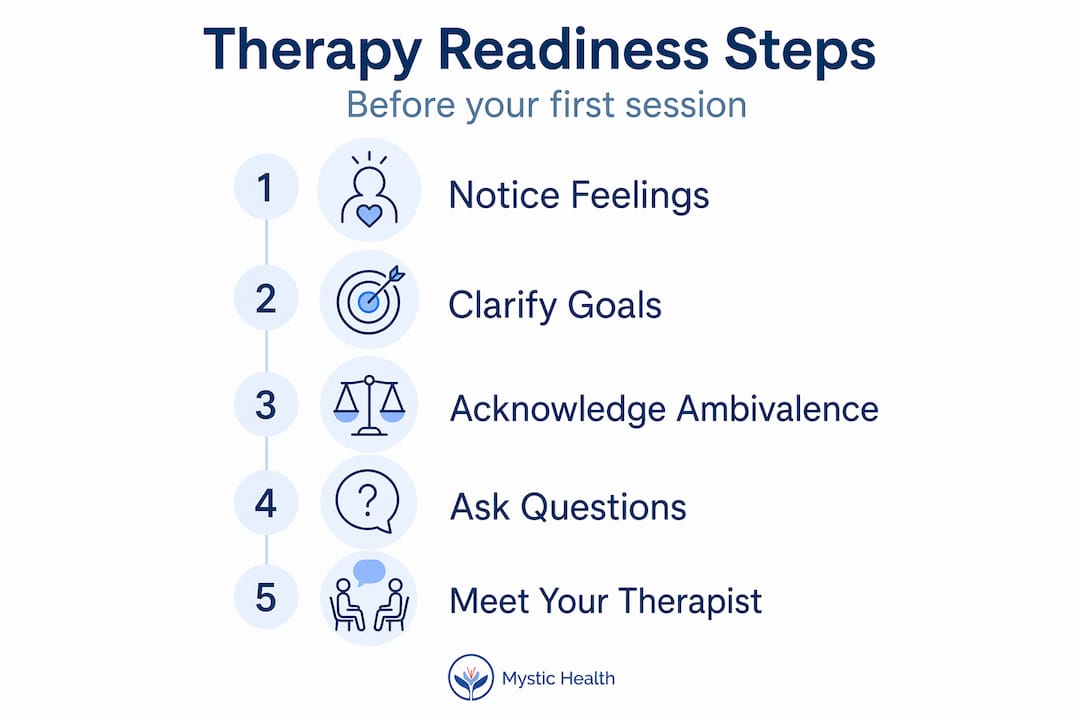
Practical steps to assess your readiness

Knowing the signs is one thing. Actually sitting with yourself and taking stock is another. This is where honest self-reflection becomes the most useful tool you have.
Start with these questions and answer them as honestly as you can:
- What’s been bothering me most over the last few months?
- Have my coping strategies been working, or am I just managing?
- Is there something I keep thinking about but never actually address?
- What would I want to feel differently about in my life?
- Am I willing to be open with someone, even if it’s uncomfortable at first?
You don’t need perfectly clear answers. The goal is awareness, not a written plan. Even sitting with a question and noticing how your body responds tells you something.
When you move toward actually meeting with a therapist, that first consultation functions as a two-way interview. You’re not just hoping they’ll accept you. You’re evaluating whether they’re the right fit. Key questions to ask include their experience with your specific concerns, their therapeutic approach, their fee structure, and how they handle emergencies between sessions.
| Assessment area | Questions to ask yourself or your therapist |
|---|---|
| Emotional clarity | What has been causing me the most distress lately? |
| Motivation | Am I seeking change, or just validation? |
| Openness | Can I talk about difficult things with some honesty? |
| Therapist fit | Does this person’s approach feel right for where I am? |
| Practicalities | Are sessions affordable, accessible, and consistent? |
The therapeutic relationship deserves special attention here. The quality of the alliance between client and therapist is a stronger predictor of positive outcomes than any specific therapy model or technique. If you meet someone and something feels off, trust that. You’re allowed to keep looking.
A mental health checklist can also help you clarify what you’re experiencing before your first session, making it easier to articulate where you are and what kind of support you’re looking for.
Pro Tip: Treat the first consultation as a conversation, not an evaluation. Your comfort with the therapist matters as much as their credentials.
Trauma therapy readiness and why it’s different
If part of what you’re hoping to address involves trauma, the readiness framework shifts in an important way. And understanding this shift can protect you from harm.
Judith Herman’s foundational work on trauma therapy emphasizes as the necessary first stage before any trauma processing begins. This isn’t about being cautious for caution’s sake. Jumping into trauma material before someone has the emotional regulation capacity to hold it can cause re-traumatization, making symptoms worse rather than better.
Trauma therapy readiness means something specific:
- You can identify when you’re becoming overwhelmed and have some way to ground yourself
- Your day-to-day life has a degree of safety and basic stability
- You have at least one trusted relationship or support source outside of therapy
- You’re not currently in crisis or in a volatile or unsafe environment
- You feel some tolerance for sitting with discomfort without immediately shutting down
is defined by your capacity to regulate your nervous system, not your willingness to talk about the past. Many deeply motivated people are not yet ready for deep trauma processing, and that’s okay. Stabilization work is real, meaningful therapy. It builds the foundation that makes everything else possible.
“Before any trauma can be meaningfully processed, the nervous system needs to know it is safe. Regulation comes first. Healing follows.” — paraphrased from Judith Herman’s stage model of trauma recovery
The emotional healing work that comes before trauma processing isn’t preliminary or lesser. It is the work.
Common mistakes when judging readiness
Even people who are genuinely ready for therapy sometimes talk themselves out of it because of beliefs that simply aren’t true. Recognizing these patterns is part of preparation for therapy.
- Waiting for a diagnosis. You do not need a formal mental health diagnosis to begin therapy. Many people start therapy without one and benefit significantly.
- Assuming readiness should feel certain. If you’re waiting to feel completely sure before making the call, you may wait indefinitely. Willingness is enough.
- Thinking readiness is permanent. Readiness fluctuates. Someone might feel ready, start therapy, take a break, and return later. That’s not failure. That’s how healing often actually works.
- Expecting linear progress. Therapy doesn’t move in a straight line. Some weeks feel like breakthroughs. Others feel like you’ve gone backward. Both are part of the process.
Viewing therapy as one part of a broader healing life, rather than a final solution, helps. It sits alongside exercise, community, creative outlets, and spiritual practice. No single thing carries the whole weight. And therapy readiness doesn’t demand perfection from you before you begin.
Pro Tip: If you’re stuck asking “Am I ready?” the question itself is the answer. Show up for yourself anyway.
My honest take on what readiness really looks like
I’ve observed a wide range of people at different stages of readiness, and the one thing I can say with confidence is this: the people who wait for perfect readiness rarely get there.
What I’ve seen again and again is that ambivalence is not the opposite of readiness. It often signals it. When someone is wrestling with the idea of therapy, turning it over in their mind, feeling pulled in two directions, that internal friction usually means something real is asking for attention. That matters.
I’ve also noticed that people who feel they need to perform “fine” in everyday life carry an enormous burden into that first therapy session. Creating a space where performance isn’t required, where you don’t have to explain or justify your emotions before they’re accepted, changes something fundamental. That’s what good therapy offers.
My honest advice: don’t aim for certainty before you start. Aim for honesty. Be willing to say “I don’t fully know what I need yet.” That’s more than enough to begin with. Small steps taken with genuine intention carry more weight than big dramatic leaps taken when you feel perfectly ready. Show up for yourself now, with whatever you have.
— Kabir
How Mystic can support your next step
Taking stock of where you are emotionally is a meaningful act. If you’ve been working through these questions and feel a pull toward deeper support, Mystic is here to help you figure out what that looks like for you.

Mystic Health offers integrative mental health programs designed to meet you where you are, whether you’re just beginning to explore therapy or considering more advanced modalities like ketamine-assisted psychotherapy. Every care path starts with a genuine conversation about fit, readiness, and what you’re hoping to move toward. You can also explore the full range of available programs to find what feels right. The first step is simply a conversation, and Mystic’s team is here to make that feel safe.
FAQ
What are the most common signs of therapy readiness?
Common signs include persistent sadness, emotional stuckness, changes in sleep or eating, and a desire to understand yourself better. Seventeen recognized indicators range from obvious distress to subtle feelings that something is off in your daily life.
Do I need a crisis or diagnosis to start therapy?
No. You do not need a crisis, a formal diagnosis, or a clearly defined problem to begin therapy. Starting with mild curiosity or a vague sense of wanting change is a completely valid and common reason to seek support.
How do I know if I’m ready for trauma therapy specifically?
Trauma therapy readiness is about your ability to regulate your nervous system, not your willingness to talk about past events. If you can ground yourself when overwhelmed and have basic stability in your daily life, you may be ready to begin. Speak with a trauma-informed therapist to assess your specific situation.
What should I ask a therapist during a first consultation?
Ask about their experience with your specific concerns, their therapeutic approach, fees, and how they handle situations between sessions. First consultations are a two-way evaluation, so trust your gut about whether the connection feels right.
Can readiness for therapy change over time?
Yes, and that’s completely normal. Readiness is a fluid state, not a fixed threshold you either meet or don’t. Someone can feel ready, step back, and return to therapy later. All of it counts as part of the process.
Recommended

Mystic Health Blog








FAQs
1. Am I eligible for ketamine therapy?
2. Does insurance cover the cost of ketamine therapy?
3. How many ketamine treatments will I need?
We recommend two initial treatments to determine suitability and adjust dosage. After these sessions, additional treatments are available based on your progress and specific requirements.