Deep emotional healing: Evidence, techniques, and risks
Most people assume that healing emotional wounds means sitting across from a therapist and talking through the past. That’s a reasonable starting point, but it’s often not enough. Somatic and psychedelic-assisted approaches provide rapid and durable relief for trauma that talk therapy alone frequently misses. If you’ve been carrying chronic pain, PTSD, or grief that just won’t shift no matter how much you’ve processed it verbally, this guide is for you. We’ll walk through what deep emotional healing actually means, how somatic and psychedelic methods work, what the evidence says, and how to stay safe along the way.
Table of Contents
- Defining deep emotional healing
- Core mechanics: Somatic and nervous system approaches
- Psychedelic-assisted therapies: Evidence, benefits, and limitations
- Risks, edge cases, and essential safeguards
- Our take: What most guides ignore about deep emotional healing
- Explore programs for deep emotional healing
- Frequently asked questions
Key Takeaways
| Point | Details |
|---|---|
| Somatic & Psychedelic Methods | These approaches offer deeper, faster relief for trauma and chronic pain than traditional talk therapy. |
| Evidence-Based Impact | Clinical trials show MDMA and psilocybin therapies can cut PTSD and depression symptoms by over 50 percent. |
| Risks Require Expertise | Re-traumatization and distress are real risks; expert trauma-informed support is essential for safety. |
| Integration Is Key | Thorough preparation and post-session integration are vital to lasting emotional healing. |
| Programs and Support | Trauma-informed programs help guide deep healing for lasting transformation and safety. |
Defining deep emotional healing
Deep emotional healing is not about managing symptoms. It’s about going to the root. Where conventional therapy often focuses on changing thought patterns or building coping skills, deep emotional healing targets trauma that lives in the body, the nervous system, and the parts of us that words can’t always reach.
This distinction matters. Trauma isn’t just a memory. It’s a physiological imprint. Your body holds onto survival responses that never got to complete. That tension in your chest, that hair-trigger startle reflex, that chronic sense of dread — these aren’t character flaws. They’re your nervous system doing its best to protect you from something that already happened.
prioritize healing trauma stored in the body, leveraging neuroplasticity and nervous system reset. But they also demand expert facilitation to avoid edge cases like re-traumatization. This isn’t something to approach casually.
Conditions that respond well to deep emotional healing include:
- Post-traumatic stress disorder (PTSD) from combat, abuse, accidents, or loss
- Complex trauma from childhood neglect or ongoing relational harm
- Treatment-resistant depression that hasn’t responded to medication
- Chronic pain with a significant emotional or trauma component
- Anxiety disorders rooted in unresolved nervous system dysregulation
“Healing is not linear. It asks you to feel what you’ve been running from, and to do that with support, not alone.”
Understanding how culture and psychedelic healing intersect is also part of this picture. Context shapes how we hold trauma and how we release it.
Core mechanics: Somatic and nervous system approaches
Now that we’ve defined the goal, let’s look at the physical and nervous system processes involved in true deep healing.
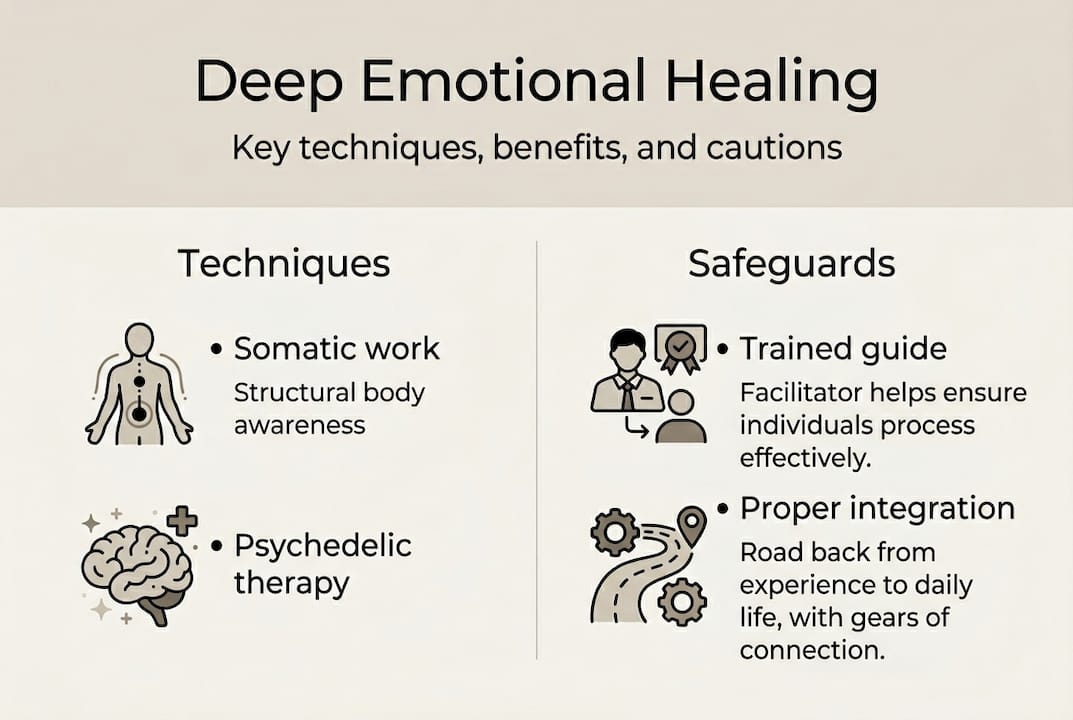
Somatic therapy works on the premise that trauma is stored in the body and must be released physically, not just understood intellectually. The core mechanics involve somatic release via nervous system regulation, titration of sensations, pendulation between safety and activation, and completion of thwarted survival responses like fight, flight, or freeze.

Here’s a quick breakdown of the key techniques:
| Technique | What it does | Why it matters |
|---|---|---|
| Titration | Gradual, small-dose exposure to distressing sensations | Prevents overwhelm and re-traumatization |
| Pendulation | Moving between activated and safe states | Builds nervous system flexibility |
| Grounding | Anchoring awareness in the present body | Reduces dissociation and panic |
| Completion | Allowing survival responses to finish | Discharges stored survival energy |
These techniques aren’t passive. They ask something of you. You might notice a tremor, a wave of heat, or an unexpected wave of emotion. That’s not a sign something is wrong. That’s often the body releasing what it’s been holding.
Key benefits of somatic approaches include:
- Reducing hypervigilance without medication
- Restoring a felt sense of safety in the body
- Improving emotional regulation over time
- Supporting mindful self-compassion as a daily practice
Pro Tip: Working with a trauma-informed facilitator significantly reduces the risk of distress or re-traumatization. Don’t try to push through intense somatic experiences alone, especially early in the process.
Somatic work pairs beautifully with psychedelic-assisted therapy, which we’ll look at next. The psychedelic healing conversation is growing louder, and for good reason.
Psychedelic-assisted therapies: Evidence, benefits, and limitations
Beyond somatic methods, psychedelic therapies are gaining serious attention. Let’s examine how the evidence stacks up and what you should know before considering this path.
The three most studied substances right now are MDMA, ketamine, and psilocybin. Each works differently, but all three appear to create windows of neuroplasticity, meaning the brain becomes temporarily more open to change and new learning.
| Substance | Primary use | Key finding |
|---|---|---|
| MDMA | PTSD | Phase 3 trials show 50%+ symptom reduction |
| Ketamine | Depression, PTSD | Rapid relief, may need repeat sessions |
| Psilocybin | Depression, trauma | 50-65% symptom reduction in veteran retreats |
Empirical data from clinical trials shows ketamine provides rapid PTSD relief, MDMA-assisted therapy yields substantial and durable PTSD improvements in Phase 3 trials, and psilocybin retreats normalize EEG patterns while cutting PTSD and depression by 50 to 65% in veterans. These are not small numbers.
Evidence-based benefits of psychedelic-assisted therapies:
- Rapid reduction in PTSD and depression symptoms, often within one to three sessions
- Durable results that persist months after treatment ends
- Increased emotional openness and reduced fear response
- Enhanced ability to process traumatic memories without being overwhelmed
- Improved sense of connection to self and others
That said, psychedelic-assisted therapies are promising for refractory trauma, with benchmarks like 50%+ symptom drops, though more large-scale trials are still needed. This is an evolving field, not a finished one.
You can review clinical evidence to understand what’s currently supported and what’s still being studied. And if you want to hear what this work actually feels like from the inside, reading about a real psychedelic medicine experience can be grounding before you decide anything.
Risks, edge cases, and essential safeguards
While the benefits are real and sometimes dramatic, navigating these methods safely requires careful attention to possible pitfalls.
One of the most important things to understand is that psychedelics can surface trauma rapidly. That’s part of how they work. But without proper integration, meaning the therapeutic work that happens after a session, that surfaced material can leave you feeling worse, not better. Psychedelics risk re-traumatization or prolonged distress if trauma resurfaces without integration, affecting roughly 22% of participants in one study. That’s not a reason to avoid these therapies, but it is a reason to take preparation seriously.
Contraindications and cautions include:
- Severe psychiatric conditions such as schizophrenia or active psychosis
- Unmanaged bipolar disorder, particularly type 1
- Certain heart conditions that interact with MDMA or ketamine
- Active suicidal crisis without stabilization support
- History of psychosis in first-degree relatives (for psilocybin)
Essential steps before beginning any advanced emotional healing program:
- Complete a thorough medical and psychiatric screening
- Work with a licensed, trauma-informed facilitator from the start
- Prepare your set (mindset) and setting (environment) carefully
- Plan for integration sessions after each therapeutic experience
- Build a support network for the days and weeks following treatment
Pro Tip: The quality of your facilitator matters more than the substance or protocol. A skilled guide can hold space for difficult material. An unskilled one can make it worse. Review safety data on therapies and ask hard questions before committing to any program.
Exploring programs overview from reputable providers is a good way to understand what responsible, structured care actually looks like in practice.
Our take: What most guides ignore about deep emotional healing
Here’s something we’ve learned that most popular guides skip over: deep emotional healing is not a protocol. It’s a relationship, with yourself, with your nervous system, and with the people who hold space for your process.
We see too many people approach somatic or psychedelic work as if it’s a shortcut. Take the medicine, feel the feelings, come out healed. Real transformation is messier than that. It asks for patience, skilled guidance, and honest self-reflection. The real psychedelic healing stories we’ve witnessed share one thing: the work didn’t end when the session did.
We also think the field undersells the importance of integration. The session opens a door. Integration is how you walk through it. Without that follow-through, even the most powerful experience fades. The evidence, the edge cases, and our own clinical observations all point to the same truth: healing happens in the space between sessions, not just inside them. Make informed decisions, lean on expert support, and give yourself the time this work actually requires.
Explore programs for deep emotional healing
If what you’ve read here resonates, you don’t have to figure out the next step alone. At Mystic Health, we’ve built structured, compassionate pathways for people who are ready to go deeper than conventional care has taken them.
Our mindful self-compassion course offers a grounded entry point for those beginning to reconnect with their bodies and emotions. For those ready for more intensive support, our integrative mental health program combines evidence-based psychedelic-assisted therapies with somatic work, expert facilitation, and thorough integration support. Every plan is personalized, trauma-informed, and built around your safety. Reach out to schedule a consultation and find out which path fits where you are right now.
Frequently asked questions
What makes deep emotional healing different from standard therapy?
Deep emotional healing integrates somatic and psychedelic-assisted methods that target trauma stored in the body and nervous system, rather than focusing solely on cognitive or talk therapies.
Are psychedelic therapies safe for everyone?
No. Psychedelic therapies are not suitable for people with severe psychiatric conditions and carry risks like re-traumatization if not supported by trauma-informed facilitators.
How effective are psychedelic-assisted therapies for PTSD?
Phase 3 trials show MDMA-assisted therapy can reduce PTSD symptoms by more than 50%, with psilocybin retreats showing similar results in veterans.
What are essential steps to avoid risks in deep emotional healing?
Prepare thoroughly, work with trauma-informed professionals, ensure proper integration after sessions, and choose safe supportive environments as outlined in current safety research.
Recommended

Mystic Health Blog








FAQs
1. Am I eligible for ketamine therapy?
2. Does insurance cover the cost of ketamine therapy?
3. How many ketamine treatments will I need?
We recommend two initial treatments to determine suitability and adjust dosage. After these sessions, additional treatments are available based on your progress and specific requirements.