Why holistic approaches heal more than symptoms: 615M reasons
TL;DR:
- Holistic mental health care treats the whole person by addressing physical, emotional, and environmental factors.
- Evidence shows holistic approaches improve patient satisfaction, reduce anxiety, and cut medication dependence.
- Psychedelic-assisted therapy enhances neuroplasticity and emotional processing when integrated within a structured holistic framework.
Mental health conditions now affect, up from 416 million in 1990, even as access to psychiatric medications has expanded dramatically. That paradox stops a lot of people cold. If we have more drugs, more diagnoses, and more awareness than ever before, why are so many of us still struggling? The honest answer is that conventional care often treats the symptom and misses the person. Holistic approaches change that equation. They look at nutrition, sleep, movement, relationships, environment, and emotional history together, not in isolation. This article walks you through what that really means, what the evidence says, and how psychedelic-assisted therapy fits into the picture.
Table of Contents
- What defines holistic approaches in mental health
- The science and evidence: What makes holistic care effective
- Integrating psychedelic-assisted therapy within a holistic framework
- Risks, limitations, and real-world nuances
- Making holistic approaches work in the real world: Hard-won lessons
- Explore holistic and psychedelic-focused care with Mystic Health
- Frequently asked questions
Key Takeaways
| Point | Details |
|---|---|
| Whole-person focus | Holistic care addresses mind, body, and lifestyle, targeting root causes for lasting results. |
| Evidence-backed benefits | Studies show higher satisfaction, reduced anxiety, and fewer medications with integrative approaches. |
| Psychedelics in context | When supported by holistic frameworks, psychedelic therapies can yield profound emotional healing. |
| Caution and customization | Holistic and psychedelic therapies require expert guidance and are not one-size-fits-all or replacements for acute care. |
| Next step: Personalized care | Your best results come from combining holistic principles with customized support and proven therapies. |
What defines holistic approaches in mental health
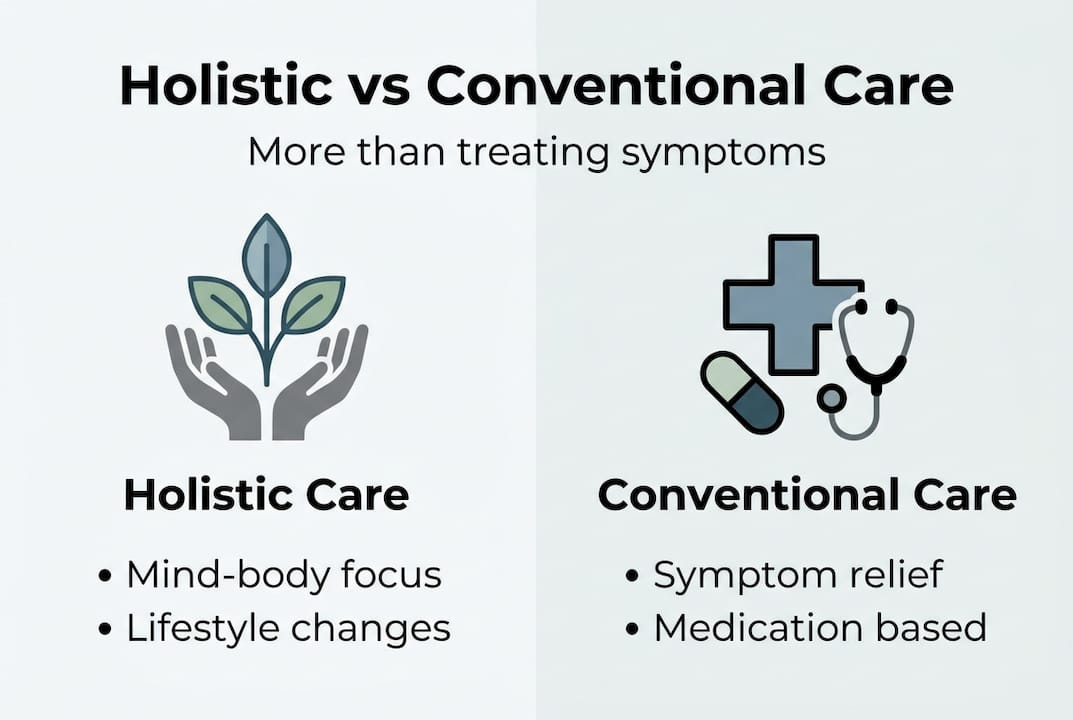
The word “holistic” gets used loosely, so let’s be precise. Holistic care treats the whole person by addressing interconnected physical, emotional, nutritional, lifestyle, and environmental factors rather than targeting a single symptom or neurotransmitter. That shift in focus changes everything about how care is designed and delivered.
Conventional psychiatry often works like this: you describe your symptoms, receive a diagnosis, and leave with a prescription. That model has genuine value, especially in crisis situations. But for the millions of people living with chronic depression, anxiety, or trauma, a pill alone rarely touches the root. Holistic care asks different questions. What are you eating? How are you sleeping? What relationships are draining you? What does your body carry that your mind hasn’t processed yet?
Here is a quick comparison of how the two models approach care:
| Feature | Conventional care | Holistic care |
|---|---|---|
| Primary focus | Symptom reduction | Root cause resolution |
| Tools used | Medication, talk therapy | Nutrition, movement, therapy, mindfulness, lifestyle |
| Treatment plan | Standardized protocols | Individualized and adaptive |
| Duration | Acute or ongoing medication | Long-term lifestyle integration |
| Whole person? | Partial | Yes |
Some of the most effective holistic strategies include:
- Nutritional psychiatry: Gut health directly influences mood through the gut-brain axis
- Sleep optimization: Chronic poor sleep worsens nearly every mental health condition
- Movement as medicine: Regular physical activity rivals antidepressants for mild to moderate depression
- Stress reduction practices: Breathwork, meditation, and mindfulness lower cortisol over time
- Environmental assessment: Toxic relationships, work stress, and living conditions all shape mental health
- Holistic palliative care: Even in serious illness, whole-person care reduces suffering meaningfully
Personalization is what makes holistic care genuinely different. Two people with the same diagnosis may need completely different interventions based on their biology, history, and life circumstances.
Pro Tip: You don’t need to overhaul your entire life overnight. Research consistently shows that small, consistent changes, like adding a 20-minute walk and cutting processed sugar, can shift mood and energy within weeks. Start with one thing and build from there.
The science and evidence: What makes holistic care effective
Skeptics sometimes assume holistic care is soft or unproven. The data tells a different story., compared to significantly lower rates in conventional-only models. Patients also report a 40% reduction in anxiety symptoms and a 25% decrease in medication dependence when holistic strategies are consistently applied alongside standard care.
Those numbers matter. They represent real people who felt heard, treated as a whole, and supported in ways that went beyond a prescription pad.
For depression specifically, the effect size is striking. Studies report a Hedges’ g of -0.84 for integrative and psychedelic-informed interventions, which is considered a large clinical effect. To put that in plain terms: the improvement is not marginal. It’s the kind of change people actually feel in their daily lives.
Here’s a snapshot of the evidence across key holistic strategies:
| Strategy | Outcome | Evidence level |
|---|---|---|
| Mindfulness-based therapy | Reduces relapse in depression by 43% | High (multiple RCTs) |
| Exercise interventions | Comparable to SSRIs for mild depression | Moderate to high |
| Nutritional psychiatry | Mediterranean diet linked to 33% lower depression risk | Moderate |
| Psychedelic-assisted therapy | Large effect sizes for PTSD, depression, addiction | Emerging but strong |
| Sleep therapy (CBT-I) | Resolves insomnia in 70-80% of cases | High |
The most effective holistic strategies confirmed by current research include:
- Combining psychotherapy with lifestyle interventions
- Addressing sleep as a primary treatment target, not an afterthought
- Using mindfulness to regulate the nervous system before and after intensive therapy
- Incorporating psychedelic medicine outcomes data to inform personalized care plans
- Building therapeutic alliance as a core treatment ingredient, not a bonus
What this evidence tells us is that the body and mind are not separate systems. When you treat them together, results improve. That is not philosophy. That is measurable clinical reality.

Integrating psychedelic-assisted therapy within a holistic framework
Psychedelic-assisted therapy is not a standalone experience. It is most powerful when held within a well-designed holistic framework. These therapies promote neuroplasticity, disrupt rigid thought patterns, enable deep emotional processing, and create lasting changes in self-perception, but only when preparation, dosing, and integration are each treated with equal seriousness.
Think of it this way. The medicine opens a door. The holistic framework helps you walk through it safely and make sense of what you find on the other side.
The three most studied compounds each offer distinct benefits:
- MDMA-assisted therapy: Produces durable improvements in PTSD, with Phase 3 trials showing 67-71% of participants no longer meeting diagnostic criteria after treatment
- Ketamine: Delivers rapid relief from treatment-resistant depression, often within hours, making it valuable for acute suffering
- Psilocybin: Shows breakthrough potential for major depression, addiction, and end-of-life anxiety, with effects lasting months after a single session
The phases of care matter enormously:
- Preparation: Building trust with your therapist, setting intentions, addressing fears, and optimizing your physical and emotional baseline
- Dosing session: The medicine experience itself, held in a safe, supportive environment with trained guidance
- Integration: Making meaning of the experience through therapy, journaling, movement, and community, so insights become lasting change
“The set and setting are not peripheral details. They are the treatment.” This is something we return to again and again at Mystic Health, because the context in which a psychedelic experience occurs shapes its outcome more than almost any other variable.
Practicing mindfulness in psychedelic therapy before and after sessions helps regulate the nervous system and deepen integration. And exploring psychedelic states wisdom from experienced clinicians can help you understand what to expect and how to work with what arises.
Pro Tip: Never attempt psychedelic-assisted work without expert guidance. The therapeutic relationship and clinical structure are not optional extras. They are what make the difference between a destabilizing experience and a transformative one.
Risks, limitations, and real-world nuances
Honesty matters here, especially when we’re talking about your mental health. Holistic and psychedelic approaches carry real promise, but they also carry real limitations, and anyone who tells you otherwise is not being straight with you.
effectively in many cases, but outcomes are heterogeneous. That means what works powerfully for one person may produce only modest results for another. Placebo effects are relevant in some studies. Research on certain modalities, including some, is still developing, and research limitations in psychedelic trials include small sample sizes and lack of long-term follow-up data.
Holistic care is not a replacement for emergency psychiatric care. If you or someone you love is in crisis, conventional intervention comes first. Always.
Key limitations and safety considerations to keep in mind:
- Psychedelic-assisted therapy remains investigational for most conditions outside of approved clinical settings
- Self-guided psychedelic use without clinical support significantly increases risk of psychological harm
- Not everyone is a candidate: Certain psychiatric diagnoses, medications, and personal histories require careful screening before any psychedelic work
- Holistic strategies without structure can become avoidance or even delay necessary treatment
- Acute mental health crises require conventional medication and crisis intervention, not lifestyle adjustments
- Integration is non-negotiable: Without it, even a powerful psychedelic experience can fade or become confusing rather than healing
Understanding emotion and healing insights from experienced clinicians can help you assess your own readiness and identify when conventional care needs to take the lead. The goal is always your safety and your healing, not adherence to any particular model.
Making holistic approaches work in the real world: Hard-won lessons
Here is what I’ve come to believe after years of working in this space: holistic and psychedelic therapies are most powerful when they are deeply personalized, not when they are trendy. The internet is full of protocols, stacks, and self-optimization frameworks. Most of them miss the point.
are among the strongest predictors of positive outcomes in both holistic and psychedelic-assisted care. That means the relationship matters as much as the modality. The preparation matters as much as the medicine. And ongoing support matters as much as the breakthrough moment.
What actually works in the real world is this: you combine evidence-based modalities, you build a lifestyle that supports your nervous system daily, and you work with people who know how to hold space for complexity. You don’t rush it. You don’t treat a psychedelic session as a shortcut around the hard work of integration.
Holistic care excels at building resilience over time, not just relieving symptoms in the short term. Explore personalized programs that are designed around your specific history, goals, and readiness. That individualization is where the real transformation happens.
Explore holistic and psychedelic-focused care with Mystic Health
If this article has opened something up for you, that’s worth paying attention to. Moving from understanding to action is its own kind of healing.
At Mystic Health, we offer integrative mental health programs that bring together ketamine-assisted therapy, mindfulness, nutritional support, and personalized care planning in one cohesive approach. Our mindfulness self-compassion course is a meaningful place to begin if you’re building your foundation. And if you’re ready to explore what whole-person care looks like for your specific situation, our Santa Monica holistic clinic team is here to walk that path with you. You don’t have to figure this out alone.
Frequently asked questions
How does holistic care differ from traditional mental health treatment?
Holistic care addresses interconnected factors including mind, body, nutrition, lifestyle, and environment, rather than focusing only on symptom management. Traditional treatment typically centers on diagnosis and medication without exploring underlying causes.
What are the main benefits of holistic approaches for mental health?
Holistic approaches are associated with higher patient satisfaction, anxiety reduction, and decreased medication dependence compared to conventional-only care. Many people also report a stronger sense of agency and resilience over time.
Can psychedelic-assisted therapy be part of holistic care?
Yes. When integrated with preparation and expert support, psychedelic therapies promote neuroplasticity and emotional processing that align naturally with holistic healing goals. The clinical framework around the experience is what makes it safe and effective.
Are there risks to holistic or psychedelic-assisted approaches?
Effects can be heterogeneous and risks increase significantly without professional guidance, especially with psychedelic-assisted work. Careful screening, expert support, and structured integration are non-negotiable safeguards.
When should conventional medicine still be used?
Holistic care complements but does not replace conventional treatment, particularly in acute psychiatric crises or emergencies where medication and immediate intervention are essential for safety.
Recommended

Mystic Health Blog








FAQs
1. Am I eligible for ketamine therapy?
2. Does insurance cover the cost of ketamine therapy?
3. How many ketamine treatments will I need?
We recommend two initial treatments to determine suitability and adjust dosage. After these sessions, additional treatments are available based on your progress and specific requirements.