
 The Mystic Journal
What Are Advanced Treatment Modalities? A Patient Guide
Kabir Ali
 11 min read

TL;DR:
- Advanced treatment modalities are specialized, innovative therapies designed to improve healing and outcomes beyond standard care in mental health, pain, and cancer. They target specific biological or psychological pathways with greater precision, often involving technology, personalization, and mechanism-based approaches to benefit patients unresponsive to conventional treatments. Careful patient selection, understanding regulatory status, and infrastructure considerations are essential for successfully integrating these modalities into personalized treatment plans.
Advanced treatment modalities are specialized, innovative therapies designed to improve healing, relieve symptoms, and enhance outcomes beyond what standard care alone can offer. If you are researching options for mental health, chronic pain, or a serious illness like cancer, you have likely encountered this phrase and wondered what it actually means in practice. The term covers a wide spectrum, from psychedelic-assisted therapies and adaptive radiotherapy to precision neuromodulation devices. Understanding what these modalities are, how they differ, and what the evidence actually says gives you a real foundation for the conversations you need to have with your care team.
What are advanced treatment modalities, and why do they matter?
Advanced treatment modalities is a descriptive phrase used across healthcare to describe newer, specialized approaches that go beyond first-line or conventional care. The recognized clinical term you will often see in research is novel therapeutic interventions, though “advanced modalities” is widely used in patient-facing and policy contexts. These approaches, and they share a common goal: to reach patients who have not responded fully to standard treatments or who need more precise, personalized care.
What makes a modality “advanced” is not just novelty. It is the combination of a specific mechanism, a defined patient population, and an evidence base that justifies moving beyond conventional options. Ketamine-assisted psychotherapy, MR-guided adaptive radiotherapy, and precision neurostimulation devices all qualify. Each targets a specific biological or psychological pathway with a level of precision that older treatments could not achieve. That precision is exactly what makes them worth understanding.
The breadth here matters. When people ask about advanced medical therapies, they are often thinking about one condition. But the principles connecting these modalities across mental health, oncology, and chronic pain are the same: personalization, mechanism specificity, and a willingness to combine approaches when no single treatment is sufficient.
What are the key types of advanced treatment modalities used in mental health care?
Mental health care has seen a genuine expansion in specialized treatment approaches over the past decade. The progress comes from combining digital delivery, personalization, and new therapeutic components rather than from any single breakthrough. That is an important framing. No one tool is a cure-all, and the most promising results come from layered, individualized programs.
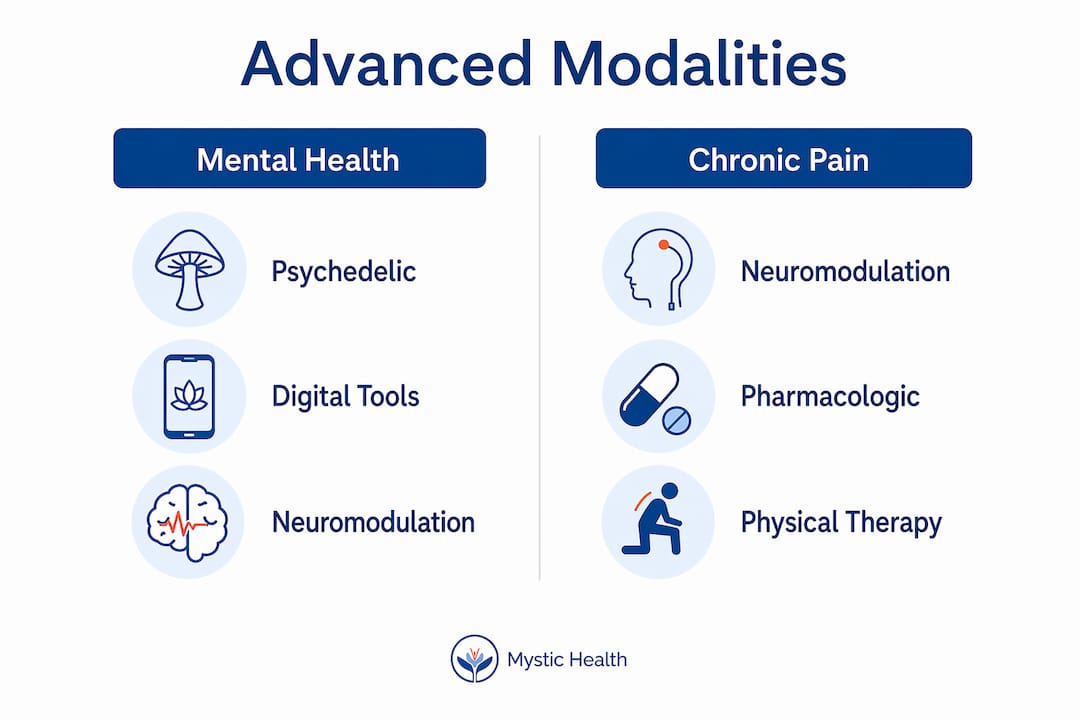
The main categories of advanced mental health therapies include:
- Digital interventions: Apps, augmented reality and virtual reality tools, prescription digital therapeutics, and AI-powered chatbots that deliver structured therapy between sessions or as standalone programs.
- Psychedelic-assisted therapies: Ketamine-assisted psychotherapy, Spravato (esketamine nasal spray), and psilocybin-assisted therapy for treatment-resistant depression and PTSD. The FDA Breakthrough Therapy designation for several psychedelic compounds signals that federal regulators now take this category seriously. That designation accelerates development and access for serious mental illness.
- Personalized psychotherapies: Machine learning tools that match patients to specific therapy types based on symptom profiles, prior treatment history, and biological markers. Cognitive behavioral therapy delivered through adaptive digital platforms is one example of this personalization in practice.
- Combination approaches: Programs that integrate mindfulness, somatic therapies, and pharmacological support within a single treatment plan, rather than treating each symptom in isolation.
The honest reality is that incremental improvements across multiple domains drive innovation here. Progress is real, but it is rarely dramatic. If you are exploring these options, expect a process of refinement rather than a single transformative moment.
Pro Tip
When evaluating any digital mental health tool, check whether it holds FDA clearance as a prescription digital therapeutic. Products like Freespira and Rejoyn have cleared that bar. Most wellness apps have not.
How do advanced treatment modalities improve chronic pain management?
Chronic pain care has been transformed by neuromodulation, a category of precision-guided neurostimulation devices that modulate pain signals at the spinal cord, peripheral nerves, or brain. Spinal cord stimulation, dorsal root ganglion stimulation, and peripheral nerve stimulation are the most established forms. Newer waveforms, including high-frequency stimulation at 10 kHz and burst stimulation patterns, have shown advantages over older tonic stimulation in specific pain phenotypes.
The evidence across these devices is heterogeneous. There are few large-scale, head-to-head trials comparing one device type to another, which means individualized patient selection is not just a preference. It is a clinical necessity. A device that works well for failed back surgery syndrome may not be the right choice for complex regional pain syndrome. Your pain phenotype, prior treatment history, and realistic goals all shape which approach makes sense.
Shared decision-making is the standard that good pain specialists follow. Before any device trial, you should understand the mechanism being targeted, the expected magnitude of relief, the reversibility of the intervention, and what happens if the device does not work. Managing expectations honestly from the start protects you from unnecessary disappointment and helps your care team calibrate the approach.
- Spinal cord stimulation (SCS): Modulates pain at the dorsal horn; multiple waveforms available.
- Dorsal root ganglion (DRG) stimulation: Targets specific spinal segments; useful for focal neuropathic pain.
- Peripheral nerve stimulation (PNS): Addresses localized nerve pain with implanted or percutaneous leads.
- Transcranial magnetic stimulation (TMS): Non-invasive brain stimulation used for both depression and certain pain conditions.
What are the latest advanced treatment modalities for serious illnesses like cancer?
Oncology has produced some of the most technically precise specialized treatment approaches of any medical field. Two categories stand out for their clinical impact: adaptive radiotherapy and energy-based ablation.
Adaptive radiotherapy (ART), adjusting the radiation plan to match the patient’s anatomy at each session. This matters because tumors shrink, organs shift, and body weight changes during a course of treatment. Conventional radiotherapy uses a plan made at the start and does not adjust. ART corrects for those changes in real time. Typical ART courses deliver 5 fractions instead of 20 to 45 conventional sessions, with sub-millimeter targeting precision. Fewer sessions with higher accuracy means less collateral damage to surrounding tissue.
MR-guided ART for prostate cancer has shown that ultra-hypofractionated regimens of 2 fractions can achieve acceptable toxicity profiles, with no grade 3 or higher acute genitourinary toxicity and lower grade 2 toxicity rates compared to 5-fraction regimens. That is a meaningful clinical finding. It suggests that for carefully selected patients, treatment can be compressed further without increasing harm.
Pro Tip
Ask any oncology center offering ART whether they use an online adaptive workflow. AI-assisted replanning compresses the replanning process from hours to minutes. Centers without this capacity cannot deliver the full benefit of the modality.
Energy-based ablation offers a different approach for solid tumors. The choice of method depends on tumor biology and location.
| Ablation method | Mechanism | Best suited for |
|---|---|---|
| Radiofrequency ablation (RFA) | Thermal: heats tissue to destroy cells | Liver, kidney, lung tumors |
| Microwave ablation (MWA) | Thermal: faster heating, larger zones | Liver tumors near vasculature |
| Cryotherapy | Thermal: freezes tissue | Prostate, kidney, bone metastases |
| Irreversible electroporation (IRE) | Non-thermal: disrupts cell membranes | Tumors near critical structures |
Thermal versus non-thermal ablation is not just a technical distinction. Non-thermal methods like IRE preserve the extracellular matrix and may trigger an immune response, which has made them interesting candidates for combination with immunotherapy. The modality choice is always driven by tumor type, location, and the patient’s overall treatment plan.
How do these advanced modalities compare across health areas?
Across mental health, chronic pain, and oncology, these specialized treatment approaches share structural similarities even when their mechanisms are completely different. All three fields are moving toward personalization, all three face evidence gaps in head-to-head comparisons, and all three are increasingly dependent on technology infrastructure to deliver their full benefit.
| Modality area | Key strength | Main limitation | Evidence maturity |
|---|---|---|---|
| Psychedelic-assisted therapy | Deep psychological access, durable remission in some patients | Regulatory access, trained provider shortage | Emerging, FDA fast-tracked |
| Neuromodulation for pain | Reversible, adjustable, mechanism-specific | Heterogeneous evidence, device selection complexity | Established but evolving |
| Adaptive radiotherapy | Real-time precision, fewer sessions | Technology-dependent, not universally available | Strong for specific cancers |
| Energy-based ablation | Minimally invasive, organ-sparing | Tumor size and location constraints | Established for select tumors |
The honest takeaway is that no single modality dominates across conditions. The most effective comprehensive treatment strategies combine approaches: a patient with cancer-related depression might benefit from both ART for their tumor and psychedelic-assisted therapy for their psychological distress. Integrative care models that hold space for both dimensions of suffering tend to produce better outcomes than those that treat the body and mind as separate problems.
What practical considerations should patients keep in mind?
Exploring innovative treatment options requires more than researching what is available. It requires understanding what is available to you, given your specific diagnosis, geography, and insurance coverage.
- Verify the technology at your treatment center. ART requires onsite MR-guided linear accelerators and rapid AI-assisted replanning workflows. A center that offers “adaptive radiotherapy” without this infrastructure cannot deliver the same outcomes as one that does.
- Ask about patient selection criteria. Ultra-hypofractionated regimens and psychedelic therapies both require careful patient screening. Ask your clinician what criteria you meet and what risks apply specifically to your profile.
- Distinguish emerging from established. Psychedelic-assisted therapies are emerging. Spinal cord stimulation is established. Both are legitimate, but the evidence base and risk profile differ significantly. Knowing where a treatment sits on that spectrum helps you calibrate expectations.
- Request the clinical trial data. For any advanced modality, ask your provider which trials support the recommendation and whether those trials included patients similar to you in age, diagnosis, and comorbidities.
- Evaluate regulatory status. FDA clearance, Breakthrough Therapy designation, and investigational status are not the same thing. Spravato is FDA-approved. Psilocybin therapy is not yet approved for general use, though it holds Breakthrough Therapy designation for certain indications.
Pro Tip
When, ask your provider to explain the difference between off-label use and approved use for any advanced therapy. That distinction shapes both your legal protections and your insurance coverage.
Key takeaways
Advanced treatment modalities work best when matched precisely to the patient’s condition, biology, and goals rather than applied as a default next step.
- 01
Definition clarity
Advanced modalities are specialized therapies beyond standard care, spanning mental health, pain, and oncology.
- 02
Mental health innovation
Progress comes from combining digital tools, psychedelic therapies, and personalized psychotherapy, not from single breakthroughs.
- 03
Chronic pain selection
Neuromodulation device choice must be individualized; shared decision-making and realistic expectations are non-negotiable.
- 04
Oncology precision
Adaptive radiotherapy and energy-based ablation offer fewer sessions and less collateral damage for carefully selected patients.
- 05
Patient action
Verify technology infrastructure, regulatory status, and patient selection criteria before committing to any advanced modality.
A note from Kabir
What I have learned from watching patients navigate these choices
I have spent years watching people arrive at advanced treatment options after exhausting what conventional medicine offered them. What strikes me most is not the technology. It is the emotional weight people carry into these decisions. They are often tired, skeptical, and quietly hoping that this time something will actually work.
The thing I want you to hear is this: the evidence for many of these modalities is real, but it is also specific. Adaptive radiotherapy does not help everyone with cancer. Ketamine-assisted therapy does not resolve every treatment-resistant depression. What the research consistently shows is that the right modality for the right patient produces outcomes that standard care cannot match. The word “right” is doing a lot of work in that sentence, and it requires honest, informed conversation with clinicians who know both the technology and your individual situation.
I am also cautious about the hype cycle that surrounds emerging therapies. Psychedelic medicine is genuinely promising. It is also genuinely early. The psychedelic therapy response rates that circulate in popular media are real, but they come from controlled trials with careful patient selection and trained facilitators. Replicating those outcomes requires the same conditions. A provider who cannot explain their screening process or their integration protocol is a provider worth questioning.
My honest recommendation: go into these conversations as an informed participant, not a passive recipient. Ask hard questions. Expect specific answers. And give yourself space to grieve the treatments that did not work before you open to the ones that might.
— Kabir
How Mystic Health supports your path to advanced healing
If you are weighing advanced mental health therapies and want a care team that takes both the science and the human experience seriously, Mystic Health was built for exactly that.
Mystic’s psychedelic medicine and palliative care programs integrate ketamine-assisted psychotherapy, Spravato, mindfulness, and somatic therapies within personalized treatment plans designed around your specific history and goals. The team at Mystic combines clinical rigor with genuine compassion, holding space for the full complexity of what you are going through. Whether you are managing treatment-resistant depression, chronic pain, or the emotional weight of a serious illness, Mystic’s integrative mental health programs offer a structured, evidence-grounded path forward. Schedule a consultation to learn what is possible for you.
FAQ
What does “treatment modality” mean in medicine?
A treatment modality is any specific method or approach used to treat a condition, such as medication, surgery, psychotherapy, or radiation. Advanced modalities are specialized versions of these approaches that go beyond standard first-line care.
Are psychedelic-assisted therapies considered advanced treatment modalities?
Yes. Ketamine-assisted psychotherapy and Spravato are FDA-approved advanced therapies for treatment-resistant depression. Psilocybin therapy holds FDA Breakthrough Therapy designation for certain indications and is actively in late-stage clinical trials.
How do I know if an advanced modality is right for my condition?
The most reliable path is a multidisciplinary consultation that reviews your diagnosis, prior treatment history, and the specific evidence base for the modality being considered. Patient selection criteria vary significantly between treatments.
Is adaptive radiotherapy available at most cancer centers?
No. Effective ART delivery requires onsite MR-guided linear accelerators and AI-assisted replanning workflows, which are available only at specialized centers. Ask specifically about the technology before assuming a center can deliver full adaptive treatment.
What is the difference between neuromodulation and standard pain medication?
Neuromodulation devices like spinal cord stimulators modulate pain signals electrically at the nerve or spinal cord level, without systemic drug effects. Standard pain medication works through the bloodstream and affects the entire body, which increases the risk of side effects and dependency.
Recommended
 Sources and references (4)
- 1.FDA Breakthrough Therapy designation whitehouse.gov
- 2.precision-guided neurostimulation devices einstein.elsevierpure.com
- 3.ultra-hypofractionated regimens murex.mahidol.ac.th
- 4.Thermal versus non-thermal ablation link.springer.com
This article is for educational purposes only and does not constitute medical advice, diagnosis, or treatment. Always consult a qualified healthcare provider about your own care.
Looking for support?
Our team can help you understand your options and build a plan that fits your values.
Schedule a consultation