What Is Trauma-Informed Care? A Clear Guide
TL;DR:
- Trauma-informed care recognizes the widespread impact of trauma and seeks to prevent re-traumatization in healthcare settings. It emphasizes safety, trust, empowerment, and cultural humility to support healing for all individuals. Implementing the approach requires organizational change, consistent training, and creating physical environments that foster safety and trust.
Trauma-informed care is defined as a clinical and organizational framework that recognizes the widespread impact of trauma and actively works to prevent re-traumatization. The core shift is simple but profound: instead of asking “What is wrong with you?” providers ask “What happened to you?” This reframing changes everything, from how a receptionist greets a patient to how a care team designs a treatment plan. The Substance Abuse and Mental Health Services Administration (SAMHSA) established six guiding principles that define what trauma-informed means in practice. Understanding these principles is the foundation for anyone who wants to support trauma-affected individuals with real skill and compassion.
What is trauma-informed care, and why does it matter?
Trauma-informed care is a framework built on one core belief: trauma is common, and its effects shape how people experience every interaction with a care system. This approach does not require a formal trauma diagnosis to activate. It applies to every person who walks through a door, because any person may carry a trauma history they have never disclosed.
The framework matters because untreated trauma responses can look like resistance, non-compliance, or hostility. A patient who cancels appointments repeatedly may not be unmotivated. They may be avoiding an environment that feels unsafe. Trauma-informed practices reinterpret these behaviors through a lens of understanding rather than judgment.
This approach also protects providers. When staff understand trauma’s effects, they respond with steadiness instead of frustration. That steadiness builds trust, and trust is the foundation of any healing relationship. The benefits of trauma-informed therapy extend to both the person receiving care and the person delivering it.

What are the six principles of trauma-informed care?
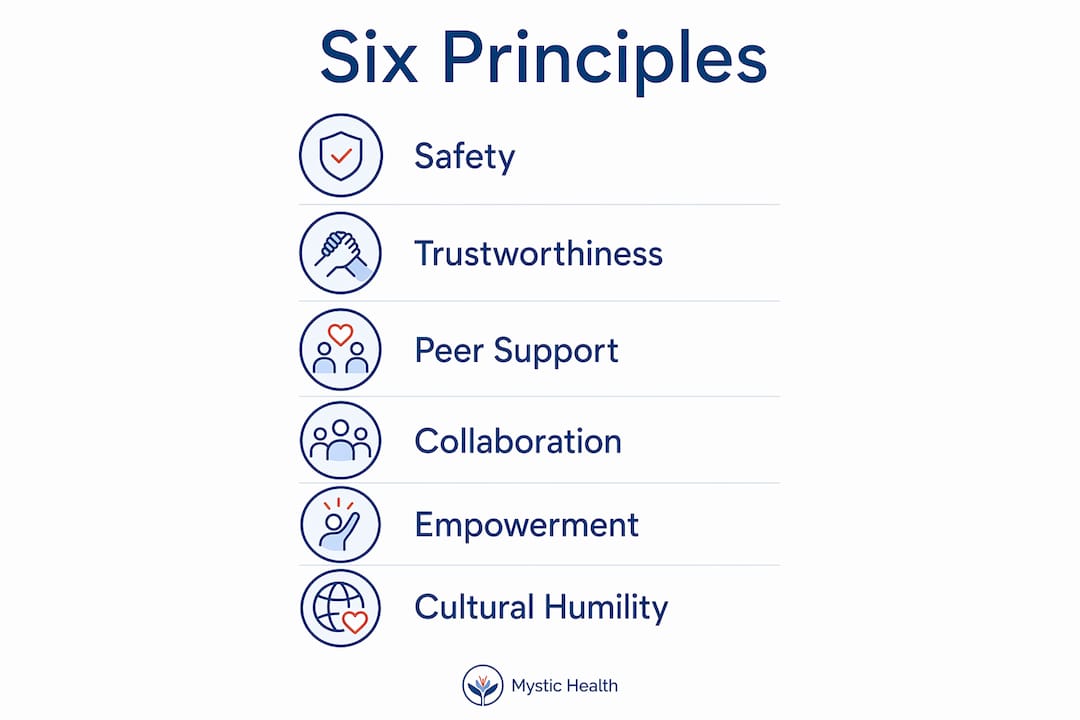
SAMHSA’s six principles form the backbone of every trauma-sensitive approach. Each one addresses a specific way that trauma disrupts a person’s sense of safety, control, and connection.
- Safety. Physical and psychological safety must be present before healing can begin. This means predictable routines, clear communication, and spaces that feel calm rather than clinical and cold.
- Trustworthiness and transparency. Providers share what they are doing and why. Hidden processes and unexplained decisions erode trust fast, especially for people whose trauma involved betrayal.
- Peer support. Connecting people with others who share lived experience reduces isolation. Peer relationships communicate something no professional credential can: “You are not alone in this.”
- Collaboration and mutuality. Power imbalances between provider and patient are real. Trauma-informed care acknowledges them and works to flatten them through shared decision-making.
- Empowerment, voice, and choice. Trauma often strips people of control. Restoring choice, even in small decisions like which chair to sit in, rebuilds a sense of agency.
- Cultural, historical, and gender issues. Trauma does not occur in a vacuum. Systemic oppression, historical injustice, and gender-based violence all shape how trauma is experienced and expressed.
These six principles work together. Applying only one or two produces inconsistent results. An organization that values transparency but ignores cultural context will still lose the trust of many patients it is trying to serve.
Pro Tip: When training staff on these principles, start with safety and trustworthiness. These two create the conditions that make the other four possible.
How is trauma-informed care applied in clinical settings?
The most important shift in clinical application is the universal precaution mindset. Providers do not wait for a patient to disclose trauma before applying trauma-sensitive approaches. Every person receives the same baseline of care, because assuming potential trauma history prevents the selective application errors that leave the most vulnerable people unprotected.
Practical implementation follows a clear sequence:
- Design the physical environment intentionally. Lighting, seating arrangement, privacy, and noise levels all function as therapeutic interventions. Thoughtful environment design prevents re-traumatization before a single word is spoken. A waiting room with harsh fluorescent lights and no privacy mirrors the conditions of many traumatic experiences.
- Use anticipatory guidance in every interaction. Explaining each step before it happens reduces unpredictability. Anticipatory guidance lowers trauma triggers because survivors often feel most distressed when they cannot predict what comes next.
- Involve patients in real-time care planning. Transparent, inclusive decision-making restores the autonomy that trauma frequently destroys. When patients participate in real-time treatment planning, they shift from passive recipients to active partners.
- Support staff to reduce secondary trauma. Providers who work with trauma-affected populations absorb stress. Organizations must build in supervision, peer support, and clear boundaries to protect their workforce.
- Review every policy for re-traumatization risk. Intake forms, billing processes, and appointment reminder scripts can all contain language or procedures that feel threatening to trauma survivors. Regular audits catch these blind spots.
Pro Tip: Before redesigning clinical spaces, walk through your facility as if you were a first-time patient who feels unsafe. Note every moment of confusion, exposure, or loss of control. That walk reveals more than any checklist.
The table below summarizes the core implementation areas and their primary purpose.
| Implementation Area | Primary Purpose |
|---|---|
| Physical environment design | Prevent re-traumatization before interaction begins |
| Anticipatory guidance | Reduce unpredictability and lower trauma triggers |
| Shared care planning | Restore patient autonomy and build trust |
| Staff support programs | Reduce burnout and secondary traumatic stress |
| Policy audits | Identify and remove hidden re-traumatization risks |
Applying patient-centered care principles alongside these steps creates a care environment where healing becomes genuinely possible.
What role does cultural humility play in trauma-informed care?
Cultural humility is not a soft add-on to trauma-informed care. It is a structural requirement. Cultural humility requires providers to acknowledge the systemic and historical trauma experienced by marginalized communities and to actively work against their own biases. Without this, even well-intentioned trauma-sensitive care can reinforce the very power dynamics it aims to dismantle.
Historical trauma refers to the cumulative emotional and psychological wounds carried across generations by communities that have experienced collective violence, forced displacement, or systemic oppression. These wounds affect how people engage with healthcare systems, often producing deep mistrust that looks like avoidance or non-compliance.
Providers who practice cultural humility do several things consistently:
- They examine their own assumptions about what “normal” behavior or “healthy” coping looks like.
- They ask patients about their cultural backgrounds and preferences rather than assuming.
- They enable patients to choose clinicians who share their cultural background when possible, because that match builds trust faster than almost any other intervention.
- They stay curious and open rather than positioning themselves as the sole authority on a patient’s experience.
Cultural responsiveness is not about having all the answers. It is about creating enough safety for patients to bring their full selves into the room. That safety is the precondition for everything else in trauma-informed care.
What are the benefits and challenges of trauma-informed care?
The benefits of trauma-informed care are well-documented and reach both patients and providers. Implementing this framework produces decreased re-traumatization risk, stronger patient engagement, better treatment adherence, and reduced staff burnout. These outcomes compound over time. A workforce that feels supported delivers more consistent, empathetic care, which in turn improves patient outcomes.
The challenges are real, though. Organizations often face:
- Resource limitations. Training takes time and money. Smaller practices may struggle to fund comprehensive staff education.
- Organizational resistance. Shifting from a deficit-based model (“What is wrong with you?”) to a strengths-based one requires cultural change, not just policy updates. That kind of change meets friction.
- Training gaps. Trauma-informed care is not yet standard in most clinical education programs. Many providers enter practice without foundational knowledge of trauma’s effects on behavior and physiology.
- Sustainability concerns. Initial enthusiasm can fade without ongoing reinforcement, supervision, and leadership commitment.
The most effective path through these challenges is to treat trauma-informed care as an organizational culture shift, not a training event. Systemic alignment across policies, physical spaces, staff support structures, and patient interactions is what makes the approach durable. A one-day workshop changes awareness. A redesigned system changes outcomes.
Key Takeaways
Trauma-informed care works because it addresses the root conditions that make healing possible: safety, trust, empowerment, and cultural responsiveness across every layer of an organization.
| Point | Details |
|---|---|
| Core question shift | Replace “What is wrong with you?” with “What happened to you?” to reframe every interaction. |
| Six SAMHSA principles | Safety, trustworthiness, peer support, collaboration, empowerment, and cultural humility form the standard framework. |
| Universal precaution mindset | Apply trauma-sensitive approaches to every person, not only those who disclose trauma history. |
| Environment as intervention | Physical space design actively prevents re-traumatization before any verbal interaction occurs. |
| Systemic change required | Sustainable trauma-informed care demands organizational culture change, not just individual training. |
Why I believe trauma-informed care is the most underestimated shift in healthcare
I have watched care systems pour resources into new medications, new technologies, and new protocols. The results are often incremental. What I have seen produce genuine, lasting change is something quieter: a provider who pauses before a procedure to explain exactly what will happen next. A waiting room redesigned so patients feel private rather than exposed. A policy rewritten so it stops asking people to relive their worst moments just to access help.
Trauma-informed care does not require a new drug or a new device. It requires a different way of seeing people. That shift is harder than it sounds, because it asks providers to examine their own assumptions and sit with discomfort. But the return is extraordinary. Patients who feel safe actually show up. They tell the truth about their symptoms. They follow through on treatment. They heal.
The piece I think gets underestimated most is the workforce protection angle. Providers who work in trauma-saturated environments without support do not become numb. They become brittle. Trauma-informed care, applied internally, protects the people doing the work. That is not a secondary benefit. It is what makes the whole system sustainable.
My honest recommendation: start with your physical environment and your language. Both are visible, changeable, and immediately felt by every person who enters your care. Build from there.
— Kabir
Mystic Health’s approach to trauma-informed healing
Mystic Health builds every program around the same principles that define trauma-informed care: safety, transparency, and genuine collaboration between patient and provider. The integrative mental health programs at Mystic incorporate ketamine-assisted psychotherapy, mindfulness practices, and peer support within a clinical environment designed to feel safe from the moment you arrive. Each treatment plan is built with you, not for you. If you are ready to experience care that starts by asking what happened rather than what is wrong, Mystic’s full program offerings are a meaningful place to begin.
FAQ
What does trauma-informed mean in simple terms?
Trauma-informed means a provider or organization understands that trauma is common and shapes behavior, and actively works to avoid causing further harm. The approach prioritizes safety, trust, and patient choice in every interaction.
What are the six principles of trauma-informed care?
SAMHSA defines the six principles as safety, trustworthiness and transparency, peer support, collaboration and mutuality, empowerment and choice, and recognition of cultural and historical issues. These principles apply across clinical, organizational, and interpersonal levels of care.
How is trauma-informed care different from trauma therapy?
Trauma-informed care is a framework applied across an entire organization or system, not a specific therapeutic technique. Trauma therapy refers to targeted clinical treatments like EMDR or somatic work, while trauma-informed care shapes how every staff member and policy responds to patients.
Who benefits from trauma-informed care?
Both patients and providers benefit. Patients experience less re-traumatization and stronger engagement with treatment. Providers experience reduced burnout and secondary traumatic stress when organizations apply trauma-informed principles to their workforce as well.
Can trauma-informed care be applied outside of healthcare?
Yes. Schools, social service agencies, criminal justice programs, and workplaces all apply trauma-informed frameworks. The core principles of safety, trust, and empowerment translate to any setting where people in distress interact with systems of support.
Recommended

Mystic Health Blog








FAQs
1. Am I eligible for ketamine therapy?
2. Does insurance cover the cost of ketamine therapy?
3. How many ketamine treatments will I need?
We recommend two initial treatments to determine suitability and adjust dosage. After these sessions, additional treatments are available based on your progress and specific requirements.