Inclusive therapy: Your guide to equitable mental health care
TL;DR:
- Inclusive therapy recognizes and validates diverse identities and lived experiences in healing.
- Culturally responsive and affirming practices improve treatment outcomes for marginalized communities.
- Applying inclusive principles to psychedelic and holistic therapies ensures ethical, effective, and respectful care.
Therapy is not a universal tool, and pretending otherwise has quietly kept a lot of people out of healing spaces they deserve. The idea that a single approach works for everyone, regardless of identity, background, trauma history, or cultural context, is a misconception that costs people real progress. If you have ever sat in a session feeling unseen or like your provider was working from a script that was never written with you in mind, that feeling was telling you something important. Inclusive therapy exists to change that experience entirely, and it is especially meaningful for people drawn to holistic and psychedelic-assisted treatment paths.
Table of Contents
- What is inclusive therapy?
- Why inclusive therapy matters: Real-world impact
- Connecting inclusive therapy and psychedelic-assisted approaches
- LGBTQ+ and TNB-affirmative therapy: How affirmation shapes healing
- Why most people misunderstand inclusive therapy: Beyond buzzwords
- Inclusive mental health care at Mystic Health
- Frequently asked questions
Key Takeaways
| Point | Details |
|---|---|
| Inclusive therapy defined | Inclusive therapy adapts care to respect identity, culture, and lived experience for better mental health outcomes. |
| Evidence-based benefits | Research proves inclusive approaches help diverse groups achieve symptom improvements and higher satisfaction. |
| Psychedelic inclusivity | Multicultural integration and equitable access are essential in psychedelic-assisted and holistic therapy. |
| Affirmative care matters | LGBTQ+ and TNB-affirming therapy methods lead to better, longer-lasting mental health improvement. |
| Relationship is key | The most inclusive therapy relies on relational skills and continuous adaptation, not checklists or protocols. |
What is inclusive therapy?
Inclusive therapy starts with a simple but radical idea: that your whole self belongs in the room. Not just the parts that fit neatly into a standard intake form.
is a mental health approach that provides accessible, culturally competent services tailored to diverse identities including race, ethnicity, gender, sexual orientation, disability, and intersectional factors. The word intersectional matters here. It means a Black queer woman living with chronic pain, for example, is not experiencing three separate issues. She is navigating all of them at once, and her care needs to hold that complexity with skill and care.
“True inclusivity in therapy is not a checkbox. It is an ongoing commitment to recognizing each person’s layered identity as the very foundation of their care.”
This approach values lived experience as real data. What you have been through, the communities you belong to, the systems that have shaped or harmed you — all of it informs how healing needs to unfold. Practitioners who work from an inclusive framework are trained to adapt, to ask questions, and to follow the client’s lead rather than impose a predetermined model.
The holistic therapy benefits that many people are already exploring, like somatic work, mindfulness, and energy-based practices, align naturally with inclusive principles because they also reject the idea that the mind is separate from the body, culture, or spirit.
Here are the core pillars that define inclusive therapy in practice:
- Cultural competence: The provider understands how cultural background shapes mental health, communication, and what healing even looks like
- Affirmative practices: The therapist actively validates rather than just tolerates your identity, especially for LGBTQ+ and marginalized communities
- Accessibility: Services are designed to reach people regardless of financial status, disability, language, or geography
- Intersectionality: Care acknowledges that multiple identities overlap and cannot be separated
- Collaborative approach: The client and therapist work as partners, not expert and subject
Each of these pillars reinforces the others. When even one is missing, the whole therapeutic relationship can feel off, and that feeling is rarely just in your head.
Why inclusive therapy matters: Real-world impact
Understanding what inclusive therapy is only gets us so far. The more pressing question is whether it actually works, and for whom. The evidence is both clear and encouraging.
Empirical data shows that minoritized clients, including clients of color and those facing financial hardship, enter therapy with higher baseline anxiety and depression levels but achieve similar symptom reductions as others when care is culturally responsive. That outcome matters enormously. It means the gap is not in the person. The gap has been in the quality and relevance of the care offered.
| Client group | Baseline symptom severity | Post-treatment improvement |
|---|---|---|
| Majoritarian clients | Moderate | Significant reduction |
| Clients of color | High | Equivalent reduction |
| Clients with financial hardship | High | Equivalent reduction |
| LGBTQ+ clients (non-affirming care) | High | Lower improvement rates |
| LGBTQ+ clients (affirming care) | High | Significant reduction |
This table reflects a pattern that practitioners working in inclusive spaces see regularly. When the care matches the person, people get better. When it does not, dropout rates rise, misdiagnoses increase, and people lose faith in the entire process of getting help.
Non-inclusive practices carry real costs. People from marginalized communities are more likely to leave therapy early, more likely to be misdiagnosed, and more likely to carry the weight of educating their own therapist, which should never be part of the healing work. Research exploring innovative therapy approaches makes it clear that combining cultural responsiveness with evidence-based methods produces the best long-term outcomes.

Pro Tip: When interviewing potential therapists, ask directly: “How do you approach care for someone with my identity and background?” A strong provider will welcome that question and answer it with specificity. Vague reassurances like “I work with everyone” should prompt follow-up.
The data on inclusive therapy is not just statistical. It reflects real people who came to therapy carrying more than most, and who finally found a space where their full story was treated as relevant.
Connecting inclusive therapy and psychedelic-assisted approaches
Inclusive principles become even more important when we talk about psychedelic-assisted and holistic mental health treatments. These modalities carry enormous promise, but they also arrive with complicated histories tied to colonization, cultural erasure, and inequitable access.
Inclusive approaches in psychedelic therapy emphasize multicultural lenses, avoiding cultural appropriation, ensuring diverse representation in research, and integrating traditional healing practices for equity. Many psychedelic medicines have roots in Indigenous and traditional cultures. Using them without acknowledgment, context, or representation is not just ethically problematic — it actively harms the communities from which these practices come.
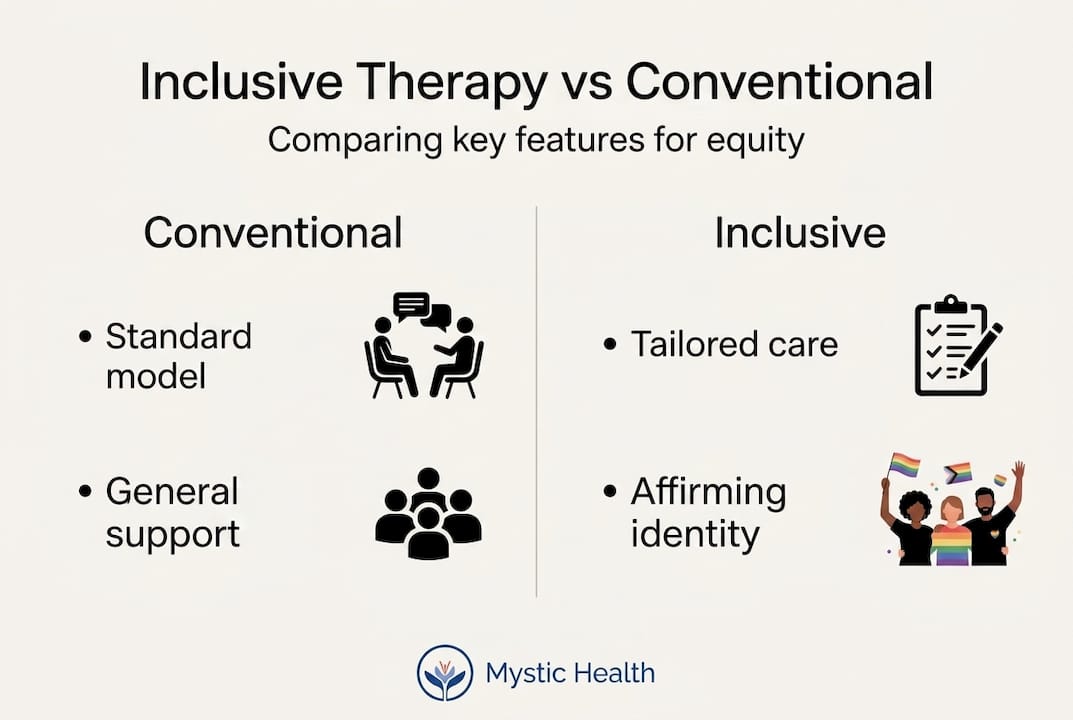
| Conventional psychedelic therapy | Inclusive psychedelic therapy |
|---|---|
| Centers Western clinical frameworks | Integrates diverse cultural healing models |
| Research pools often lack diversity | Actively recruits from marginalized communities |
| Therapist determines meaning of experience | Client’s cultural context shapes interpretation |
| Ignores historical trauma connections | Acknowledges intergenerational and systemic trauma |
| Spiritual elements treated as secondary | Spiritual and cultural meaning is central |
The difference between these two columns is not just philosophical. It shapes what someone actually experiences during treatment, how they make sense of it afterward, and whether they feel safe enough to go deep in the first place. The conversation around multicultural psychedelic healing is growing for exactly this reason.
When inclusive practices are not applied to psychedelic or holistic therapy, specific risks emerge:
- Cultural erasure: Healing methods from specific traditions get commodified without credit or care
- Perpetuation of inequity: Already underserved communities remain excluded from promising treatments
- Misattribution of healing: If cultural context is ignored, the source of someone’s breakthrough may be misunderstood or attributed to the wrong mechanism
- Retraumatization: Without cultural sensitivity, a powerful therapeutic experience can land in a way that reinforces rather than releases pain
- Research gaps: Non-diverse participant pools lead to treatment models that do not translate across communities
This is why advocacy within the psychedelic therapy field matters so much right now. The field is young enough that norms are still being shaped. Demanding mental health transformation that actually includes everyone is both possible and necessary at this stage.
LGBTQ+ and TNB-affirmative therapy: How affirmation shapes healing
Inclusivity also means specifically addressing the needs of LGBTQ+ and trans/nonbinary (TNB) individuals through affirmative practice. This is not a niche add-on. For many people in these communities, the quality of affirmation they receive in therapy is the single biggest factor in whether treatment helps at all.
LGBTQ+ affirmative CBT, specifically the AFFIRM model, has shown significant long-term reductions in depression and anxiety, and those gains are mediated by increased coping skills, stronger social support, and greater hope. That last word matters. Hope is not soft. It is a clinical outcome, and it shows up consistently when people feel genuinely affirmed in their therapy process.
For trans and nonbinary clients specifically, the picture is equally compelling and equally sobering. TNB-affirmative practice predicts higher satisfaction and effectiveness through therapeutic alliance. Critically, the most common reason TNB clients leave therapy prematurely is not because their issues have been resolved. It is because their practitioner does not understand their experience.
“Only 22% of TNB therapy terminations happen because the presenting issues have been resolved — underscoring how much premature departure is driven by provider-side limitations, not client-side progress.”
That statistic should stop us in our tracks. If someone leaves therapy without healing because their therapist simply did not understand who they are, that is a failure of the system, not the person.
Finding the right affirming therapist takes some intentional searching. Here is how to approach it:
- Research before reaching out. Look for therapists who explicitly list LGBTQ+ or TNB affirmative care in their profiles. Credentials and training in affirmative CBT therapy are meaningful signals.
- Ask specific questions in a consultation. Inquire about their training in gender-affirming care and their experience working with clients who share your identity. Specificity invites honesty.
- Trust your gut in early sessions. Notice whether you feel you have to explain basic concepts about your identity. A truly affirmative therapist already brings foundational knowledge to the table.
- Know that you can leave and try again. A bad fit is not a failure. Personalized therapy planning is part of what makes care effective, and finding the right match is worth the effort.
Affirmative therapy is not about the therapist telling you your identity is okay. It is about the entire framework of care being built with the understanding that your identity is not a problem to be managed but a dimension of who you are that shapes your healing path.
Why most people misunderstand inclusive therapy: Beyond buzzwords
Here is something I want to say honestly, from having been close to this work for a long time. The word “inclusive” has started to do the thing that important words sometimes do. It gets overused until it loses its weight.
Organizations add it to mission statements. Therapists list it as a specialty. Websites use it in page titles. And none of that is necessarily wrong, but it can reduce a living, relational practice to a branding exercise. Real inclusivity is not a credential you earn once. It is a practice you return to every single session.
The most genuinely inclusive practitioners I have seen work are often the ones who are the most willing to say, “I got that wrong. Can you help me understand your experience better?” That kind of humility is not weakness. It is the whole point. It signals that the therapeutic relationship is built around you, not around the therapist’s self-image. The holistic therapy guide we offer at Mystic Health reflects this orientation, because we believe that healing that does not hold your whole story is only partial healing.
One common pitfall for clients is assuming that a provider from a shared background automatically offers inclusive care. Cultural identity matters, but inclusive practice is a set of skills and values that anyone can build, and that anyone can fail to build. Ask questions. Observe how your therapist responds to discomfort, correction, or complexity. Those responses tell you more than any profile bio.
For practitioners, the pitfall is in treating inclusivity as a training module rather than an ongoing reflective practice. Workshops and certifications are starting points, not endpoints. Your client’s lived experience is always more current than any framework you studied.
Pro Tip: Look specifically for providers who invite you to give feedback about the therapeutic relationship itself. Not just “how are you feeling today,” but “is this approach working for you, and is there anything about how I’m engaging that feels off?” That kind of invitation is a meaningful marker of genuine inclusive practice.
Inclusive mental health care at Mystic Health
If this guide has resonated with you, the next step is finding care that actually lives these values rather than just describing them.
At Mystic Health, we built our approach around the understanding that healing is personal, cultural, and relational all at once. Our integrative mental health care programs bring together evidence-based treatment and inclusive, whole-person frameworks designed to meet you where you are. Whether you are drawn to ketamine-assisted psychotherapy, Spravato, or other psychedelic-assisted paths, our team is trained to hold your cultural context with care and your healing goals with seriousness. Our mindfulness for psychedelic therapy program complements treatment with grounding practices that can be tailored to your background. You can also explore the clinical evidence behind our therapies to make informed choices about what fits your needs. We believe you deserve a space where your whole self is welcome.
Frequently asked questions
What makes therapy “inclusive” rather than just supportive?
Inclusive therapy actively tailors support to each person’s identity, background, and lived experience rather than relying on generic approaches. Supportive therapy may be kind and helpful, but it does not necessarily adapt to cultural or identity-specific needs the way inclusive therapy does.
Does inclusive therapy work for people of color and other marginalized communities?
Yes, and the research is clear. Minoritized clients achieve equivalent therapy outcomes as other groups when care is culturally sensitive and inclusive, even though they often enter treatment with higher baseline symptom severity.
How do I know if a therapist is inclusive?
Look for therapists who discuss cultural competence in their intake process, hold affirmative training credentials, and openly invite feedback about your lived experience. The willingness to be corrected and to adapt is one of the clearest signs of genuinely inclusive practice.
Do psychedelic-assisted therapies follow inclusive principles?
When properly conducted, psychedelic-assisted therapy integrates multicultural frameworks, avoids cultural appropriation, and incorporates traditional healing practices. Not all programs do this well, so asking providers directly about their approach to diversity and cultural context is important.
Are there therapy methods that specifically affirm LGBTQ+ and TNB identities?
Yes. AFFIRM CBT has demonstrated significant long-term reductions in depression and anxiety for LGBTQ+ clients, and TNB-affirmative therapy frameworks show measurable improvements in treatment satisfaction and therapeutic alliance. These are not soft interventions — they produce real, lasting results.
Recommended

Mystic Health Blog








FAQs
1. Am I eligible for ketamine therapy?
2. Does insurance cover the cost of ketamine therapy?
3. How many ketamine treatments will I need?
We recommend two initial treatments to determine suitability and adjust dosage. After these sessions, additional treatments are available based on your progress and specific requirements.