

Psycho-spiritual therapy: A holistic guide to healing
TL;DR:
- Psycho-spiritual therapy integrates mind, body, and spirit to address meaning and existential issues.
- It enhances traditional therapies, especially in psychedelic support, through meaning-centered and somatic techniques.
- Evidence shows it is effective for depression, trauma, addiction, end-of-life care, and grief.
Most mental health treatment focuses almost entirely on the mind. Thoughts, behaviors, patterns, and symptoms. But what about the part of you that asks why am I here or what does this pain mean? Research shows that integrating spiritual dimensions into therapy addresses mental, emotional, and existential issues in ways that mind-only approaches simply cannot reach. Psycho-spiritual therapy treats you as a whole person: mind, body, and spirit. In this guide, we’ll walk through what it is, how it works, what the evidence says, and how to know if it’s the right path for you.
Table of Contents
- Understanding psycho-spiritual therapy: Foundations and philosophy
- Core methodologies and techniques in psycho-spiritual therapy
- Psycho-spiritual therapy and psychedelic-assisted care
- What the evidence says: Effectiveness and considerations
- Is psycho-spiritual therapy right for you? Self-assessment and next steps
- Our perspective: What most guides get wrong about psycho-spiritual therapy
- Take the next step with integrative support
- Frequently asked questions
Key Takeaways
| Point | Details |
|---|---|
| Holistic healing approach | Psycho-spiritual therapy blends mental, emotional, and spiritual practices for whole-person care. |
| Blends evidence and spirituality | Integrates traditional therapy methods with spiritual growth and modern research. |
| Supports psychedelic integration | Provides essential guidance for preparing and integrating psychedelic experiences. |
| Empirical support exists | Studies show these therapies are effective for depression, anxiety, and life crises. |
Understanding psycho-spiritual therapy: Foundations and philosophy
At its core, psycho-spiritual therapy is a holistic approach that integrates psychological and spiritual aspects to address the full complexity of human experience. It doesn’t ask you to follow a religion or adopt a belief system. Instead, it creates space for you to explore what feels meaningful, sacred, or transcendent in your own life, while working through the emotional and psychological layers that keep you stuck.
This approach draws from several rich philosophical traditions. Transpersonal psychology, developed in the late 1960s by thinkers like Abraham Maslow and Stanislav Grof, was one of the first frameworks to take spiritual experience seriously as a clinical subject. Humanistic psychology, with its focus on self-actualization and inherent human dignity, also runs through the roots of this work. Together, these traditions gave rise to a therapy model that honors the full spectrum of who you are.
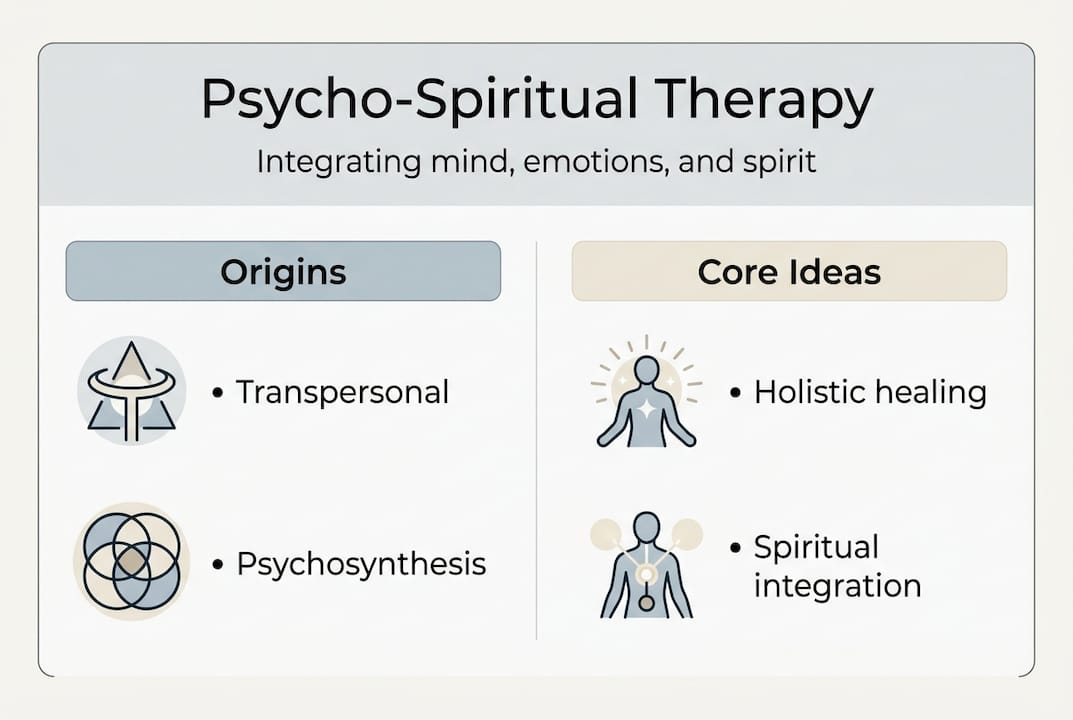
The benefits of holistic therapy become clearer when you understand what’s typically left out of conventional care. Standard cognitive-behavioral or talk-based approaches are valuable, but they often don’t touch questions of meaning, purpose, grief, or spiritual disconnection. Psycho-spiritual therapy does.
Here’s what makes it distinct:
- It treats spiritual experiences as clinically relevant, not as symptoms to be managed
- It supports personal meaning-making without imposing any religious framework
- It works with the body as a site of stored emotion and spiritual memory
- It integrates evidence-based tools with contemplative and expressive practices
- It encourages whole person healing across all dimensions of experience
“Healing is not just the absence of symptoms. It’s the presence of meaning.”
This philosophy shapes everything from how sessions are structured to how a therapist holds space for your story. It’s a genuinely different kind of care.
Core methodologies and techniques in psycho-spiritual therapy
Knowing the philosophy is one thing. Understanding what actually happens in a session is another. Psycho-spiritual therapy draws from a wide range of modalities, and a skilled practitioner will weave them together based on your needs and readiness.
Psychosynthesis and related methodologies employ free association, dream analysis, meditation, and integration with evidence-based therapies such as CBT. That combination is what gives this work its depth. You’re not just analyzing thoughts. You’re also listening to your body, your dreams, and your deeper self.

Here’s a summary of the main methods used:
| Method | Description | Key benefit |
|---|---|---|
| Transpersonal therapy | Explores peak experiences, altered states, and spiritual identity | Expands self-understanding beyond ego |
| Mindfulness-based practice | Present-moment awareness integrated into session and daily life | Reduces anxiety and improves emotional regulation |
| Somatic therapy | Works with physical sensations as gateways to emotional memory | Releases trauma stored in the body |
| Dream work and expressive arts | Uses creative and symbolic material to access the unconscious | Surfaces insights that talk therapy may miss |
| CBT with spiritual integration | Applies cognitive tools within a meaning-centered framework | Combines structure with depth |
APA-reviewed spiritually integrated therapies confirm that these approaches are not fringe practices. They are increasingly recognized as legitimate clinical tools. A session might begin with a grounding meditation, move into a conversation about a recurring dream, and close with a somatic check-in. The work is layered and personal.
You can also expect your therapist to draw from integrative spiritual care principles, meaning they’ll honor your background while gently expanding your capacity for self-awareness and healing. The goal is never to push you toward a particular worldview. It’s to help you connect more fully with your own.
Pro Tip: Before your first session, spend a few minutes journaling about what “spiritual” means to you personally. This gives your therapist a genuine starting point and helps you feel less vulnerable walking in.
The integrative medicine for emotional healing framework also informs how these techniques are sequenced. Healing rarely moves in a straight line, and a good psycho-spiritual therapist knows how to follow your pace.
Psycho-spiritual therapy and psychedelic-assisted care
One of the most exciting and rapidly growing areas where psycho-spiritual therapy shows up is in psychedelic-assisted care. This is where the two fields genuinely need each other.
Psychedelic experiences, whether with psilocybin, ketamine, or ayahuasca, can open profound windows into the self. But without proper preparation and integration, those windows can close just as fast. More preparation therapy hours correlate with larger depressive symptom reductions, and the data is clear: the therapy surrounding the medicine matters as much as the medicine itself.
Here’s how psycho-spiritual therapy supports the full arc of psychedelic care:
- Preparation: Therapists help you clarify intentions, understand set and setting, process fears, and establish psychological safety before any session.
- Support during experience: Some models include a therapist present during the session to provide grounding and compassionate presence.
- Integration: After the experience, therapy helps you make meaning of what arose, connect it to your daily life, and sustain the growth over time.
- Ongoing spiritual development: The insights from psychedelic work often point toward deeper questions that ongoing psycho-spiritual therapy can continue to explore.
Acute mystical experiences predict positive affect and mindfulness gains, which means the spiritual quality of the experience itself is clinically significant. This is not just anecdotal. It’s measurable.
| Focus | Traditional therapy | Psycho-spiritual therapy in psychedelic care |
|---|---|---|
| Methods | Talk, CBT, behavioral tools | Transpersonal, somatic, meaning-centered, contemplative |
| Measured outcomes | Symptom reduction | Symptom reduction plus spiritual growth, positive affect, mindfulness |
| Integration emphasis | Low to moderate | Central and ongoing |
For those exploring psychedelic therapy integration or curious about how culture and psychedelic healing intersect, psycho-spiritual therapy provides the container that makes transformative work sustainable.
What the evidence says: Effectiveness and considerations
You deserve to know what the research actually shows, not just the hopeful framing. The good news is that the evidence is genuinely encouraging.
Spiritually integrated approaches show effect sizes comparable to standard therapies for depression and anxiety, with a Hedges g of -0.84 for psychedelic-assisted therapy in depression. That’s a large effect. For context, many widely used antidepressants show effect sizes in the 0.3 to 0.5 range.
Psycho-spiritual approaches also lead to enhanced positive affect, mindfulness, and reduced negative affect following psychedelic treatment. These aren’t just symptom scores. They reflect real changes in how people experience their lives.
The approach has shown particular promise in:
- Trauma recovery: Somatic and spiritual tools reach layers that cognitive approaches often miss
- Addiction treatment: Meaning-centered work addresses the existential void that often underlies substance use
- End-of-life care: Spiritual integration helps people face mortality with less fear and more peace
- Grief and loss: The framework holds space for grief that doesn’t fit neatly into clinical categories
Research on trauma and addiction care continues to support the value of spiritually informed approaches in these areas.
“The most meaningful shifts I’ve witnessed in clients happen when they’re finally allowed to bring their whole self into the room, including the part that wonders, grieves, and seeks.”
That said, there are real considerations to hold. Spiritual emergencies can occur when deep material surfaces faster than a person can integrate. Not every therapist is trained to handle this. Ethical concerns around power dynamics and spiritual influence are also real. And this work is simply not the right fit for everyone.
Pro Tip: Ask any prospective therapist directly how they handle spiritual emergencies and what their supervision structure looks like. A qualified practitioner will welcome that question.
Exploring innovative emotional healing therapies alongside a qualified guide makes all the difference between a transformative experience and an overwhelming one.
Is psycho-spiritual therapy right for you? Self-assessment and next steps
Not every healing path fits every person. Psycho-spiritual therapy tends to resonate most with people who feel something is missing from their current care, even when symptoms are being managed.
This approach supports personal spiritual exploration rather than dogmatic religious belief, and it’s designed for people who are ready to look inward with honesty and some courage. Here are some markers that suggest it might be a good fit for you:
- You’ve worked with traditional therapy and feel like something deeper hasn’t been touched.
- You’re navigating existential questions: purpose, identity, mortality, or meaning.
- You’ve had meaningful experiences with mindfulness, meditation, or spiritual practice and want to bring that into your healing work.
- You’re preparing for or integrating a psychedelic experience and want professional support.
- You’re dealing with grief, trauma, or addiction and sense that the roots go beyond behavior or thought patterns.
- You feel spiritually disconnected and want to explore that in a safe, non-religious context.
When looking for a practitioner, check for training in transpersonal or integrative psychology, experience with spiritual or psychedelic integration, and a clear ethical framework. Red flags include therapists who push specific spiritual beliefs, discourage questions, or lack supervision structures.
Spiritual care in healing is most effective when the therapeutic relationship feels genuinely safe and collaborative. You should never feel pressured to adopt a worldview that isn’t yours.
Pro Tip: Before committing to a therapist, ask about their own relationship with spirituality and how they handle clients whose beliefs differ from their own. The answer will tell you a lot about their actual approach.
If mindfulness in therapy is already part of your life, psycho-spiritual therapy can be a natural and powerful next step.
Our perspective: What most guides get wrong about psycho-spiritual therapy
Here’s something we’ve seen repeatedly: most guides treat psycho-spiritual therapy as a gentle add-on to conventional care. A little meditation here, some meaning-making there. That framing undersells the work and, honestly, sets people up for disappointment.
Real psycho-spiritual work asks something of you. It asks you to show up not just as a patient with symptoms, but as a full human being with a history, a spirit, and questions you may have been avoiding for years. That’s not comfortable. It’s also not supposed to be.
We’ve also seen the damage that superficial “spiritual” branding can do. When therapists use the language of spirituality without the training or ethical grounding to back it up, clients can end up more confused and more hurt than before. The holistic therapy lessons that matter most come from genuinely integrative, evidence-based practice, not from aesthetics.
The practitioners who do this work well are humble, well-supervised, and deeply committed to the client’s autonomy. That combination is rarer than it should be. When you find it, hold onto it.
Take the next step with integrative support
If this guide has opened something in you, that’s worth paying attention to. Healing that touches the spirit as well as the mind is real, and you don’t have to navigate it alone.
At Mystic Health, our integrative mental health programs are built for people who are ready to go deeper. Whether you’re preparing for a psychedelic experience, working through grief, or simply feeling like conventional therapy hasn’t reached the root, we offer guided support that honors your whole self. Our mindfulness support for therapy and broader all-integrative programs are designed to meet you where you are and walk with you through what comes next. Reach out when you’re ready.
Frequently asked questions
How is psycho-spiritual therapy different from traditional psychotherapy?
Psycho-spiritual therapy goes beyond mind-only focus, integrating body and spirit alongside psychological tools to address meaning, purpose, and the non-material dimensions of healing that standard approaches often leave out.
Does psycho-spiritual therapy require religious beliefs?
No. The approach centers on personal spirituality, not dogmatic religious belief, meaning you can explore what feels meaningful to you without adopting any particular tradition or creed.
How does psycho-spiritual therapy support psychedelic-assisted healing?
Integration therapy after psychedelics enhances symptom reduction and well-being by helping clients prepare for, process, and make lasting meaning from their experiences.
What are typical techniques used in psycho-spiritual therapy?
Sessions may include meditation, free association, dream work, expressive arts, somatic practices, and cognitive-behavioral strategies woven together based on each client’s needs.
Are there risks or downsides to psycho-spiritual therapy?
While generally safe, spiritual crises and ethical concerns are real possibilities, which is why working with a well-trained, supervised practitioner who prioritizes client consent is essential.
Recommended

Mystic Health Blog








FAQs
1. Am I eligible for ketamine therapy?
2. Does insurance cover the cost of ketamine therapy?
3. How many ketamine treatments will I need?
We recommend two initial treatments to determine suitability and adjust dosage. After these sessions, additional treatments are available based on your progress and specific requirements.