

Step by Step Sound Healing Process for Beginners
TL;DR:
- Sound healing has expanded beyond wellness centers, providing a practical method to relieve stress and emotional heaviness through body-based sound frequencies.
- A structured, intentional practice involving grounding, tone decays, and chakra work can deepen relaxation and promote emotional processing over time.
Sound healing has moved well beyond yoga studios and wellness retreats. If you are carrying chronic stress, emotional heaviness, or just a persistent sense of being “off,” the step by step sound healing process offers a real, practical path toward relief. This is not mysticism wrapped in metaphor. It is a body-based practice where sound frequencies shift your nervous system from high-alert mode into genuine rest. This guide walks you through exactly what to prepare, how to conduct a session, what to expect emotionally, and how to track real progress over time.
Table of Contents
- Key takeaways
- What you need before starting
- The step by step sound healing process
- Common mistakes and how to avoid them
- What to expect as you keep practicing
- My honest take on sound healing
- How Mystic supports your healing
- FAQ
Key takeaways
| Point | Details |
|---|---|
| Prepare your space intentionally | A quiet, comfortable environment with the right tools sets the foundation for effective sound healing. |
| Follow a structured sequence | Moving through grounding, toning, chakra work, silence, and closure produces the deepest results. |
| Allow emotional release | Crying or sudden joy during a session is healthy and signals your nervous system is processing stress. |
| Let tones fully decay | Waiting 10 to 20 seconds between strikes prevents sensory overload and deepens the healing response. |
| Track mood and sleep changes | Consistent practice shows up in measurable shifts in stress levels, sleep quality, and emotional balance. |
What you need before starting
Before you play a single note, the preparation matters as much as the practice itself. Most people rush past this phase and then wonder why their sessions feel flat. Getting the right tools, space, and mental posture in place is how you make room for something real to happen.
Choosing your instruments
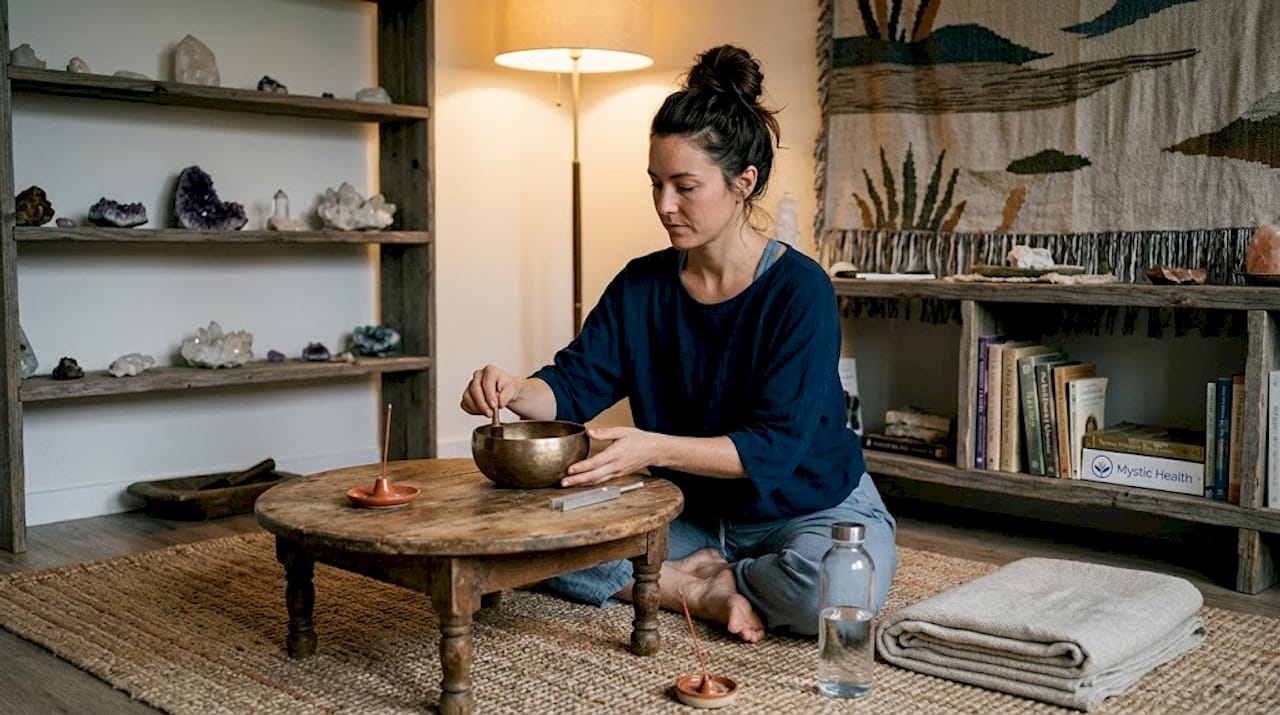
The most common beginner tools are Tibetan singing bowls, crystal singing bowls, tuning forks, chimes, and gongs. Each creates a distinct frequency range and texture of sound. Tibetan singing bowls are widely recommended for home practice because they are durable, affordable, and produce rich, layered overtones that are easy to feel in the body. Tuning forks offer more precision and are popular in clinical sound therapy settings. Gongs are powerful but can be overwhelming for solo beginners.
You do not need an expensive collection to start. One quality singing bowl is enough for a meaningful session.
Setting up your environment
Choose a room where you will not be interrupted for at least 45 to 60 minutes. Standard sound bath sessions typically run this long, with participants lying still in a reclined position similar to the yoga pose Savasana. Dim the lights, roll out a yoga mat or blanket, and place a pillow under your head and knees for full-body comfort.
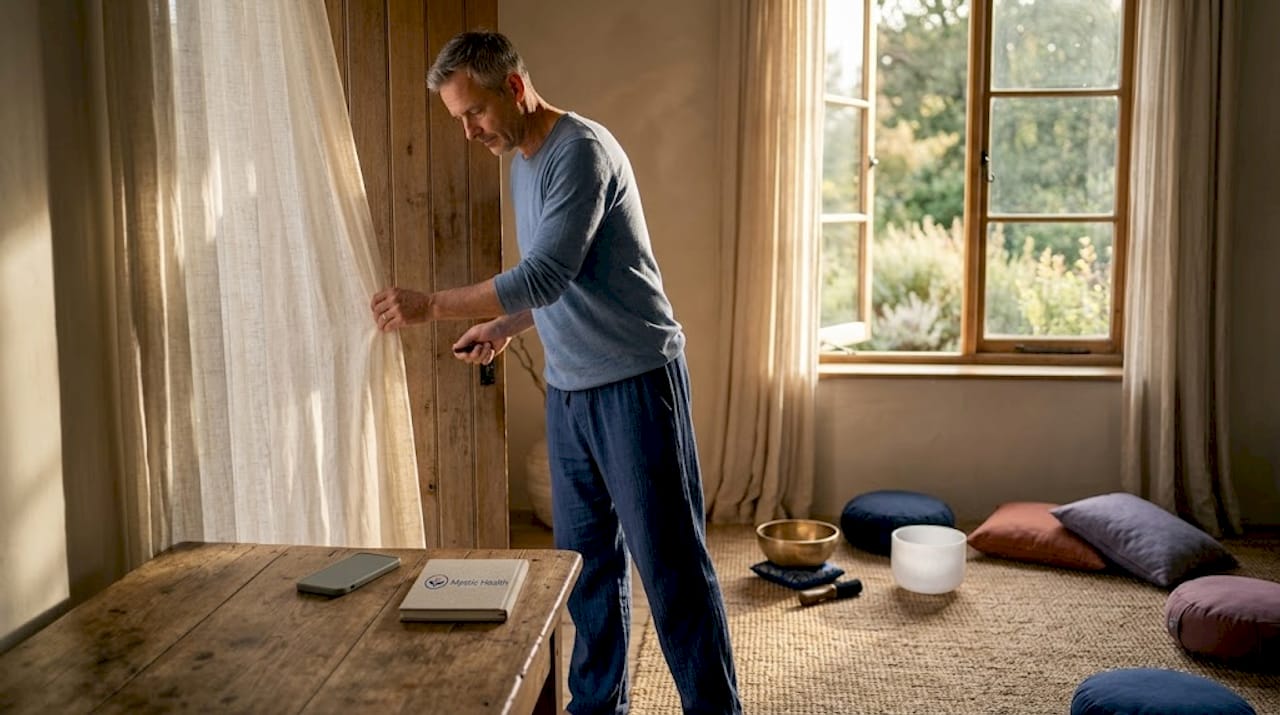
Remove your phone from the room or switch it to airplane mode. Ambient noise is fine. Traffic hum or birdsong will not derail a session. What breaks the spell is the ping of a notification.
Mindset and hydration
Set a clear intention before you begin. This does not have to be poetic. Something simple like “I want to release tension from this week” is more than enough. Intention gives your nervous system a direction.
Hydration before sessions genuinely matters here. Sound waves conduct more efficiently through a well-hydrated body, which means you will feel the vibrations more deeply and get more out of the experience. Drink a full glass of water at least 20 minutes before you begin.
| Element | What to prioritize | Why it matters |
|---|---|---|
| Instrument | Start with one quality singing bowl | Overtones produce measurable nervous system response |
| Space | Quiet room, no interruptions, soft surface | Physical comfort supports deeper relaxation |
| Intention | One clear, simple statement | Focuses attention and nervous system response |
| Hydration | Full glass of water 20 minutes prior | Improves vibration conduction through body tissue |
Pro Tip: When selecting a singing bowl, hold it in your palm and strike it gently. A quality bowl will resonate for at least 20 to 30 seconds. If the sound dies quickly, the bowl will not sustain enough tone for a productive session.
The step by step sound healing process
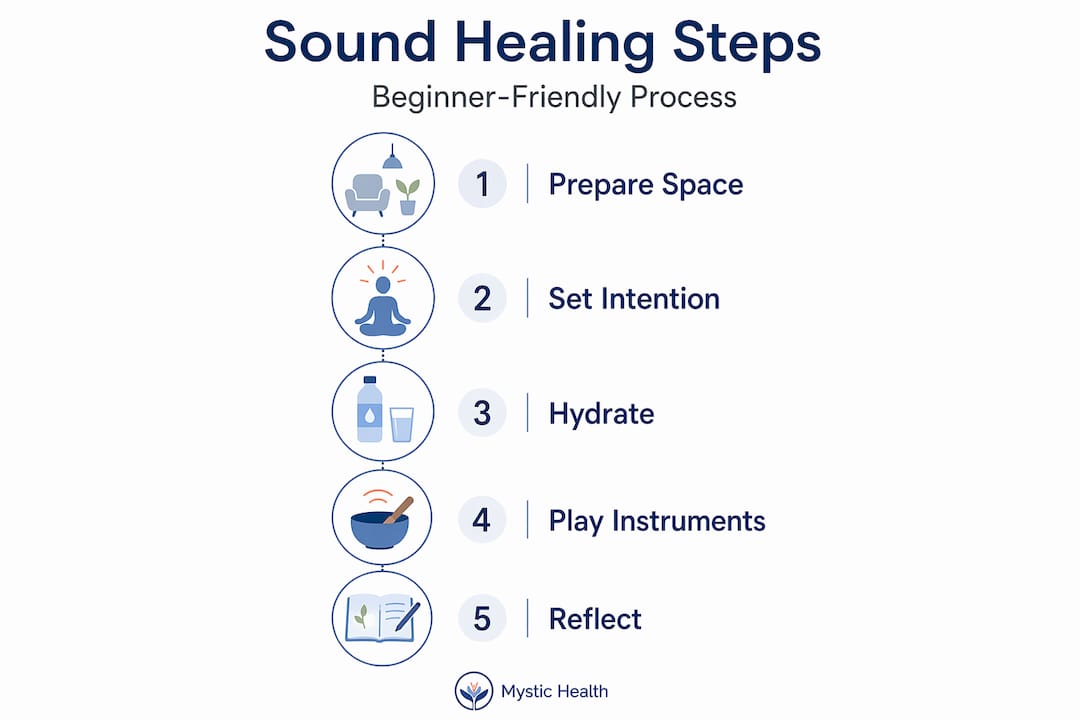
This is the core of guided sound healing techniques put into a sequence you can actually follow at home. Give yourself a full hour for your first session.
-
Ground yourself (5 minutes). Lie down on your mat with your arms resting naturally at your sides. Close your eyes. Take five slow, deep breaths, exhaling longer than you inhale. Feel the weight of your body against the floor. This is not a formality. This grounding phase signals your brain to shift out of Beta brainwave activity and into the more receptive Alpha state where healing work becomes possible.
-
Set your intention out loud (1 to 2 minutes). Speak your intention quietly, either aloud or in a whisper. Hearing your own voice stating a purpose activates a different kind of focused attention. If you prefer silence, write the intention on paper before you lie down and keep it nearby.
-
Begin with gentle opening tones (5 minutes). Strike your singing bowl softly on the outside rim using a mallet. Let the tone ring out completely before striking again. Letting tones fully decay takes roughly 10 to 20 seconds. This pacing is not optional. It prevents sensory overload and gives your nervous system time to register and integrate each sound wave.
-
Move into rim-singing (10 minutes). Rest the bowl flat on your open palm or place it on a soft surface near your body. Press the mallet against the outer rim and move it slowly and steadily in a circular motion. This produces a continuous, building tone. The vibration becomes almost physical. Focus on where you feel it in your body, your chest, your throat, your abdomen.
-
Work through body areas and chakras (21 minutes minimum). Move your focus or physically position your bowl near different areas of the body, starting from the base of the spine and moving upward. Spending at least 3 minutes per chakra allows genuine nervous system entrainment across all seven energy centers. You are not required to hold strong beliefs about chakras for this to work. Think of it as giving deliberate attention to each region of the body in sequence.
-
Rest in silence (5 to 10 minutes). This is the step most beginners skip, and it is arguably the most important one. After the peak of the sound work, set your instrument down and simply lie still. The nervous system needs this integration window. Think of it as the pause after rain, when the ground absorbs what has fallen.
-
Close with soft, fading tones (5 minutes). Return to gentle strikes, but make them lighter and further apart than your opening. Let each tone grow softer. This signals to your body that the active phase of the session is ending and prepares you to transition back to everyday awareness without feeling jarred.
-
Transition mindfully (3 to 5 minutes). Do not sit up abruptly. Roll to one side, rest for a moment, then slowly bring yourself upright. Drink water. Give yourself a minute before reaching for your phone. Your nervous system has just done significant work.
Pro Tip: If you feel nothing during your first few sessions, that does not mean nothing is happening. Physiological benefits occur even without perceived profound experiences because the brain shifts into restorative Alpha and Theta states regardless of whether you feel a dramatic effect.
Common mistakes and how to avoid them
Even with the best intentions, certain habits get in the way of effective sound healing practices. Here is what to watch for.
- Striking too fast. Beginners often strike singing bowls too quickly, stacking sounds on top of each other before the previous tone has decayed. The result is noise rather than resonance. Slow down significantly. More space between strikes produces more effect, not less.
- Pressing the mallet too hard during rim-singing. Light, consistent pressure produces a clean sustained tone. Heavy pressure creates friction that chokes the sound. If your bowl is scratching instead of singing, ease off.
- Skipping the silence. The rest period after active sound work is not dead time. It is where integration happens. Cutting this short is like leaving bread in the oven for only half the baking time.
- Judging your emotional responses. Emotional releases such as crying or sudden joy are common and healthy. They signal that your nervous system is processing stored stress. Do not suppress these responses or feel embarrassed by them. Let them move through.
- Expecting a peak experience every time. Some sessions will feel profound. Others will feel like a quiet afternoon nap. Both have value. Attaching to dramatic outcomes creates resistance that actually slows progress.
- Practicing alone when you need support. If emotional material that comes up feels overwhelming or unmanageable, a group session or guided practice with a trained facilitator offers a safer container. You do not have to navigate everything solo.
What to expect as you keep practicing
The benefits of a consistent, steps-for-sound-therapy practice are real, and they build over time.
Physically, regular sessions are associated with lower cortisol, reduced muscle tension, and improved sleep quality. Emotionally, many practitioners describe a gradual softening, where situations that used to trigger anxiety feel more manageable after several weeks of practice.
The key word is gradual. Sound healing is not a switch you flip. It is more like physical therapy for the nervous system. You might notice after two or three sessions that you fall asleep more easily. After a few weeks, you may find that you respond rather than react to stressful situations. These are the markers worth tracking.
| Benefit | Common sensation during sessions |
|---|---|
| Reduced stress hormones | Warmth or heaviness in the limbs |
| Emotional release | Spontaneous tears, laughter, or vivid imagery |
| Improved sleep | Deep drowsiness near the end of a session |
| Increased body awareness | Tingling or pulsing near the bowl’s contact area |
| Mental clarity | A sense of quiet or spaciousness after silence phase |
Keeping a simple journal after each session helps. Even three sentences noting your mood before and after, plus any sensations or emotions that arose, gives you trackable data. Over time, the pattern becomes clear. You are not imagining it. You are changing.
You can also explore how sound therapy balances emotions at the physiological level if you want to understand the science behind what you are experiencing. The research on brainwave entrainment and autonomic nervous system regulation gives real context to what can otherwise feel intangible.
My honest take on sound healing
I will be direct with you. When I first encountered sound healing, I was skeptical in the way that most people are skeptical of things that seem too gentle to actually work. I kept waiting for it to fail the test.
What I discovered, and what I have seen reflected in the experiences of people who come to Mystic for care, is that the real obstacle is not the practice itself. It is the pace. We are so trained to expect fast results and clear metrics that we abandon things before they have had time to take root. Sound healing asks something different of you. It asks you to show up consistently and stay curious rather than hungry for outcomes.
What I find most worth saying is this: the silence is the practice. The tones open a door, but the stillness is where you actually walk through it. Most people rush back to ordinary life the moment the sound stops. Learning to sit in that quiet space after a session, without immediately reaching for distraction, is the skill that transfers everything else into daily life.
I also want to gently challenge the idea that you need to believe in chakras or energy fields for this to work. The spectrum of emotional releases that people report in sound therapy sessions is real and measurable in its effect on how they feel afterward. You can approach this as a pragmatist and still benefit deeply. The body does not require your philosophical agreement. It just needs you to show up and listen.
Combining sound healing with other integrative holistic practices tends to compound the benefit. Sound works especially well alongside breathwork, mindfulness, and in clinical settings, alongside psychedelic-assisted therapy for people dealing with deeper trauma or grief.
— Kabir
How Mystic supports your healing
At Mystic, sound healing does not exist in isolation. It is one thread within a larger, evidence-based approach to mental and emotional wellness. Mystic’s integrative mental health programs weave together modalities like sound therapy, mindfulness, and psychedelic-assisted care to meet you where you are, whether you are managing chronic stress, processing grief, or navigating a serious illness. If you are ready to move beyond solo practice into a supported clinical environment, explore what Mystic offers. A guided session in the right container can change what is possible for you.
FAQ
What is the ideal length for a sound healing session?
Standard sessions last 45 to 60 minutes, with participants lying comfortably in a reclined position. Longer integrative sessions including preparation and recovery can extend to several hours.
How often should you practice sound healing for results?
Most practitioners recommend two to three sessions per week when starting out, as consistent practice is what produces lasting shifts in mood, sleep, and stress response.
What does emotional release during a session mean?
Emotional releases such as crying or sudden joy are healthy and expected. They indicate the nervous system is processing stored stress rather than holding it.
Do you need to believe in chakras for sound healing to work?
No. The physiological effects of sound, including brainwave shifts from Beta to Alpha and Theta states, occur regardless of your belief system. The body responds to frequency and vibration whether or not you subscribe to any particular framework.
Can you practice sound healing at home without a teacher?
Yes, especially using this step by step sound healing process as a guide. Beginners can start effectively with a single quality singing bowl. If emotional material feels unmanageable, working with a facilitator or joining a group session offers helpful support.
Recommended

Mystic Health Blog





FAQs
1. Am I eligible for ketamine therapy?
2. Does insurance cover the cost of ketamine therapy?
3. How many ketamine treatments will I need?
We recommend two initial treatments to determine suitability and adjust dosage. After these sessions, additional treatments are available based on your progress and specific requirements.