Sound therapy: A step-by-step guide for emotional healing
TL;DR:
- Sound therapy offers a structured, goal-oriented alternative to passive music listening, especially beneficial alongside professional guidance.
- Preparation, clear goals, and safety considerations are essential, particularly for those with trauma or complex emotional histories.
- Integrating sound therapy into a holistic mental health plan enhances its effectiveness and ensures safe, personalized healing outcomes.
There are moments when conventional approaches to managing stress just stop feeling like enough. Maybe you’ve tried talk therapy, medication, or simple lifestyle changes, and while they’ve helped, something still feels unresolved, a quiet weight that won’t lift. That’s where structured sound therapy can open a door you didn’t know was there. This guide walks you through what sound therapy actually involves, how to prepare, what the process looks like from start to finish, and how to integrate it safely alongside your broader mental health care.
Table of Contents
- What is sound therapy? Understanding the basics
- Preparing for sound therapy: What you need to know
- Sound therapy in action: A step-by-step process
- Safety, effectiveness, and troubleshooting
- Integrating sound therapy within a holistic mental health approach
- What most guides miss about sound therapy: A grounded take
- Ready to try sound therapy? Your next steps with Mystic Health
- Frequently asked questions
Key Takeaways
| Point | Details |
|---|---|
| Sound therapy is structured care | Effective sound therapy uses assessment, planning, and professional guidance for best outcomes. |
| Preparation and safety matter | Adequate preparation and awareness of risks ensure a safer sound therapy experience. |
| Evidence is condition-specific | Sound therapy shows benefits for stress but mixed results for other issues like tinnitus. |
| Integration enhances results | Combining sound therapy with holistic mental health approaches improves overall effectiveness. |
What is sound therapy? Understanding the basics
To start your sound therapy journey, it’s important to grasp what separates a therapeutic process from simply playing your favorite playlist.
A lot of people think sound therapy just means listening to calming music before bed. That’s understandable. But the two are genuinely different things. Sound therapy, in a clinical sense, is a structured, intentional intervention. is a goal-directed intervention delivered by credentialed music therapists within a therapeutic relationship, involving assessment and individualized treatment planning. That’s a significant distinction from passive listening.
Sound therapy works through two primary modalities:
- Active modalities: You participate by making music, using instruments, vocalizing, or creating sound as part of the therapeutic process.
- Receptive modalities: You listen, often in a guided way, to specific sound frequencies, live instruments like singing bowls, or curated music chosen by a therapist with clear therapeutic intent.
The role of a credentialed therapist matters more than many people realize. They assess your emotional and psychological baseline, identify specific goals, and adapt the intervention as you progress. Without that clinical relationship, sound therapy risks becoming something pleasant but ultimately unfocused.
Here’s a quick comparison to make this concrete:
| Feature | Casual music listening | Structured sound therapy |
|---|---|---|
| Goal-setting | None | Formalized with therapist |
| Assessment | None | Standardized evaluation |
| Customization | Self-selected | Clinically tailored |
| Progress tracking | None | Documented and adjusted |
| Professional oversight | None | Credentialed therapist |
Understanding this distinction also helps you recognize when professional guidance genuinely matters. If you’re navigating trauma, grief, or persistent anxiety, working with a practitioner who understands integrative mental health approaches is not just preferable. It’s often essential.
Preparing for sound therapy: What you need to know
With clear definitions in hand, preparation is your next crucial step. Here’s how to get ready.
Before you begin any sound therapy practice, taking stock of where you are emotionally and physically is worth doing honestly. Not every person is at the same place of readiness, and that’s okay. The process works best when you enter it with a realistic sense of your own needs and limitations.
One important safety nuance deserves your attention here. Some individuals may experience emotional catharsis that could be overwhelming, and clinical sources advise that those with PTSD engage only under supervision of trained professionals rather than through unsupervised exposure. If you carry unresolved trauma, a guided clinical setting is not optional. It’s protective.
Here’s a practical look at what to consider before starting:
| Consideration | Professional session | Self-guided session |
|---|---|---|
| Prior trauma or PTSD | Strongly recommended | Not advised without clinical support |
| Mild stress or anxiety | Beneficial | Possible with structure |
| Setting | Clinical or therapeutic space | Quiet, private environment |
| Equipment | Provided by therapist | Singing bowls, tuning forks, or playlists |
| Goal clarity | Developed with therapist | Self-defined but specific |
When it comes to tools and environment, you don’t need a lot to begin. What you do need is intentionality. A quiet room, minimal distractions, a consistent time of day, and a specific intention for each session all matter. For self-guided approaches, instruments like singing bowls, tuning forks, or curated binaural beat recordings are commonly used. For clinical sessions, your therapist will provide the tools.

Goal-setting deserves its own attention. Vague goals produce vague results. Before your first session, ask yourself what you’re actually hoping for. Emotional relief? Better sleep? A greater sense of groundedness? The more specific you can be, the more useful it becomes. A mental health checklist can help you organize your priorities and communicate them effectively to a provider.
Pro Tip: Write down three specific, measurable intentions before your first session. For example: “I want to feel less tension in my body after each session” or “I want to notice my emotional reactions with more distance.” These become your personal benchmarks for progress.
Sound therapy in action: A step-by-step process
Once you’ve prepared, the process follows these structured stages.
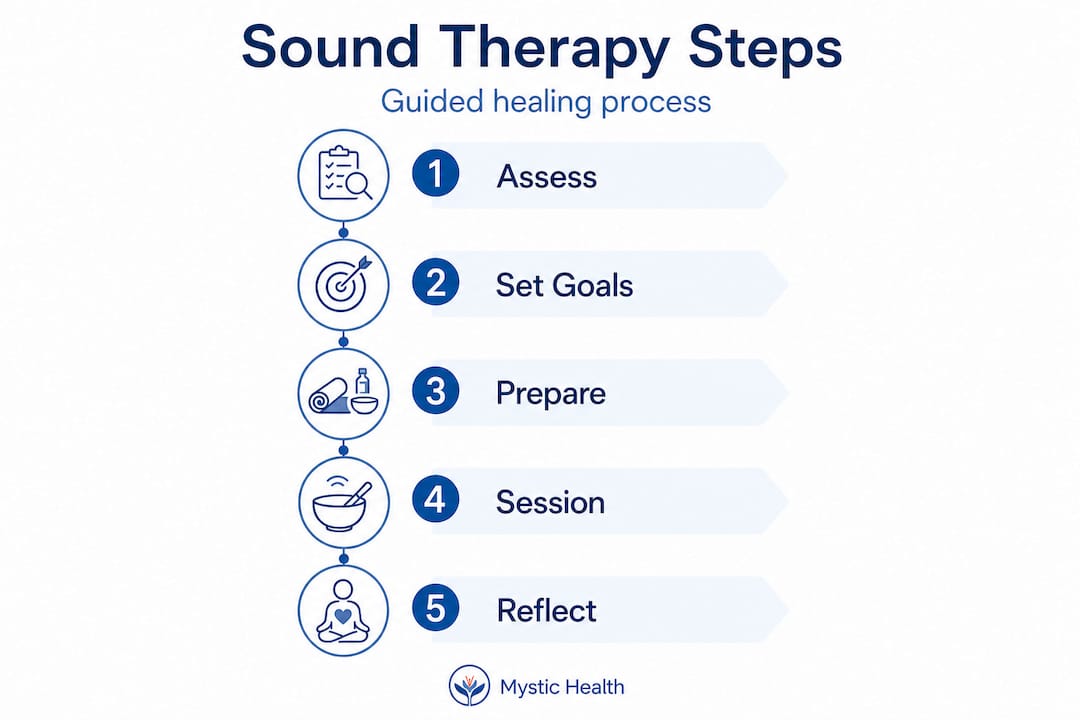
Sound therapy isn’t something you just drop into randomly. It moves through recognizable phases, and understanding them helps you stay grounded when the experience gets intense or unexpected. A structured assessment process is commonly described in stages including preparation, data gathering, analysis and interpretation, and documentation, with the overall therapy process extending from referral through discharge or termination.
Here’s how that plays out in practice:
- Referral or self-initiation. You recognize the need for support and either receive a referral from a clinician or seek out a sound therapist directly. This is where intention begins.
- Initial assessment. A credentialed therapist evaluates your emotional history, current symptoms, preferences around sound, and any contraindications. This shapes everything that follows.
- Treatment planning. Together, you and your therapist define goals, choose modalities (active or receptive), and establish session frequency. This plan is documented and revisited regularly.
- Implementation. Sessions take place in a consistent space, following the plan. Each session typically includes a brief check-in, the therapeutic sound intervention itself, and a closing reflection. Progress is noted after each session.
- Discharge or transition. As goals are met or needs shift, the treatment concludes or evolves. This stage includes a review of what changed, what tools you can carry forward, and whether referrals to other modalities are warranted.
For self-guided practice, the same logic applies but with more personal responsibility. You act as your own tracker. Journaling after each session, noting how your body felt, what emotions arose, and what shifted, gives you the data to adjust your approach.
The consultation workflow for clinical therapeutic contexts follows a similar arc of assessment, plan, implementation, and review. And if you’re wondering how this fits into a personalized therapy plan, the principle is the same: the more tailored the approach, the more meaningful the outcome.
Pro Tip: After each session, spend five minutes writing in a notebook. Note your mood before and after, any images or memories that arose, and any physical sensations. Over several weeks, patterns will emerge that tell you exactly what’s working.
Safety, effectiveness, and troubleshooting
With the process underway, addressing safety and realistic expectations supports success.
One of the most honest things we can say at Mystic Health is this: sound therapy is promising, but it isn’t magic, and the research is still catching up to the practice. Being clear-eyed about the evidence helps you use it wisely.
For tinnitus specifically, a Cochrane review found insufficient evidence to support the superiority of sound therapy over control conditions. That doesn’t mean it offers no value, but it does mean you shouldn’t enter it expecting a cure for every condition.
For stress and emotional regulation, the picture is more encouraging. Music-based interventions show measurable physiological effects, including improvements in heart rate variability (HRV) metrics like RMSSD and high-frequency power, both of which reflect the nervous system’s capacity to regulate itself under stress.
Sound therapy also intersects with meditative and healing practices that are being studied with standardized psychological scales and physiological measures. Research on sound-based meditation consistently reinforces that these interventions should be understood as complementary rather than standalone treatments.
Common markers that suggest sound therapy is working for you:
- You feel noticeably calmer or more centered after sessions
- Sleep quality improves over several weeks
- Emotional responses to daily stressors become less reactive
- Physical tension in the body decreases
- You feel more able to name and sit with difficult emotions
Red flags that suggest you need to pause and seek support:
- Intense emotional flooding that doesn’t settle within hours of a session
- Flashbacks or intrusive memories triggered by specific sounds
- Worsening anxiety or dissociation
- Feeling destabilized rather than grounded after repeated sessions
If any of those red flags appear, that’s not failure. It’s information. And it’s a signal to bring a clinician into the picture, if one isn’t already. The evidence for healing modalities consistently shows that safety and professional guidance are the factors that separate beneficial outcomes from harmful ones.
For those curious about physical applications alongside emotional healing, tools like represent another dimension of sound-based approaches that some practitioners use in integrative contexts.
“Sound therapy should be appraised as a complementary modality, not a replacement for evidence-based clinical care. It works best when it’s one tool in a thoughtfully assembled plan.”
Integrating sound therapy within a holistic mental health approach
Moving from process to integration helps you maximize the benefits and avoid common pitfalls.
Sound therapy doesn’t exist in a vacuum. Its real power emerges when it’s woven into a broader approach that includes professional support, honest self-assessment, and a willingness to coordinate across care providers. This is where the principles of integrative care approaches become essential.
Ethical practice in this space centers on autonomy and informed consent. That means you should always understand what a session involves, what the expected outcomes might be, and what risks exist before you agree to anything. A practitioner who skips this conversation isn’t following ethical standards.
Documentation also matters more than people expect. Tracking your sessions, emotional responses, and progress creates a record that both you and your providers can use to make better decisions. When adverse reactions occur, they should be documented too, not minimized or dismissed.
Here’s how to build a responsible integration plan:
- Inform your primary care provider or mental health clinician that you’re engaging in sound therapy
- Bring any written goals or session notes to regular check-ins with your healthcare team
- Ask your sound therapist to coordinate with your other providers when clinically appropriate
- Allow your treatment plan to evolve as your needs change, standardized elements can coexist with personalized adjustments
- Review outcomes at regular intervals rather than waiting until something feels wrong
The Frontiers in Human Neuroscience highlights this exact tension: ethical practice requires both standardizing core therapeutic components for reliability and allowing individualization for genuine relevance. Both matter. One without the other produces either rigidity or chaos.
What most guides miss about sound therapy: A grounded take
Most resources on sound therapy focus on the benefits and leave out the harder truths. I want to be honest with you here, because that’s the only approach that actually serves you.
The biggest gap I see is this: people enter sound therapy, especially group sound baths or self-guided practices, without any prior assessment or professional scaffolding. And for a lot of people, that works fine. The experience is pleasant. Maybe calming. Occasionally moving.
But for others, particularly those carrying unresolved trauma, that openness to emotion that sound creates can become a door that swings too wide too fast. Clinical guidance explicitly advises that individuals with PTSD engage only under professional supervision rather than through unsupervised sound bath exposure. This isn’t overly cautious. It reflects real clinical experience with real people who were overwhelmed rather than healed by unguided sound exposure.
The second thing most guides miss is the role of personalization. Sound therapy isn’t a single modality. It’s a category of interventions, and what works for one person emotionally, neurologically, and even physically, may do very little for another. Generic approaches produce generic results. A mental health safety checklist before beginning helps you identify what kind of support you actually need.
Here’s what I believe after years of working in integrative care: the most powerful healing happens at the intersection of structure and safety. Sound therapy, when practiced with professional guidance, clear goals, and honest self-awareness, can be a genuinely transformative part of your mental health journey. Without those elements, it’s a pleasant experience at best and a destabilizing one at worst. You deserve the real thing.
Ready to try sound therapy? Your next steps with Mystic Health
If this guide has resonated with you, and you’re feeling ready to explore sound therapy as part of a real, supported healing plan, we’re here to help.
At Mystic Health, we believe healing works best when it’s whole-person, evidence-informed, and built around your specific needs. Our integrative mental health support brings together approaches like sound therapy, mindfulness, and psychedelic-assisted care in a way that honors both the science and the deeply human experience of healing. If you’re looking for a structured starting point, our mindfulness course for healing is a practical companion to sound therapy work. And if you want to understand the research behind the modalities we offer, our clinical evidence library is a great place to begin. You don’t have to figure this out alone.
Frequently asked questions
Can I practice sound therapy at home, or do I need a professional?
Self-guided sound therapy can be a gentle starting point, but goal-directed clinical music therapy delivered by a credentialed therapist within a therapeutic relationship is significantly more effective and safer for individuals with complex emotional histories.
How do I know if sound therapy is working for me?
You may notice improved mood, reduced reactivity, and better sleep across sessions. Measurably, music interventions increase HRV metrics like RMSSD and high-frequency power, both of which reflect improved nervous system regulation.
Is sound therapy scientifically proven for all conditions?
No, evidence quality varies by condition. For example, a Cochrane review on tinnitus found insufficient evidence of superiority, while stress-related applications show more consistent measurable results.
Can sound therapy cause emotional distress?
Yes, for some people it can surface strong or overwhelming emotions. Clinical guidance specifically advises that individuals with PTSD or similar trauma histories engage only under professional supervision to reduce this risk.
Recommended

Mystic Health Blog








FAQs
1. Am I eligible for ketamine therapy?
2. Does insurance cover the cost of ketamine therapy?
3. How many ketamine treatments will I need?
We recommend two initial treatments to determine suitability and adjust dosage. After these sessions, additional treatments are available based on your progress and specific requirements.