How psychedelics aid healing: science, evidence, and insights
TL;DR:
- Psychedelic healing involves acute neural desynchronization and lasting neuroplasticity in the brain.
- Proper set, setting, and structured therapy are crucial for effective and safe psychedelic outcomes.
- Evidence supports psychedelics for mental health in serious illness but long-term safety and standards need further research.
Many people still carry a simple mental image of psychedelics: you take a substance, you have an intense experience, and something shifts. That picture, while not entirely wrong, leaves out most of what actually matters. Leading neuroscience reviews now converge on two distinct biological processes, acute neural desynchronization and lasting neuroplasticity, as the engines behind therapeutic change. But even those processes don’t tell the whole story. Real healing, especially for people carrying chronic pain or the weight of serious illness, depends on what happens before, during, and long after any single session. This article lays out what we know, what is still emerging, and what you should consider if you are exploring this path.
Table of Contents
- How psychedelics work in the brain and mind
- Psychedelic-assisted therapy: structure and importance of set and setting
- Current evidence: psychedelics for chronic pain and serious illness
- Safety considerations, consent, and the limits of current knowledge
- Why real healing with psychedelics requires more than molecules
- Take the next step with evidence-based support
- Frequently asked questions
Key Takeaways
| Point | Details |
|---|---|
| Healing is both brain and context | Effective psychedelic-assisted therapy requires both biological change and the right therapeutic environment. |
| Therapy structure shapes outcomes | Preparation, dosing supervision, and integration are all essential to maximize benefits and minimize risks. |
| Evidence is strong for serious illness | Studies show lasting relief from depression, anxiety, and spiritual distress in patients with life-threatening conditions. |
| Early promise for chronic pain | Small studies suggest safety and pain relief potential, but more research is needed before wide recommendation. |
| Safety and ethics are evolving | Proper consent, aftercare, and program choice are crucial as the field continues to develop. |
How psychedelics work in the brain and mind
To understand how psychedelics help healing, you first need to know what they actually do in your brain. Classic psychedelics, meaning substances like psilocybin and LSD, primarily bind to serotonin 2A receptors distributed throughout the cortex. That binding sets off a cascade of changes that researchers are still mapping, but two broad categories have become central to the clinical conversation.
The first is acute neural desynchronization. During a psychedelic session, the brain’s default mode network, the system responsible for your ongoing internal narrative and sense of self, becomes temporarily disrupted. Brain regions that don’t normally communicate begin exchanging signals. This is part of why people describe a loosening of rigid thought patterns, a sense of expanded perspective, or moments of profound emotional release. It can feel disorienting, but that disruption appears to be therapeutically meaningful. Tightly held beliefs about pain, identity, and hopelessness have a chance to soften.
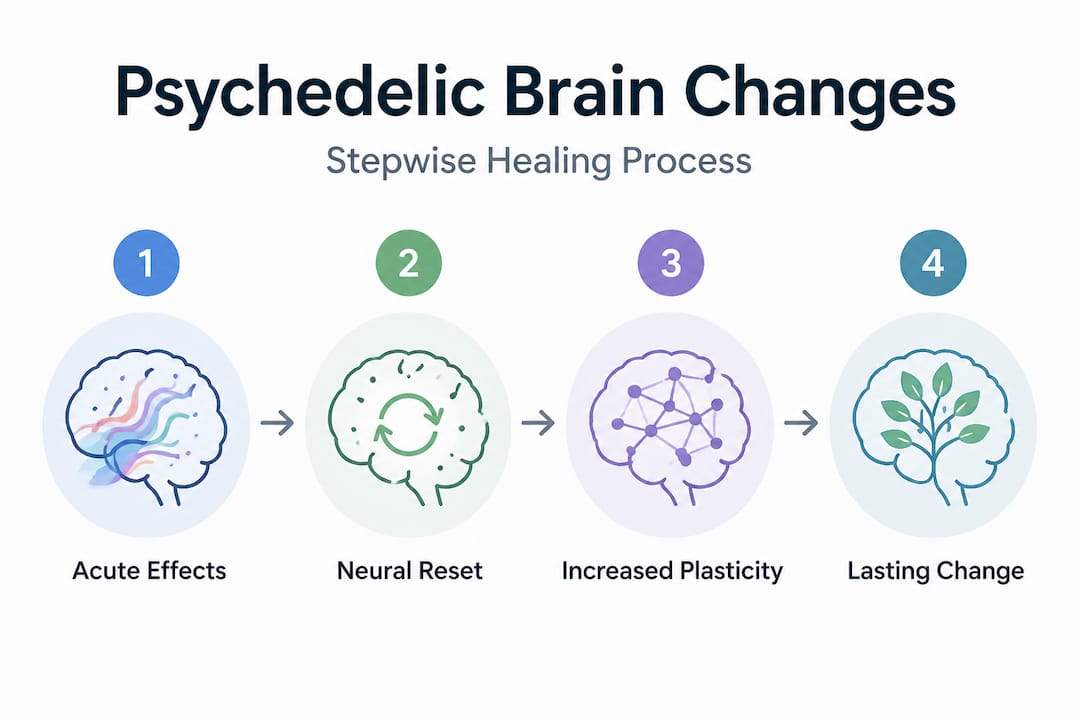
The second process is subacute neuroplasticity, and this is where the lasting change lives. In the days and weeks following a psychedelic experience, research shows elevated expression of proteins involved in synaptic growth. The brain, put simply, becomes more receptive to learning and forming new connections. Clinicians often describe this as an open window, a period when therapeutic work, reflection, and integration can take root in ways they might not under ordinary conditions.
| Brain process | When it occurs | Clinical significance |
|---|---|---|
| Acute neural desynchronization | During the session | Disrupts rigid thought patterns; enables new perspective |
| Subacute neuroplasticity | Days to weeks after | Enhances learning, emotional processing, and behavioral change |
| Serotonin 2A receptor activation | Immediately on dosing | Primary pharmacological trigger for both processes |
As psychedelic therapy outcomes research continues to grow, the evidence points to something important: neither process alone produces healing. The brain changes create the possibility of transformation. Whether that possibility becomes real depends heavily on what you bring to the experience and how you work with it afterward.
“Mechanistically, leading neuroscience reviews converge on two complementary therapeutic-relevant processes after classic psychedelics: acute neural desynchronization and subacute neuroplasticity.” — Nature Medicine review
This balance of biological change and psychological context is not a footnote. It is the foundation of responsible clinical practice.
Psychedelic-assisted therapy: structure and importance of set and setting
Knowing the brain mechanisms is just one side of the story. The other is how those changes are catalyzed through supportive therapy. This is where the concept of set and setting becomes essential, and where clinical psychedelic therapy differs most dramatically from recreational use.

“Set” refers to your mindset walking into a session: your intentions, your fears, your psychological history, and your readiness. “Setting” refers to the physical and relational environment, the room, the music, the presence of trained therapists, and the emotional safety of the space. Research consistently shows that outcomes depend strongly on these non-drug factors. Two people taking the same dose of psilocybin can have radically different experiences based on context alone.
Properly structured psychedelic-assisted therapy moves through three core phases:
- Preparation. Sessions with your therapist to clarify intentions, address anxiety, review medical history, and set relational trust before any substance is involved. This phase is often underestimated, but it does as much heavy lifting as the dosing session itself.
- Supervised dosing. The actual psychedelic experience occurs in a carefully controlled environment with trained clinicians present. You are not alone. Music, comfortable surroundings, and the therapist’s calm presence all form part of the therapeutic container.
- Integration. This is where insights become lasting change. Through follow-up sessions, you work to understand and apply what arose during the experience. Without emotional healing integration, the neuroplastic window often closes without producing meaningful transformation.
| Factor | Recreational use | Clinical psychedelic therapy |
|---|---|---|
| Setting | Variable, often uncontrolled | Structured, monitored, safe |
| Therapist presence | None | Trained clinical team |
| Pre-session preparation | Minimal or absent | Multiple sessions; intention setting |
| Post-experience integration | Absent or informal | Structured follow-up sessions |
| Safety protocols | Self-managed | Medical screening and crisis support |
| Legal and ethical framework | Outside regulation | Governed by clinical ethics boards |
The difference matters enormously. Without preparation and integration, a powerful experience can feel destabilizing rather than healing. With proper structure, that same intensity can become a turning point.
Pro Tip: When evaluating any psychedelic therapy program, ask specific questions. How many preparation sessions are included? What are your therapists’ credentials and training in psychedelic-assisted work? Is there a structured integration plan after dosing? A quality program will have clear, confident answers to all three. You can also learn about the consultation process to understand what thorough preparation looks like in practice.
Current evidence: psychedelics for chronic pain and serious illness
Therapeutic structure sets the foundation for healing, but what does the actual research show for the toughest cases? This is where things get genuinely encouraging, with important caveats.
For people facing cancer and life-threatening illness, the evidence is perhaps most compelling. Psilocybin-assisted psychotherapy has produced and improvements in spiritual well-being and death-related distress in a phase 2b randomized controlled trial. These aren’t small or fleeting effects. Participants in these trials often describe a fundamental shift in how they relate to their diagnosis, their fear, and their sense of meaning. For someone living with cancer, that kind of shift can be as valuable as any symptom management tool.
Here is a summary of where the evidence currently stands:
- Depression in serious illness. Multiple trials now support psilocybin’s effectiveness for treatment-resistant depression and depression linked to life-threatening diagnosis. Effects can persist for weeks to months after a single or small number of sessions.
- Anxiety and existential distress. Cancer patients in clinical trials have reported significant reductions in death-related anxiety and improved quality of life metrics. Spiritual well-being scores, measured by validated tools, showed meaningful improvement.
- Chronic pain. This is an area of active and early investigation. An open-label pilot study suggests feasibility and potential benefit for certain chronic pain conditions, but the evidence base is still limited. Researchers are working to understand which pain types respond, what doses are appropriate, and how psychological factors mediate outcomes.
- PTSD and addiction. Both conditions show promising early results, with MDMA-assisted therapy for PTSD having received particularly significant clinical attention, though regulatory status continues to evolve.
- End-of-life distress. Arguably the most consistent finding across trials involves the reduction of existential suffering for people approaching end of life, including improvements in acceptance, peace, and connectedness.
Pro Tip: If you are managing chronic pain or a serious illness and are exploring psychedelic therapy, ask your prospective provider whether they have experience with your specific condition, what screening criteria apply to you, and whether they coordinate care with your existing medical team. These questions protect you and signal program quality.
Exploring new approaches to healing through a well-supervised program can open genuine doors. But informed expectation setting is part of responsible care, and any honest provider will make that a priority.
Safety considerations, consent, and the limits of current knowledge
Recognizing the promise of psychedelics, it’s equally important to be mindful of their risks and limitations. The science is still young, and some foundational questions about safety and ethics remain genuinely open.
One of the most important and often overlooked considerations is consent during an altered state. When you are in the depths of a psychedelic experience, your cognitive and emotional state is profoundly changed. Consent for therapist contact or boundary management in those moments becomes complicated. Qualitative research with clinical researchers identifies this as an active ethical concern, and thoughtful programs address it explicitly before any dosing session begins. Pre-session conversations about boundaries and expectations are not administrative formality; they are ethical bedrock.
Beyond consent, several other safety and knowledge gaps deserve honest acknowledgment:
- Long-term safety data is limited. Most trials follow participants for months, not years. We don’t yet have strong evidence about how repeated sessions over long periods affect the brain or behavior.
- Therapist training standards are inconsistent. The field is growing faster than certification infrastructure. Programs vary widely in the quality of clinical training their therapists have received.
- Psychological contraindications are real. People with personal or family histories of psychosis or certain bipolar presentations require careful screening. Not everyone is a good candidate.
- Infrastructure is still developing. Regulatory frameworks differ by region and substance, and access to high-quality programs remains uneven.
- Adverse experiences can occur. Challenging psychological experiences during sessions are common and not always harmful, but without adequate support, they can be distressing or destabilizing.
“Expert clinical leadership warns that psychedelics are not a standalone solution due to tempered evidence and operational challenges.” — Becker’s Behavioral Health
This is not a reason to step away from exploring therapy. It is a reason to be thoughtful about where and with whom you pursue it. Aftercare matters. Ongoing clinical support matters. Choosing a program that takes integrative approaches seriously, rather than treating the dosing session as the endpoint, is one of the most important decisions you can make.
Why real healing with psychedelics requires more than molecules
Let me be honest with you about something that gets lost in a lot of the excitement around psychedelic therapy. The molecule is not the therapy. This is the most important thing we try to communicate, and it is the thing most easily misunderstood.
When people hear about dramatic improvements in depression after a single psilocybin session, the natural instinct is to focus on the substance itself. What did it do chemically? How much do you need? Can we replicate the effect with a pill? These are reasonable questions, but they risk missing what the research is actually showing. The neuroplastic window that psychedelics open is only as valuable as what you do with it. A door is not a destination.
What the evidence keeps pointing toward is this: standardized, emotionally safe context may be as important as the molecule itself. Participants who received careful preparation, experienced supportive dosing sessions, and engaged in structured integration showed the strongest and most durable results. Those who had powerful experiences without that scaffolding often found the insights faded, or worse, felt confused and unsupported.
We see this pattern reflected in the cultural and emotional nuance conversations happening within the field. The best practitioners are not just pharmacologists. They are listeners, guides, and skilled integrators of complex human experience. Choosing a provider who understands this distinction, who builds the relationship before the dosing and sustains it after, is choosing healing over novelty.
For those of you drawn to psychedelic therapy because conventional treatments haven’t reached your pain, that instinct deserves respect. But sustainable transformation is a process. It requires preparation, support, and the willingness to keep showing up for yourself over time. That is where genuine change lives.
Take the next step with evidence-based support
For those ready to explore next steps, specialized support makes the journey safer and more effective. At Mystic Health, we’ve built our programs around the understanding that healing is whole-person work. Every pathway we offer, from ketamine-assisted psychotherapy to Spravato, integrates clinical rigor with compassionate therapeutic presence.
You can explore our full clinical evidence to understand the research foundations behind our treatment modalities. If you’re drawn to the integration side of healing, our mindfulness and integration program provides the ongoing support that turns experiences into lasting change. For those navigating serious illness or end-of-life distress, our dedicated support for serious illness program combines palliative care with psychedelic-assisted approaches. We’d be honored to walk this path with you.
Frequently asked questions
What mental health conditions show the most evidence for psychedelic-assisted therapy?
Current research most strongly supports psilocybin-assisted therapy for depression, anxiety, and existential distress in people facing serious illness, with durable improvements in spiritual well-being documented in phase 2b trials. Evidence for other conditions, including addiction and PTSD, is promising but still accumulating.
Is psychedelic therapy safe for people with chronic pain?
Early clinical pilots suggest that psychedelic-assisted therapy is feasible and shows a potential benefit signal for certain chronic pain conditions, but the evidence base remains limited and more rigorous research is needed before broad clinical recommendations can be made.
Why are “set and setting” important in psychedelic-assisted healing?
Set and setting, meaning your mindset, the physical environment, and the full therapeutic structure around a session, strongly influence outcomes in ways that are often as significant as the pharmacological effects of the substance itself. Without proper preparation and integration, even profound experiences often fail to produce lasting healing.
What are the main risks and uncertainties with psychedelic therapy?
Long-term safety data is still limited, therapist training standards vary considerably across programs, and consent management during altered states remains an active ethical concern. Careful program selection, thorough screening, and robust aftercare planning are the most important protective factors available to you right now.
Recommended

Mystic Health Blog








FAQs
1. Am I eligible for ketamine therapy?
2. Does insurance cover the cost of ketamine therapy?
3. How many ketamine treatments will I need?
We recommend two initial treatments to determine suitability and adjust dosage. After these sessions, additional treatments are available based on your progress and specific requirements.