
 The Mystic Journal
Personalized therapy plan for psychedelic healing in 5 steps
Learn how to build a personalized therapy plan for psychedelic-assisted healing, covering screening, dosing, and integration for lasting mental health and…
Kabir Ali
 9 min read

TL;DR:
- Personalized therapy plans tailor preparation, dosing, and integration to individual needs and goals.
- A thorough assessment and collaboration ensure safety, relevance, and long-term healing outcomes.
- Patient-driven approaches with holistic support maximize treatment effectiveness and lasting transformation.
Finding a therapy plan that actually fits you is harder than it sounds. Generic protocols exist for a reason, but when you’re carrying complex trauma, chronic pain, or emotional wounds that standard treatments haven’t touched, a one-size approach often falls short. Psychedelic-assisted therapy offers something different: a framework that can be molded around your history, your nervous system, your goals. This guide walks you through how to build a truly personalized therapy plan, from initial screening all the way through integration, so you can show up for yourself with the support you actually need.
Key Takeaways
- 01
Phased personalization
Effective therapy plans adapt preparation, dosing, and integration phases to individual needs and histories.
- 02
Safety first approach
Thorough screening and ongoing medical monitoring are essential before starting and throughout therapy.
- 03
Integration drives results
Translating psychedelic experience insights into daily habits leads to lasting emotional and pain relief.
- 04
Holistic alignment
Combining psychedelic support with holistic practices and patient input enhances healing outcomes.
Understanding the foundations: What is a personalized therapy plan?
A personalized therapy plan isn’t just swapping out one medication for another. It means your care team looks at your full picture: medical history, current emotional challenges, pain patterns, relationships, and what you’re hoping to heal. That’s a very different starting point than checking boxes on a standard intake form.
In psychedelic-assisted therapy programs, personalization operates across three distinct phases. According to the Cleveland Clinic Journal of Medicine, these three structured phases are preparation, dosing, and integration, and each one is tailored individually based on the patient’s needs and goals. That structure matters because skipping or rushing any phase tends to undercut the results.
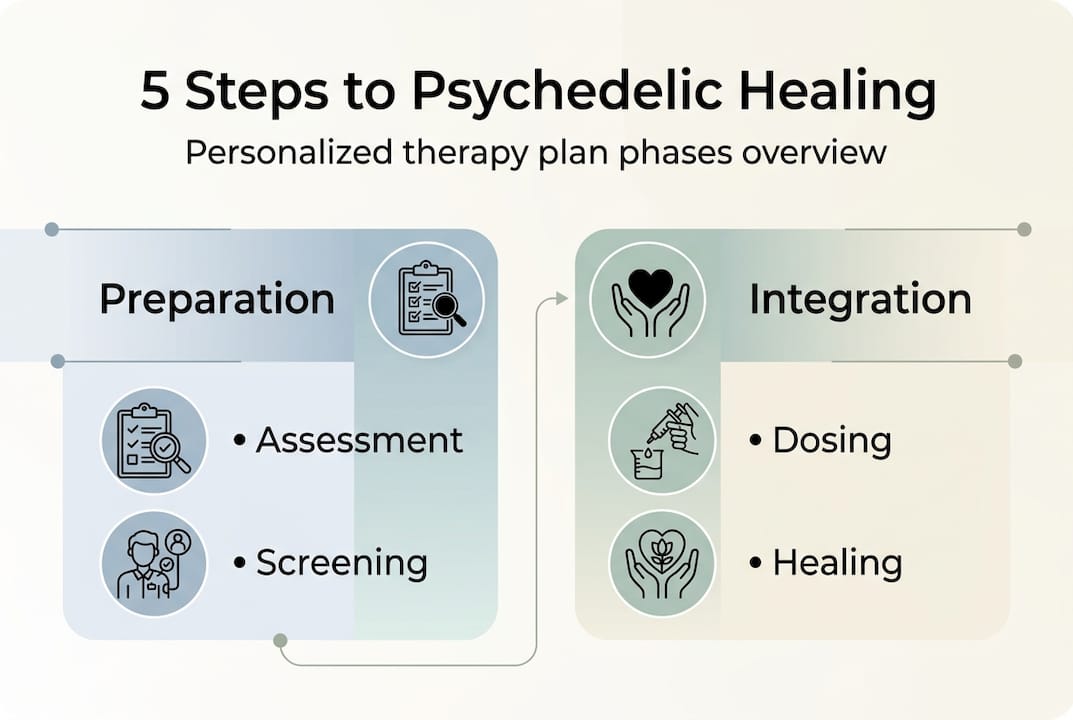
Here’s how a personalized plan compares to a generic one:
| Feature | Generic plan | Personalized plan |
|---|---|---|
| History review | Basic intake form | Full biopsychosocial assessment |
| Medicine choice | Protocol-driven | Diagnosis and goal-matched |
| Dosing environment | Standard clinical room | Curated set and setting |
| Integration support | Minimal follow-up | Ongoing therapy and tools |
| Chronic pain focus | Rarely addressed | Core treatment component |
Personalization is especially critical for complex presentations. If you’re managing both depression and chronic pain, for example, a generic psilocybin protocol might address mood but miss the somatic dimension entirely. A well-designed plan considers all of it.
Key elements of a truly individualized approach include:
- Medical history and contraindications reviewed carefully before any session
- Personal intentions and healing goals shaped collaboratively with your therapist
- Environment and support preferences factored into every dosing session
- Integration tools matched to your lifestyle and nervous system
Following the for safety and structure is a solid starting point for understanding what best-practice personalization actually looks like in clinical settings.
Step 1: Assessment, screening, and building your plan’s foundation
Before any medicine enters the picture, rigorous screening is non-negotiable. This phase is where your safety gets established and your care team builds a genuine understanding of who you are, not just your diagnosis.
Your integrative mental health assessment should cover psychological history, current medications, cardiovascular health, family history of mental illness, and any prior trauma responses. Research from Frontiers in Pain Research identifies clear contraindications that exclude certain individuals: a personal or family history of psychosis, medications like lithium or serotonergic drugs, significant cardiovascular risks, and pregnancy. These aren’t just administrative checkboxes; they’re protections.
For chronic pain specifically, assessment should apply a biopsychosocial lens. That means looking at the physical source of pain alongside the emotional and social factors that amplify it. Low-dose ketamine tends to be preferred in these cases because it carries a lower risk profile while still offering meaningful therapeutic access.
Here’s a standard screening pathway:
- Complete medical history review with your prescribing clinician
- Psychological evaluation, including trauma and mood disorder screening
- Medication interaction review and washout planning if needed
- Informed consent discussion, covering risks, expectations, and rights
- Intention-setting session with your therapist to clarify personal goals
“The informed consent process is not just a legal formality. It’s the first real act of trust between you and your care team.” Detailed guidance on screening and informed consent reinforces how central this step is to ethical, effective treatment.
Alliance-building with your therapist during this phase is just as important as the clinical data. The relationship you develop here directly shapes how safe and open you’ll feel during the dosing session itself.
Step 2: Designing the dosing session for maximum benefit
Once your foundation is solid, the dosing session itself gets shaped around you. This is where personalization becomes most visible, and also where it matters most.

The choice of medicine, dose, setting, and therapeutic support all interact. ReSPCT guidelines outline dosing personalization clearly: MDMA is typically administered at 80 to 180mg following MAPS protocols, psilocybin at roughly 20 to 30mg per 70kg body weight, and ketamine at 0.5mg/kg via IV or IM, adjusted for anxiety levels and pain thresholds. Each of these carries a different emotional and physiological profile.
Choosing the right medicine depends on your primary goal:
- Emotional healing and relational trauma: MDMA tends to open a warm, connected inner space that makes processing grief and relational wounds more accessible.
- Depression and existential distress: Psilocybin is often preferred, offering broader shifts in perspective and self-narrative.
- Chronic pain and treatment-resistant conditions: Ketamine therapy for pain has the strongest clinical infrastructure currently, with established outpatient protocols.
Set and setting refers to your emotional readiness and your physical environment during the session. A quiet, comfortable room, carefully selected music, and a therapist trained in non-directive support all shape the quality of the experience significantly.
Pro Tip
Ask your care team what music playlist they use during sessions and why. Research-backed playlists are designed to guide emotional arcs, and knowing this ahead of time can reduce pre-session anxiety meaningfully.
For those managing anxiety alongside pain or depression, mindfulness strategies practiced before the session can lower baseline distress and improve receptivity. Personalized ketamine protocols continue to evolve, and your clinician should be familiar with the latest adjustments.
Step 3: Integration—translating insights into long-term healing
The dosing session opens a door. Integration is how you walk through it and stay on the other side.
Many people underestimate this phase. The insights that arise during a psychedelic experience, however vivid or moving, won’t automatically translate into behavioral change or lasting emotional relief. That translation takes intentional work. Evidence published in American Therapeutics shows that psilocybin remission rates for depression range from 42 to 57% in smaller trials, while ketamine for chronic pain shows 20 to 46% clinically meaningful improvement in pain and function across studies.
Those numbers represent real lives. But they depend heavily on what happens after the session.
Core integration practices include:
- Talk therapy sessions within 24 to 72 hours of dosing to process what emerged
- Journaling and somatic practices to anchor body-based insights
- Support groups with others navigating psychedelic healing, offering community and perspective
- Physical therapies like breathwork, yoga, or gentle movement to complement emotional processing
- Ongoing plan reviews with your clinician to adjust as your needs evolve
Pro Tip
Block off three days after any dosing session for lighter obligations. You don’t need to be isolated, but you do need space to breathe and reflect without external pressure pushing you back into old patterns immediately.
Resources like integration strategies for healing and emotional healing innovations can supplement what you’re doing with your clinical team. Research on integration-focused practices continues to grow, offering more nuanced tools each year.
Troubleshooting and optimizing your therapy plan
Even when you’ve done everything right, a plan may need adjusting. This is normal. Healing is rarely linear, and a good care team expects to revisit and refine your approach over time.
Common challenges include sessions that feel emotionally flat, unexpected emotional intensity that doesn’t resolve quickly, or pain symptoms that plateau before reaching your goals. These aren’t failures. They’re signals.
“The most effective psychedelic therapy isn’t about a single profound experience. It’s about the relationship between that experience and everything that follows it.” RCPsych Research Guidance supports this, noting that therapist training and stance, paired dosing teams, and adjunct approaches like EMDR or somatic therapy are essential for complex presentations.
When optimizing your plan, consider these adjustments:
- Therapist credentials: Ensure your therapist has specific psychedelic-assisted training, such as MAPS certification or equivalent
- Adjunct therapies: Pain-related presentations often benefit from adding Pain Reprocessing Therapy or somatic experiencing alongside medicine sessions
- Dosing frequency: More sessions aren’t always better. Quality of integration between sessions matters more than volume
- Cultural and emotional factors: Your background shapes how you process psychedelic experiences; reading about cultural and emotional factors in healing can help your team support you more fully
Knowing when to pause is equally important. If you’re in a period of acute life crisis or your support system has shifted significantly, a temporary break from dosing sessions to consolidate what you’ve already processed is often the wisest move.
Our take: Why the future of therapy is patient-driven and holistic
Standard protocols are genuinely useful. They represent hard-won clinical knowledge and provide a necessary safety floor. But after seeing what real healing looks like in practice, we believe they’re rarely enough on their own.
What we’ve observed is that the most meaningful transformations happen when patients feel ownership over their own healing journey. When they’re encouraged to name their intentions, shape their environment, choose their support team, and define what success looks like for them. That sense of agency isn’t just psychologically satisfying; it appears to be clinically relevant.
The insights from ketamine best practices consistently point in this direction: the medicine opens a window, but the patient and therapist together decide what to do with the view. Holistic tools like mindfulness, somatic work, and community support aren’t soft add-ons. They’re part of what makes the gains stick. The future of this field belongs to models that treat the whole person, not just the symptom.
Ready to start your personalized therapy journey?
If what you’ve read here resonates, you don’t have to figure out the next step alone. At Mystic Health, we’ve built our care model around exactly what this guide describes: personalized, evidence-backed, whole-person support for mental health and chronic pain.
Our personalized programs are designed to meet you where you are, whether you’re exploring psychedelic-assisted therapy for the first time or looking to deepen an existing healing practice. You can review the clinical evidence behind our treatment modalities, and explore our mindfulness integration course as a powerful complement to any dosing work. Reach out when you’re ready. The space is here for you.
Frequently asked questions
What are the phases of a personalized psychedelic therapy plan?
Personalized plans follow three structured phases: preparation, dosing, and integration, and each phase is adapted to the individual’s unique clinical and emotional needs.
Who should NOT pursue psychedelic-assisted therapy?
Anyone with a personal or family history of psychosis, medications that interact with psychedelics, or major cardiac risks should not proceed; clear contraindications are established and reviewed during screening.
How is the right psychedelic and dose chosen?
Choices are based on diagnosis, body weight, treatment goals, and overall health, using established protocols like MAPS or ReSPCT to personalize the approach safely.
Why is integration therapy so important?
Integration transforms session insights into lasting emotional and behavioral change, and therapist-supported integration is considered essential for sustaining the benefits of any psychedelic-assisted treatment.
Recommended
 Sources and references (6)
- 1.Cleveland Clinic Journal of Medicine ccjm.org
- 2.Frontiers in Pain Research frontiersin.org
- 3.screening and informed consent cap.ab.ca
- 4.American Therapeutics journals.lww.com
- 5.integration-focused practices pmc.ncbi.nlm.nih.gov
- 6.RCPsych Research Guidance rcpsych.ac.uk
This article is for educational purposes only and does not constitute medical advice, diagnosis, or treatment. Always consult a qualified healthcare provider about your own care.
Looking for support?
Our team can help you understand your options and build a plan that fits your values.
Schedule a consultation