Evidence-based therapy: Benefits, principles, and healing
TL;DR:
- Evidence-based therapy combines the best current research, clinician judgment, and personal values to provide personalized mental health care. It relies on ongoing measurement to track progress and adapt treatment, allowing for holistic and culturally sensitive approaches that go beyond rigid protocols. The approach emphasizes that science and human connection together foster effective, individualized healing.
Most people assume that “evidence-based therapy” means following a strict, step-by-step manual — a rigid script that clinicians apply to every client regardless of who they are or what they’ve been through. That assumption is understandable, but it misses something important. Evidence-based practice actually weaves together the best available research, a clinician’s lived professional judgment, and your own values, culture, and goals. In this article, we’ll walk through what evidence-based therapy truly means, how progress gets measured, how holistic aims fit in, and why this approach offers something far richer than a one-size-fits-all protocol.
Table of Contents
- Defining evidence-based therapy: Core principles
- Measurement-based care: How outcomes are tracked and adjusted
- Comparing therapy approaches: Evidence strength and personalization
- Integrating holistic goals and cultural preferences in evidence-based care
- Debates and evolving definitions: What counts as “evidence-based”?
- Going beyond the manual: A whole-person approach to evidence-based care
- Explore integrative, evidence-based care with Mystic Health
- Frequently asked questions
Key Takeaways
| Point | Details |
|---|---|
| Evidence-based means personalized | Effective therapy blends research, clinical expertise, and client values for best outcomes. |
| Progress tracking is essential | Measurement-based care helps verify if therapy is working and guides adjustments. |
| Holistic goals are supported | Therapists can integrate spiritual, cultural, and lifestyle aims within evidence-based frameworks. |
| Definitions evolve | What counts as ‘evidence-based’ is expanding, with more value given to clinical judgment and patient preferences. |
| Guideline strength varies | Some approaches are backed by strong evidence for particular conditions, but personalization always matters. |
Defining evidence-based therapy: Core principles
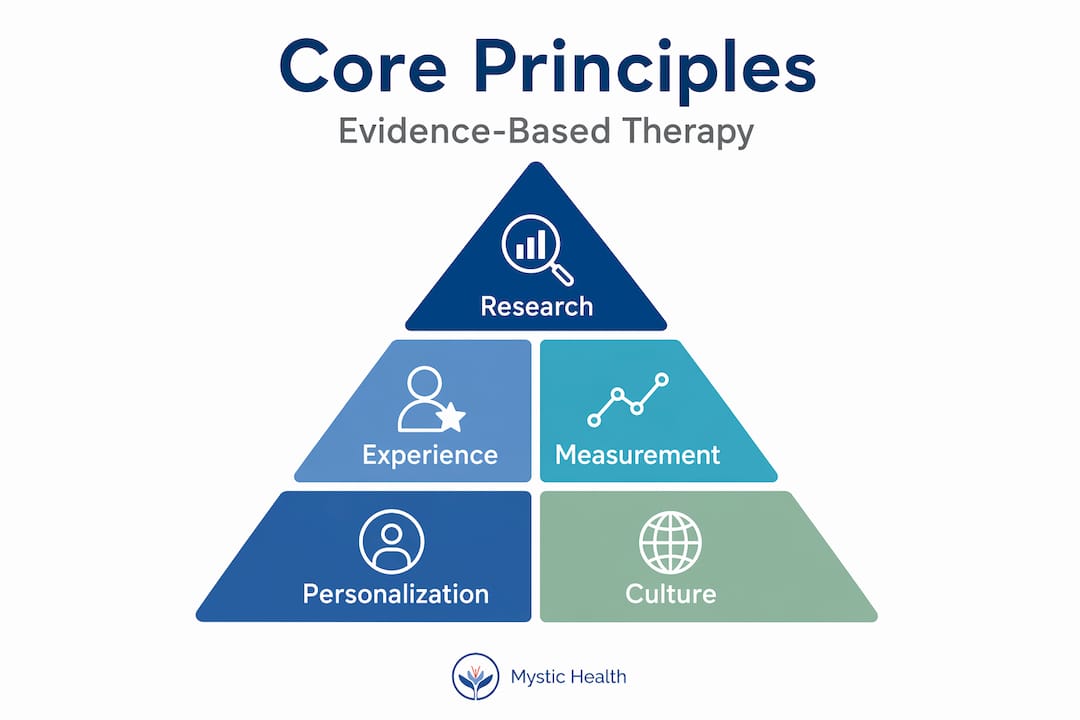
When people hear “evidence-based,” they often picture white lab coats and clinical trials. But the reality is more human than that. Evidence-based therapy means selecting and delivering mental health interventions using the best available research evidence, while also incorporating clinician judgment and the client’s preferences and cultural context. That’s a three-part foundation, and all three parts carry equal weight.
Think of it as a three-legged stool. Research evidence gives you the science. Clinician expertise gives you the wisdom of experience. Client values give you the person in the room. Remove any one leg, and the whole thing becomes unstable. This is why evidence-based therapy can look quite different from one person to the next, even when the underlying framework is the same.
Here’s what the three pillars actually look like in practice:
- Research evidence: Findings from peer-reviewed studies, meta-analyses, and clinical trials showing what interventions tend to reduce suffering for a given condition.
- Clinician expertise: A therapist’s professional training, years of experience, pattern recognition across many clients, and ethical judgment about when to adapt or shift approach.
- Client preferences and culture: Your personal history, spiritual beliefs, cultural background, communication style, and what kind of healing feels meaningful to you.
“Evidence-based practice is not about applying a single rigid treatment to every person. It is about using the best science available as a guide, not a prescription.” — Adapted from APA policy guidance.
A common misunderstanding is that evidence-based automatically means manualized, meaning locked to a specific treatment protocol. In reality, the framework actually supports innovative therapies when they align with the client’s needs and the available science. It’s a living process, not a checklist.
Measurement-based care: How outcomes are tracked and adjusted
Once we know evidence-based therapy relies on best practices, let’s see how your progress is actually measured and optimized. This is where a concept called measurement-based care, or MBC, becomes central.
A core mechanic of evidence-based therapy is ongoing measurement to verify whether treatment is helping and to guide adjustments when it isn’t. MBC means your therapist is not just listening and responding from intuition alone. They are using structured data to understand what’s working, what isn’t, and what needs to shift.
Here’s how the process typically unfolds:
- Baseline assessment: Before or early in treatment, you complete standardized questionnaires that measure symptoms, functioning, and quality of life.
- Ongoing monitoring: At regular intervals — often weekly or biweekly — you complete brief symptom ratings so both you and your therapist can see trends over time.
- Data review: Your therapist reviews the scores, identifies patterns, and flags if progress has stalled or symptoms have worsened.
- Treatment adjustment: If the data shows limited improvement, your therapist adapts the approach. This might mean shifting techniques, increasing session frequency, or integrating an additional modality.
- Collaborative discussion: You and your therapist talk through what the data means, which keeps you active and informed in your own healing process.
Common tools include the PHQ-9 for depression, the GAD-7 for anxiety, and the PCL-5 for PTSD symptoms. These aren’t just bureaucratic checkboxes. They give you and your therapist a shared language for tracking real shifts in your inner world.
| Tool | What it measures | How often used |
|---|---|---|
| PHQ-9 | Depression severity | Weekly or biweekly |
| GAD-7 | Generalized anxiety | Weekly or biweekly |
| PCL-5 | PTSD symptoms | Before and during treatment |
| WHODAS 2.0 | Overall functioning | Monthly or at key milestones |
What about edge cases? Not every experience fits neatly into a scale. For someone whose distress is deeply tied to grief, spiritual crisis, or cultural trauma, standard metrics may not capture the full picture. That’s where integrative mental health approaches matter — they recognize that data is a guide, not the whole truth.
Pro Tip: At your first session, ask your therapist which outcome measures they use and how often you’ll review results together. This simple question signals that you’re an engaged partner in your care, and it opens the door to more personalized, responsive treatment.
Comparing therapy approaches: Evidence strength and personalization
Measurement informs which approaches work, but how are therapies actually compared and picked for specific needs?
Different conditions have different evidence landscapes. For PTSD and trauma, for example, guideline-based evidence identifies specific psychotherapy approaches as leading options while still emphasizing personalization and broader clinical context. Cognitive Processing Therapy (CPT), Prolonged Exposure (PE), and Trauma-Focused Cognitive Behavioral Therapy (TF-CBT) are among the most robustly supported by research for trauma-related conditions.
But calling any single approach the “gold standard” gets complicated quickly. Context matters enormously. A veteran with combat trauma has different needs than a survivor of childhood neglect, even if both carry a PTSD diagnosis. What the research calls “most effective on average” may not align with what is most effective for you specifically.
Here’s a simplified comparison of how some approaches stack up:
| Therapy | Primary evidence base | Best suited for | Personalization flexibility |
|---|---|---|---|
| Cognitive Processing Therapy | Strong RCT evidence | PTSD, trauma beliefs | Moderate |
| Prolonged Exposure | Strong RCT evidence | Avoidance-based PTSD | Moderate |
| EMDR | Strong evidence | Trauma, complex PTSD | High |
| Ketamine-assisted psychotherapy | Growing evidence | Treatment-resistant depression, PTSD | High |
| Mindfulness-based approaches | Broad evidence base | Anxiety, depression, chronic pain | Very high |
“The science tells us what tends to help most people. The art of therapy is figuring out what helps this person, right now, in this room.” — A principle shared across integrative clinical settings.
This is why clinical judgment is so essential. A therapist who only follows guidelines mechanically may miss the signals that a different approach, or a blended one, would serve you better. The following factors all influence which therapy is selected:
- Severity and type of symptoms
- Previous treatment history and what helped before
- Cultural and spiritual background
- Specific goals you’ve named for yourself
- Practical factors like session availability and cost
Evidence-based therapy respects all of these variables. It doesn’t override them.
Integrating holistic goals and cultural preferences in evidence-based care
Personalization means honoring what matters to you, so how does evidence-based therapy actually allow for holistic and cultural aims?
This is the part that surprises many people most. As APA guidance clarifies, “evidence-based” does not mean “only one manualized technique.” In well-established frameworks, it means the overall treatment plan is chosen and adjusted using research evidence plus clinical judgment and the client’s preferences and culture. That leaves real room for holistic goals to be central rather than peripheral.
What does that look like? It might mean:
- Incorporating mindfulness or meditation practices alongside trauma processing sessions
- Honoring cultural rituals or community healing frameworks as part of your recovery
- Including somatic or body-based practices for clients who struggle to access healing through talk alone
- Integrating spiritual goals, such as reconnecting to a sense of meaning or transcendence, into the treatment plan
- Building lifestyle changes, like sleep hygiene, movement, and nutrition, into the therapeutic framework
Therapists who practice in holistic approaches to mental health understand that you are not just a collection of symptoms. You are a whole person with a history, a body, a community, and a spiritual life. Evidence-based care, done well, holds all of that.
The holistic therapy benefits that people often describe — feeling seen, feeling safe, feeling like the therapy reflects their actual life — come directly from this integration. And research increasingly supports whole-person models. Studies on integrative therapy show that when clients feel their values are respected, they stay in treatment longer and report better outcomes.

Pro Tip: Before your first session, write down two or three values or goals that feel sacred to you — whether spiritual, cultural, or lifestyle-based. Share these early with your therapist. A skilled clinician will find ways to weave them into your care plan, not work around them.
If you’re exploring what support looks like beyond the clinical setting, that exploration can complement and enrich your therapeutic journey.
Debates and evolving definitions: What counts as “evidence-based”?
With holistic goals and personalization in mind, let’s examine why “evidence-based” is a moving target and what it means for your choices.
This is an area of genuine, ongoing debate in the mental health field. There is active debate about how broadly “evidence-based” should be defined and whether therapist judgment and patient values should be integrated beyond strictly “empirically supported treatments.” On one side, some researchers argue for strict hierarchies where only randomized controlled trials count as real evidence. On the other, clinicians and patient advocates point out that real-world therapy rarely resembles a controlled lab setting.
A contrasting viewpoint worth holding is that trial-based hierarchies can lead to debates about “gold standard” status, with questions about replicability, researcher bias, and whether effect sizes in controlled trials translate to real-world settings. A therapy that works beautifully for a homogeneous sample in a university study may perform very differently in a community mental health clinic serving people with layered trauma, poverty, and systemic stress.
Here’s what the debate actually means for you as a client:
- You don’t have to choose between “scientific” and “holistic.” The best care integrates both.
- Ask your therapist how they stay current with research, and how they balance that with individual judgment.
- Be cautious of any approach that claims to be the only evidence-based option for your condition.
- Look for therapists who can articulate why they’re choosing a particular approach for you specifically.
- Recognize that “evidence-based” is not a fixed label but an ongoing commitment to learning, questioning, and adapting.
The field is moving. Definitions are expanding. And that’s actually good news for anyone seeking care that honors the full complexity of who they are.
Going beyond the manual: A whole-person approach to evidence-based care
Here’s my honest take, shaped by what we see and believe at Mystic Health. Reducing evidence-based practice to protocol-following is one of the most limiting things the mental health field has done to itself. When a therapist becomes so focused on fidelity to a manual that they stop truly seeing the person in front of them, the evidence stops mattering. Because the evidence was always supposed to serve the person, not the other way around.
What actually produces healing, in our experience, is the combination of rigorous science and deep human attunement. When a client knows their therapist is both tracking real data and genuinely present with their pain, something shifts. Trust forms. The therapeutic relationship becomes a container strong enough to hold even the hardest work.
I’ve seen people come to us who were told their only “evidence-based” option was a 12-week CBT protocol. They felt like they were failing when it didn’t resolve years of complex trauma. But they weren’t failing. They were simply in a program designed for a different kind of problem. When we developed holistic treatment plans that integrated trauma-focused therapy with ketamine-assisted sessions, mindfulness practices, and attention to their cultural and spiritual values, the same people began to experience real movement. Not because we abandoned the evidence, but because we used it more wisely.
My practical advice: advocate for yourself. Ask questions. If a therapist can’t explain why a particular approach fits you, that’s worth exploring. The best evidence-based care is also the most personal.
Explore integrative, evidence-based care with Mystic Health
At Mystic Health, we believe the most effective care lives at the intersection of scientific rigor and whole-person compassion. If reading this has sparked something in you — a recognition, a question, a longing for care that truly fits — we’d love to support your next step.
Our integrative mental health program blends evidence-based modalities with holistic frameworks tailored to your unique needs. Whether you’re curious about our mindfulness course or want to review our clinical evidence for specific treatments, we make it easy to find the path forward. Schedule a consultation and experience what care that honors all of you actually feels like.
Frequently asked questions
Is evidence-based therapy always the same for everyone?
No, evidence-based therapy adapts to individual needs, integrating clinical judgment and client values alongside research evidence, which means your treatment plan is shaped by who you are, not just your diagnosis.
How do therapists track progress in evidence-based therapy?
Therapists use structured tools like symptom scales and regular assessments, as measurement-based care guides treatment adjustments and ensures your care is responding to real changes in your experience over time.
Can holistic goals be part of evidence-based therapy?
Yes, client preferences, culture, and holistic goals can be integrated into evidence-based therapy frameworks, meaning your spiritual, cultural, and lifestyle aims aren’t separate from your clinical care — they can be central to it.
What if strict scientific evidence isn’t available for my needs?
Therapists can use measurement-based care strategies to adapt and personalize approaches even when research evidence is limited, ensuring your progress is still tracked and your care remains responsive and thoughtful.
Recommended

Mystic Health Blog








FAQs
1. Am I eligible for ketamine therapy?
2. Does insurance cover the cost of ketamine therapy?
3. How many ketamine treatments will I need?
We recommend two initial treatments to determine suitability and adjust dosage. After these sessions, additional treatments are available based on your progress and specific requirements.