Mind-body healing: benefits, methods, and integration
TL;DR:
- Mind-body healing involves practices grounded in research that connect mental, emotional, and physical health to promote well-being. It includes methods like meditation, yoga, breathwork, and biofeedback, which can help manage pain, stress, and mood disorders. Evidence shows these approaches are effective as complementary treatments, but they require personalized application and professional guidance.
Most people hear “mind-body healing” and picture someone sitting cross-legged on a yoga mat, burning incense, and calling it therapy. That image does the field a real disservice. The truth is that mind-body practices include a wide range of interventions with measurable, documented outcomes for pain, mood, and overall quality of life. This isn’t philosophy dressed up as medicine. It’s an approach grounded in research, and it’s changing how many of us think about emotional and physical healing. If you’ve been curious but skeptical, this is the guide that will help you decide what’s actually worth exploring.
Table of Contents
- What is mind-body healing?
- Core methods and practices of mind-body healing
- What does the evidence say?
- Real-world considerations: who benefits, what to avoid, and psychedelic integration
- Why mind-body healing is often misunderstood, and what actually matters
- Explore holistic healing programs with expert guidance
- Frequently asked questions
Key Takeaways
| Point | Details |
|---|---|
| Evidence-backed benefits | Mind-body healing can reduce pain, stress, and boost mood for many people. |
| Diverse methods | A variety of practices exist, including meditation, yoga, and breathwork, allowing for personalized healing journeys. |
| Know the limits | Not everyone is suited for all techniques, and serious mental health issues require medical supervision. |
| Integration is key | Combining mind-body healing with conventional and, when appropriate, psychedelic therapies can enhance emotional and spiritual growth. |
What is mind-body healing?
Mind-body healing refers to practices and therapies that work with the connection between your mental, emotional, and physical states to promote health and well-being. It’s not about choosing your mind over your body, or vice versa. It’s recognizing that the two are inseparable, and that what happens in one always affects the other.
Think about how grief can cause chest tightness, or how a stressful meeting leaves your shoulders knotted for hours. These aren’t coincidences. Your nervous system, immune system, and emotional brain are in constant conversation. When you ignore that conversation, healing stays incomplete. When you engage it, something shifts.
“The body keeps the score,” as trauma researchers have put it for decades. Healing that skips the body leaves a chapter unread.
Exploring integrative healing practices shows just how wide the spectrum really is. Mind-body healing isn’t “just meditation.” It includes somatic therapies, biofeedback, breathwork, guided imagery, and much more. It’s especially relevant for people seeking holistic mental or emotional wellness, those living with chronic conditions, and anyone who feels that conventional approaches alone haven’t been enough.
A few common misconceptions are worth addressing directly:
- It’s not a rejection of medical care. Most practitioners use it alongside conventional treatment.
- It’s not one-size-fits-all. What works for anxiety may differ from what helps chronic pain.
- It’s not exclusively spiritual, though for many people, spirituality is a meaningful part of the process.
- It does not require any specific belief system to be effective.
Once you understand what mind-body healing actually is, the variety of methods available starts to make a lot more sense.
Core methods and practices of mind-body healing
With a clear definition in mind, let’s break down the popular and effective methods you might encounter. The field is broad, and that breadth is actually one of its strengths. Different tools serve different needs.
Common methodologies include meditation, mindfulness, yoga, tai chi, acupuncture, massage, breathwork, guided imagery, biofeedback, and somatic therapies. Each one works through a slightly different pathway, whether that’s the nervous system, breath regulation, movement, or cognitive reframing.
Here’s a quick overview of the most widely used approaches:
- Mindfulness meditation focuses your attention on the present moment without judgment. It’s one of the most studied methods, with strong links to reduced anxiety and improved emotional regulation.
- Yoga combines physical postures, breath control, and meditation. It’s particularly helpful for people managing both physical tension and emotional stress simultaneously.
- Breathwork uses controlled breathing patterns to regulate the nervous system. Techniques like box breathing and holotropic breathwork can shift the body out of a stress response quickly.
- Biofeedback uses real-time data from your body (heart rate, muscle tension, skin temperature) to teach you how to control involuntary physical responses. It’s especially useful for pain management and stress-related conditions.
- Somatic therapy focuses on body sensations as a gateway to processing trauma and emotional pain. It’s a slower, more body-centered approach than traditional talk therapy.
- Guided imagery involves using mental visualization to shift emotional or physical states. Research supports its use for pain, anxiety, and even immune function.
- Tai chi and qigong are gentle movement practices that combine breath, posture, and focus. They’re particularly accessible for older adults or those with physical limitations.
| Method | Best for | Potential risks | Entry difficulty |
|---|---|---|---|
| Mindfulness meditation | Anxiety, stress, depression | Rare emotional discomfort | Low |
| Yoga | Pain, stress, flexibility | Injury if done incorrectly | Low to moderate |
| Breathwork | Trauma, acute stress | Hyperventilation, dissociation | Moderate |
| Biofeedback | Pain, hypertension | Minimal | Moderate |
| Somatic therapy | Trauma, PTSD (with guidance) | Temporary distress | Moderate to high |
| Guided imagery | Pain, surgery prep, anxiety | Minimal | Low |
| Tai chi | Older adults, balance, pain | Minimal | Low |
Understanding the benefits of mindfulness is a great starting point, but don’t let one method define the entire field for you. There are many doorways in.
Pro Tip: Start with the method that feels least intimidating, not the one that seems most “effective.” Consistency matters more than intensity at the beginning. A five-minute breathing practice done daily will outperform a 90-minute yoga class done once a month.
The most important insight here is that variety isn’t confusion. It’s an opportunity. The range of psychological healing methods available means there’s almost certainly an approach that fits your personality, history, and current needs.

What does the evidence say?
Understanding the main methods is important, but how well do they actually work? The data gives us a clear answer, and it’s more encouraging than many skeptics expect.
Research shows significant pain reduction in chronic low back pain (SMD of negative 1.01) and improved quality of life (SMD of negative 0.57), along with reduced depression (Hedges’ g of negative 0.86) and reduced anxiety (Hedges’ g of negative 0.38). These are clinically meaningful effect sizes, not marginal improvements.
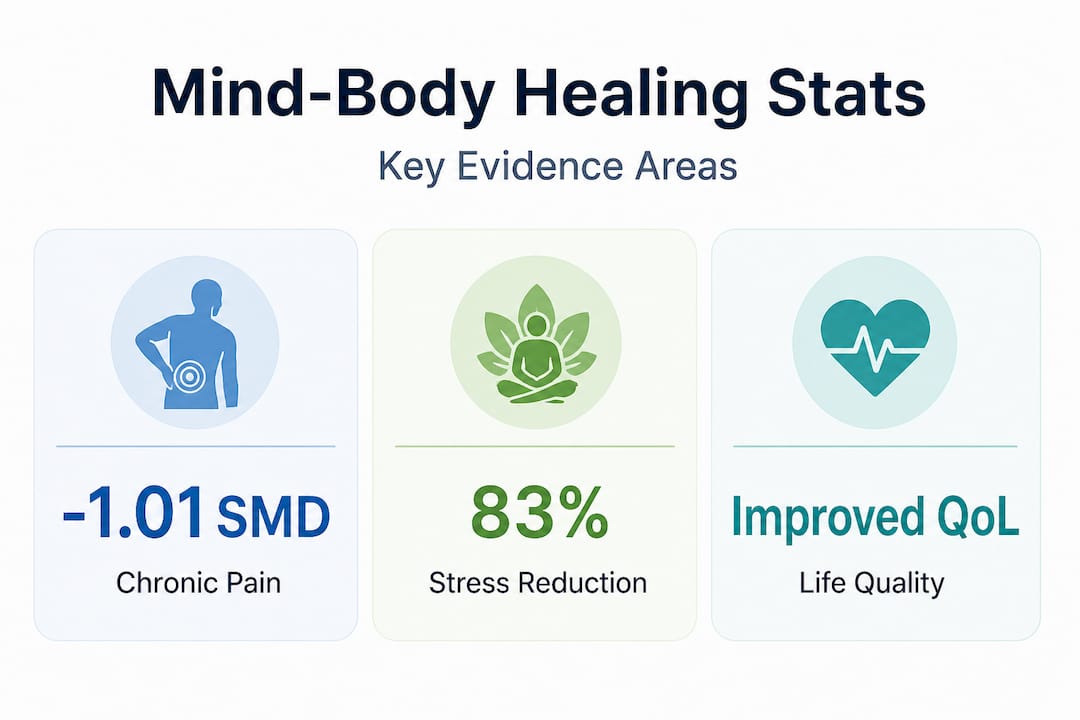
To put that in plain terms: for people with chronic pain, mind-body interventions produced pain reduction comparable to many physical rehabilitation programs. For mood disorders, the effect sizes sit in the moderate to large range, which is significant given how difficult depression and anxiety can be to treat.
| Condition | Outcome | Effect size | Evidence quality |
|---|---|---|---|
| Chronic low back pain | Pain reduction | SMD negative 1.01 | Moderate |
| Chronic low back pain | Quality of life | SMD negative 0.57 | Moderate |
| Depression | Symptom reduction | g negative 0.86 | Moderate |
| Anxiety | Symptom reduction | g negative 0.38 | Moderate |
| Stress-related illness | Cortisol, inflammation | Variable | Promising |
| Multiple sclerosis symptoms | Fatigue, mood | Mixed | Low to moderate |
Where is the evidence strongest? Stress reduction, chronic pain, and inflammation have the most robust support. Depression and anxiety outcomes are promising, but they benefit most when mind-body methods are personalized and applied with clinical awareness of contraindications.
It’s worth being honest about limitations too. Many studies in this field involve small sample sizes, self-reported outcomes, and high variability in how practices are delivered. That doesn’t invalidate the results, but it does mean we should hold the data with some humility. For conditions like multiple sclerosis or autoimmune diseases, the evidence is still developing.
Key takeaways from the research:
- Mind-body healing works best as part of a broader treatment strategy, not in isolation.
- Individual variation is high. What produces dramatic results for one person may produce modest improvement for another.
- The quality of the facilitator matters. A poorly led breathwork session can trigger distress rather than relief.
- Consistency over time produces better results than intensive short-term practice.
Using mindfulness for emotional wounds is one well-supported entry point, especially for those processing grief, loss, or chronic stress. The evidence there is steady and growing.
Real-world considerations: who benefits, what to avoid, and psychedelic integration
The numbers are promising, but no approach is one-size-fits-all. Here’s how to know if mind-body healing is right for you, and when to seek alternative support.
Mind-body healing tends to be a strong fit for people who:
- Are already exploring holistic or body-oriented approaches to health
- Want to address emotional and spiritual dimensions of their well-being, not just physical symptoms
- Are managing chronic stress, mild to moderate depression or anxiety, or chronic pain
- Are looking to support their recovery alongside conventional medical treatment
- Feel disconnected from their bodies after trauma or prolonged illness
- Are curious about mindfulness for cancer healing or other serious illness support
However, there are real situations where caution is necessary. Research clearly indicates that some conditions require special care before engaging in mind-body practices. Acute psychosis, active suicidality, and severe untreated PTSD are red flags. In these situations, certain practices, especially those that heighten body awareness or reduce cognitive defenses, can temporarily intensify distress rather than relieve it.
That’s not a reason to avoid mind-body healing entirely. It’s a reason to involve a qualified professional from the start.
Mind-body healing also fits naturally alongside psychedelic-assisted therapy, which is an area we work with closely at Mystic Health. Somatic processing, breathwork, and mindfulness can help prepare someone for a ketamine session and support the integration period afterward. They offer tools for processing what surfaces during these experiences. The NCCIH notes that while direct evidence linking mind-body practices to psychedelic integration is still limited, their role in supporting emotional and spiritual processing is well-established.
It’s also worth acknowledging an important contrasting view: mind-body approaches work best as complements to medical care, not replacements. Their benefits are sometimes comparable to cognitive behavioral therapy (CBT), which is encouraging, but high heterogeneity across studies means we should avoid overgeneralizing.
A safety checklist before starting:
- Talk to your doctor or mental health provider before beginning any new practice.
- Disclose any history of trauma, psychosis, or significant psychiatric conditions.
- Start slowly. Intensity should build gradually, not immediately.
- Choose practitioners with verifiable credentials and experience in clinical or therapeutic settings.
- Notice how you feel after sessions, not just during them. Temporary discomfort is normal; persistent distress is a signal to pause.
Pro Tip: If you’re considering combining mind-body practices with ketamine-assisted therapy or another psychedelic modality, discuss this explicitly with your care team. Integration isn’t something to navigate alone, and a skilled guide makes a measurable difference in how safely and deeply the process unfolds.
Why mind-body healing is often misunderstood, and what actually matters
With benefits, limitations, and integration in mind, let’s look deeper at why mind-body healing is so frequently misunderstood, and what truly makes it work.
Here’s what I’ve seen again and again: people approach mind-body healing looking for relaxation or a spiritual experience, and they miss the deeper mechanism entirely. Yes, these practices can be deeply calming. Yes, they can open spiritual dimensions. But reducing them to either of those outcomes is like calling surgery “a good nap.” It undersells what’s actually happening.
The real power of mind-body healing is precision. It’s about learning to read your own system, noticing where tension lives in your body, where grief has set up residence in your chest, where old fear is still running the show in your nervous system. That’s not woo. That’s neuroscience applied with care and attention.
What most guides get wrong is ignoring the nuance of fit. They present these practices as universally beneficial, as though any person at any stage of their healing could simply pick up a meditation app and transform. That’s not honest, and it sets people up for disappointment. The truth is that matching the right practice to the right person at the right moment in their healing is both an art and a science.
The practices that changed my understanding weren’t the most dramatic ones. They were the quiet, consistent ones. The breathwork session that helped me notice how I was holding my breath during conflict. The somatic check-in that revealed I’d been carrying grief in my hips for years without knowing it. Small moments, big awareness.
The practical healing steps that actually stick are the ones built around your specific history, your nervous system, your readiness. That’s the thing most people aren’t told upfront. Healing isn’t linear, and it isn’t generic.
Awareness, evidence, and personalization are what drive real-world results. Not intensity. Not the most exotic practice. Not the longest retreat. Just the right approach, held with honesty and sustained attention over time.
Explore holistic healing programs with expert guidance
If this article has opened something in you, or if you’ve been sitting with questions about where to start, you don’t have to figure it out alone.
At Mystic Health, we believe healing works best when it’s personalized, evidence-informed, and held within a compassionate clinical environment. Our integrative mental health services bring together the best of what the research supports, including mindfulness-based approaches, somatic therapies, and psychedelic-assisted modalities for those who may benefit. If you’re new to this path, our featured mindfulness course offers a structured, accessible entry point. And if you’re ready to see what a full healing program might look like for you, we invite you to explore our programs and take that first step.
Frequently asked questions
Is mind-body healing scientifically proven?
Yes, current research supports mind-body healing for pain, stress, and mood, with significant clinical effect sizes documented for chronic pain and depression, though some areas still need more rigorous study.
Can mind-body healing replace my current medications or therapy?
No. These approaches are most effective as complements to medical or psychiatric care, and the evidence supports using them alongside, not instead of, established treatments.
What are the main risks of mind-body healing practices?
Some practices may trigger temporary emotional discomfort, and they are not suitable for everyone, particularly those with acute psychosis, severe PTSD, or active suicidality. Always consult a healthcare provider first.
How do I start with mind-body healing?
Begin with an accessible practice like mindfulness breathing or gentle yoga, and connect with a qualified practitioner who can help you tailor the approach to your specific history and needs.
Recommended

Mystic Health Blog








FAQs
1. Am I eligible for ketamine therapy?
2. Does insurance cover the cost of ketamine therapy?
3. How many ketamine treatments will I need?
We recommend two initial treatments to determine suitability and adjust dosage. After these sessions, additional treatments are available based on your progress and specific requirements.