Integrative therapy: Personalized approaches for holistic mental health
TL;DR:
- Integrative therapy combines techniques from multiple approaches for personalized, flexible healing.
- It is guided by four core models ensuring coherent, whole-person care tailored to complex needs.
- Success depends on therapist expertise, ongoing learning, and careful outcome monitoring.
Many people assume therapy means picking one approach and sticking with it. You see a therapist, they use cognitive behavioral therapy (CBT), and that’s that. But healing rarely works in a straight line, and neither should treatment. from multiple theoretical orientations, tailored to your unique needs. It’s not a single method. It’s a living, breathing approach that grows with you. In this article, we’ll clear up the most common misconceptions, walk through the foundational models and techniques, and show you why integrative therapy may be the most honest reflection of how healing actually happens.
Table of Contents
- How integrative therapy differs from traditional therapy
- Four models behind integrative therapy
- Key techniques used in integrative therapy
- Holistic and mind-body benefits of integrative therapy
- Nuances, challenges, and evolving perspectives
- The reality behind integrative therapy: What most guides miss
- Next steps: Connect with integrative therapy resources
- Frequently asked questions
Key Takeaways
| Point | Details |
|---|---|
| Flexible therapeutic approach | Integrative therapy blends multiple evidence-based methods to meet your unique mental health needs. |
| Wide range of techniques | Therapists can draw from cognitive, behavioral, humanistic, psychodynamic, and somatic practices. |
| Holistic healing potential | Mind, body, emotions, relationships, and spirituality are all addressed within integrative frameworks. |
| Expertise is critical | Success with integrative therapy depends on finding a therapist trained in combining methods effectively. |
| Emerging applications | Psychedelic-assisted and mind-body therapies are becoming part of integrative approaches, with ongoing research. |
How integrative therapy differs from traditional therapy
Traditional therapy often means one orientation. A therapist trained in psychoanalysis uses psychoanalytic tools. A CBT therapist uses CBT. That structure works well for some people. But life is complicated, and most people walk into therapy carrying more than one kind of pain.
Integrative therapy takes a different path. As research confirms, it’s distinguished by combining methods from different schools, not just one. That means your therapist can draw from CBT, mindfulness, somatic work, and humanistic approaches all within the same treatment plan, depending on what you need most.
Here’s what makes that meaningful in practice:
- Personalization: Your history, personality, and goals shape the methods used, not the other way around.
- Flexibility: As you grow and change, the approach adapts with you.
- Broader reach: One method rarely addresses every layer of trauma, anxiety, or emotional pain.
- Reduced dropout: Clients who feel seen and heard tend to stay engaged in treatment longer.
Compare the two approaches side by side:
| Feature | Traditional therapy | Integrative therapy |
|---|---|---|
| Methods used | Single orientation | Multiple, blended approaches |
| Flexibility | Fixed | Adapts to client needs |
| Personalization | Limited | High |
| Best for | Specific, defined concerns | Complex or layered challenges |
| Therapist training | Specialized | Broad and ongoing |
A common misconception is that integrative therapy is just “trying different things” without structure. That’s not accurate. The role of integrative therapy is grounded in theory and clinical reasoning. Each choice a therapist makes is intentional, not random. The goal is coherent, whole-person care.
Now that you know integrative therapy breaks the mold, let’s look at the foundational models it draws from.
Four models behind integrative therapy
Integrative therapy isn’t one thing. It’s shaped by four major frameworks, and understanding them helps you see how thoughtful the process really is.
Four primary models guide integrative practice: common factors, technical eclecticism, theoretical integration, and assimilative integration. Each one reflects a different philosophy about how and why therapy works.
- Common factors: This model focuses on the elements shared across all effective therapies, like the therapeutic alliance, empathy, and a sense of hope. The relationship between you and your therapist is treated as the core healing agent.
- Technical eclecticism: Here, therapists select specific techniques from different approaches based on what the evidence suggests works for your particular situation. It’s practical and data-informed.
- Theoretical integration: This model blends two or more complete theoretical systems into a new framework. For example, combining psychodynamic insight with behavioral strategies creates something greater than either alone.
- Assimilative integration: A therapist works primarily from one orientation but intentionally borrows techniques from others when needed. It’s a more structured form of flexibility.
| Model | Core focus | Best used when |
|---|---|---|
| Common factors | Relationship and shared elements | Building trust and engagement |
| Technical eclecticism | Evidence-based technique selection | Targeting specific symptoms |
| Theoretical integration | Blending full frameworks | Complex, layered presentations |
| Assimilative integration | One base, selective additions | Therapist has a primary specialty |
Therapists choose between these models based on their training, the client’s needs, and the nature of the presenting concerns. Integration in mental health care is not about throwing everything at the wall. It’s about knowing which tools to reach for and why.
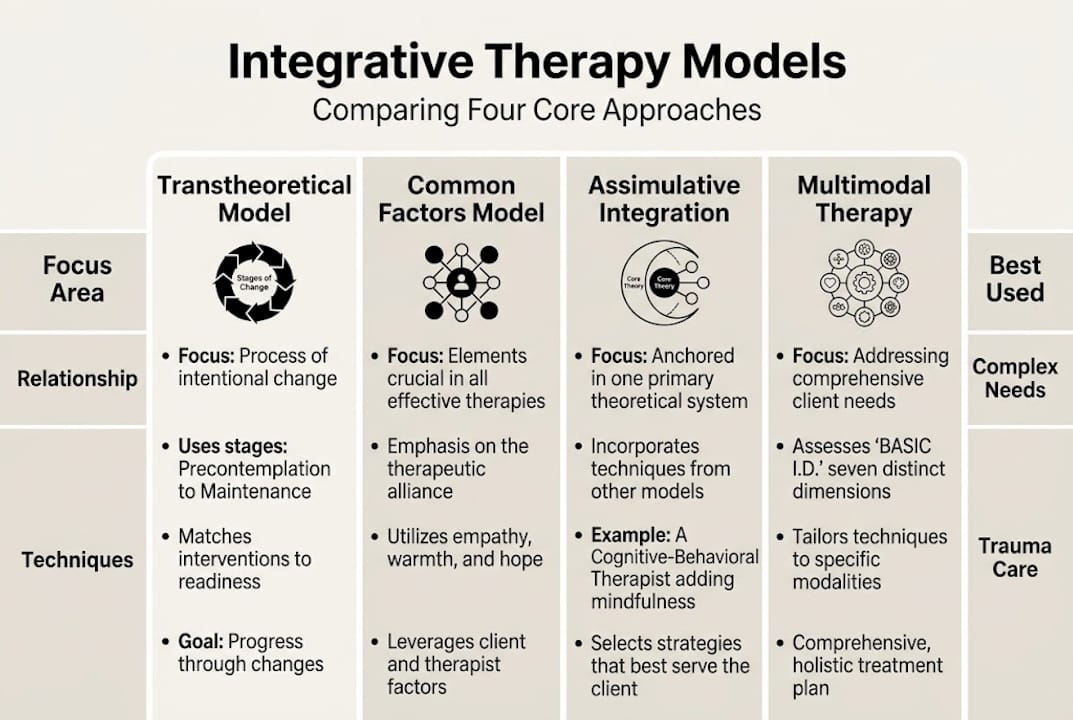
Pro Tip: If you’re dealing with complex trauma, grief, or co-occurring conditions, ask your therapist which integration model guides their work. Their answer tells you a lot about how thoughtfully they’ll approach your care.
With these models in mind, it’s crucial to understand the wide array of techniques available to integrative therapists.
Key techniques used in integrative therapy
Techniques are where the theory becomes real. Integrative therapists draw from a rich toolkit, and the selection is always guided by your specific needs, not habit or convenience.
Common techniques include cognitive restructuring, exposure therapy, mindfulness practices, psychodynamic exploration, behavioral activation, somatic (body-focused) practices, and person-centered elements. That’s a wide range, and each one serves a different purpose.
Here’s how some of these show up in real sessions:
- Cognitive restructuring: Identifying and shifting unhelpful thought patterns, especially useful for anxiety and depression.
- Somatic practices: Noticing and working with body sensations to process trauma stored physically, not just mentally.
- Mindfulness: Building present-moment awareness to reduce reactivity and emotional overwhelm.
- Psychodynamic exploration: Looking at early experiences and unconscious patterns that still shape current behavior.
- Behavioral activation: Gently increasing engagement with meaningful activities to lift mood and restore motivation.
“The most effective therapy isn’t the most complex one. It’s the one that meets you where you are.”
These techniques apply across settings too. Individual therapy, group therapy, and family sessions can all benefit from integrative methods. If you’re exploring mindfulness integration or want to understand your full range of therapy program options, the variety is genuinely encouraging.
For those drawn to newer modalities, psychedelic-assisted therapy is increasingly being explored within integrative frameworks. A thoughtful psychedelic healing conversation with a trained clinician can help you understand how these approaches fit within a personalized plan.
Pro Tip: Before starting with any integrative therapist, ask directly about their training in specific techniques. A good integrative therapist should be able to explain not just what they use, but why they’d use it for someone like you.
Understanding techniques naturally leads us to the holistic benefits integrative therapy offers.
Holistic and mind-body benefits of integrative therapy
One of the most meaningful things about integrative therapy is how far it reaches. It doesn’t just address symptoms. It addresses you, the whole person.

Integrative therapy is effective for anxiety, depression, trauma, stress, and more, offering holistic benefits by addressing mind, body, emotions, relationships, and spirituality. That’s not a marketing claim. It’s a reflection of how layered human suffering actually is.
Here’s what that looks like across different dimensions of wellness:
- Mental: Reducing cognitive distortions, building emotional regulation, and improving clarity.
- Emotional: Creating space to grieve, process, and feel without being overwhelmed.
- Physical: Somatic and body-focused work helps release tension and trauma held in the body.
- Relational: Attachment-informed and family-systems approaches improve how you connect with others.
- Spiritual: For those who value it, meaning-making and existential exploration are welcomed, not dismissed.
Integrative therapy’s flexibility allows incorporation of mindfulness, somatic, and body-focused elements for holistic healing. This is especially relevant for people drawn to holistic mental health care or those navigating serious illness, grief, or major life transitions.
“Healing doesn’t happen in one dimension. When therapy honors the whole person, something deeper becomes possible.”
People who benefit most from integrative therapy tend to have complex or evolving needs. Those with PTSD layered over depression, or grief complicated by relationship stress, often find that a single-method approach leaves too much unaddressed. The holistic program model gives therapists room to follow the client, not the protocol.
If you’re curious about what it means to access your own capacity for resilience, exploring your inner superpower through integrative work is a powerful place to start.
Now that we’ve covered holistic benefits, let’s explore the nuances and challenges for therapists and clients.
Nuances, challenges, and evolving perspectives
Integrative therapy is not without its tensions. Knowing the challenges helps you make smarter choices about your care.
to avoid arbitrary mixing. It’s best suited for complex cases and demands ongoing training from the therapist. Without that foundation, “integrative” can become a vague label that masks inconsistent or poorly matched care.
Here are some important distinctions and risks to keep in mind:
- Integrative vs. eclectic: Eclectic therapy mixes techniques without a unifying theory. Integrative therapy has a coherent framework guiding every choice.
- Risk of syncretism: Combining incompatible methods without clinical reasoning can dilute effectiveness or even cause harm.
- Therapist variability: Not all therapists who call themselves integrative have the same depth of training or theoretical grounding.
- Outcome monitoring: Without tracking progress, it’s hard to know whether the blend of methods is actually working for you.
, and integrative approaches are now the most prevalent orientation among therapists. That’s significant. It reflects the field’s honest acknowledgment that one size never fit all.
The rise of modern integrative approaches also signals something hopeful. The field is moving toward pluralism, toward honoring the complexity of human experience rather than forcing it into a single framework.
Pro Tip: Ask your therapist how they monitor your progress over time. If they can’t describe a clear method for tracking outcomes and adjusting the approach, that’s worth exploring further before committing to a treatment plan.
With nuance and challenges covered, let’s step back for an honest perspective on what integrative therapy means outside theory.
The reality behind integrative therapy: What most guides miss
Most articles about integrative therapy make it sound clean and straightforward. Pick a model, blend some techniques, and healing follows. The reality is messier, and that’s okay.
What I’ve seen, and what the research reflects, is that integrative therapy mirrors psychotherapy’s evolution toward pluralism, but more research is still needed, especially for emerging protocols like psychedelic integration. That gap matters. It means clients and clinicians need to hold both hope and humility at the same time.
The biggest thing most guides miss is this: the quality of integrative therapy depends almost entirely on the therapist’s ongoing education and self-awareness. A framework is only as good as the person applying it. Therapists who stop learning stop growing, and their clients feel it.
For those of us drawn to latest integrative trends, including psychedelic-assisted care, the invitation is to stay curious and ask hard questions. Integrative therapy, done well, is one of the most honest forms of care available. Done poorly, it’s just a label. You deserve the real thing.
Next steps: Connect with integrative therapy resources
If this resonated with you, you don’t have to figure out the next step alone. Healing is rarely a solo journey, and finding the right support makes all the difference.

At Mystic Health, we offer integrative therapy programs designed around your whole person, not just your symptoms. Whether you’re exploring mind-body approaches, navigating trauma, or curious about innovative care, our integrative mental health clinic brings together evidence-based methods with deep compassion. You can also explore our mindfulness course for therapy as a gentle starting point. We’re here when you’re ready.
Frequently asked questions
Is integrative therapy evidence-based?
Yes, integrative therapy relies on evidence-based techniques tailored to individual needs, though outcome variability means ongoing monitoring is essential to ensure the approach is working for you.
Does integrative therapy include psychedelic-assisted treatments?
Integrative therapy can incorporate mindfulness and somatic elements aligned with holistic healing, and emerging research is exploring psychedelic-assisted innovations, though these protocols are still being developed and benchmarked.
Who should seek integrative therapy?
Integrative therapy is best suited for people with layered or complex needs, offering holistic benefits across mind, body, emotions, relationships, and spirituality for those seeking personalized, whole-person care.
Is there a difference between integrative and eclectic therapy?
Yes. Integrative vs. eclectic therapy comes down to framework: integrative therapy uses a coherent theoretical foundation to guide technique selection, while eclectic therapy mixes methods more pragmatically without that unifying structure.
How do I find a qualified integrative therapist?
Look for therapists with documented training in evidence-based integration who can explain how they personalize treatment and track your progress over time, since expertise and ongoing education are what separate quality integrative care from a vague label.
Recommended

Mystic Health Blog








FAQs
1. Am I eligible for ketamine therapy?
2. Does insurance cover the cost of ketamine therapy?
3. How many ketamine treatments will I need?
We recommend two initial treatments to determine suitability and adjust dosage. After these sessions, additional treatments are available based on your progress and specific requirements.