Why Support for Cancer Care Matters to Patients
TL;DR:
- Support for cancer care encompasses emotional, practical, financial, and psychosocial resources needed throughout diagnosis and treatment. Recognizing and integrating this support improves treatment adherence, emotional well-being, and can even increase survival by activating health-modulating pathways. Mental health and caregiver programs are essential, with resources available to address unmet needs across all domains.
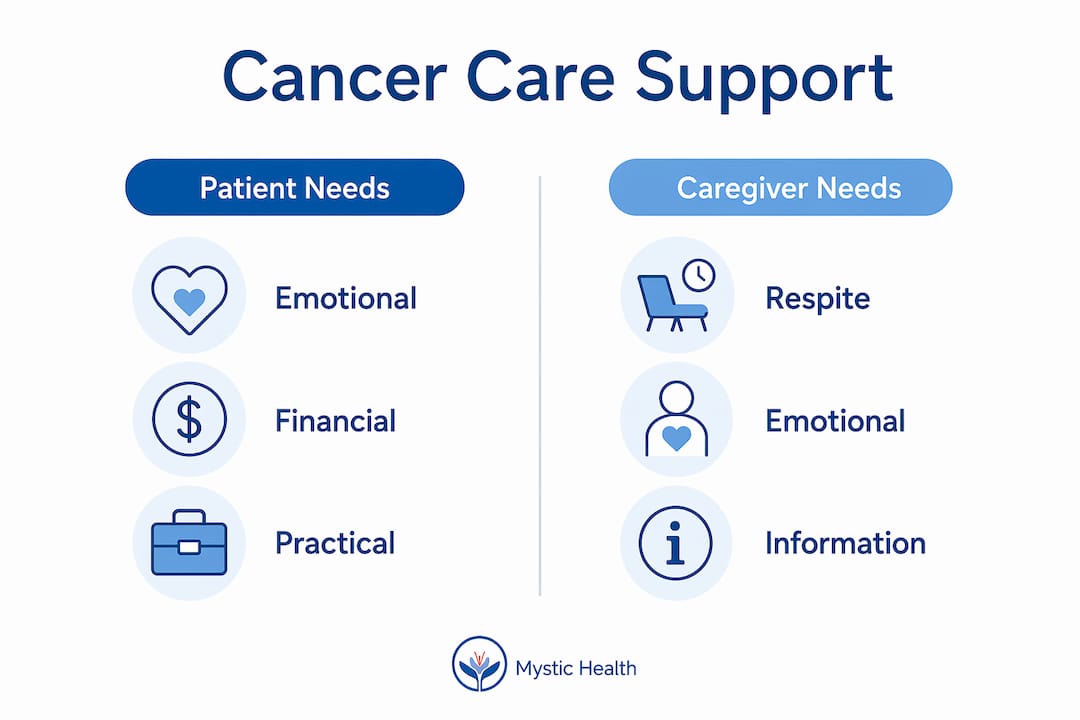
Support for cancer care is defined as the full network of emotional, practical, financial, and psychosocial resources that patients, survivors, and caregivers need throughout every stage of a cancer diagnosis. The WHO frames supportive care as essential to any cancer program, not a secondary concern. Without it, patients face treatment with fewer coping tools, less information, and no buffer against the psychological weight of a life-altering illness. The importance of cancer support has never been clearer, and the evidence behind it has never been stronger.
Why support for cancer care is more than emotional comfort
Most people think of cancer support as a kind word or a hand to hold. The reality is far broader. Unmet supportive care needs span emotional, informational, and practical domains, and they are common across patients, survivors, and caregivers alike. A 2026 cross-sectional survey involving 62 patients, 86 survivors, and 60 caregivers found overlap indices above 0.90 between patient and caregiver unmet needs. That number tells you something important: the person sitting in the waiting room is carrying nearly as much as the person receiving treatment.

Patients in active treatment report the highest unmet needs, but survivors are not free from them either. The transition out of active treatment can feel disorienting, even frightening, because the structure of appointments and clinical contact disappears. Survivors often describe a loss of safety net. Caregivers, meanwhile, are frequently invisible in traditional care models, their needs unaddressed because the system is designed to focus on the patient alone.
The benefits of cancer care extend to everyone in the room. Recognizing this is the first step toward building support systems that actually work.
Common unmet needs across patients and caregivers
- Emotional needs: Fear of recurrence, anxiety, grief, and depression are reported consistently across all groups
- Informational needs: Gaps in understanding treatment options, side effects, and what to expect after active care ends
- Practical needs: Transportation, childcare, household management, and financial planning
- Psychological needs: Coping strategies, identity shifts, and relationship strain
- Spiritual needs: Questions of meaning, purpose, and legacy that medical teams rarely address
Pro Tip: If you are a caregiver, ask your loved one’s oncology team directly whether your needs are part of the care plan. Many teams will add caregiver check-ins once they know you want them.
How does cancer support improve health outcomes?
Supporting cancer patients is not just about quality of life. It is about survival. A 2026 meta-analysis in Communications Psychology, drawing on 16 randomized controlled trials, found that psychosocial interventions were associated with a median survival increase of approximately 3.9 months compared to standard care alone. That is a meaningful number, and it deserves context: it suggests that addressing the psychological and emotional dimensions of illness may activate health-modulating pathways that purely medical treatment does not reach.
The evidence goes further. A 2026 randomized controlled trial found that structured exercise combined with behavioral support produced hazard ratios of 0.63 for overall survival and 0.72 for disease-free survival in stage 3 colorectal cancer patients. Those figures represent a real reduction in mortality risk. Behavioral medicine, which includes both physical activity and psychosocial support, is not a soft add-on to cancer treatment. It is part of the treatment itself.
Stress reduction and improved coping are likely mediators of these effects. When patients feel less alone, they adhere to treatment more consistently, communicate more openly with their care teams, and manage side effects with greater resilience. The WHO’s position is clear: psychosocial support belongs inside comprehensive cancer care, not outside it.
| Support type | Measured outcome |
|---|---|
| Psychosocial interventions | ~3.9-month median survival increase (16 RCTs, 2026) |
| Exercise plus behavioral support | 0.63 hazard ratio for overall survival in colorectal cancer |
| Emotional and coping support | Improved treatment adherence and reduced dropout |
| Financial and practical assistance | Reduced care delays and access barriers |
Pro Tip: When evaluating a cancer care program, ask specifically whether behavioral medicine or psychosocial support is integrated into the treatment plan. If it is not, ask for a referral to a licensed oncology social worker or counselor.
What support services and resources are available?
Knowing that support matters is one thing. Knowing where to find it is another. The good news is that structured resources exist across emotional, financial, and navigational domains. Here is a practical breakdown of what is available and how to access it.
-
Emotional and psychological support: Individual therapy with a licensed counselor who specializes in oncology, group support programs, and peer mentorship networks all provide space to process fear, grief, and uncertainty. Mystic Health offers cancer-specific therapy options that integrate mindfulness, somatic approaches, and evidence-based counseling for patients and families.
-
Financial assistance: CancerCare’s Online Helping Hand is a searchable database covering federal and state programs, pharmaceutical patient assistance programs, and co-pay relief organizations. You can search by diagnosis and zip code, which removes the guesswork from a genuinely overwhelming process.
-
Care navigation: Patient navigators help reduce delays in diagnosis and treatment by coordinating appointments, translating medical information, and connecting patients to community resources. Many major cancer centers now employ dedicated navigators, and some community health organizations offer this service at no cost.
-
Caregiver-specific programs: Organizations like CancerCare offer dedicated caregiver counseling, and some hospital systems have begun integrating caregiver assessments into standard oncology intake. Companion and social support services, including those addressing, can also reduce the emotional burden caregivers carry between clinical visits.
-
Palliative and integrative care: Palliative care is not end-of-life care. It is specialized support for symptom management, emotional well-being, and quality of life at any stage of illness. Mystic Health’s approach to holistic palliative support combines clinical expertise with integrative therapies to address the whole person.
How does integrating caregiver support improve overall care quality?
Caregivers are the hidden backbone of cancer care. They manage medications, coordinate appointments, absorb emotional distress, and often set aside their own health in the process. Research confirms that caregiver unmet needs frequently equal or exceed those of patients, particularly in emotional and practical domains. Yet traditional care models still treat caregivers as bystanders rather than participants.
Dyadic interventions, meaning programs designed to support both the patient and caregiver together, show real promise. When both people in the relationship receive communication tools, coping strategies, and emotional support simultaneously, the quality of their interactions improves. Patients feel less guilty about their burden on loved ones. Caregivers feel seen and equipped rather than invisible and overwhelmed.
The system-level changes needed to make this work are not small. They require:
- Routine caregiver needs assessments at intake and key treatment milestones
- Training for oncology nurses and social workers to recognize caregiver distress
- Inclusion of caregivers in care planning conversations, not just as note-takers but as participants
- Access to respite care and peer support networks specifically designed for caregivers
The need for cancer care advocacy in this area is real. When caregivers burn out, patients lose their most consistent source of support. Protecting caregiver well-being is not a secondary priority. It is a direct investment in patient outcomes.
Key takeaways
Support for cancer care is a clinical necessity, not an optional comfort, because psychosocial and practical interventions directly improve treatment adherence, quality of life, and measurable survival outcomes.
| Point | Details |
|---|---|
| Support is clinically meaningful | Psychosocial interventions are linked to a ~3.9-month median survival increase across 16 RCTs. |
| Caregivers need support too | Caregiver unmet needs mirror patients’ with overlap indices above 0.90, yet most care models ignore them. |
| Financial resources exist | CancerCare’s Online Helping Hand provides searchable financial aid by diagnosis and zip code. |
| Behavioral medicine improves survival | Exercise plus behavioral support reduced mortality risk in stage 3 colorectal cancer patients. |
| Dyadic care models work | Supporting patients and caregivers together improves communication, adherence, and resilience. |
What I’ve learned from watching support change everything
I have sat with patients who arrived at their first session carrying years of unspoken fear. Not fear of dying, necessarily. Fear of being a burden. Fear of losing who they were before the diagnosis. Fear that no one around them could hold the weight of what they were feeling. And I have watched that fear shift, slowly and then all at once, when they finally had a space where they did not have to protect anyone from the truth.
What strikes me most is how often the support piece is treated as a luxury. Families tell me they feel guilty spending time on therapy or support groups when there are medical bills to pay and treatment schedules to manage. I understand that. But the research we now have makes the case plainly: support is not separate from treatment. It is part of it. The evidence on psychosocial interventions does not allow us to keep treating emotional care as optional.
I also want to say something directly to caregivers reading this. You are not just a support person. You are a person who needs support. The fracture that a cancer diagnosis creates runs through the whole family, not just the patient. Showing up for yourself is not selfish. It is what makes it possible to keep showing up for the person you love. Programs that treat the dyad, the patient and the caregiver together, are the ones I believe in most. They reflect how healing actually works.
— Kabir
How Mystic can support you through cancer care
If you or someone you love is navigating a cancer diagnosis, Mystic Health offers integrative mental health and palliative care programs designed to meet you where you are.
Mystic’s approach combines evidence-based therapies, including ketamine-assisted psychotherapy and mindfulness-based interventions, with compassionate clinical support tailored for serious illness. Whether you are managing treatment-related anxiety, processing grief, or looking for ways to support a caregiver in your life, Mystic’s palliative and cancer care programs offer a structured, whole-person path forward. You can also explore Mystic’s full range of integrative care options to find the right fit for your situation.
FAQ
What does support for cancer care actually include?
Support for cancer care includes emotional counseling, financial assistance, care navigation, caregiver programs, and palliative services. The WHO defines it as addressing physical, psychosocial, and spiritual well-being alongside medical treatment.
Can emotional support really affect cancer survival?
A 2026 meta-analysis of 16 randomized controlled trials found that psychosocial interventions were associated with a median survival increase of approximately 3.9 months. The effect is meaningful, though results vary across individual studies.
Why do caregivers need support too?
Caregiver unmet needs closely mirror those of patients, with overlap indices above 0.90 in emotional and practical domains. Unaddressed caregiver burnout directly reduces the quality of care patients receive.
Where can cancer patients find financial help?
CancerCare’s Online Helping Hand is a searchable database covering federal and state programs, pharmaceutical assistance, and co-pay relief organizations, searchable by diagnosis and zip code.
How does exercise fit into cancer support?
Structured exercise combined with behavioral support produced a hazard ratio of 0.63 for overall survival in stage 3 colorectal cancer patients in a 2026 RCT. Physical activity is a recognized component of behavioral medicine in cancer care.
Recommended

Mystic Health Blog







FAQs
1. Am I eligible for ketamine therapy?
2. Does insurance cover the cost of ketamine therapy?
3. How many ketamine treatments will I need?
We recommend two initial treatments to determine suitability and adjust dosage. After these sessions, additional treatments are available based on your progress and specific requirements.