What Is Compassionate Care? Principles and Benefits
TL;DR:
- Compassionate care involves recognizing suffering and actively taking steps to relieve physical and emotional distress. It requires intentional action, not just feelings of empathy, to improve patient outcomes, reduce burnout, and strengthen healthcare relationships. Implementing structured practices and organizational support ensures compassionate care becomes a consistent part of clinical practice.
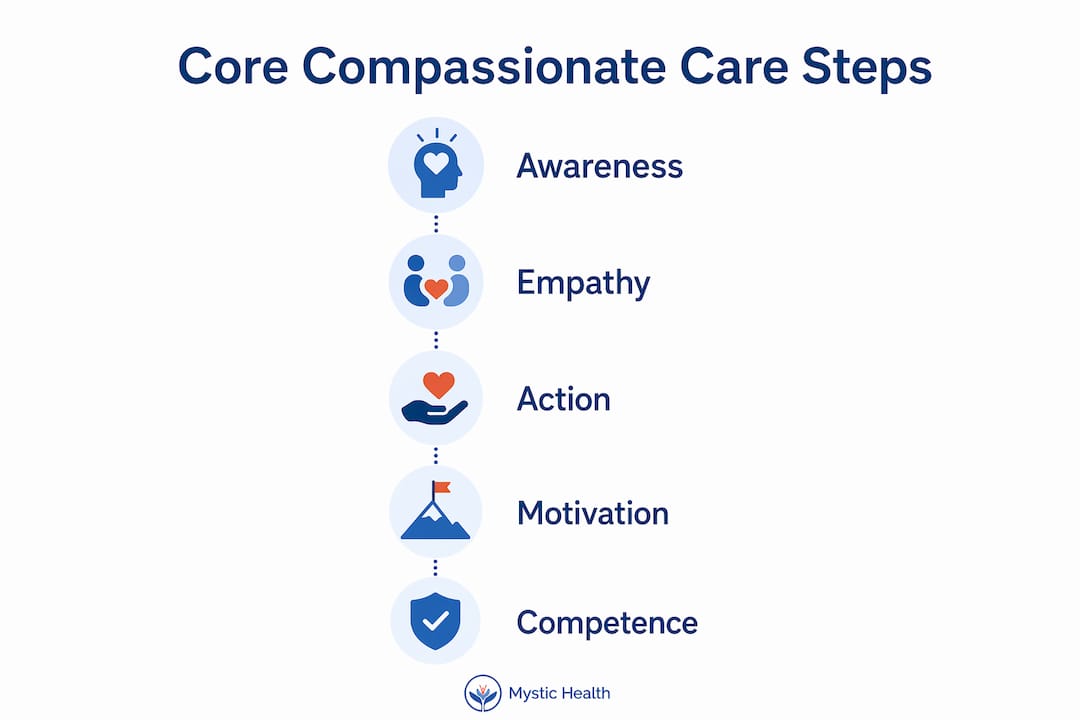
Compassionate care is defined as the active recognition of a patient’s suffering combined with motivated action to relieve both physical and emotional distress through genuine, personalized human connection. The Schwartz Center distinguishes compassion from empathy alone: empathy means feeling what another person feels, while compassion adds the drive to do something about it. The World Health Organization frames this as a three-part process: awareness, empathy, and action. For healthcare professionals, patients, and caregivers, understanding this distinction is the foundation of everything that follows.
What is compassionate care and why does it matter?
Compassionate care is not a soft skill or a personality trait. It is a clinical and ethical practice that shapes patient outcomes in measurable ways. Research confirms that compassionate care improves patient satisfaction, speeds healing, reduces caregiver burnout, and decreases malpractice risk. Those are not small wins. They represent a shift in how we think about what good medicine actually looks like.
The importance of compassionate care becomes clearest when you consider what its absence feels like. Patients who feel unseen, rushed, or treated as a diagnosis rather than a person report lower trust in their providers and worse treatment adherence. The connection between feeling cared for and getting better is not sentimental. It is biological, psychological, and well-documented.
Compassionate care also matters for the people delivering it. Clinicians who practice it with intention report greater meaning in their work. That sense of purpose is one of the strongest buffers against burnout in high-pressure healthcare environments.
What are the core principles of compassionate care?
The WHO positions compassion as a transformative force in primary health care, built on three interlocking elements: awareness of suffering, empathetic understanding of that suffering, and motivated action to address it. Nursing research adds further depth. A hybrid concept analysis from 2025 identifies three domains: cognitive (understanding the patient’s experience), relational (building trust and emotional connection), and behavioral (taking concrete steps to relieve distress).

Two widely used frameworks help organize these principles in practice.
| Framework | Core Elements | Primary Focus |
|---|---|---|
| Schwartz Center Model | Empathy + motivated action, human connection, continuity | Clinician behavior and patient relationship |
| WHO Compassion Model | Awareness, empathy, action | System-level and individual care quality |
| Nursing 6 Cs (UK) | Care, compassion, competence, communication, courage, commitment | Nursing professional standards |
| Nursing 5 Elements Model | Presence, listening, knowing the patient, empathy, action | Relational and behavioral nursing practice |
Each framework arrives at the same core truth: compassion without action is incomplete. The Schwartz Center is explicit that true compassionate care requires what clinicians do, not just what they feel. The WHO goes further, arguing that healthcare systems must be designed to enable clinicians to notice, understand, and act. Without that structural support, compassion stays an attitude rather than a practice.
Pro Tip: If you are a clinician, pick one framework and use it as a personal checklist at the start of each patient interaction. Even 30 seconds of intentional awareness before entering a room changes the quality of connection.
How is compassionate care practiced in clinical settings?
Patients recognize compassionate care through specific, observable behaviors. Nursing research links compassionate care to good communication, emotional presence, respect, and genuine involvement in care decisions. These are not vague qualities. They show up in how a nurse makes eye contact, whether a physician sits down during a conversation, and how a care team responds when a patient expresses fear.
The National Institute for Health and Care Excellence (NICE) maps observable compassionate behaviors for real-world evaluation. Their caring standards include:
- Treating people with kindness and dignity at every interaction
- Responding promptly to expressed needs, including emotional distress
- Promoting patient independence and respecting personal choices
- Providing individualized care rather than standardized protocols
- Using clear, honest communication that invites questions
- Acknowledging uncertainty without abandoning the patient emotionally
These behaviors are learnable. Compassionate care is a moral choice requiring skills and competence. Training improves patient perceptions and care quality. That means compassion is not reserved for naturally warm personalities. It is a practice that any clinician can develop with the right support.
Barriers are real, though. Systematic reviews identify time pressure and inadequate communication infrastructure as the two most common obstacles. When staff feel rushed or unsupported, compassionate behaviors are the first thing to erode. This is why organizational culture matters as much as individual intention.
Pro Tip: Nonverbal communication carries more weight than most clinicians realize. Sitting at eye level, uncrossing your arms, and pausing before responding are small physical shifts that signal genuine presence to a patient.
What are the benefits of compassionate care?
The benefits of compassionate care extend across three levels: the patient, the caregiver, and the healthcare system as a whole.
For patients
Patients who receive compassionate care report higher satisfaction and greater trust in their providers. That trust translates directly into better treatment adherence, more honest symptom reporting, and faster recovery. When patients feel emotionally safe, they share information that changes clinical decisions. A patient who feels judged stays quiet. A patient who feels seen speaks up.
Emotional support in palliative settings shows particularly strong outcomes. Patients facing serious illness or end-of-life care experience measurably lower anxiety and greater peace when their care team treats them as whole people rather than medical cases.
For caregivers
Compassionate care protects the people delivering it. Clinicians who practice intentional compassion report stronger sense of purpose and lower rates of emotional exhaustion. The Schwartz Center’s research shows that consistent human connection is not just good for patients. It sustains the clinician’s own sense of meaning in their work. Compassion fatigue, paradoxically, is more common among those who suppress empathy than those who practice it with clear boundaries.
For healthcare systems
At the organizational level, compassionate care reduces malpractice litigation. Patients are far less likely to sue providers they felt genuinely cared for them, even when outcomes are poor. Institutions that build compassionate cultures also see lower staff turnover and stronger team cohesion. These are not soft outcomes. They have direct financial and operational implications.
Pro Tip: If you are a healthcare leader, track patient satisfaction scores alongside staff wellbeing metrics. The two move together. Improving one almost always improves the other.
How to implement compassionate care effectively
Knowing the principles is one thing. Embedding them into daily clinical practice is another. Here is a practical sequence for healthcare professionals and caregivers who want to make compassionate care a consistent reality rather than an occasional gesture.
-
Start with self-awareness. Reflect on your own emotional state before patient interactions. You cannot offer genuine presence when you are depleted or distracted. Brief mindfulness practices, like those offered through Mystic’s mindfulness program, build the internal capacity needed for sustained compassionate practice.
-
Learn the patient’s story. Ask open-ended questions beyond the clinical checklist. “What worries you most about this?” opens a different conversation than “Do you have any questions?” Knowing the patient as a person, not just a condition, is the cognitive foundation of compassionate care.
-
Pair relational behaviors with concrete symptom goals. Compassionate care advances from abstract ideal to practical therapeutic partnership when emotional connection is tied to specific relief goals. Ask what the patient most wants to feel better about, then build the care plan around that answer.
-
Advocate for organizational support. Individual effort matters, but implementation suffers without adequate time and communication infrastructure. If your workplace culture does not support compassionate practice, name that gap. Push for protected time, communication training, and peer support structures.
-
Build continuity into care relationships. One warm interaction is not compassionate care. Consistent, acknowledging, and responsive communication over time is what patients actually need. Assign consistent care team members where possible and document emotional as well as clinical needs.
-
Invest in ongoing education. Compassionate care skills degrade under pressure without reinforcement. Seek out training programs, reflective practice groups, and resources like patient-centered care strategies that keep the practice alive and grounded in evidence.
The common thread across all these steps is intentionality. Compassionate care does not happen by accident in busy clinical environments. It happens because someone decided it mattered and built habits around that decision.
Key takeaways
Compassionate care is the most direct path from clinical competence to genuine healing, and it requires awareness, empathy, and motivated action working together.
| Point | Details |
|---|---|
| Definition is precise | Compassionate care means recognizing suffering and taking active steps to relieve it, not just feeling empathy. |
| Frameworks guide practice | The Schwartz Center, WHO, and nursing models all confirm that action is what separates compassion from sympathy. |
| Benefits are measurable | Compassionate care improves patient satisfaction, speeds recovery, reduces burnout, and lowers malpractice risk. |
| Barriers are structural | Time pressure and lack of organizational support are the primary obstacles to consistent compassionate practice. |
| Implementation is learnable | Training, self-awareness, and continuity of care relationships are the core tools for embedding compassion into daily practice. |
Why compassionate care changed how i think about healing
I have spent years working at the intersection of mental health, palliative care, and integrative medicine. And the thing that still moves me most is not the technology or the treatment protocols. It is the moment when a patient realizes someone is actually with them in their pain.
Compassionate care is not the same as being nice. I have seen clinicians who were warm and personable but never really showed up for their patients when it mattered. And I have seen others who were quiet and reserved but whose patients felt deeply held. The difference was always intention and action, not personality.
What I have learned is that compassion requires a kind of courage. You have to be willing to sit with someone’s suffering without rushing to fix it or minimize it. That is harder than it sounds in a healthcare system that rewards speed and efficiency. The pressure to move on is constant. Choosing to stay present anyway is a decision you make over and over, every single day.
The other thing I want to say is this: compassionate care protects you too. When you show up fully for your patients, you remember why you chose this work. That memory is what keeps you going when the system makes it hard. It is not a luxury. It is a form of professional survival.
— Kabir
How Mystic brings compassionate care to life
Mystic was built on the belief that real healing requires more than a diagnosis and a prescription. Every program at Mystic, from integrative mental health care to ketamine-assisted psychotherapy and palliative support, is designed around the principles explored in this article: awareness, empathy, and motivated action toward whole-person relief.
If you or someone you care for is navigating serious illness, treatment-resistant depression, or end-of-life challenges, Mystic’s care programs offer a space where compassion is not an afterthought. It is the foundation. Explore what personalized, evidence-based compassionate care looks like in practice, and take the first step toward a different kind of healing.
FAQ
What does compassionate care mean in healthcare?
Compassionate care means recognizing a patient’s suffering and taking active, personalized steps to relieve both physical and emotional distress. The Schwartz Center defines it as empathy plus motivated action, distinguishing it from empathy alone.
How is compassionate care different from empathy?
Empathy is the ability to feel or understand another person’s experience. Compassionate care goes further by requiring a behavioral response, meaning clinicians must act on that understanding to address the patient’s needs.
What are the main principles of compassionate care?
The WHO identifies awareness, empathy, and action as the three core principles. Nursing frameworks add cognitive understanding, relational trust-building, and behavioral symptom relief as equally important domains.
What are the benefits of compassionate care for patients?
Patients who receive compassionate care report higher satisfaction, greater trust in providers, better treatment adherence, and faster recovery. In palliative settings, emotional support also reduces anxiety and improves quality of life.
How can caregivers implement compassionate care daily?
Caregivers can practice compassionate care by learning each patient’s personal story, pairing emotional presence with concrete symptom goals, and building continuity into care relationships over time rather than relying on isolated gestures.
Recommended

Mystic Health Blog








FAQs
1. Am I eligible for ketamine therapy?
2. Does insurance cover the cost of ketamine therapy?
3. How many ketamine treatments will I need?
We recommend two initial treatments to determine suitability and adjust dosage. After these sessions, additional treatments are available based on your progress and specific requirements.