What Is Grief Counseling? A Guide to Integrative Care
Grief counseling is a professional, evidence-informed service where licensed clinicians provide a safe, nonjudgmental space to help you process loss, develop coping strategies, and rebuild daily functioning. It isn’t about rushing you past your pain. It’s about giving you room to carry it differently.
At its core, grief counseling aims to:
- Help you accept the reality of what happened
- Process painful emotions without being overwhelmed by them
- Rebuild a sense of purpose and daily rhythm
- Maintain a continuing bond with what you’ve lost, without being frozen by it
Sessions can be individual, group, or family-based. At specialty integrative clinics, the care may also include supervised psychedelic-assisted sessions, such as ketamine-assisted psychotherapy, as part of a broader healing plan.
Table of Contents
- What does grief counseling actually do for you?
- Who provides grief counseling and what credentials matter?
- What can you expect in a grief counseling session?
- Which therapeutic approaches are used in grief counseling?
- When should you seek grief counseling?
- How do psychedelic and holistic therapies integrate safely with grief care?
- How do you choose the right grief counselor?
- What does grief counseling cost, and what does insurance cover?
- What can grief counseling realistically do for you?
- Key Takeaways
- The part most people don’t hear enough about
- Mystic Health offers integrative grief care with real clinical depth
- Useful sources for further reading
What does grief counseling actually do for you?
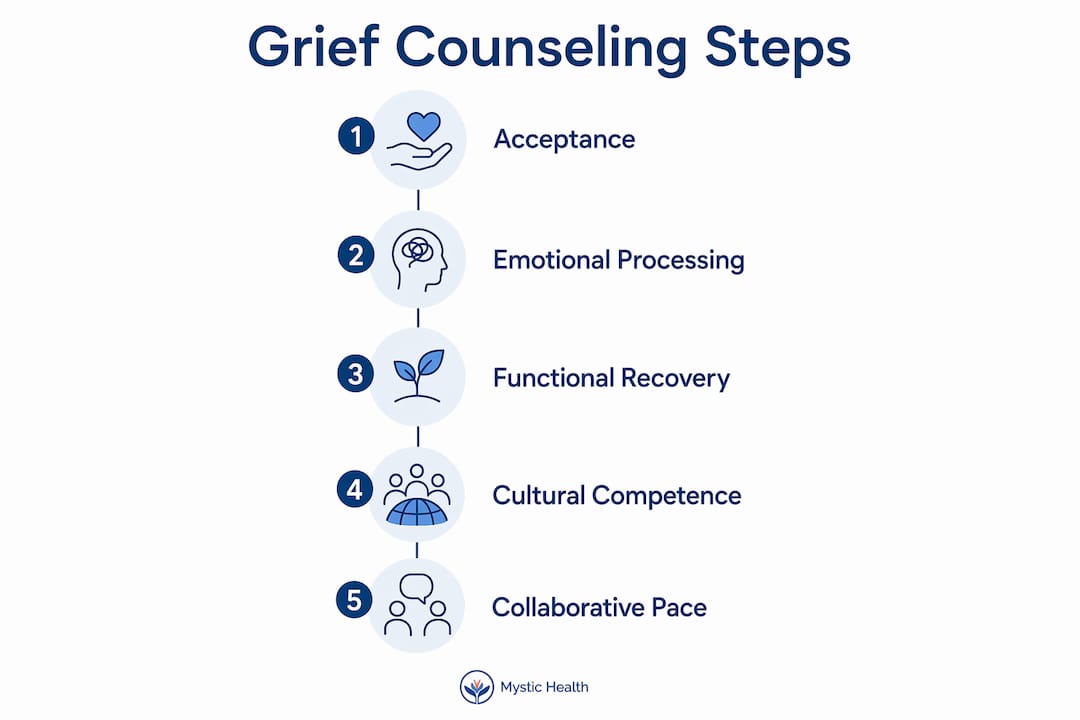
The primary goals of grief work are acceptance, emotional processing, and functional recovery. A good counselor doesn’t pathologize your grief or tell you there’s a “right” way to feel. They meet you where you are.

Core principles include cultural competence, collaborative pacing, and an evidence-based orientation. The therapeutic relationship itself is part of the medicine. As clinicians note, the counseling space serves as a safe container for validating complex emotions and reducing the isolation that grief so often brings.
There’s also an important distinction worth knowing: supportive grief counseling helps people with uncomplicated grief move toward healthy resolution. Grief therapy, by contrast, uses clinical interventions for traumatic, prolonged, or complicated grief reactions. The intensity, duration, and methods differ significantly between the two.
Pro Tip: If you’re unsure which level of care you need, start with an intake consultation. A licensed clinician can assess your grief presentation and recommend the appropriate level of support.
Who provides grief counseling and what credentials matter?
Not everyone who calls themselves a grief counselor holds the same training or scope of practice. Here’s what to look for:
- LCSW (Licensed Clinical Social Worker): Trained in psychotherapy and case management; can diagnose and treat mental health conditions.
- PhD/PsyD Psychologist: Doctoral-level training; often specializes in assessment and complex trauma or grief presentations.
- Licensed Professional Counselor (LPC/LPCC): Master’s-level clinician trained in talk therapy and behavioral interventions.
- Specialty training signals: Look for bereavement certification, complicated grief treatment (CGT) training, trauma-informed care, or formal psychedelic-assisted therapy training when those modalities are offered.
When psychedelic-assisted therapies like ketamine-assisted psychotherapy or Spravato (esketamine) are part of the program, medical oversight from a physician or psychiatrist is non-negotiable. The clinical team needs to include both a licensed therapist and a medical provider.
At Mystic Health, Lisa Kring, LCSW exemplifies this model, bringing licensed clinical training together with an integrative, whole-person approach to grief and emotional healing.
Pro Tip: Ask any prospective provider directly: “What specific training do you have in grief or bereavement?” A vague answer is a signal to keep looking.
What can you expect in a grief counseling session?
Sessions vary by format and clinical setting, but most share a recognizable structure. Common formats include individual therapy, group sessions, family or couples counseling, and multidisciplinary intakes at integrative clinics where a therapist and medical provider both participate.
Within sessions, you might engage in:
- Narrative work: Telling the story of your loss, at your own pace, to make sense of what happened
- Emotion-focused processing: Naming, sitting with, and gradually integrating difficult feelings
- Skills training: CBT-based strategies, behavioral activation, and grounding techniques
- Mindfulness practices: Breath work, body awareness, and present-moment anchoring
- Practical planning: Preparing for anniversaries, holidays, or triggering situations
Sessions typically last about an hour, though frequency can flex based on your needs and the intensity of your grief. Integrative programs that include psychedelic-assisted components often bundle preparation sessions, supervised dosing appointments, and integration therapy into a structured sequence.
Which therapeutic approaches are used in grief counseling?
Evidence-based grief counseling techniques span a wide range, and a skilled clinician will match the method to your specific presentation:
- CBT and third-wave CBT: Addresses unhelpful thought patterns, behavioral avoidance, and exposure work for traumatic loss elements
- Acceptance and Commitment Therapy (ACT): Focuses on accepting the reality of loss and re-engaging with life according to your values, rather than suppressing or “fixing” grief
- Narrative and meaning-centered therapy: Explores how loss reshapes identity and relationship, and helps you construct a coherent story that includes the loss
- Complicated grief therapy (CGT): A specialized, structured protocol for prolonged grief disorder (PGD), now recognized in both ICD-11 and DSM-5-TR; a network meta-analysis of 55 studies found several psychotherapies effective for PGD versus waitlist
- Psychedelic-assisted modalities: Ketamine-assisted psychotherapy and esketamine (Spravato) may be integrated into a grief care plan at specialty clinics, always with medical oversight and structured integration work
A large evidence review found that psychotherapy outperformed many other bereavement interventions for easing grief and depression. That’s a meaningful signal when you’re weighing your options.
When should you seek grief counseling?
Most bereaved people adapt over time without professional intervention. But some grief presentations call for clinical support sooner rather than later.
Seek counseling if you notice:
- Persistent functional impairment (can’t work, sleep, or care for yourself)
- Suicidal ideation or thoughts of self-harm
- Severe avoidance of reminders, people, or places
- Substance use as a primary coping strategy
- Symptoms that feel as intense months later as they did at the start
Grief counseling is also appropriate for disenfranchised grief, losses that society doesn’t always recognize as “real” grief. Job loss, divorce, disability, infertility, and pet loss all qualify. These losses are valid reasons to seek support, and a good counselor will treat them that way.
Prolonged grief disorder markers include persistent intense yearning, preoccupation with the person or thing lost, and an inability to re-engage with life after many months, especially when co-occurring depression or PTSD is present.
How do psychedelic and holistic therapies integrate safely with grief care?
Safety is the foundation of any responsible integrative program. When ketamine-assisted psychotherapy or Spravato is part of a grief care plan, the process follows a structured sequence:
- Medical screening and psychiatric clearance before any dosing begins
- Informed consent covering risks, benefits, and what to expect during and after sessions
- Supervised dosing with medical staff present throughout
- Pre-session preparation to set intentions and build therapeutic rapport
- Integration psychotherapy after each dosing session to translate the experience into lasting behavioral and meaning-making changes
The multidisciplinary model matters here. At integrative clinics like Mystic Health, therapists, physicians, and care coordinators work as a team. No one provider carries the whole plan alone.
Pro Tip: When evaluating any clinic offering psychedelic-assisted grief care, ask specifically: What screening tools do you use? What happens if I have an adverse reaction during dosing? How are integration sessions scheduled and billed? Clear answers to these questions are a sign of a well-run program.
How do you choose the right grief counselor?
The intake call is your evaluation, too. Come prepared.
Questions to ask:
- What is your licensure, and do you have specific training in grief or bereavement?
- Which evidence-based methods do you use for grief presentations?
- If psychedelic-assisted therapy is offered, who provides medical oversight?
- What happens in a mental health emergency between sessions?
- Do you accept insurance, offer sliding scale fees, or work with FSA/HSA accounts?
Evaluation checklist:
- Scope of practice matches your needs (supportive counseling vs. clinical grief therapy)
- Clear session structure and measurable goals discussed at intake
- Transparent billing and insurance information provided upfront
- Integration planning included for any psychedelic-assisted components
Red flags to watch for:
- Provider promises a quick resolution or a fixed timeline for healing
- No informed consent process for psychedelic work
- Medical oversight is absent or vague when medication is involved
- Pressure to move quickly through dosing or skip integration sessions
What does grief counseling cost, and what does insurance cover?
Costs vary considerably depending on the clinician’s level, session frequency, and whether medical procedures are involved.
- Standard talk therapy sessions with an LCSW or LPC typically range based on location, setting, and insurance status; many are covered under mental health benefits
- Psychologist (PhD/PsyD) sessions tend to run higher due to doctoral-level training
- Ketamine-assisted psychotherapy involves both therapy fees and medical procedure costs; most programs are self-pay, though some components may qualify for FSA/HSA reimbursement
- Spravato (esketamine) is FDA-approved for treatment-resistant depression and may carry insurance coverage in some cases; verify with your insurer and the clinic
- Sliding scale fees are available at many community mental health settings and some private practices; always ask
Brief supportive counseling may wrap up in a handful of sessions. Complicated grief therapy or an integrative psychedelic program typically runs several months, with preparation, dosing, and integration phases bundled together.
What can grief counseling realistically do for you?
Grief counseling can reduce distress, improve daily functioning, and help you integrate loss into your life story in a way that doesn’t erase it but doesn’t paralyze you either. For people with complicated grief, targeted psychotherapy meaningfully reduces symptoms compared to no treatment.
What it can’t do: erase the loss, guarantee a timeline, or replace the natural support of community and relationship. Good grief work doesn’t aim to “fix” grief. It helps you carry it while rebuilding your life around it.
Specialized therapy or additional treatment is worth considering when prolonged grief disorder, severe trauma, suicidality, or co-occurring psychiatric conditions are present. In those cases, standard supportive counseling alone is rarely sufficient.
This article is general information, not professional medical or mental health advice. Please consult a licensed clinician or your primary care provider to determine what level of care is right for your situation.
Key Takeaways
Grief counseling works best when it is targeted, evidence-based, and matched to the severity and type of grief you’re experiencing.
| Point | Details |
|---|---|
| Core purpose | Licensed clinicians provide a safe, evidence-informed space to process loss and rebuild daily functioning. |
| When it helps most | Targeted grief counseling is most effective for complicated grief, high distress, or inadequate social support. |
| Evidence base | A network meta-analysis of 55 studies found several psychotherapies effective for prolonged grief disorder versus waitlist. |
| Psychedelic integration | Ketamine-assisted psychotherapy and Spravato require medical screening, supervised dosing, and structured integration sessions. |
| Mystic Health | Mystic offers integrative grief care combining licensed therapy, medical oversight, and psychedelic-assisted options with insurance and financing support. |
The part most people don’t hear enough about
Most articles on grief counseling focus on what happens in sessions. What they skip is the relational reality: the moment you sit across from a clinician who doesn’t flinch at your pain, who doesn’t try to reframe it away or hand you a coping worksheet before you’ve even finished your sentence. That moment is the intervention.
I’ve seen patients arrive convinced their grief was “too much” or “taking too long.” They’d been told, directly or indirectly, that they should be further along by now. What they needed wasn’t a faster timeline. They needed someone to say: this is real, it makes sense, and we can work with it.
The integrative model, combining talk therapy with mindfulness, somatic awareness, and when appropriate, carefully supervised psychedelic-assisted sessions, doesn’t replace that relational core. It deepens it. The preparation and integration work surrounding a ketamine session, for instance, is where the real therapeutic weight lives. The dosing session opens a window. The therapy sessions before and after determine what you do with the view.
If you’re considering this path, the most important question isn’t which modality to try. It’s whether the team you’re working with will hold you accountable to your own healing, at your own pace, with full transparency about what they’re doing and why. That’s the standard worth holding out for.
Mystic Health offers integrative grief care with real clinical depth
Grief that isn’t moving, grief that’s pulling you under, sometimes needs more than weekly talk therapy. Mystic Health’s integrative mental health programs combine licensed psychotherapy, medical oversight, and psychedelic-assisted options including ketamine-assisted psychotherapy and Spravato into a coordinated care plan built around your specific situation.

What sets Mystic apart is the multidisciplinary structure: therapists, physicians, and care coordinators working together, not in silos. Every psychedelic-assisted component includes standardized screening, informed consent, supervised dosing, and dedicated integration sessions. Insurance compatibility and financing options are part of the conversation from the start, not an afterthought.
If you’re ready to explore what this kind of care looks like for you, request an intake consultation at Mystic Health. Come with your questions. The team will meet you where you are.
Useful sources for further reading
These are the clinical and educational resources referenced throughout this article, along with additional reading for anyone who wants to go deeper:
- What Is Grief Counseling? Techniques and How It Helps — Maryville Online
- Therapy for Grief: What You Need to Know — Healthline
- What Is Grief Counseling? — WebMD
- Grief Counseling: What to Expect — Simply Psychology
- Grief Best Managed Through Talk Therapy — Powers Health
- Psychotherapies for Prolonged Grief Disorder — Systematic Review / Network Meta-Analysis
- Grief Counseling Overview — Choosing Therapy
- Grief Counseling — e-counseling
- Mystic Health Clinical Evidence
- Lisa Kring, LCSW — Mystic Health
Pro Tip: If you’re researching integrative or psychedelic-informed grief care specifically, the Mystic Health clinical evidence page is a good starting point for understanding the research base behind these approaches.
Recommended

Mystic Health Blog








FAQs
1. Am I eligible for ketamine therapy?
2. Does insurance cover the cost of ketamine therapy?
3. How many ketamine treatments will I need?
We recommend two initial treatments to determine suitability and adjust dosage. After these sessions, additional treatments are available based on your progress and specific requirements.