Alternative Mental Health Therapies for Treatment-Resistant Care
Two clinical paths stand out for people who haven’t gotten relief from standard antidepressants: ketamine-assisted psychotherapy (KAP) and SPRAVATO (esketamine), both delivered under medical supervision, never as self-directed or recreational use. SPRAVATO tends to fit adults with FDA-recognized treatment-resistant depression or acute suicidal symptoms, monitored under a strict REMS program. KAP tends to fit people carrying complex trauma or layered, treatment-resistant presentations who can commit to real psychotherapy alongside the dosing sessions.
Before you choose either, look for three things: REMS certification if SPRAVATO is on the table, a clinician-led integration plan either way, and documented informed consent that spells out risks in plain language.
- SPRAVATO — REMS-certified clinics, FDA-approved indications, 2-hour monitoring window
- KAP — psychotherapy-integrated model, flexible formulations, longer course of care
- Both — require medical evaluation and a written treatment plan before the first dose
Key Takeaways
Treatment-resistant depression responds best when ketamine or esketamine dosing is paired with structured psychotherapy and integration, not delivered as a standalone medical procedure.
| Point | Details |
|---|---|
| Two realistic clinical paths | SPRAVATO fits FDA-recognized treatment-resistant depression; KAP fits complex, trauma-linked presentations needing psychotherapy. |
| REMS certification is non-negotiable | SPRAVATO requires certified sites and at least two hours of post-dose monitoring. |
| Integration drives outcomes | Dosing sessions without follow-up psychotherapy rarely produce lasting change in either model. |
| Screening protects safety | Cardiovascular history, psychiatric status, and substance-use history all shape eligibility. |
| Mystic integrates both models | Mystic Health pairs REMS-certified SPRAVATO and KAP with clinician-led integration and insurance support. |
Table of Contents
- Alternative Mental Health Therapies: KAP vs. SPRAVATO at a Glance
- What Ketamine-Assisted Psychotherapy Actually Involves
- SPRAVATO: FDA Approval, REMS Rules, and What to Expect Physically
- Screening, Contraindications, and Red Flags to Take Seriously
- From First Consultation to Integration: What the Process Looks Like
- How to Vet a Reputable Psychedelic-Assisted Provider
- How Long Treatment Takes and What It Tends to Cost
- Where Clinical Judgment Still Matters Most
- Getting Supervised Psychedelic Care Through Mystic
- Frequently Asked Questions
- Sources
Alternative Mental Health Therapies: KAP vs. SPRAVATO at a Glance
The two options diverge on formulation, model, and setting, and those differences shape who they’re built for.
SPRAVATO is esketamine, a nasal spray with a single approved manufacturing path (Janssen Pharmaceuticals) and a narrow, FDA-defined indication: treatment-resistant depression, or major depressive disorder with acute suicidal ideation when paired with an oral antidepressant. KAP, by contrast, uses racemic ketamine, delivered by IV, IM, or oral lozenge depending on the clinic, and it’s built around a psychotherapy relationship rather than a fixed drug protocol. That’s the real fork in the road: SPRAVATO is medication-first with monitoring attached; KAP treats the ketamine dose as one part of a therapy course.
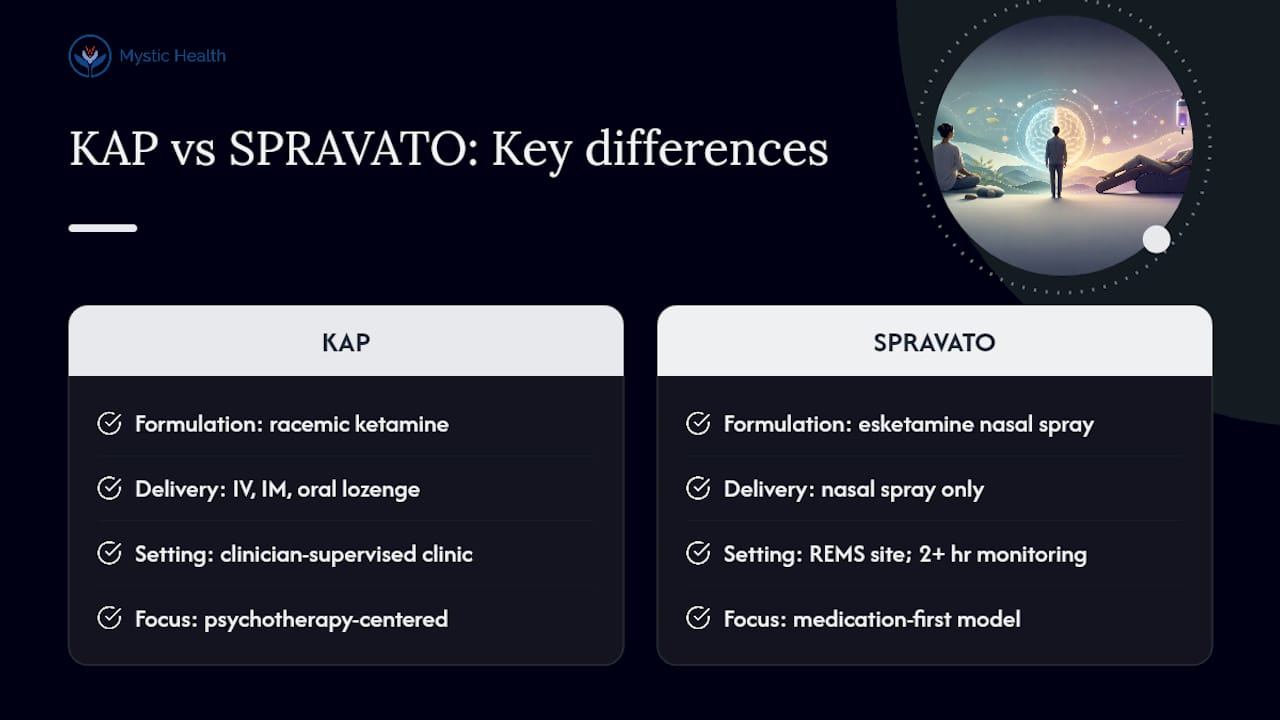
Setting requirements track that same split. SPRAVATO can only be administered at a REMS-certified site, with patients monitored for at least two hours post-dose. KAP is typically clinician-supervised in-clinic, though some programs offer hybrid or at-home models under direct oversight.
Both share one clinical reality worth flagging: dissociation during dosing is often part of the therapeutic mechanism, not just a side effect to tolerate.
What Ketamine-Assisted Psychotherapy Actually Involves
KAP pairs ketamine’s neuroplastic window with structured psychotherapy across three phases: preparation, dosing, and integration. The ketamine isn’t the treatment. It’s the opening.

During dosing, many patients enter a dissociative or trance-like state, and clinicians increasingly view that state as functionally useful rather than incidental. Practitioner commentary suggests that reaching this altered state helps patients approach painful memories and rigid thought patterns with less fear attached, which is precisely why integration work afterward matters so much. Skip that step and you’ve spent money on a dissociative experience with no durable change attached.
KAP tends to suit people carrying complex trauma, chronic depression with comorbid anxiety, or presentations that haven’t responded to multiple medication trials, provided they can commit to repeated sessions.
- Preparation: goal-setting, safety planning, building trust with the therapist
- Dosing: supervised, clinician-present, often multiple sessions over weeks
- Integration: the sessions where insight becomes actual behavioral change
Leading academic programs are explicit that dosing sessions alone rarely produce lasting benefit without the surrounding therapy.
Pro Tip: Ask your provider how many integration sessions are built into your plan before you schedule a single dosing appointment. If the answer is vague or the number is zero, that’s a program built around the drug, not the healing.
SPRAVATO: FDA Approval, REMS Rules, and What to Expect Physically
SPRAVATO is FDA-approved for treatment-resistant depression and for depressive symptoms tied to acute suicidal ideation when used alongside an oral antidepressant, always as a nasal spray, never a compounded alternative. Because of the abuse and dissociation risk, it’s dispensed only through the REMS program at certified sites.
Induction dosing commonly runs twice weekly for an initial period, after which providers reassess and shift to individualized maintenance scheduling. Every session requires medical staff to observe you for at least two hours after administration, watching for sedation, blood pressure spikes, and prolonged dissociation.
Expect to fast for at least two hours before dosing and skip liquids for at least 30 minutes prior. Plan a ride home; you cannot drive until after a full night’s sleep. Our guide to what SPRAVATO treatment involves walks through the logistics in more depth.
Patient materials are direct about this: SPRAVATO is dispensed only in certified healthcare settings, and coverage for commercially insured patients is common, though it varies by plan and often requires prior authorization.
Screening, Contraindications, and Red Flags to Take Seriously
Not everyone qualifies, and a reputable provider will tell you that upfront rather than after collecting payment.
Screening covers cardiovascular history (uncontrolled hypertension and aneurysmal vascular disease are serious concerns), active psychosis, pregnancy, substance-use history, and age-related risk factors. Both KAP and SPRAVATO carry documented risk for blood pressure elevation during dosing, which is why vitals get checked before, during, and after every session, not just once.
- Cardiovascular disease or uncontrolled hypertension
- History of psychosis or active substance-use disorder
- Pregnancy or plans to become pregnant
- Younger adult patients, given documented suicidality risk signals in this group
A documented informed consent conversation should walk through all of this before you ever sit in the treatment chair, and our KAP safety and screening guide covers what that conversation should include.
Pro Tip: Ask directly how the clinic handles a prolonged blood pressure spike or extended sedation. A provider with a real emergency protocol will answer in specifics, not reassurances.
Preparation and informed consent aren’t paperwork formalities. They’re what separates a clinical treatment from a risky improvisation.
From First Consultation to Integration: What the Process Looks Like
- Medical and psychiatric evaluation to confirm eligibility and rule out contraindications.
- Informed consent and goal-setting, where you and your clinician define what success looks like.
- Preparatory psychotherapy to build the safety and trust the dosing session depends on.
- The dosing session itself, arrival, pre-dose vitals, administration, then a monitored recovery period before discharge.
- Integration sessions, scheduled in the days after dosing, where you and your therapist work through what surfaced.
During dosing, expect perceptual shifts, a sense of detachment from your body, and sometimes vivid emotional material surfacing. That’s expected, not alarming, inside a supervised setting.
Pro Tip: Many clinicians assign a journaling prompt right after dosing, something like “what image or feeling stayed with you,” to anchor material for the integration session before it fades.
How to Vet a Reputable Psychedelic-Assisted Provider
Start with the prescriber. You want a psychiatrist, a psychiatric APRN, or a therapist working under direct physician supervision, not a general practitioner dabbling in ketamine on the side.
- Confirm REMS certification if SPRAVATO is part of the offering.
- Ask how many integration sessions are included in the total course, not just the dosing count.
- Ask what their emergency protocol looks like for adverse events.
- Request a written treatment plan and a real informed consent document, not a verbal summary.
- Documented emergency procedures on file, not improvised
- Transparent billing that separates psychotherapy, evaluation, and dosing costs
- Outcome tracking across your course, not a one-and-done dosing sale
Walk away from any clinic that sells single dosing sessions with no integration attached, minimizes your screening questions, or pushes cash-only high-volume scheduling. That pattern shows up in the comparison between KAP and SPRAVATO models and it’s a consistent marker of a program built for volume, not outcomes.
How Long Treatment Takes and What It Tends to Cost
SPRAVATO generally follows an induction block, often twice weekly for a month, before shifting to individualized maintenance dosing based on how you respond. KAP courses vary more, typically spanning several dosing visits spread across weeks, would allow integration work between sessions.
Insurance coverage splits unevenly. Evaluation visits and psychotherapy sessions are more often billed to insurance, while ketamine dosing sessions in KAP programs are frequently self-pay. SPRAVATO has broader insurance traction since it’s FDA-approved, though prior authorization is common.
- Ask specifically which billing codes apply to which part of your care
- Plan for transport home and skip driving until the next day
- Take the day off if possible; recovery isn’t instant
- Review current medications with your provider for interaction risks before starting
Where Clinical Judgment Still Matters Most
The field has a habit of treating ketamine as a silver bullet, and that framing undersells the harder truth: the drug opens a door, but nothing walks through it without skilled psychotherapy on the other side. I’d push back on any provider, or any patient’s expectation, that treats a dosing session as complete care on its own.
What gets underestimated is how much the dissociative state itself does the work when it’s held inside a trauma-informed relationship. That’s not mysticism. It’s a clinical observation worth taking seriously, and it’s exactly why integration deserves as much attention as the pharmacology.
Getting Supervised Psychedelic Care Through Mystic
If you’ve been weighing KAP against SPRAVATO, or wondering whether either fits your history, Mystic Health builds both into a single, integrated care model rather than treating dosing as a standalone product.
Mystic offers in-clinic and supervised at-home options, REMS-certified SPRAVATO administration, and integration therapy led by licensed psychiatric clinicians, not a rotating cast of technicians. Every treatment plan starts with a real medical evaluation and documented informed consent, and Mystic works directly with insurance and financing so cost isn’t the reason you delay care you actually need.
Before booking anywhere, ask about REMS certification for SPRAVATO and how many integration sessions come with your plan. Then take the next step: schedule a consultation with Mystic Health to talk through which path, KAP, SPRAVATO, or a combination, fits your history and your goals.
Frequently Asked Questions
Is ketamine-assisted psychotherapy the same as SPRAVATO? No. KAP uses racemic ketamine within a psychotherapy-centered model, while SPRAVATO is an FDA-approved esketamine nasal spray dispensed only through REMS-certified sites.
How fast do these alternative mental health therapies work? Some patients report improvement within days of a dosing session, though lasting results depend heavily on integration therapy, not the dose alone.
Are these treatments covered by insurance? SPRAVATO has broader coverage since it’s FDA-approved, though prior authorization is common. KAP evaluations and psychotherapy are often covered, while dosing sessions are frequently self-pay.
Who should avoid ketamine or esketamine treatment? People with uncontrolled hypertension, active psychosis, certain cardiovascular conditions, or unmanaged substance-use disorders typically aren’t candidates without further evaluation.
What happens if I don’t do integration therapy after dosing? Clinical guidance consistently shows that skipping integration reduces the odds of lasting benefit, since the dosing session opens a window for change rather than delivering the change itself.
This article is general information, not a substitute for advice from a qualified doctor. Consult a qualified healthcare professional about your own circumstances before acting on anything here.
Sources
- What to know about ketamine‑assisted psychotherapy (KAP) — Psychology Today
- SPRAVATO® (esketamine) MedGuide — DailyMed
- Ketamine‑Assisted Psychotherapy (KAP) — Huntsman Mental Health Institute, University of Utah Health
Recommended

Mystic Health Blog





FAQs
1. Am I eligible for ketamine therapy?
2. Does insurance cover the cost of ketamine therapy?
3. How many ketamine treatments will I need?
We recommend two initial treatments to determine suitability and adjust dosage. After these sessions, additional treatments are available based on your progress and specific requirements.