The Best Music for Ketamine Therapy Sessions
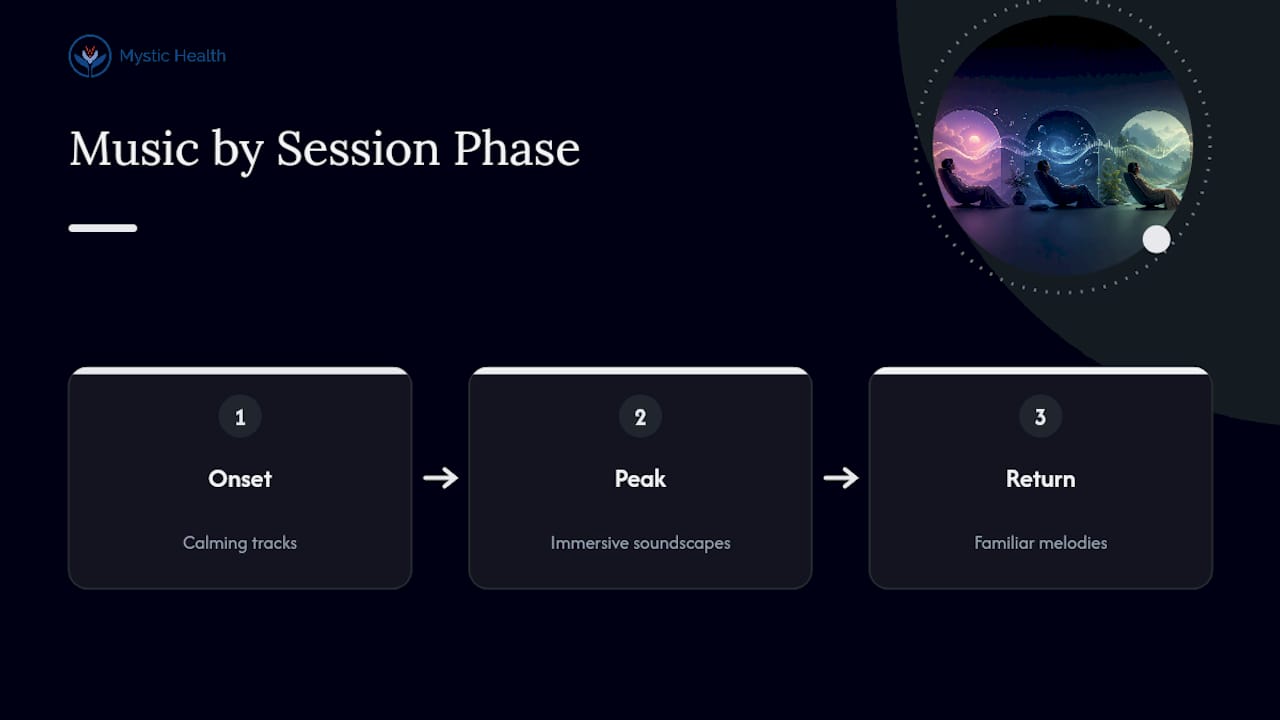
Instrumental music sequenced to match your session phases works best for most ketamine therapy sessions. Start with calming ambient or neoclassical for onboarding, shift to immersive soundscapes at the peak, and finish with familiar, soothing tracks for re-entry.
Three picks to start with today: the Johns Hopkins psychedelic playlist approach (phase-structured, mostly instrumental), Music For Ketamine Therapy Vol. 1 by Orpheo McCord, and anything from Hiroshi Yoshimura’s ambient catalog. If you want something more adaptive, the MUSIC CARE web app uses a “U-sequence” that adjusts to your preferences in real time.
- Lead with instrumentals. Save lyrics for after the session.
- Sequence by phase, not by mood alone.
- Bring your own favorites, but flag them to your clinician first.
Pro Tip: Test your playlist at home, at a normal volume, before your session. What sounds soothing at 2 p.m. on a Tuesday can feel completely different once the ketamine takes hold.
Key Takeaways
Phase-sequenced instrumental music, personalized in collaboration with your clinician, produces more stable and predictable ketamine therapy sessions than any generic playlist.
| Point | Details |
|---|---|
| Sequence by phase | Move from calm ambient at onset to immersive soundscapes at peak, then familiar tracks for return. |
| Favor instrumentals | Skip lyrics in your own language until the return phase to avoid pulling focus into cognitive processing. |
| Personalize with your clinician | Share your musical history and triggers during intake so your playlist reflects both preference and safety. |
| Prepare a fallback | Keep nature sounds or white noise ready for sessions where composed music feels like too much. |
| Work with Mystic | Mystic incorporates music preferences into ketamine-assisted psychotherapy intake and adjusts playlists across sessions. |
Table of Contents
- What Music Works Best for Ketamine Therapy?
- Why Music Matters During Ketamine Sessions
- How to Choose or Build Your Ketamine Therapy Playlist
- Sample Playlists by Session Phase
- Setting Up Music for Your Session
- Safety, Consent, and Working With Your Clinician
- What a Clinician Learns From Choosing Session Music
- Bring Music Into Your Ketamine Therapy Plan With Mystic
- Frequently Asked Questions
- Sources
What Music Works Best for Ketamine Therapy?
Clinic-curated playlists differ from anything you’d build on a streaming app in one key way: they follow an arc, not a mood. A generic “relaxing music” playlist on Spotify shuffles between styles with no regard for where you are in the experience. A clinical playlist moves you through it.
Here are four references worth knowing before you build your own list.
- The Johns Hopkins playlist approach. Researchers there describe their music as a “nonverbal support system”, structured across five segments: onset, ascent, peak, post-peak, and welcome back. It’s mostly instrumental until the final phase, when familiar melodies help ground you back in your body.
- Music For Ketamine Therapy Vol. 1 by Orpheo McCord. Built specifically for infusion sessions, this album leans on slow-building percussion and tonal drones rather than melody you’d hum later. It suits the peak phase well, when you want texture without narrative pull.
- Hiroshi Yoshimura’s ambient catalog, especially Music for Nine Post Cards. Yoshimura composed for spaces, not performances, and that quality makes his work ideal for onset. It’s calm without being sleepy, and it never demands your attention.
- MUSIC CARE’s U-sequence model. Instead of a fixed playlist, this evidence-based approach personalizes track order based on your stated preferences, then adjusts pacing. It’s less “playlist” and more “adaptive score,” and it’s worth exploring if fixed lists feel limiting.
Pro Tip: If you gravitate toward classical music, choose pieces without a strong narrative arc of their own, like Arvo Pärt or Max Richter, rather than something with a dramatic crescendo that might clash with your session’s natural rhythm.
Why Music Matters During Ketamine Sessions
Music isn’t background noise here. Johns Hopkins researchers frame it as a “nonverbal support system” that stays quiet when things go smoothly but gives you something to hold onto if the experience turns difficult. That’s the “net” function: present, but not intrusive.
The evidence backs this up beyond theory. The MUSIK randomized trial found that curated playlists, played starting at infusion onset and continuing throughout the session, improved how well patients tolerated ketamine physiologically. Separately, a Frontiers in Pain Research trial using the MUSIC CARE app found that preferred music reduced experimental pain significantly faster than music participants disliked, with measurable effects shortly after starting.
Music that fits the arc of your session, not just your general taste, produces more predictable and stable experiences than an arbitrary playlist ever could.
That predictability is exactly why structure matters more than genre.
How to Choose or Build Your Ketamine Therapy Playlist
Building a playlist starts with a conversation, not a Spotify search.
- Define the emotional goal first. Are you hoping to process grief, sit with anxiety, or simply relax into the medicine? Your goal should shape the tone before you pick a single track.
- Tell your clinician about your history. Certain songs carry emotional weight tied to trauma, breakups, or loss. Flag anything with strong personal associations.
- Match music to each phase. Calm and sparse for onset, immersive and textured for peak, familiar and warm for return.
- Choose delivery preference. Headphones or speakers changes how immersive the experience feels; decide this with your clinician in advance.
A few nonnegotiable rules make the process safer:
- Favor instrumentals over anything with lyrics in a language you understand.
- Foreign-language vocals or wordless choral pieces are fine as texture, since they don’t pull you into interpretation.
- Keep a neutral fallback ready. Nature sounds or white noise work when composed music feels like too much.
- Always prepare a short “emergency grounding” list. Two or three familiar, calming tracks you can switch to instantly if anxiety spikes.
Pro Tip: Test-listen to your full playlist during an ordinary afternoon, not right before your appointment. Music that feels neutral in daily life can feel overwhelming under ketamine, and you want to know that before you’re in session.
Sample Playlists by Session Phase
Most ketamine sessions move through four rough phases, and each one calls for a different sonic texture. Timing runs anywhere from 20 to 60 minutes total, depending on your protocol.
Onset (0 to 10 minutes): calming and sparse.
- Hiroshi Yoshimura, “Feel”
- Max Richter, “On the Nature of Daylight”
- Brian Eno, “1/1”
- Ólafur Arnalds, “Near Light”
Peak (10 to 35 minutes): immersive, long-form, minimal transitions.
- Orpheo McCord, selections from Music For Ketamine Therapy Vol. 1
- Stars of the Lid, “Requiem for Dying Mothers”
- Nils Frahm, “Says”
Return (35 to 50 minutes): warm, familiar, grounding.
- A track you already know and love, chosen in advance with your clinician
- Ludovico Einaudi, “Nuvole Bianche”
- Hania Rani, “Glass”
You can safely bring a personal favorite into the return phase, since familiarity helps you reorient. Avoid it during peak, where an unexpected emotional association could pull you out of the experience rather than deepen it.
Pro Tip: If you’re building this yourself rather than using a clinic-provided list, download the tracks instead of streaming them. A buffering interruption at the wrong moment can be jarring in ways a normal listening session never reveals.
Setting Up Music for Your Session
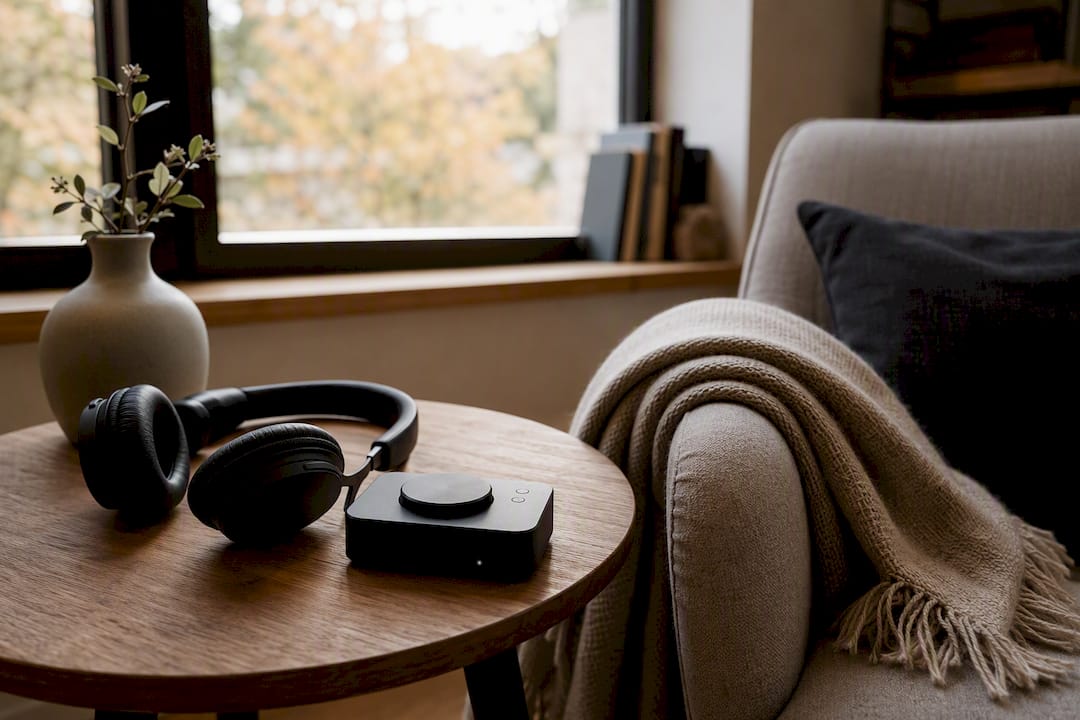
Headphones work best for solo introspective work since they block outside noise and deepen immersion. Speakers make more sense when a partner or family member is present, or when your clinician wants to stay verbally engaged with you throughout.
Keep volume comfortable, never loud, and avoid tracks with sudden dynamic swings that could startle you mid-session. Clinical playlists are deliberately built with gradual shifts in density and texture for exactly this reason.
- Use gapless playback so tracks flow without silence between them.
- Choose long-form pieces over short songs to reduce transition points.
- Test your headphones and device battery before you arrive.
- Bring a backup playback device if your clinic allows it.
A dead phone mid-session is a preventable disruption nobody wants to troubleshoot while you’re under the medicine’s effects.*
If you’re preparing for your first appointment, review how to prepare for ketamine sessions so your music setup fits into the broader checklist.
Safety, Consent, and Working With Your Clinician
Your intake conversation should cover music preferences the same way it covers medical history. A good clinician will ask about songs tied to trauma, past experiences with music during altered states, and whether you’d rather have silence than composed sound.
Pause or change the music immediately if a track triggers unexpected distress, and know that your clinician is trained to make that call in real time if you can’t.
Personalization consistently supports better outcomes, but personalization only works when it’s discussed openly between you and the person guiding your care.
Mystic integrates this directly into the patient consultation workflow, including compatibility with MUSIC CARE-style adaptive sequencing for later sessions.
What a Clinician Learns From Choosing Session Music
Every patient responds differently, so the first session often becomes a listening test as much as a treatment. One patient found ambient drones distracting and did far better with sparse solo piano; another needed near-silence until the peak phase passed, then asked for a familiar song to come back to.
Speak up if something isn’t landing. Bring three or four options to your next session. The right music is rarely obvious in advance, and adjusting it is a normal part of good care, not a disruption to it.
Bring Music Into Your Ketamine Therapy Plan With Mystic
Mystic builds music selection into ketamine-assisted psychotherapy from the first consultation, not as an afterthought bolted on at session time. Your intake includes questions about musical history, triggers, and preferences, and your care team adjusts your playlist across sessions as your needs shift.
If you’re ready to combine phase-structured playlists with clinical oversight, explore Mystic’s psychedelic medicine programs and book a consultation to talk through what your first session could look like.
Frequently Asked Questions
What’s the best music for ketamine therapy sessions? Instrumental ambient and neoclassical music sequenced by session phase works best for most people, with calming tracks at onset, immersive soundscapes at peak, and familiar melodies for return.
Can I bring my own music to a ketamine therapy session? Yes, but discuss your choices with your clinician first. Personal favorites work well during the return phase but can pull you out of the experience if introduced during the peak.
Should ketamine therapy music have lyrics? Generally no. Lyrics in a language you understand can trigger cognitive processing that interferes with the experience. Foreign-language vocals or wordless choral music are safer if you want vocal texture.
What is MUSIC CARE and how does it relate to ketamine therapy playlists? MUSIC CARE is a web-based, evidence-informed music platform that uses a “U-sequence” to adapt track order to a listener’s preferences, and it’s cited in pain research as improving how quickly preferred music reduces discomfort.
Do I need headphones for ketamine therapy music? Headphones offer more immersion for solo introspective sessions, while speakers suit sessions where a clinician or support person stays present and verbally engaged with you.
This article is general information, not a substitute for advice from a qualified doctor. Consult a qualified healthcare professional about your own circumstances before acting on anything here.
Sources
- Inside the Johns Hopkins psilocybin playlist | Johns Hopkins Medicine
- A web app-based music intervention reduces experimental thermal pain: A randomized trial on preferred versus least-liked music | Frontiers in Pain Research
Recommended

Mystic Health Blog






FAQs
1. Am I eligible for ketamine therapy?
2. Does insurance cover the cost of ketamine therapy?
3. How many ketamine treatments will I need?
We recommend two initial treatments to determine suitability and adjust dosage. After these sessions, additional treatments are available based on your progress and specific requirements.