Sound Therapy for Anxiety: Evidence-Based Methods That Work
Sound therapy can meaningfully reduce anxiety symptoms as a complementary, evidence-supported tool. Randomized clinical trials, systematic reviews, and clinical guidance from institutions like UCLA Health all point in the same direction: sound-based interventions reliably produce short-term reductions in tension, worry, and physiological stress markers. That’s a real signal worth paying attention to, especially if you’re looking for something that works alongside your existing care.
Three things to hold onto as you read:
- Primary benefit: Sound therapy produces acute reductions in state anxiety and relaxation responses, with some trials showing measurable decreases in heart rate, blood pressure, and self-reported worry within a single session.
- Main limit: It is not a proven standalone treatment for diagnosed anxiety disorders. The evidence supports it as an adjunct to therapy, medication, or other clinical care, not a replacement.
- Safety note: If you’re already working with a psychiatrist, therapist, or prescriber, coordinate with them before adding sound-based sessions, particularly if you have a trauma history, seizure disorder, or severe auditory sensitivity.
Key Takeaways
Sound therapy produces real, measurable reductions in state anxiety as a complementary tool, with the strongest evidence supporting combined music and auditory beat stimulation in sessions of 20–36 minutes, held consistently over time.
| Point | Details |
|---|---|
| Evidence level | RCTs and systematic reviews support acute anxiety reduction; sound therapy is an adjunct, not a standalone treatment. |
| Session length and frequency | Trials show dose-response benefits; aim for 20–36 minute sessions, scheduled 3–4 times per week for consistent results. |
| Best-studied methods | Combined music + auditory beat stimulation outperformed ABS alone and pink-noise control in a 163-person RCT. |
| Safety and consultation | Coordinate with your clinician if you’re in active treatment; specific contraindications include seizure disorders and acute psychosis. |
| Mystic’s approach | Mystic integrates sound therapy within licensed clinical programs, pairing it with psychotherapy and other evidence-based modalities. |
Table of Contents
- What sound therapy is and how it differs from music therapy
- Common sound therapy methods and how they work in practice
- What the science says and how sound therapy may reduce anxiety
- How to try sound therapy safely at home and what to expect in a clinical session
- Safety notes and who should pause before starting
- How to pick a provider, facilitator, or app for sound therapy
- A deeper look at the research: what the trials actually show
- An editorial perspective on sound therapy and real-world care
- Sound therapy at Mystic Health: guided, evidence-informed care
- Sources
What sound therapy is and how it differs from music therapy
Sound therapy is a broad category of practices that use acoustic vibration, resonance, or structured auditory input to influence the nervous system, mood, and physiological state. The goal is not entertainment or artistic expression. It’s regulation. Practitioners use instruments, tones, or electronically generated frequencies to guide the listener’s body and brain toward a calmer state.
Music therapy is a related but distinct discipline. It involves a board-certified music therapist who uses active music-making, singing, lyric analysis, or receptive listening as part of a structured clinical plan. Music therapy is a licensed profession with standardized training. Sound therapy, by contrast, is a wider umbrella that includes practices ranging from clinical music-based interventions to ancient traditions like Tibetan singing bowls, and it does not require a licensed therapist to administer.
The subtypes you’ll encounter most often:
Sound baths use resonant instruments, typically singing bowls (crystal or metal) and gongs, to fill a room with layered tones. The listener lies still and receives the sound passively. A gong bath is a specific variant that centers on the deep, complex overtones of large gongs.

Binaural beats / auditory beat stimulation (ABS) deliver two slightly different frequencies to each ear through headphones. The brain perceives a third “beat” at the difference between the two, which is thought to nudge brainwave activity toward a target frequency range.
Calming music refers to slow-tempo, low-complexity instrumental or vocal music used to reduce arousal. This is the most studied format in clinical trials.
Pink noise and nature soundscapes use broadband sound or recorded natural environments (rain, forest, ocean) to mask environmental stressors and promote relaxation.
| Feature | Sound therapy | Music therapy |
|---|---|---|
| Primary purpose | Nervous system regulation, relaxation | Clinical therapeutic goals (emotional, cognitive, social) |
| Typical method | Passive listening, resonant instruments, tones | Active music-making, structured receptive listening |
| Settings | Wellness studios, clinics, home | Hospitals, schools, outpatient mental health |
| Practitioner credential | Varies widely (no universal standard) | Board-certified music therapist (MT-BC) |
| Evidence level | Promising, growing RCT base | Established clinical evidence base |
Common sound therapy methods and how they work in practice
Each method targets a different mechanism, and the equipment matters more than most people expect.
- Sound baths (singing bowls and gongs): Best experienced in person or through high-quality speakers. The physical vibration of the bowls is part of the effect, so earbuds flatten the experience. A sound bath for anxiety session typically runs 30–60 minutes, with the listener lying on a mat while a facilitator plays around them.
- Binaural beats / ABS: Require stereo headphones. The left and right channels carry different base frequencies (for example, 200 Hz and 206 Hz), and the brain generates a perceived beat at the 6 Hz difference, landing in the theta range. Without headphones, the effect disappears.
- Calming music: Works through speakers or headphones. Slow-tempo (60–80 BPM), low-complexity instrumental music is the format most consistently studied in clinical trials for anxiety reduction.
- Pink noise: A broadband sound with more energy in lower frequencies than white noise. Often used as a sleep aid or focus tool. Can be played through speakers or earbuds without losing its core effect.
- Nature soundscapes: Recorded birdsong, rain, ocean waves, or forest ambience. Accessible through any playback device and widely available through apps and streaming platforms.
Frequency targets and a necessary caveat. Binaural beat protocols often aim for specific EEG bands: theta (4–7 Hz) for deep relaxation and meditative states, alpha (8–13 Hz) for calm alertness, and beta (14–30 Hz) for focus. Multiple small studies have documented physiological changes (reduced heart rate and blood pressure) after 15–30 minute exposures across these ranges. But frequency-specific superiority is not firmly established. There is no single “magic frequency” universally proven to treat anxiety, and commercial apps that claim otherwise are outpacing the evidence.
Pro Tip: If you’re new to binaural beats, start with an alpha-range protocol (around 10 Hz) for 15–20 minutes before bed. It’s the range most consistently associated with relaxed wakefulness in the literature, and it’s gentle enough to assess your own response before committing to longer sessions.
What the science says and how sound therapy may reduce anxiety
The honest summary: the evidence is promising, moderate in effect size, and still maturing. That’s not a dismissal. It’s a realistic read of what the trials actually show.
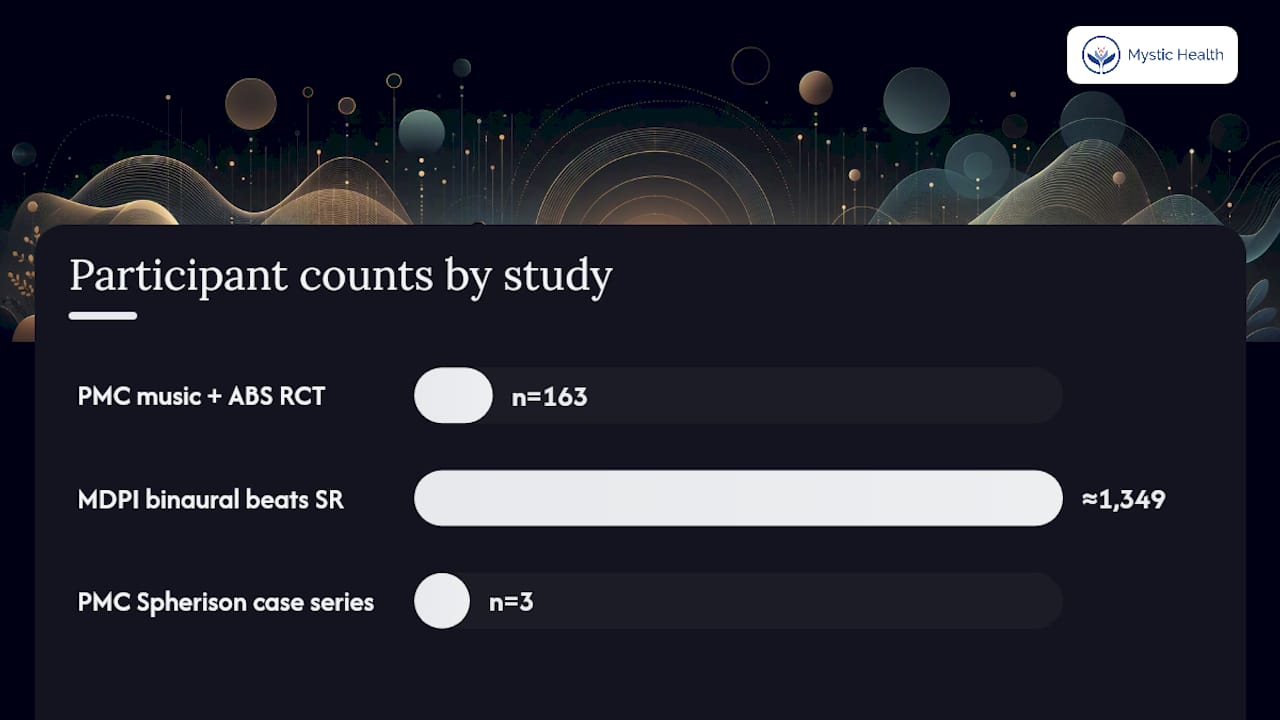
A systematic review of binaural beats across 12 eligible studies and approximately 1,349 patients found that binaural beats generally improved anxiety and depression scores compared to control conditions. The authors were clear about the limits: heterogeneity across studies was high, and standardized protocols are still lacking. The signal is there. The precision isn’t yet.
For combined music and auditory beat stimulation, the picture is sharper. An RCT published in PMC with 163 participants found that the combined music + ABS condition produced greater reductions in both somatic and cognitive state anxiety than ABS alone or a pink-noise control, particularly for participants with moderate trait anxiety. People with high trait anxiety showed more variable responses, suggesting they may need longer or repeated sessions to reach comparable outcomes.
Session length also matters. A separate dose-response RCT tested 12-, 24-, and 36-minute conditions of music combined with ABS. The largest reduction in negative affect occurred at 36 minutes, suggesting a dose-response relationship where longer sessions produce meaningfully greater benefit.
| Study / Source | Design | Population | Intervention | Session length | Primary outcome | Main result | Limitation |
|---|---|---|---|---|---|---|---|
| PMC (music + ABS RCT) | Open-label RCT | n=163, moderate/high trait anxiety | Music + ABS vs. ABS alone vs. pink noise | Single session | STAI state anxiety | Combined condition reduced somatic and cognitive anxiety most | Open-label; single session |
| PLOS Mental Health (dose-response RCT) | RCT | Anxiety-prone adults | Music + ABS at 12, 24, 36 min | 12–36 min | Negative affect scale | Largest effect at 36 min | Single session; lab setting |
| MDPI systematic review (binaural beats) | Systematic review | ~1,349 patients across 12 studies | Binaural beats vs. control | Varied | Anxiety and depression scales | Better than control; heterogeneous | High heterogeneity; no standard protocol |
| PMC (sound meditation) | Pre/post study | 62 participants | Singing bowl meditation | Single session | Tension, anger, fatigue | Significant pre/post reductions | No control group |
| PMC (Spherison case series) | Case series | 3 adults with GAD | Immersive Sound 6D device | 30 min × 3 weekly | Clinician-rated and self-report anxiety | Clinically meaningful reductions; stable at 6 months | n=3; uncontrolled |
How sound therapy may work physiologically
Three mechanisms appear most plausible, though none is fully proven at a mechanistic level.
Autonomic regulation. Sound-based interventions tend to shift the autonomic nervous system toward parasympathetic dominance, lowering heart rate and blood pressure. This is the most consistently documented physiological effect across binaural beat and music studies.
Vagal activation. Slow, rhythmic sound may stimulate the vagus nerve, which runs from the brainstem through the chest and abdomen. Vagal activation interrupts the threat-mode physiology that sustains anxiety, slowing breathing and reducing cortisol. UCLA Health’s clinical overview describes this pathway as one of the plausible routes through which sound therapy produces its relaxation effects.
Neural entrainment. The hypothesis is that the brain’s electrical activity tends to synchronize with a rhythmic external stimulus, a phenomenon called entrainment. Binaural beats leverage this by presenting a beat frequency that corresponds to a target EEG band. The evidence for entrainment is real but modest, and the clinical translation (does entrainment cause anxiety reduction?) remains an open question.
How to try sound therapy safely at home and what to expect in a clinical session
Starting at home is reasonable, and the barrier is low. The key is structure. A scattered, occasional listen to a rain sounds playlist is not the same as a scheduled, intentional session.
At-home session checklist:
- Choose your method. Pick one format to start: a binaural beats track, a singing bowl recording, or a nature soundscape. Don’t combine multiple formats in your first session.
- Set up your space. Dim the lights, silence your phone, and find a position where you can stay still for the full session, either lying down or seated comfortably.
- Check your equipment. Binaural beats require stereo headphones. For sound baths or nature soundscapes, quality speakers work well. Keep volume at a comfortable conversational level, roughly 60–70 dB, never loud enough to cause ear fatigue.
- Set a timer. Start with 20–30 minutes. Trial data suggests this range produces measurable relaxation effects, and the dose-response RCT found meaningful benefit at 36 minutes for music + ABS.
- Do a brief pre-session check. Notice your current anxiety level on a simple 1–10 scale. This gives you a reference point for after.
- During the session: Let your attention rest on the sound without forcing anything. If your mind wanders, gently return to the sound. No special technique required.
- Post-session: Sit quietly for 2–3 minutes before returning to activity. Note your anxiety level again. Over several sessions, this tracking helps you see whether the practice is working for you.
- Frequency: Aim for scheduled sessions, ideally 3–4 times per week. Consistency matters more than intensity. Small clinical series suggest structured weekly sessions produce more stable anxiety reductions than sporadic listening.
For a more detailed walkthrough, Mystic’s step-by-step sound healing guide for beginners covers preparation, what to expect, and how to build a sustainable practice.
In a clinical session, the setup is more intentional. A facilitator typically prepares the room with specific instruments or audio equipment, guides you through a brief grounding exercise before the sound begins, and remains present throughout. In integrative mental health settings, sound sessions are often paired with psychotherapy, either immediately before to lower arousal before a talk-therapy session, or as a standalone module within a broader treatment plan. The facilitator’s role is to hold the space, not to direct your experience.
Pro Tip: Never use binaural beats or immersive sound sessions while driving, operating machinery, or doing anything that requires sustained attention. The relaxation response is real, and it can reduce alertness quickly.
Safety notes and who should pause before starting
Sound therapy has a strong general safety profile. Adverse events in published trials are rare, and most people tolerate sessions well. That said, a few specific situations call for caution or a conversation with a clinician first.
Contraindications and cautions:
- Severe auditory sensitivity or hyperacusis: Amplified or resonant sound can cause distress or pain. Start with very low volume or avoid until assessed.
- Seizure disorders: Some individuals with photosensitive or sound-sensitive epilepsy may be at risk from rhythmic auditory stimulation. Consult a neurologist before using binaural beats or gong baths.
- Recent ear surgery or active ear infection: Any intervention involving headphones or loud resonant instruments should wait until cleared by an ENT.
- Active psychosis: Immersive sound environments can be disorienting. Sound therapy in this context should only occur under direct clinical supervision.
- Suicidal ideation or acute psychiatric crisis: Sound therapy is not a crisis intervention. If you or someone you know is in crisis, contact the 988 Suicide and Crisis Lifeline by calling or texting 988.
- Existing medication or psychotherapy: Clinical safety reviews recommend coordinating with your treating provider before adding sound-based sessions, particularly when you’re on psychoactive medications or in active trauma processing.
If you have a trauma history, sound therapy can be genuinely helpful, but the path in matters. Certain tones, rhythms, or immersive environments can unexpectedly activate trauma responses. The safest approach is to begin with a clinician-supervised session where you retain full control over playback, have an agreed opt-out signal, and can debrief immediately afterward.
Pro Tip: If you’re in trauma-focused therapy, bring up sound therapy with your therapist before your first session. A brief conversation about which formats feel safe and which to avoid can prevent an unnecessary setback.
How to pick a provider, facilitator, or app for sound therapy
The field is largely unregulated, which means the quality gap between a well-trained facilitator and someone with a singing bowl and a weekend certificate is significant. Here’s how to evaluate what you’re walking into.
For in-person providers and facilitators, ask:
- What is your training background, and is it specific to therapeutic facilitation rather than performance?
- Do you have clinical oversight or a licensed mental health professional on your team?
- How do you handle participants who have a trauma history or active mental health diagnoses?
- What is your safety plan if someone becomes distressed during a session?
- Do you offer integration support after the session, or is it a standalone experience?
For apps, look for:
- Transparent session length options (not just “play indefinitely”)
- Volume controls and hearing-safety guidance built into the interface
- References to clinical trials or peer-reviewed research in the app’s documentation
- A clear privacy policy covering your listening data
- Offline mode, so you’re not dependent on a data connection during a session
Red flags to avoid: Any provider or app claiming to cure anxiety disorders, eliminate the need for medication, or guarantee results from a specific frequency. The evidence does not support those claims. Lack of safety guidance, no clinical referral pathway for users with serious mental health conditions, and pressure to purchase extended packages upfront are all signals to walk away.
If cost and insurance coverage are part of your decision, Mystic’s insurance-friendly treatments guide covers what integrative mental health services may be covered and how to navigate billing.
A deeper look at the research: what the trials actually show
The evidence base is growing, but it’s worth being honest about where the gaps are.
Representative studies in detail:
| Study | Design | Population | Intervention details | Session length | Primary outcomes | Key numeric result | Limitations |
|---|---|---|---|---|---|---|---|
| PMC music + ABS RCT | Open-label RCT | n=163; moderate and high trait anxiety | Music + ABS vs. ABS alone vs. pink-noise control | Single session | STAI state anxiety (somatic and cognitive subscales) | Combined condition: largest reduction in cognitive anxiety for moderate trait-anxiety group | Open-label; single session; no long-term follow-up |
| PLOS Mental Health dose-response RCT | RCT | Anxiety-prone adults | Music + ABS at 12, 24, and 36 min | 12, 24, or 36 min | Negative affect scale | Largest negative-affect reduction at 36 min | Lab setting; single session; no clinical diagnosis required |
| MDPI binaural beats systematic review | Systematic review | ~1,349 patients; 12 studies | Binaural beats vs. various controls | Varied across studies | Anxiety and depression rating scales | Binaural beats outperformed control conditions across most included studies | High heterogeneity; no standardized frequency protocol |
| PMC Spherison case series | Case series | 3 adults with GAD refusing medication | Immersive Sound 6D (Spherison) device | 30 min × 3 weekly sessions | Clinician-rated and self-report anxiety | Clinically meaningful reductions; 2 of 3 stable at 6-month follow-up | n=3; uncontrolled; no comparison group |
| PMC sound meditation pre/post study | Pre/post observational | 62 participants | Singing bowl meditation (sound bath) | Single session | Tension, anger, fatigue, mood | Significant pre/post reductions in tension and negative mood | No control group; self-selected sample |
Common methodological gaps across the field:
- Small sample sizes in most individual trials limit statistical power and generalizability.
- Short follow-up periods mean we know very little about whether benefits persist beyond days or weeks.
- Heterogeneity in ABS and binaural beat parameters (carrier frequencies, beat frequencies, delivery methods) makes cross-study comparison difficult.
- Lack of blinding in many trials introduces expectation effects that are hard to separate from the intervention itself.
- Most trials use single-session designs, which don’t reflect how most people would actually use sound therapy.
What the evidence currently supports: Acute symptom relief and a complementary role within broader mental health care. Sound therapy, particularly music-based interventions and combined music + ABS, can reduce state anxiety in a single session. The immersive Spherison case series suggests that repeated structured sessions may produce more durable effects, but that finding needs replication in larger controlled trials.
What remains unresolved: Optimal frequencies for specific anxiety presentations, long-term durability of effects, and whether certain populations (high trait anxiety, PTSD, GAD) respond differently to different formats. These are the questions the next generation of trials needs to answer.
An editorial perspective on sound therapy and real-world care
Sound therapy occupies an unusual position in mental health care. The evidence is real enough to take seriously, but the wellness industry has gotten there first, and the gap between what the research supports and what practitioners claim can be wide.
What strikes me most about the trial data is the moderation finding: people with moderate trait anxiety tend to show the most reliable, statistically significant relief from standard protocols. People with high trait anxiety, the ones who arguably need the most help, show more variable responses and may need longer, more tailored approaches. That’s a clinically important nuance that almost never makes it into the marketing for sound baths or binaural beat apps.
There’s also something worth naming about the dose-response finding. The fact that 36 minutes outperformed 12 minutes in reducing negative affect isn’t just a trial detail. It suggests that the casual, five-minute “chill out” use of these tools may not be where the real benefit lives. Structured, intentional sessions of meaningful length, held consistently, are closer to what the evidence actually supports.
The honest framing is this: sound therapy is a genuinely useful tool for the nervous system, with a growing evidence base and a low risk profile for most people. It pairs well with psychotherapy, mindfulness practice, and, in integrative settings, with approaches like ketamine-assisted therapy where the goal is to lower the nervous system’s baseline reactivity. What it is not is a cure, a replacement for clinical care, or a reason to delay getting help from a licensed professional. Used with that clarity, it has real value.
Sound therapy at Mystic Health: guided, evidence-informed care
At Mystic, sound therapy isn’t offered as a standalone wellness product. It’s integrated into a broader clinical framework where every modality, including sound-based sessions, is part of a personalized treatment plan developed with licensed clinicians.
For patients working through anxiety, trauma, or the emotional weight of serious illness, sound sessions at Mystic are designed to complement, not replace, the primary therapeutic work. That might mean a sound session before a ketamine-assisted psychotherapy appointment to lower baseline arousal, or as a regular adjunct within an integrative mental health program that includes talk therapy, medication management, and holistic modalities. Clinical oversight is built in, not optional. If you’re ready to explore what evidence-informed sound therapy looks like within a full care plan, you can schedule a consultation through Mystic Health’s programs page and speak directly with a clinician about what fits your situation.
Sources
- The effects of music & auditory beat stimulation on anxiety: A randomized clinical trial - PMC
- What is sound therapy — and could it benefit your health?
- The Efficiency of Binaural Beats on Anxiety and Depression—A Systematic Review
This article is general information, not a substitute for advice from a qualified doctor. Consult a qualified healthcare professional about your own circumstances before acting on anything here.
Recommended

Mystic Health Blog





FAQs
1. Am I eligible for ketamine therapy?
2. Does insurance cover the cost of ketamine therapy?
3. How many ketamine treatments will I need?
We recommend two initial treatments to determine suitability and adjust dosage. After these sessions, additional treatments are available based on your progress and specific requirements.