Step by Step Ketamine Therapy: A First-Timer's Guide
TL;DR:
- Step-by-step ketamine therapy involves thorough medical screening, route-specific supervised dosing, and structured follow-up to ensure safety and maximize therapeutic results. Different delivery methods, including IV infusion, Spravato nasal spray, and at-home sublingual protocols, require tailored monitoring and procedures, emphasizing the importance of informed choice and preparation. Post-treatment integration, symptom tracking, and ongoing care are critical for sustaining benefits and achieving lasting change from this multifaceted treatment approach.
Step by step ketamine therapy is a clinically supervised process that moves from medical screening through dosed treatment to structured follow-up, with each stage designed to protect your safety and maximize therapeutic benefit. Clinicians refer to this as ketamine-assisted treatment (KAT) or, when paired with psychotherapy, ketamine-assisted psychotherapy (KAP). Whether you are considering IV infusion, Spravato nasal spray, or sublingual protocols for depression, anxiety, PTSD, or chronic pain, understanding the full sequence before you begin makes the experience far less daunting and far more effective.
What prerequisites and preparations are needed before ketamine therapy?
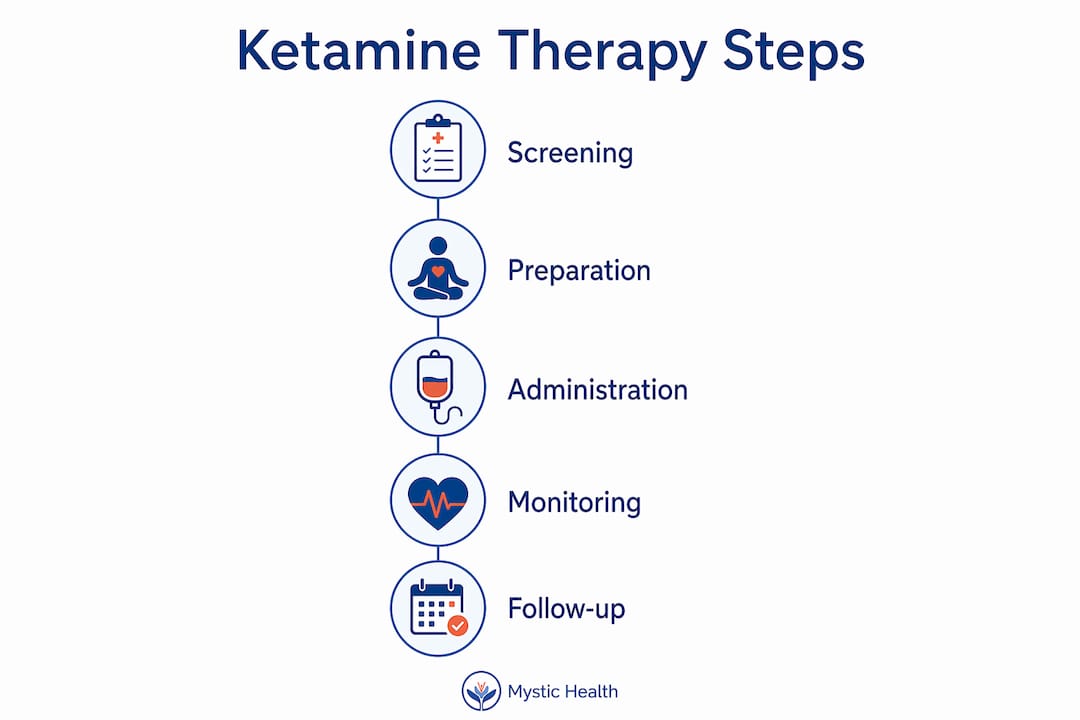
Ketamine therapy begins with rigorous medical safety screening, and this step is not a formality. Your provider reviews your full medical history, current medications, and mental health diagnoses to determine whether ketamine is appropriate for you. Depending on your health profile, you may need specialist clearances from a cardiologist, neurologist, ophthalmologist, or nephrologist before treatment begins. Lab work typically includes liver and kidney function panels, and some clinics add a metabolic panel or complete blood count.
Here is what most patients need to complete before their first session:
- Medical history review: Disclose all diagnoses, including any history of psychosis, mania, or substance use disorder, since these can affect candidacy.
- Specialist clearances: Cardiac, neurologic, renal, or eye specialist sign-off may be required based on your individual health status.
- Lab work: Liver and kidney function tests are standard; your provider may order additional panels.
- Medication review: Some medications interact with ketamine, including benzodiazepines and certain stimulants. Your care team needs the full picture.
- Fasting or hydration instructions: Many clinics ask patients to fast for several hours before IV infusion to reduce nausea risk.
- Transportation arrangements: You cannot drive after a session. Post-session grogginess can last one to two hours, so arrange a ride in advance.
If you are pursuing Spravato (esketamine nasal spray), there is an additional layer. Spravato requires administration under a restricted Risk Evaluation and Mitigation Strategy (REMS) program due to risks including sedation and respiratory depression. Your clinic must be certified under this program before you can receive it.
Pro Tip: Be completely transparent with your care team about every supplement, medication, and recreational substance you use. Withholding information does not protect you. It limits your provider’s ability to keep you safe and calibrate your dose accurately.
How is ketamine therapy administered step by step?
The ketamine therapy process differs meaningfully across three delivery routes: off-label IV infusion at a clinic, FDA-approved Spravato nasal spray under REMS, and at-home sublingual or oral protocols. Understanding each pathway helps you know what to expect and ask the right questions when choosing a provider. You can explore route-specific differences in detail through Cleveland Clinic’s published protocols.
IV infusion: the step-by-step sequence
A typical IV ketamine appointment lasts about two hours total, broken into three phases. First, you complete a symptom questionnaire and meet your care team for a pre-session check-in. Your blood pressure, heart rate, and oxygen saturation are recorded as baseline vitals. An IV line is placed, usually in your forearm, and the infusion begins at a carefully calculated dose.

The infusion itself runs approximately 40 minutes. During this time, staff monitor your blood pressure, pulse oximetry, and heart rate every 5 to 15 minutes. You may feel relaxed, slightly detached from your surroundings, or experience mild perceptual shifts. These dissociative sensations are expected and temporary. After the infusion ends, you move into a 20 to 45 minute observation period before discharge.
Spravato nasal spray: REMS-supervised steps
Spravato follows a more structured protocol because of its REMS requirements. The standard induction dose is 84 mg administered twice weekly for four weeks, always in a certified healthcare setting. You self-administer the nasal spray under direct clinical supervision, then remain in the facility for at least two hours of monitoring. The clinic handles device disposal and documents each session per REMS requirements.
At-home sublingual protocols
Some providers prescribe sublingual ketamine lozenges or troches for home use, typically once or twice weekly over four to six weeks. Monitoring is less intensive, relying on patient self-reporting and scheduled check-ins rather than continuous vital sign tracking. This route offers convenience but requires greater personal accountability and honest symptom tracking.
| Route | Session duration | Monitoring level | Key safety step |
|---|---|---|---|
| IV infusion | ~2 hours total | Continuous vitals every 5-15 min | Baseline vitals before dose |
| Spravato nasal spray | 2+ hours in clinic | 2-hour post-dose observation | REMS program certification required |
| Sublingual at home | 1-2 hours self-directed | Self-report and scheduled check-ins | Honest symptom logging |
Pro Tip: The dissociative sensations during IV infusion can feel disorienting if you are not prepared for them. Many patients find it helpful to bring an eye mask and a calming playlist. Surrendering to the experience rather than resisting it tends to produce better outcomes.
What to expect after ketamine therapy and how to manage follow-up care?
The period immediately after your session matters as much as the treatment itself. Most clinics hold you for observation after infusion or Spravato to confirm your vitals have stabilized and you are safe to leave. Do not plan anything demanding for the rest of that day. Your thinking will be slower, your coordination slightly off, and your emotional state may feel tender or open in ways that are worth honoring rather than pushing through.
Intravenous ketamine can reduce depressive and suicidal symptoms within hours to days of a single infusion, with large effect sizes at the 4-hour and 24-hour marks. This rapid relief is real, but it is not permanent on its own. Most providers build a series of sessions into the initial protocol, typically six IV infusions over two to three weeks, to consolidate and extend the benefit.
Here is what structured follow-up looks like in practice:
- Symptom tracking: Use a daily mood log or a validated scale like the PHQ-9 between sessions. Your care team uses this data to adjust dosing and timing.
- Psychotherapy integration: Ketamine-assisted psychotherapy may extend symptom improvement up to six months, though evidence quality varies. Scheduling therapy sessions in the days following a ketamine infusion, when neural plasticity is elevated, is the standard approach.
- Maintenance sessions: After the initial series, many patients move to monthly or quarterly maintenance infusions based on how long their relief lasts.
- Recognizing warning signs: Seek immediate help if you experience persistent confusion, chest pain, severe dissociation that does not resolve, or worsening suicidal ideation after a session.
- Realistic expectations: Ketamine is part of a broader treatment plan, not a standalone cure. Reassessment at regular intervals keeps your protocol aligned with your actual progress.
Pro Tip: Schedule a brief integration call with your therapist or care coordinator within 48 hours of each session. The window of heightened neuroplasticity after ketamine is real, and having a structured conversation during that window helps anchor the insights that emerge.
What are common challenges and practical tips for a successful experience?
Access remains one of the most practical barriers to ketamine therapy. IV infusion clinics are concentrated in urban centers, and out-of-pocket costs can be significant for off-label IV treatment. Spravato carries FDA approval for treatment-resistant depression and major depressive disorder with suicidal ideation, which means insurance coverage is more likely. Knowing which route your insurance covers before you commit to a clinic saves both time and money. Mystic’s patient guide to ketamine clinics outlines what to look for when evaluating providers.
Dosing adjustments are normal and expected. Your first session establishes a baseline response. Clinicians then titrate up or down based on your tolerability and symptom changes. If a session felt overwhelming or produced no noticeable effect, say so. That feedback directly shapes your next dose.
A few practical points worth keeping in mind:
- Avoid alcohol for at least 24 hours before and after a session. Alcohol amplifies sedation and can blunt the therapeutic effect.
- Do not make major life decisions on session day. Your judgment is genuinely impaired for several hours post-treatment.
- Bring a trusted person to drive you home. Rideshare apps are acceptable, but having someone who knows you is better for the first few sessions.
- Ask your provider specific questions before starting. How many sessions are in the initial protocol? What metrics do you use to assess response? What is your protocol if I have a difficult experience?
Pro Tip: In the 24 hours before a session, reduce stimulation. Limit screen time, avoid stressful conversations, and get a full night of sleep. Your nervous system’s baseline state going into a session shapes the quality of what you experience during it.
Key takeaways
Ketamine therapy works best as a structured, multi-step process that begins with thorough screening, moves through route-specific supervised dosing, and continues with integrated follow-up and psychotherapy.
| Point | Details |
|---|---|
| Screening is non-negotiable | Medical history, labs, and possible specialist clearances protect you and inform your dose. |
| Three distinct routes exist | IV infusion, Spravato under REMS, and sublingual at home each carry different monitoring requirements. |
| Rapid relief needs reinforcement | Symptom reduction can occur within hours, but a series of sessions and psychotherapy sustain the benefit. |
| Post-session care is active | Symptom tracking, integration therapy, and honest provider communication are part of the treatment. |
| Practical logistics matter | Transportation, fasting, medication review, and clinic selection directly affect safety and outcomes. |
Why the sequence of ketamine therapy matters more than any single session
I have spoken with many people who arrive at ketamine therapy hoping one infusion will reset everything. I understand that hope. When you have been living with treatment-resistant depression or chronic pain for years, the idea of rapid relief feels almost too good to question. But what I have seen, both in the research and in the experiences people share, is that the sequence is what creates lasting change.
The pre-treatment screening is not bureaucratic friction. It is the foundation that makes everything else safe. The session itself is the catalyst, not the cure. And the follow-up, the integration work, the honest conversations with your care team, is where the real transformation takes root. Skipping or rushing any of these stages is like planting a seed and then not watering it.
I also want to name something that does not get said enough: the route you choose matters. IV infusion in a supervised clinic, Spravato under REMS, and at-home sublingual are not interchangeable. They carry different risks, different monitoring requirements, and different levels of clinical support. Choosing based on cost or convenience alone, without understanding those differences, is a risk worth avoiding. The clinical evidence supporting ketamine is genuinely exciting. Honoring the process that evidence was built on is how you access those benefits safely.
— Kabir
Explore ketamine therapy programs at Mystic
Mystic offers supervised ketamine therapy as part of a broader integrative mental health approach that combines clinical rigor with whole-person care. From your initial assessment through your follow-up sessions, every step is supported by a team that takes both your safety and your healing seriously.
Whether you are exploring IV ketamine, Spravato, or ketamine-assisted psychotherapy for depression, anxiety, PTSD, or chronic pain, Mystic’s programs are built around your individual needs. Insurance compatibility and financing options are available. If you are ready to take the first step, explore Mystic’s treatment programs and schedule a consultation with a care team that will meet you where you are.
FAQ
What is the first step in ketamine therapy?
The first step is a comprehensive medical screening, including a review of your health history, current medications, and possible lab work or specialist clearances. This assessment determines whether ketamine is appropriate for you and informs your initial dose.
How long does a ketamine infusion session take?
A typical IV ketamine appointment lasts approximately two hours, covering pre-session assessment, a 40-minute infusion, and 20 to 45 minutes of post-infusion observation before discharge.
How many ketamine sessions are needed for depression?
Most providers prescribe six IV infusions over two to three weeks as an initial course, or twice-weekly Spravato sessions for four weeks. Maintenance sessions follow based on how long symptom relief lasts for each individual.
Can ketamine therapy be combined with psychotherapy?
Yes. Ketamine-assisted psychotherapy schedules therapy sessions in the days following an infusion to take advantage of elevated neuroplasticity. Research suggests this combination may extend symptom relief up to six months, though outcomes vary by individual.
Is ketamine therapy covered by insurance?
Spravato (esketamine nasal spray) carries FDA approval for treatment-resistant depression and major depressive disorder with suicidal ideation, making insurance coverage more accessible than for off-label IV infusion. Contact your insurer and clinic directly to confirm your specific coverage before starting treatment.
Recommended

Mystic Health Blog








FAQs
1. Am I eligible for ketamine therapy?
2. Does insurance cover the cost of ketamine therapy?
3. How many ketamine treatments will I need?
We recommend two initial treatments to determine suitability and adjust dosage. After these sessions, additional treatments are available based on your progress and specific requirements.