What Is Resilience Training for Psychedelic-Assisted Care
TL;DR:
- Resilience training helps individuals develop skills to adapt to adversity, regulate emotions, and find meaning. It is a learnable capacity supported by techniques like mindfulness, cognitive reappraisal, emotional regulation, and exercise. Integrating resilience practice with psychedelic therapy improves emotional processing and supports long-term recovery.
Resilience training is a structured, evidence-based practice that teaches you to adapt to adversity, regulate your emotions, and find meaning after hardship. The American Psychological Association frames resilience not as a fixed trait but as a capacity you can actively cultivate through connection, healthy thinking, wellness, and meaning. For patients pursuing psychedelic-assisted or holistic mental health care, that distinction matters deeply. Ketamine-assisted psychotherapy and Spravato can open profound emotional windows, but what you do with what surfaces in those sessions shapes how lasting the healing becomes. Resilience training gives you the skills to stay present with difficult material, make sense of it, and carry it forward. At Mystic, it sits at the center of how we prepare patients for treatment and support integration afterward.
- Resilience is a learnable skill set, not a personality trait
- Core techniques include cognitive reappraisal, mindfulness, emotional regulation, and aerobic exercise
- Resilience building is especially valuable before and after psychedelic-assisted sessions
- Clinical screening is required before combining resilience training with intensive therapies
Table of Contents
- What does resilience training actually teach you?
- What does the research say about how well it works?
- How is resilience training delivered, and how does it fit with psychedelic-assisted therapy?
- Practical starter techniques you can begin safely right now
- Who benefits, and when should you be careful?
- How do you choose a credible program or clinician?
- What timeline and outcomes should you realistically expect?
- Key Takeaways
- The part most programs don’t talk about honestly
- Mystic’s integrative resilience programs: what’s available to you
- Useful sources for further reading
What does resilience training actually teach you?
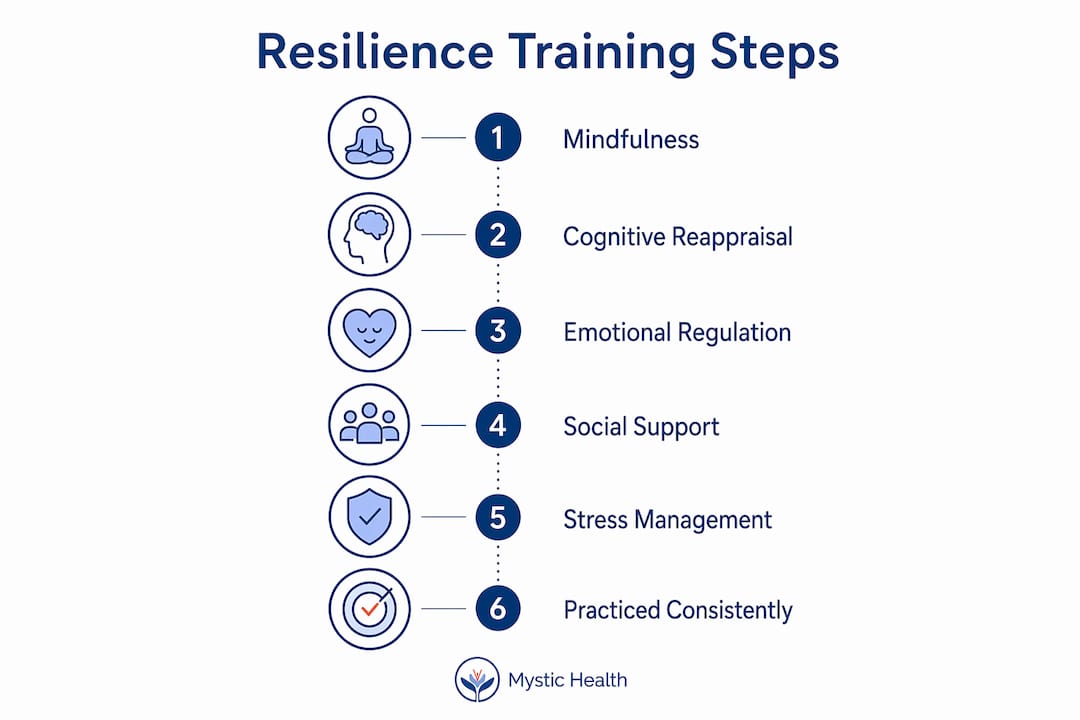
Resilience training works across several interconnected domains. Understanding which skills you’re developing helps you engage with practice more intentionally.
- Cognitive flexibility and reappraisal: Learning to notice and reframe unhelpful thought patterns, a skill drawn from cognitive behavioral strategies that builds automatic access to flexible thinking under pressure
- Mindfulness: Anchoring attention to the present moment so you can observe difficult emotions without being swept away by them; particularly valuable during psychedelic integration when unexpected material surfaces
- Emotional regulation: Recognizing and modulating emotional responses, including distress tolerance when feelings become intense
- Meaning-making: Connecting experiences, even painful ones, to personal values and a larger sense of purpose; this is the domain most directly activated during psychedelic-assisted therapy
- Social connection: Proactive relationship-building predicts resilience outcomes better than support mobilized only during a crisis
- Lifestyle habits: Regular aerobic exercise, consistent sleep, and nutrition prime your biological stress-response systems and support long-term gains
Pro Tip: Don’t try to practice all six domains at once. Pick one, mindfulness or reappraisal, and commit to it daily for two weeks before adding another. Consistency in a single skill compounds faster than scattered effort across all of them.
What does the research say about how well it works?
The evidence base for resilience training is real, and honest about its limits.
A systematic review and meta-analysis of resiliency training programs found moderate benefits for resilience and reductions in stress and depression within three months of follow-up. The same review flagged significant heterogeneity across trials and limited long-term follow-up data, meaning we know programs work in the short term but have less certainty about how durable those gains are without continued practice.
The ingredients with the strongest backing are consistent: cognitive reappraisal, mindfulness practices, emotional regulation training, and regular aerobic exercise that supports faster cortisol recovery after stress. Programs that combine education with guided, experiential practice outperform passive instruction. The field still lacks a single consensus definition of resilience, which makes comparing studies difficult. Short follow-up windows and inconsistent outcome measures are the two most common methodological gaps. What this means practically: choose a program that measures outcomes and uses structured, evidence-based methods rather than one that relies on general wellness language.
How is resilience training delivered, and how does it fit with psychedelic-assisted therapy?
Resilience training is typically delivered as an organized program spanning several weeks, with weekly meetings led by a clinician or trained instructor, in person or virtually, plus structured practice between sessions.
Common formats include:
- Weekly individual therapy sessions integrating reappraisal and mindfulness skills
- Group workshops that build social connection alongside skill practice
- Blended programs combining digital tools with clinician check-ins
- Short courses designed to consolidate new neural patterns through repetition
The fit with psychedelic-assisted therapy is direct. Before a ketamine or Spravato session, resilience skills help you approach the experience with less fear and more psychological flexibility. After a session, practices like expressive writing and mindfulness anchor the insights that emerged and help you build resilience through psychedelic integration rather than letting them fade.
At Mystic, resilience training is woven into every phase of care: intake and medical screening, preparation sessions before treatment, and integration work afterward. The Mindful Self Compassion in Support of Psychedelic-Assisted Therapy course is offered as a featured mindfulness resource, giving patients a structured, evidence-informed path to deepen self-compassion and meaning-making alongside their clinical treatment.
Practical starter techniques you can begin safely right now
You don’t need to be enrolled in a formal program to start. These exercises are safe for most patients and can be practiced alongside clinical care.
- Cognitive reappraisal (5 minutes): Write down one stressful thought. Then write two alternative ways to interpret the same situation, neither dismissive nor falsely positive. Practice noticing which interpretation gives you more room to act.
- Mindfulness anchor (5–10 minutes): Sit quietly and focus on the physical sensation of breathing. When your mind wanders, gently return without judgment. This is the foundational skill for staying present during intense therapy sessions.
- Expressive writing for meaning-making (10 minutes): After a difficult experience or therapy session, write freely about what happened, what it means to you, and what you want to carry forward. Research links this practice to improved emotional processing.
- Graded aerobic activity: Start with 20 minutes of brisk walking three times per week. Aerobic exercise directly supports cortisol regulation and builds the biological foundation for emotional resilience.
A simple 6-week schedule: weeks 1–2, daily mindfulness anchor; weeks 3–4, add reappraisal journaling three times per week; weeks 5–6, add aerobic activity and one expressive writing session per week. Effective programs typically run several weeks to allow new patterns to consolidate.
Pro Tip: If you’re in active psychiatric care, share this practice schedule with your clinician before starting. Some exercises, particularly expressive writing after a psychedelic session, are most effective when reviewed with a therapist who can help you process what surfaces.

Who benefits, and when should you be careful?
Resilience training is appropriate for a wide range of patients, but not without clinical consideration.
Who tends to benefit most:
- Patients preparing for or integrating ketamine-assisted psychotherapy or Spravato
- Caregivers managing chronic stress alongside a loved one’s serious illness
- People with chronic health conditions, including cancer, navigating mindfulness-based approaches
- First responders and others with occupational trauma exposure
Situations requiring careful clinical screening or program modification:
- Active psychosis or recent psychotic episode
- Unstable medication regimen, particularly antipsychotics or mood stabilizers
- Acute suicidality or recent self-harm
- Severe dissociation that mindfulness practices may intensify
Structural and external factors, including chronic illness, financial instability, and lack of social support, can limit resilience development and must be acknowledged rather than ignored. A good clinician validates these barriers rather than asking you to simply try harder. For patients combining resilience training with ketamine or Spravato, medical oversight is not optional. A physician or psychiatric nurse practitioner should review your full clinical picture before and during training.
How do you choose a credible program or clinician?
Not all programs are equal. Here’s what to ask before committing.
- Is the lead clinician licensed? Look for a licensed therapist, psychologist, or psychiatrist with documented training in trauma-informed care.
- Does the program use evidence-based methods? Ask specifically about CBT-based reappraisal, mindfulness, and structured outcome measurement.
- Is there medical oversight for patients using psychedelic-assisted therapies? A medical director or supervising physician should be part of the team.
- How does the program handle contraindications? A credible program screens for active psychosis, suicidality, and medication interactions before enrollment.
- What does the program measure? Programs that track outcomes with validated tools, such as resilience or self-efficacy questionnaires, take their results seriously.
Red flags to avoid:
- No licensed clinician involved in delivery
- Vague wellness language with no named techniques or outcome measures
- No contraindication screening process
- Claims of guaranteed results or rapid transformation without clinical basis
What timeline and outcomes should you realistically expect?
| Timeframe | What typically happens |
|---|---|
| Weeks 1–2 | Orientation to core concepts; mindfulness and breathing practices begin |
| Weeks 3–4 | Cognitive reappraisal skills introduced; initial shifts in emotional reactivity |
| Weeks 5–6 | Meaning-making and values work; lifestyle habits reinforced |
| Weeks 7–8 | Skill consolidation; integration with therapy sessions deepens |
| 3 months post-program | Some gains in resilience and stress reduction, per meta-analytic evidence |
Simple ways to track your progress:
- A daily practice log noting which exercises you completed and for how long
- A weekly mood and stress rating on a 1–10 scale
- A validated self-report tool such as the Brief Resilience Scale or the General Self-Efficacy Scale, reviewed with your clinician
Maintaining gains after formal training ends requires continued practice, even informal daily moments of reappraisal or mindfulness. The skills don’t disappear, but they do fade without use.
Key Takeaways
Resilience training is most effective when it combines structured, evidence-based techniques with consistent practice over 6–8 weeks and is integrated into clinical care rather than treated as a standalone wellness activity.
| Point | Details |
|---|---|
| Resilience is learnable | The APA confirms it is a capacity built through practice, not a fixed personality trait. |
| Core techniques are evidence-backed | CBT reappraisal, mindfulness, emotional regulation, and aerobic exercise have the strongest research support. |
| Integration with psychedelic therapy matters | Resilience skills prepare patients for sessions and deepen integration of insights afterward. |
| Clinical screening is required | Active psychosis, acute suicidality, and unstable medications are contraindications that need medical review. |
| Mystic’s approach | Mystic integrates resilience training across intake, preparation, and post-session care, including the Mindful Self Compassion in Support of Psychedelic-Assisted Therapy course. |
The part most programs don’t talk about honestly
There’s a version of resilience training that gets sold as a self-improvement shortcut. Ten days, a new mindset, a better you. I’ve seen patients arrive at Mystic having completed those programs and still feeling like something essential was missing. The skills were real. The gap was context.
What the research actually shows is that resilience training works best when it’s embedded in a relationship with a clinician who knows your history, understands your nervous system, and can adjust the approach when something unexpected surfaces. That’s especially true for patients doing psychedelic-assisted work. A ketamine session can bring up material that no journaling prompt prepared you for. The question isn’t whether you have the skills. It’s whether you have someone alongside you when you need them.
The other thing worth saying plainly: resilience building is not about becoming someone who doesn’t struggle. It’s about developing the capacity to stay present with struggle long enough to find what’s true and useful in it. That’s a quieter promise than most programs make. It’s also the one that holds.
Mystic’s integrative resilience programs: what’s available to you
Mystic’s integrative mental health programs are built around exactly this kind of embedded, clinically supported resilience work. Patients receive a thorough intake and medical screening before any treatment begins. From there, preparation sessions introduce the core resilience skills, including the Mindful Self Compassion in Support of Psychedelic-Assisted Therapy course, a structured mindfulness program designed specifically to support patients through psychedelic-assisted care. Ketamine-assisted psychotherapy and Spravato are available for eligible patients, with integration sessions scheduled to help you process and apply what each treatment brings up.
Insurance compatibility and financing options are available, and the clinical team includes licensed therapists and medical oversight for every patient. If you’re ready to take the next step, you can explore Mystic’s programs or schedule a consultation directly through the website.
Useful sources for further reading
- American Psychological Association: Building Your Resilience
- PMC: The Efficacy of Resiliency Training Programs — Systematic Review and Meta-Analysis
- Cleveland Clinic: Resilience Training — What It Is, How It Works & Exercises
- Cornell Health: Building Resilience
- Simply Psychology: Evidence-Based Resilience Building Strategies
- Mind: Managing Stress and Building Resilience
This article is for general informational purposes only and is not a substitute for professional medical or mental health advice. Please consult a qualified clinician before beginning any resilience training program, particularly if you are managing a psychiatric condition or considering psychedelic-assisted therapy.
Recommended

Mystic Health Blog








FAQs
1. Am I eligible for ketamine therapy?
2. Does insurance cover the cost of ketamine therapy?
3. How many ketamine treatments will I need?
We recommend two initial treatments to determine suitability and adjust dosage. After these sessions, additional treatments are available based on your progress and specific requirements.