Esketamine Dosing Schedule: What Adults Should Expect
The FDA-approved esketamine dosing schedule starts with twice-weekly doses of 56 mg or 84 mg for four weeks, then tapers to once weekly and eventually once every two weeks, depending on how you respond. If you’re being treated for acute suicidal ideation or behavior, the schedule is more fixed: 84 mg twice weekly for four weeks, with a possible step down to 56 mg. Every dose happens under direct medical supervision, because Spravato is only available through the Spravato REMS program.
There’s no take-home version. You’ll be in a certified clinic, and you’ll stay there.
- Induction (weeks 1–4): 56 mg or 84 mg, twice weekly
- Maintenance (weeks 5–8): 56 mg or 84 mg, once weekly
- Week 9 onward: individualized, once weekly or every 2 weeks
- REMS requirement: supervised administration plus a minimum 2-hour observation period
Every dose comes from a 28 mg device. Two devices make 56 mg. Three devices make 84 mg. There’s no ambiguity in the math, only in how your body responds to it.
Key Takeaways
The FDA-approved esketamine schedule combines induction, maintenance, and individualized long-term dosing, all delivered under mandatory REMS supervision with a minimum two-hour observation period.
| Point | Details |
|---|---|
| Induction phase | Weeks 1 to 4 mean twice-weekly dosing at 56 mg or 84 mg for TRD. |
| Maintenance tapering | Weeks 5 to 8 drop to once weekly, then week 9+ moves to weekly or every 2 weeks. |
| Suicidal ideation protocol | 84 mg twice weekly for 4 weeks, reducible to 56 mg, with no data past that window. |
| Device math matters | Each device delivers 28 mg; 2 devices make 56 mg, 3 devices make 84 mg. |
| Mystic offers supervised care | Mystic provides REMS-certified administration, monitoring, and aftercare planning. |
Table of Contents
- Esketamine Dosing Schedule for TRD vs. Acute Suicidal Ideation
- How Spravato Is Administered in the Clinic
- REMS Requirements and Post-Dose Monitoring
- Adjusting Dose and Handling Missed Sessions
- Safety Considerations That Shape the Schedule
- How Clinicians Decide When to Space Out Your Doses
- Getting Ready for a Spravato Session
- Why the Schedule Isn’t the Whole Story
- Getting Supervised Esketamine Treatment Through Mystic
- Frequently Asked Questions
- Sources
Esketamine Dosing Schedule for TRD vs. Acute Suicidal Ideation
The label splits into two distinct paths depending on why you’re being treated, and mixing them up is a common source of confusion for patients researching their own care.
For treatment-resistant depression, the induction and maintenance schedule unfolds in three phases. Weeks 1 through 4 call for twice-weekly dosing at 56 mg or 84 mg. Weeks 5 through 8 drop to once weekly at the same dose range. From week 9 forward, your provider individualizes the interval, which is to say, they find the least frequent schedule that still keeps your depression in check, either once weekly or every two weeks.
For MDD with acute suicidal ideation or behavior, the approach is more rigid: 84 mg twice weekly for four straight weeks, with a reduction to 56 mg permitted if 84 mg is too much to tolerate. What happens after week four is genuinely unclear. Use beyond that point hasn’t been systematically evaluated in trials, so any continuation past four weeks becomes a clinical judgment call between you and your provider.
| Indication | Phase | Weeks | Frequency | Dose |
|---|---|---|---|---|
| TRD | Induction | 1 to 4 | Twice weekly | 56 mg or 84 mg |
| TRD | Maintenance | 5 to 8 | Once weekly | 56 mg or 84 mg |
| TRD | Long-term | 9+ | Weekly or every 2 weeks | 56 mg or 84 mg |
| MDD with suicidal ideation | Fixed course | 1 to 4 | Twice weekly | 84 mg (may reduce to 56 mg) |
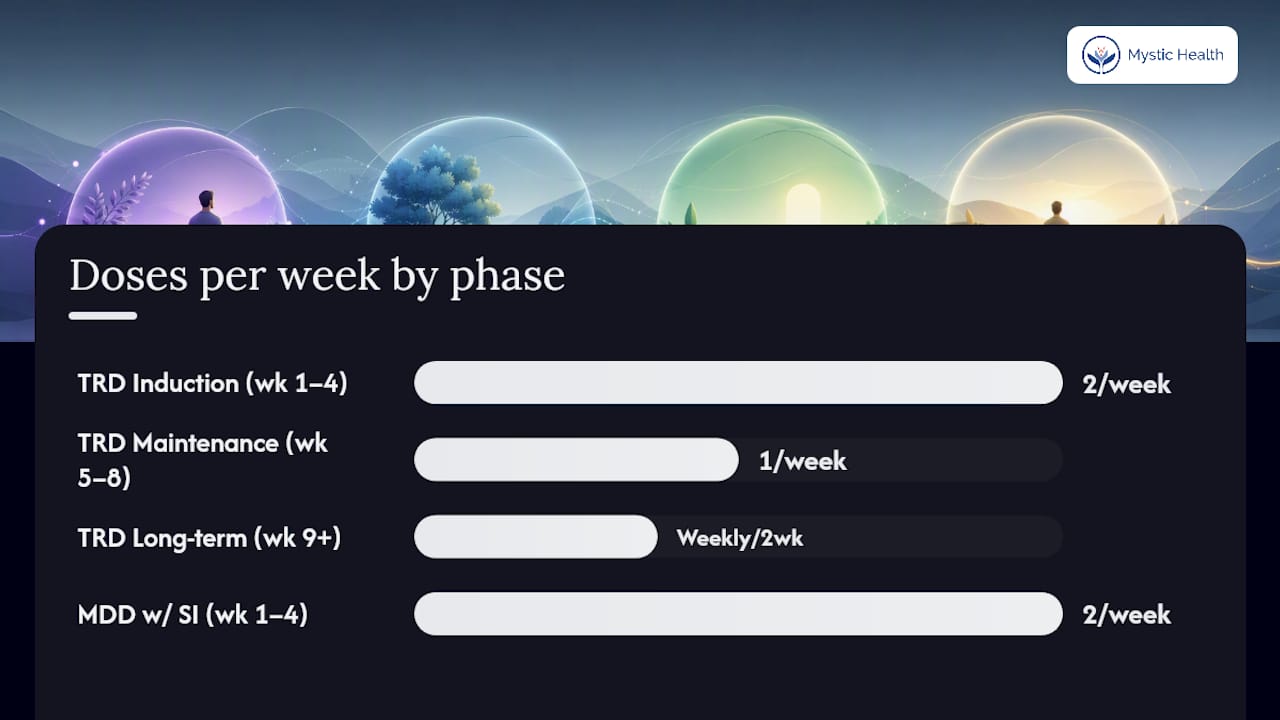
The professional monograph reinforces this same structure and adds one practical note: dose changes at any phase should be guided by both how well the treatment is working and how well you’re tolerating it, not by a fixed calendar alone.
How Spravato Is Administered in the Clinic
Each nasal spray device holds 28 mg of esketamine, delivered across two sprays, one per nostril. That number is the whole basis for your dose. Two devices equal 56 mg. Three devices equal 84 mg. There’s no partial-device dosing and no way to split a device between visits.
Clinics are instructed not to prime the device before handing it to you, since priming wastes medication that’s supposed to reach you. Between devices, you’ll wait about five minutes to let the previous dose absorb before starting the next one.
A typical session flow looks like this:
- Staff confirm your dose and count out the correct number of devices.
- You self-administer the first device under direct observation.
- You wait roughly five minutes before the next device, repeating until your full dose is given.
- Staff document administration and move you into the observation period.
- Blood pressure is checked before you start
- Sprays happen one device at a time, never rushed
- No device is primed in advance
REMS Requirements and Post-Dose Monitoring
Spravato can’t be prescribed like a typical nasal spray you pick up and use at home. It’s dispensed and administered only through the Spravato REMS program, which requires direct supervision by a healthcare professional in a certified setting, full stop.
After dosing, you’re required to stay for observation, not as a courtesy but as a REMS mandate.
You must be monitored for at least 2 hours after each dose, with blood pressure checked before administration and again during that observation window.
A notable portion of patients in clinical trials experienced clinically significant blood pressure increases after dosing, which is why that pre and post check isn’t optional paperwork. If your reading stays elevated or you show signs of prolonged dissociation, sedation, or an anxious reaction, staff extend the observation window until you’re stable. You’re also barred from driving or operating machinery until the day after treatment, once you’ve had a full, restful night of sleep.
Adjusting Dose and Handling Missed Sessions
Dose changes aren’t arbitrary. If 84 mg brings on side effects you can’t tolerate, your provider can step you down to 56 mg. The reverse is also true: if 56 mg isn’t controlling symptoms well enough and you’re tolerating it fine, moving up is reasonable.
Missed sessions follow a simple rule. If you skip a dose and your depression symptoms haven’t worsened, you simply resume the current schedule. If missed maintenance sessions are followed by a return of symptoms, your provider may decide to go back to the previous, more frequent interval, essentially undoing the taper until you’re stable again.
- Never combine two missed doses into one larger dose
- Report symptom changes to your provider before your next scheduled visit
- Expect your provider to reassess frequency, not skip straight to a higher dose
Doubling up to “catch up” on missed treatment isn’t how this medication works, and it isn’t safe.
Safety Considerations That Shape the Schedule
Esketamine’s most common side effects, dissociation, dizziness, sedation, nausea, and that blood pressure spike, aren’t rare footnotes. They’re the reason the entire REMS structure exists in the first place.
- Blood pressure increases requiring pre- and post-dose checks
- Dissociation and vertigo that can persist into the observation window
- Sedation and euphoric mood shifts that make independent travel unsafe
- Cognitive impairment severe enough to bar driving until the next day
Certain patients shouldn’t receive esketamine at all. That includes anyone with a history of aneurysmal vascular disease, arteriovenous malformation, or intracerebral hemorrhage, along with anyone hypersensitive to esketamine or ketamine. Pregnancy carries fetal risk, and breastfeeding requires a conversation with your provider about weighing the benefits against potential exposure.
Pro Tip: Arrange your ride home before you ever walk into the clinic. Book it, confirm it, and treat it as part of your treatment plan, not an afterthought you’ll figure out after the session.
How Clinicians Decide When to Space Out Your Doses

The goal isn’t just following a calendar. It’s finding the least frequent interval that still keeps you well, then holding steady there.
Clinicians typically reassess at the end of induction, around week four, using standardized symptom scales alongside your own reporting of how you’re feeling. From there, review happens roughly every four weeks. If your symptoms creep back at a wider interval, that’s the trigger to tighten the schedule again rather than wait it out.
Pro Tip: Keep a simple weekly mood log between visits. It gives your provider real data instead of a memory of “some good days, some bad days,” and that specificity often changes the dosing conversation.
Getting Ready for a Spravato Session

Before your appointment, bring a photo ID and your current medication list, and arrange a ride both ways since you won’t be cleared to drive.
During the visit, expect staff to confirm your device count, walk you through administration with those five-minute rests built in, and hold you for at least two hours afterward.
- Skip nasal decongestants close to your dose unless your provider clears it
- Expect some dissociation as normal, not alarming, in the hours after treatment
- Flag any side effect that feels unusual before you leave the building
Why the Schedule Isn’t the Whole Story
The label gives you a starting map, not a fixed destination. Two patients on identical induction doses can end up on completely different maintenance intervals six months later, and that’s not inconsistency. That’s the treatment working as intended. REMS oversight means you’re never doing this alone in a clinic room.
Getting Supervised Esketamine Treatment Through Mystic
Mystic gives you REMS-certified, in-clinic Spravato administration without the runaround of finding a provider who actually handles the observation and monitoring requirements correctly.

Beyond the dosing itself, Mystic builds out the parts that make treatment sustainable: patient education before your first session, blood pressure and symptom monitoring during the two-hour observation window, and aftercare planning so you know exactly what week nine and beyond looks like for you specifically. That’s the difference between a clinic that hands you a device and one that walks the full integrative mental health path with you.
If you’re ready to talk through whether esketamine fits your situation, explore Mystic’s programs and schedule a consultation to get your induction schedule started.
Frequently Asked Questions
What is the standard esketamine dosing schedule for depression? For treatment-resistant depression, it’s twice weekly at 56 mg or 84 mg for four weeks, then once weekly for four more weeks, then individualized to weekly or every two weeks after that.
How often do you take esketamine for suicidal ideation? Twice weekly at 84 mg for four weeks, with a possible reduction to 56 mg if tolerability becomes an issue.
Can you take esketamine at home? No. It’s only given under direct supervision in a REMS-certified clinical setting, followed by at least two hours of observation.
What happens if you miss an esketamine dose? If your symptoms haven’t worsened, you resume your current schedule. If they have, your provider may return you to a more frequent interval.
This article is general information, not a substitute for advice from a qualified doctor. Consult a qualified healthcare professional about your own circumstances before acting on anything here.
Sources
Recommended

Mystic Health Blog







FAQs
1. Am I eligible for ketamine therapy?
2. Does insurance cover the cost of ketamine therapy?
3. How many ketamine treatments will I need?
We recommend two initial treatments to determine suitability and adjust dosage. After these sessions, additional treatments are available based on your progress and specific requirements.