Spravato Dosing Schedule: What to Expect at Each Phase
The FDA-recommended Spravato dosing schedule follows three phases: twice-weekly doses of 56 mg or 84 mg during induction (weeks 1 through 4), once-weekly dosing at the same strengths during maintenance (weeks 5 through 8), and an individualized frequency of once weekly or every two weeks from week 9 onward. Every dose is delivered through nasal spray devices, each containing 28 mg. Two devices give you 56 mg, three devices give you 84 mg, and every session happens in a certified clinic under direct observation, as required by the SPRAVATO REMS program.
I know how much it helps to see the whole arc laid out before you walk into your first appointment. Here’s the phase breakdown at a glance, along with the safety basics you’ll want in your back pocket.
Before you leave any session, your care team should confirm a few things:
- Blood pressure has returned to a safe range after peaking around 40 minutes post-dose.
- You’ve been observed for the required window and cleared by clinical staff.
- You have a driver or caregiver arranged, since you cannot operate a vehicle until after a full night’s rest.
Key Takeaways
The Spravato dosing schedule moves through three distinct phases, twice-weekly induction, once-weekly maintenance, and individualized long-term dosing, all delivered under direct clinical supervision.
| Point | Details |
|---|---|
| Induction dosing | Weeks 1 to 4 require twice-weekly sessions at 56 mg or 84 mg. |
| Maintenance dosing | Weeks 5 to 8 drop to once weekly at the same dose options. |
| Long-term individualization | Week 9 onward shifts to weekly or every-2-week dosing based on response. |
| REMS and supervision | Every dose happens in a certified clinic with required post-dose observation. |
| Missed doses | Contact your provider promptly; stable symptoms mean resuming as scheduled, worsening symptoms may mean reverting to a more frequent schedule. |
| Mystic Health’s role | Provides REMS-compliant administration, monitoring, and coordinated follow-up alongside your prescriber. |
Table of Contents
- Spravato Dosing Schedule By Treatment Phase
- How Spravato Is Administered in the Clinic
- Safety Monitoring and REMS Requirements During Treatment
- Missed Sessions and Dose Adjustments
- Dosing for Acute Suicidal Ideation: A Different Regimen
- How Long Does Spravato Treatment Typically Last?
- Questions to Bring to Your Provider Before Starting
- How Mystic Health Supports Your Spravato Treatment Plan
- Sources
Spravato Dosing Schedule By Treatment Phase
The schedule isn’t arbitrary. It’s built around how esketamine behaves in the body over weeks of repeated exposure, and it gives your provider several checkpoints to see whether the treatment is actually working before locking in a long-term rhythm.
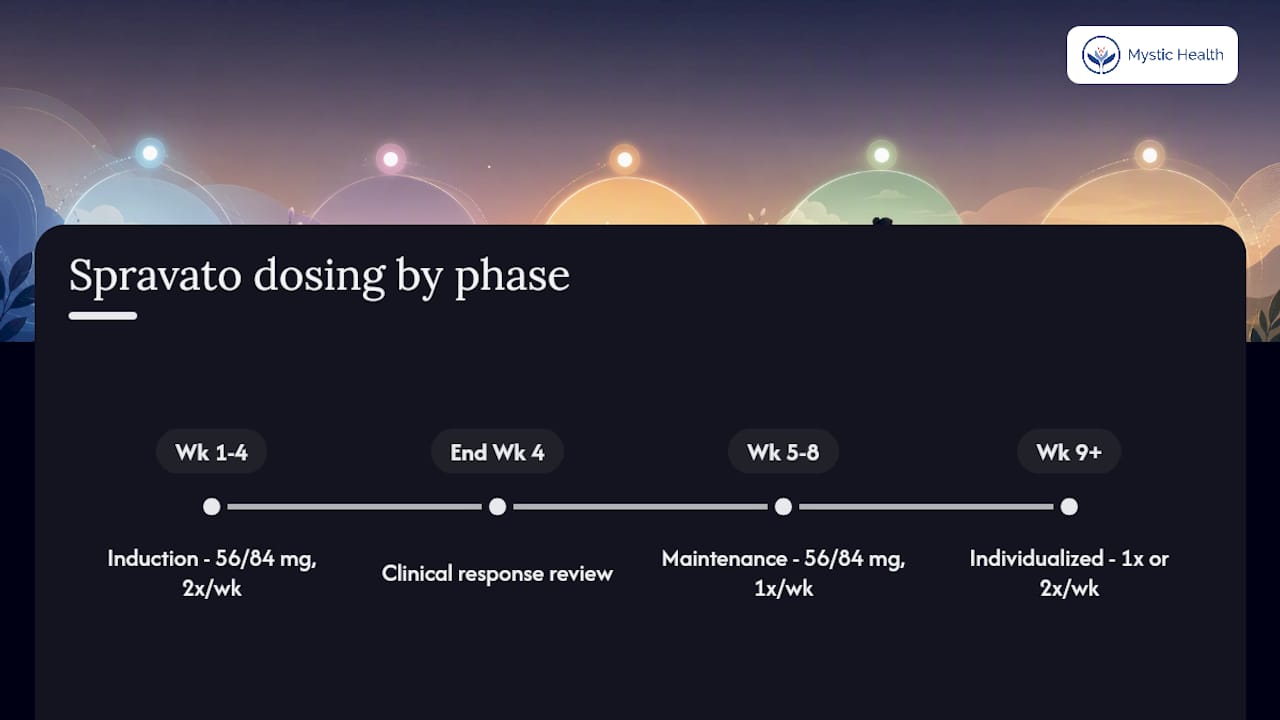
During induction, the Janssen prescribing information calls for twice-weekly sessions at either 56 mg or 84 mg. Most patients start at 56 mg. If that first dose is well tolerated and your provider wants to push toward a stronger response, the dose may increase to 84 mg at the next session. If side effects are rough, a single reduction back down is permitted. This isn’t a sign that treatment is failing. It’s the schedule doing exactly what it’s designed to do.
Maintenance begins in week 5. The frequency drops to once weekly, still at 56 mg or 84 mg, and this is typically when your clinician sits down with you to talk honestly about whether Spravato is moving the needle on your depression symptoms. That conversation matters. Clinical response is formally evaluated at the end of induction, and what you report in that visit shapes everything that follows.
From week 9 forward, dosing becomes individualized. Your provider aims for the lowest effective frequency, either weekly or every two weeks, based on how you’re doing. Long-term studies behind the drug’s approval, including the SUSTAIN trials, show patients settling into a mix of these patterns depending on symptom stability. Some stay weekly for months. Others taper to every other week and hold steady there.
Pro Tip: Keep a simple mood log between now and your next dose adjustment. Even three or four lines a day about sleep, energy, and irritability gives your provider real data to work with instead of a foggy memory of “the last two weeks.”
How Spravato Is Administered in the Clinic

Every session follows a structured process, and knowing it ahead of time takes a lot of the anxiety out of walking through the door.
Each nasal spray device delivers 28 mg total across two sprays. For a 56 mg dose, you’ll use two devices. For 84 mg, three. The devices are never primed beforehand, and you rest five minutes between each one to let absorption happen properly, according to DailyMed’s dosing details.
Here’s what a typical visit looks like from start to finish:
- Arrive with an empty stomach. The Spravato patient site recommends no food for at least 2 hours before dosing and no liquids for 30 minutes prior.
- Your provider checks baseline blood pressure and reviews how you’ve been feeling since the last session.
- You self-administer the nasal spray under supervision, one device at a time, with a 5-minute rest between each.
- You settle into observation for at least 2 hours while staff monitor blood pressure, alertness, and how you’re generally doing.
- Once cleared, you head home with your driver. Not yourself. Same-day driving isn’t allowed.
Plan for the whole visit to run 2 to 3 hours, not just the dosing itself. Wear something comfortable. Bring a book or headphones if that helps you settle in during the observation window. If you want a fuller walkthrough of what a first session feels like, our guide to what to expect covers the emotional side of it too.
Pro Tip: Nausea is one of the more common complaints during sessions. Sipping ginger tea beforehand (within your liquid restriction window) or asking your clinic about anti-nausea medication in advance can make a real difference.
Safety Monitoring and REMS Requirements During Treatment
Spravato cannot be dispensed for home use. It’s a Schedule III controlled substance, and every dose has to happen in a setting certified under the SPRAVATO REMS program, with a healthcare provider supervising directly. That structure exists because esketamine carries real risks around sedation, dissociation, and blood pressure spikes, and those risks need a trained eye watching for them in real time.
Blood pressure typically peaks around 40 minutes after dosing. Clinicians treat a baseline reading above 140/90 mmHg as a factor requiring clinical judgment about whether to proceed, and continued monitoring is standard until levels normalize.
Beyond blood pressure, your care team is watching respiratory status and your overall level of sedation. You won’t be released until you’re clinically stable, meaning alert, coordinated, and no longer feeling the drug’s dissociative effects. Driving or operating machinery is off the table until after a full night’s rest, not just until you feel “fine” in the clinic.
A few things worth confirming before your first appointment:
- Ask whether the clinic is REMS-certified (it must be, but confirming builds confidence).
- Understand that repeated vitals checks are normal, not a sign something’s wrong.
- Know that observation typically runs at least 2 hours, sometimes longer if your response calls for it.
If safety protocols around dissociative or psychedelic-adjacent treatments interest you more broadly, this guide to harm reduction covers the principles behind why these monitoring windows exist across the field.
Missed Sessions and Dose Adjustments
Life happens. A missed session doesn’t automatically undo your progress, but how your provider responds depends entirely on how you’re feeling.
If you miss a dose and your symptoms remain stable, you generally just pick back up on the existing schedule. No penalty, no restart. But if depressive symptoms noticeably worsen after a gap, your provider may step you back to a more frequent schedule, sometimes twice weekly again, to regain footing, per DailyMed’s missed-dose guidance.
Dose reductions work on similar logic. A single step down to 56 mg is permitted after your first dose if tolerability is an issue, and further adjustments are made case by case as treatment continues.
If you miss a session, here’s a simple sequence to follow:
- Contact your provider’s office as soon as you realize you’ll miss or have missed a dose.
- Track how you’re feeling over the following days, specifically mood, sleep, and irritability.
- Report any worsening promptly rather than waiting for your next scheduled visit.
- Follow your provider’s guidance on whether to resume the same schedule or temporarily increase frequency.
If scheduling logistics are a recurring headache, it’s worth reading how other clinics structure appointment flexibility around missed doses and rebooking.
Dosing for Acute Suicidal Ideation: A Different Regimen
Spravato dosing changes meaningfully for adults with major depressive disorder who are also experiencing acute suicidal ideation or behavior. This isn’t a variation of the standard treatment-resistant depression schedule. It’s a distinct regimen built for urgency.
The recommended dose for this indication is 84 mg twice weekly for 4 weeks, with reduction to 56 mg twice weekly permitted for tolerability. Use beyond that 4-week window hasn’t been systematically evaluated, so continuation is decided case by case with the treating provider.
Here’s how it diverges from the standard schedule covered earlier:
- Starting dose is higher (84 mg) rather than building up gradually.
- The twice-weekly frequency holds for the full 4 weeks with no maintenance step-down built in.
- There’s no established long-term protocol beyond week 4, unlike the individualized week 9-plus pattern used for treatment-resistant depression.
Caregivers should know this indication typically comes with tighter clinical oversight. Frequent assessment and an active safety plan matter here more than almost anywhere else in the treatment process, and providers usually coordinate closely with any existing mental health support the patient has.
How Long Does Spravato Treatment Typically Last?
There’s no fixed ceiling on how long someone stays on Spravato. That surprises a lot of people who expect a defined “course” the way you’d expect with an antibiotic.
Clinical practice leans toward individualized duration, with many patients continuing treatment for roughly 6 to 12 months while providers reassess regularly to maintain remission and watch for relapse.
Your clinician re-evaluates efficacy right at the end of induction, then continues checking in, often every 4 weeks or per the clinic’s own protocol, to figure out the lowest frequency that still keeps you stable. Follow-up visits typically involve:
- Standardized mood and symptom scales to track measurable change over time.
- Ongoing blood pressure checks tied to the same peak-effect window as your dosing sessions.
- Medication reconciliation, especially if you’re on other psychiatric medications alongside Spravato.
- Periodic conversations about whether your current frequency still fits or needs adjusting.
Roughly a third of patients in long-term studies had their frequency or dose adjusted more than once as treatment progressed, which tells you something important: this isn’t a “set it and forget it” medication. It’s a living treatment plan that moves with you.
Questions to Bring to Your Provider Before Starting
Walking into a Spravato conversation informed changes everything about how that conversation goes. A few questions worth raising directly with your provider:
- What specific indication am I being treated for, and how does that shape my dosing plan?
- What timeline should I expect before we know if this is working?
- How will you measure my response, and how often will we check in?
- What’s the safety plan if I have a difficult reaction during or after a session?
- Is this clinic REMS-certified, and am I enrolled in the program?
- What will this cost, and what does my insurance actually cover?
- Who is my designated driver contact, and does the clinic need that confirmed in advance?
On the day of treatment itself, a short prep checklist goes a long way: confirm your fasting window (no food for 2 hours, no liquids for 30 minutes), wear something comfortable, arrange your driver ahead of time, bring an updated medication list, and have a contact person the clinic can reach if needed. Confirming REMS enrollment and clinic certification isn’t paperwork for its own sake. It’s the structural backbone that makes supervised esketamine treatment as safe as it is.
How Mystic Health Supports Your Spravato Treatment Plan
Mystic Health administers Spravato in REMS-certified clinical settings, meaning every session follows the observation, monitoring, and safety protocol standards outlined above. Beyond the dosing itself, the care team coordinates with your prescriber, tracks your response across phases, and adjusts your treatment plan as your symptoms evolve, all under direct clinical supervision.

If you’re navigating a diagnosis like treatment-resistant depression and wondering whether Spravato fits your situation, the next step is a consultation, not a guessing game. Mystic Health’s team can walk you through insurance and benefits verification, help you enroll in the REMS program if you haven’t already, and get your first appointment on the calendar. Explore the full program details or start with an integrative mental health evaluation to see whether supervised Spravato treatment makes sense for your care plan. Final clinical decisions rest with your treating provider, but getting evaluated is the step that starts everything else moving.
Sources
Bringing primary sources into your appointment can make label language and dosing specifics easier to discuss directly with your care team.
- SPRAVATO prescribing information (Janssen)
- DailyMed - SPRAVATO (esketamine) dosing and device details
- How to use SPRAVATO® Nasal Spray (Spravato patient site)
- FDA — REMS overview
This article is general information, not a substitute for advice from a qualified doctor. Consult a qualified healthcare professional about your own circumstances before acting on anything here.
Recommended

Mystic Health Blog





FAQs
1. Am I eligible for ketamine therapy?
2. Does insurance cover the cost of ketamine therapy?
3. How many ketamine treatments will I need?
We recommend two initial treatments to determine suitability and adjust dosage. After these sessions, additional treatments are available based on your progress and specific requirements.