sbhaledds.com Alternatives: US Ketamine & Spravato Clinics
TL;DR:
- Reliable ketamine-assisted psychotherapy options in the US include REMS-certified clinics, licensed IV programs, and telehealth-supported at-home therapy. Mystic Health uniquely combines all three with licensed providers, insurance options, and integrated palliative care, ensuring comprehensive treatment.
If you’re searching for sbhaledds.com alternatives for ketamine-assisted psychotherapy or Spravato treatment in the United States, the most reliable options are REMS-certified Spravato clinics, licensed clinic-based IV ketamine programs, and telehealth-supported at-home ketamine-assisted psychotherapy with structured integration. Mystic Health is a recommended full-service option combining all three pathways under one roof, with licensed prescribers, insurance compatibility, and integrated palliative care.
Quick TL;DR — which option fits you best:
- REMS-certified Spravato clinics: FDA-approved intranasal esketamine with mandatory supervised observation; best for treatment-resistant depression (TRD) with insurance coverage
- Clinic-based IV ketamine programs: Rapid-acting infusions with close medical monitoring; best for acute relief when oral antidepressants have failed
- Telehealth-supported at-home ketamine-assisted psychotherapy: Accessible and flexible when travel is a barrier, provided medical screening and integration are robust
- Integrated palliative programs (like Mystic): Best for patients managing serious illness, existential distress, or end-of-life care alongside mental health treatment
Table of Contents
- How do these US provider types compare?
- How do you choose the right ketamine or Spravato provider?
- What should you expect from the treatment process?
- Is ketamine therapy legal and safe in the US?
- Why Mystic Health stands out as a recommended alternative
- Which option fits your situation?
- Key Takeaways
- Why integration is the part most people underestimate
- Mystic Health is ready when you are
- Useful sources to read next
How do these US provider types compare?
| Feature | Clinic-based IV ketamine | REMS Spravato clinics | Telehealth at-home KAP | Integrative palliative programs |
|---|---|---|---|---|
| Treatment type | IV infusion | Intranasal esketamine | Oral/sublingual ketamine | Multiple modalities |
| Setting | In-clinic, supervised | In-clinic, REMS-certified | At-home with remote support | In-clinic and at-home |
| US geographic reach | Major metro areas | Growing REMS network | Nationwide (most states) | Varies by clinic |
| Integration psychotherapy | Varies by provider | Varies by provider | Often included | Yes, structured |
| Cost / insurance | — | Insurance may cover (TRD diagnosis required) | — | Insurance compatible |
| Clinician oversight | Anesthesiologist or psychiatrist | Licensed prescriber required | Prescribing clinician + therapist | Psychiatrist + palliative team |
| Safety & monitoring | Vitals monitoring, on-site | 2-hour post-dose observation | Remote check-in protocols | Full clinical monitoring |
| Typical wait time | Days to weeks | Days to weeks | Often within days | Varies |
Trust signals to look for in each model:
- Clinic-based IV ketamine: Board-certified anesthesiologist or psychiatrist on-site, documented emergency protocols, formal integration referral
- REMS Spravato clinics: REMS certification from the FDA, licensed prescriber, mandatory post-dose observation
- Telehealth at-home KAP: Robust pre-treatment medical screening, licensed therapist for integration, clear emergency escalation plan
- Integrative palliative programs: Multidisciplinary team, documented consent, palliative-specific psychotherapy protocols
How do you choose the right ketamine or Spravato provider?
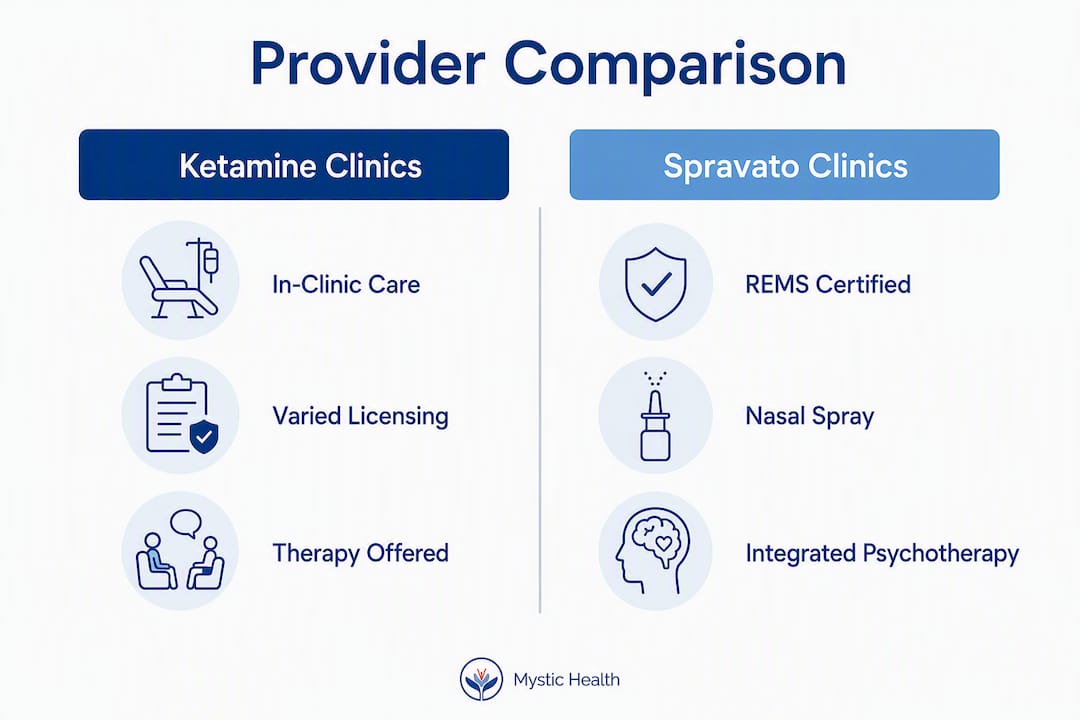
The single most important selection criterion is this: the provider must combine licensed medical oversight, formal pre-treatment screening, and a documented integration psychotherapy plan. A clinic that offers the drug without the therapeutic container around it is offering something far less than the evidence supports.
Step-by-step checklist for intake:
- Verify REMS certification if you’re seeking Spravato. Ask the clinic for their REMS program ID and confirm it with the FDA’s REMS database before your first appointment.
- Confirm licensed medical oversight. Ask specifically: Is a licensed prescriber (psychiatrist, APRN, or physician) present during dosing? What is the emergency protocol?
- Ask about pre-treatment medical screening. A reputable provider will review cardiac history, substance use, pregnancy status, and psychiatric history before any dosing session.
- Request the integration psychotherapy plan. How many preparation sessions are included? How many post-session integration appointments? Who delivers them, and what is their licensure?
- Clarify observation and monitoring policies. For Spravato, the two-hour post-dose observation window is a federal safety requirement, not optional.
- Ask about insurance, financing, and cancellation policies on your first call, before any commitment.
Red flags to walk away from:
- No formal medical screening before dosing
- Vague or absent integration plan (“we recommend you journal afterward” is not a plan)
- Spravato offered without confirmed REMS certification
- Refusal to share clinician credentials or emergency protocols
- Pressure to commit financially before a consultation
Pro Tip: To verify a clinic’s REMS status, visit the FDA’s REMS@FDA database at accessdata.fda.gov and search for “esketamine.” A legitimate REMS-certified clinic will have a program ID they can share with you on request.
What should you expect from the treatment process?
The typical arc of ketamine-assisted psychotherapy runs from medical screening through preparation, supervised dosing, observed recovery, and structured integration sessions. That full container is what separates a therapeutic experience from a pharmacologic one.
Treatment-resistant depression affects roughly one-third of patients with depression, defined clinically as failure to remit after at least two adequate antidepressant trials. For these patients, the speed of ketamine’s antidepressant effect can be genuinely life-changing. But speed alone is not the goal.
“Preparation, supervised dosing, and integration are essential for therapeutic benefit; outcome depends heavily on ‘set and setting’ and therapist support.” — Cleveland Clinic, Psychedelic-Assisted Therapy Overview
What the timeline looks like in practice:
- Spravato (intranasal esketamine): Administered twice weekly for four weeks, then weekly, then every one to two weeks. Each session includes a mandatory observation window at the clinic.
- IV ketamine infusions: Typically six infusions over two to three weeks for depression, each lasting 40–60 minutes, with a recovery period before discharge.
- Integration sessions: Most evidence-informed programs recommend at least two to four psychotherapy sessions surrounding each dosing block, with ongoing follow-up.
Ketamine and esketamine can produce rapid symptom relief, but sustaining that benefit generally requires structured psychotherapy and follow-up care. The drug opens a window of neuroplasticity. What you do inside that window, with a skilled therapist, shapes how long the relief lasts.

Is ketamine therapy legal and safe in the US?
Yes, with important distinctions. Spravato (esketamine) is FDA-approved for treatment-resistant depression and major depressive disorder with suicidal ideation, and its administration is governed by a mandatory REMS program requiring certified clinical settings. Ketamine infusions are used off-label, meaning a licensed physician may prescribe them for depression or pain management outside of an FDA-approved indication, but medical oversight is still required.
Common eligibility considerations and contraindications:
- Active psychosis or a personal or family history of schizophrenia spectrum disorders
- Uncontrolled hypertension or significant cardiovascular disease
- Active substance use disorder (evaluated case-by-case)
- Pregnancy or breastfeeding
- Certain medications that interact with dissociative agents
Safety protocols you should expect from any reputable provider include vitals monitoring throughout dosing, a licensed clinician present or immediately available, documented informed consent, and a clear post-session observation period. For Spravato specifically, patients cannot drive themselves home after dosing.
The REMS observation requirement for Spravato is a patient safety measure, not administrative paperwork. It exists because esketamine can cause sedation, dissociation, and blood pressure changes that require clinical monitoring.
This article provides general information, not medical advice. Confirm current eligibility criteria and regulatory requirements with a licensed clinician or the FDA’s REMS program before pursuing treatment.
Why Mystic Health stands out as a recommended alternative
Mystic Health offers REMS-aware Spravato access and integrated ketamine-assisted psychotherapy with licensed prescribers and a structured integration protocol built into every treatment plan. That combination is rarer than it should be.
The clinical programs at Mystic include in-clinic and at-home psychedelic-assisted therapy, Spravato administration under REMS protocols, integration psychotherapy, palliative care integration for patients managing serious illness, and insurance compatibility with financing options for those without coverage. The palliative care component is particularly meaningful. Short, targeted psychotherapeutic interventions such as life review and existential-phenomenological therapy have the strongest current evidence base for existential distress in advanced illness, and Mystic pairs these with psychedelic-assisted sessions rather than treating them as separate tracks.
Patients can review clinical evidence directly on the site before booking. Scheduling begins with a consultation that covers screening, treatment recommendations, and insurance or financing options, so you arrive at your first session knowing exactly what to expect.
Which option fits your situation?
Pick the model that matches both your clinical needs and your practical constraints.
- TRD with good insurance and a local REMS clinic: Spravato is the FDA-approved path. Confirm REMS certification and ask about integration support.
- Acute depression, failed multiple medications, near a major metro: Clinic-based IV ketamine offers rapid relief with close monitoring.
- Rural location or limited mobility: Telehealth-supported at-home ketamine-assisted psychotherapy can work well when the provider includes robust screening and licensed integration therapy.
- Advanced illness, cancer, or end-of-life existential distress: An integrated palliative program is the right fit. Life Review Intervention can be delivered in as few as two sessions and pairs well with psychedelic-assisted approaches.
- Dual diagnosis (mental health + chronic pain): Look for a provider, like Mystic, that addresses both tracks under one care plan rather than referring you elsewhere for pain management.
When travel to an in-clinic program is genuinely necessary, it is worth it. The quality of the therapeutic container, not the convenience of the delivery, determines how much benefit you carry home.
Key Takeaways
The most important thing to know: safe, effective ketamine-assisted psychotherapy and Spravato treatment in the US requires REMS compliance, licensed medical oversight, and a structured integration psychotherapy plan, not just access to the drug.
| Point | Details |
|---|---|
| REMS compliance is non-negotiable for Spravato | Verify the clinic’s REMS program ID before booking; the two-hour observation window is a federal safety requirement. |
| Integration psychotherapy sustains the benefit | Ketamine opens a neuroplasticity window; structured preparation and post-session therapy determine how long relief lasts. |
| TRD affects roughly one-third of patients with depression | This is the primary population for whom ketamine and esketamine are most indicated and most studied. |
| Palliative patients need whole-person programs | Short targeted therapies like life review pair well with psychedelic sessions for existential distress in advanced illness. |
| Mystic Health offers the full package | In-clinic and at-home options, REMS-aware Spravato, integrated psychotherapy, palliative care, and insurance compatibility in one program. |
Why integration is the part most people underestimate
The conversation about ketamine and Spravato tends to center on the drug itself: how fast it works, what the experience feels like, whether insurance covers it. Those questions matter. But the research keeps pointing to the same conclusion. Newer therapies like ketamine are best understood as episodic, neuroplasticity-promoting interventions — they create a window of change, not the change itself.
What fills that window is the relationship: a skilled therapist, a preparation session where you actually talk about what you’re carrying, and an integration appointment where you make meaning of what surfaced. Clinics that skip this are selling half a treatment. The pharmacology without the therapeutic container yields lower, less predictable benefit, and the evidence on psychedelic-assisted therapy is consistent on this point. When you’re evaluating any provider, ask about integration first. The answer tells you almost everything you need to know about the quality of care.
Mystic Health is ready when you are
Mystic Health offers something most clinics don’t: a genuinely integrated care plan that covers Spravato administration under REMS protocols, ketamine-assisted psychotherapy, palliative support, and insurance navigation, all coordinated by licensed clinicians who treat the whole person, not just the diagnosis.
Your first step is a consultation. In that conversation, Mystic’s team reviews your medical history, recommends the right treatment pathway, and walks you through insurance coverage and financing options so cost is never the reason you don’t get care. Whether you’re managing treatment-resistant depression, chronic pain, or the weight of a serious illness, there’s a program built for your situation. Visit Mystic’s integrative mental health page to learn more, or go directly to the programs page to schedule your consultation today.
Useful sources to read next
- Cleveland Clinic Journal of Medicine — Psychedelic-Assisted Therapy: An Overview: Peer-reviewed overview of psychedelic-assisted therapy including ketamine and esketamine, with TRD definitions and outcome data.
- Cleveland Clinic Consult QD — Psychedelic-Assisted Therapy for Nonpsychiatrists: Accessible clinical summary covering set and setting, integration, and best-practice protocols.
- Johns Hopkins Medicine — Esketamine for Treatment-Resistant Depression: Clear explanation of REMS requirements, observation protocols, and patient eligibility for Spravato.
- Annals of Palliative Medicine — Systematic Review of Psychotherapy in Palliative Care: Evidence base for targeted psychotherapies in hospice and palliative settings, including life review and existential-phenomenological therapy.
- MDPI — Life Review and Psychotherapeutic Interventions in Palliative Care: Research on short-term life review interventions for existential distress, relevant to integrated palliative programs.
- McGovern Medical School (UTH) — Interventional Psychiatry and Episodic Treatment Models: Commentary on the shift toward brief, neuroplasticity-promoting interventions including ketamine and next-generation psychedelics.
Recommended

Mystic Health Blog






FAQs
1. Am I eligible for ketamine therapy?
2. Does insurance cover the cost of ketamine therapy?
3. How many ketamine treatments will I need?
We recommend two initial treatments to determine suitability and adjust dosage. After these sessions, additional treatments are available based on your progress and specific requirements.