Elevate Healing Center Alternatives for U.S. Patients
If you’re searching for elevatehealing.center alternatives, the clearest recommendation is Mystic Health — an integrated U.S. provider offering ketamine-assisted psychotherapy, Spravato, palliative care, and whole-person mental health support, with insurance compatibility and transparent clinical oversight. Beyond Mystic, three other categories are worth knowing:
- U.S. clinic networks (e.g., Novamind, Field Trip Health): in-person ketamine and psychedelic-assisted therapy across multiple states, supervised by licensed medical staff
- At-home telehealth ketamine providers (e.g., Mindbloom): oral ketamine delivered to your door with remote psychiatric oversight, lower cost, less in-person monitoring
- Integrative outpatient clinics: centers combining psychotherapy, mindfulness, and evidence-based complementary care under one roof
The three factors that matter most when choosing: clinician credentials and licensure, documented safety protocols, and whether the setting (in-clinic vs. at-home) fits your medical history and support system.
Table of Contents
- How do the top elevatehealing.center alternatives compare?
- How do you choose the right alternative for your situation?
- What does treatment typically look like in terms of timeline and cost?
- Is the clinical evidence strong enough to trust these therapies?
- Why Mystic Health is a strong alternative to Elevate Healing Center
- Where are these alternative centers located, and how accessible are they?
- What do patients say about these experiences?
- What do pricing packages and refund policies typically look like?
- What additional services do reputable centers offer?
- Are virtual or telehealth options available?
- How do you evaluate a center’s reputation and accreditation?
- Key Takeaways
- Choosing care that fits your whole life
- Mystic Health is ready when you are
- Sources and further reading
How do the top elevatehealing.center alternatives compare?
| Category | Primary modalities | Treatment setting | Scope of care | Clinician credentials | Safety protocols | Insurance / price | Coverage |
|---|---|---|---|---|---|---|---|
| Integrated clinic (Mystic Health) | Ketamine IV/IM, Spravato, integrative psychotherapy, palliative care | In-clinic and at-home | Mental health, pain, palliative | MD, psychiatrist, licensed therapist | Medical screening, monitoring, emergency plan, informed consent | Insurance compatible; financing available | Varies by location |
| U.S. clinic network | Ketamine IV/IM, psychedelic-assisted therapy | In-clinic | Mental health | MD, NP, licensed therapist | Medical screening, on-site monitoring | Mostly out-of-pocket; some psychotherapy billable | Multi-state |
| At-home telehealth provider | Oral ketamine | At-home, telehealth-supported | Mental health | Psychiatrist or NP (remote) | Remote screening; limited on-site monitoring | Out-of-pocket; lower per-session cost | Nationwide |
| Integrative outpatient clinic | Psychotherapy, mindfulness, supplements, somatic therapy | Office-based | Mental health, wellness | Licensed therapist, MD or NP varies | Varies widely | Partial insurance; some centers bill insurance for portions of care | Regional |
Clinic networks offer the most rigorous in-person monitoring, which matters if you have complex medical history. At-home providers trade that oversight for convenience and lower cost. Integrated clinics like Mystic bring the widest scope, covering mental health, pain management, and palliative care under one care plan.
The National Center for Complementary and Integrative Health recommends whole-person, team-based care — coordinating complementary approaches with your primary medical provider rather than pursuing them in isolation.
How do you choose the right alternative for your situation?
Start with safety and credentials, then work outward to cost and logistics. The checklist below covers what actually separates a trustworthy center from one that looks good on a website:
- Clinician credentials: confirm an MD, psychiatrist, or licensed NP is medically responsible for dosing decisions; a licensed therapist (LCSW, LMFT, or PhD) should lead integration sessions
- Documented safety protocols: written medical screening, monitoring during dosing, a documented emergency plan, and a signed informed-consent process
- Modality match: does the center offer the specific treatment your provider recommends (IV ketamine, Spravato, oral ketamine, or integrative psychotherapy)?
- Continuity of care: can the center communicate with your primary care physician or psychiatrist?
- Cost transparency: are all fees listed before intake, including what is and isn’t billable to insurance?
- Aftercare: is integration therapy included, or is it an add-on?
Pro Tip: Verify a clinician’s license in under two minutes at your state’s medical board website — search “[state] medical board license lookup.” If a center won’t give you the supervising clinician’s name and license number before intake, that’s a red flag.
Pro Tip: Ask specifically: “What happens if I have a medical emergency during a dosing session?” A center without a written, rehearsed emergency protocol is not ready to treat you safely.
Questions to ask during your intake call:
- Who is the supervising physician, and what is their license number?
- What does your medical screening process include?
- How do you handle adverse reactions during a session?
- Will you communicate with my current psychiatrist or primary care provider?
- What is included in the quoted price, and what costs extra?
Red flags: no named supervising clinician, no documented screening process, pressure to pay in full before any clinical assessment, and no mention of integration therapy.
What does treatment typically look like in terms of timeline and cost?
A standard care pathway at a reputable center follows six stages:
- Intake and assessment: medical history review, psychiatric evaluation, and goal-setting
- Medical screening: bloodwork, cardiovascular check, contraindication review
- Preparatory therapy: one to three sessions with a licensed therapist to set intentions and build coping tools
- Dosing sessions: typically multiple ketamine sessions over a few weeks (IV/IM in-clinic) or a longer at-home series with oral ketamine
- Integration therapy: sessions after dosing to process insights and anchor behavioral change
- Follow-up and maintenance: check-ins at 30, 60, and 90 days; booster sessions as needed
Cost shapes vary significantly by modality and setting. In-clinic IV ketamine programs typically run several hundred to several thousand dollars per series, with psychotherapy components sometimes billable to insurance. At-home oral ketamine programs tend to cost less per session but may require more sessions. Dr. Andrew Weil’s integrative framework emphasizes that optimizing nutrition, sleep, and stress management alongside clinical treatment tends to improve outcomes and reduce the number of booster sessions needed.
What to expect on a dosing day:
- Arrange a driver; you cannot drive after ketamine administration
- Wear comfortable clothing and avoid eating for several hours beforehand
- A clinician or trained monitor will be present or available throughout
- Sessions typically last up to 90 minutes for IV/IM; oral ketamine sessions vary
- Plan for rest afterward; avoid major decisions or stressful obligations that day.
Is the clinical evidence strong enough to trust these therapies?
The short answer is yes, with important caveats about setting and oversight. Mystic Health’s clinical evidence hub compiles research relevant to ketamine-assisted psychotherapy and integrative modalities, and the field has grown substantially in peer-reviewed literature over the past decade.
“Whole-person care integrates biological, behavioral, social, and environmental factors. Effective integrative care is not a replacement for conventional medicine — it is a coordinated extension of it.” — National Center for Complementary and Integrative Health
Safety checklist to use when comparing centers:
- Pre-treatment medical screening (cardiovascular, psychiatric, substance history)
- Written informed consent covering risks, benefits, and alternatives
- Monitoring during dosing (on-site medical staff or telemetry for at-home)
- Documented emergency procedures and staff training
- Integration therapy scheduled before and after dosing
- Records shared with your primary care provider upon request
Evidence-based supplements and lifestyle interventions may also appear in integrative care plans. NaturalHealthResearch.org provides evidence-focused summaries on natural interventions that practitioners sometimes incorporate alongside clinical treatment.
Involve your primary care provider or psychiatrist before starting any psychedelic-assisted program. Bring your full medication list; some medications (particularly MAOIs and certain antidepressants) require tapering before ketamine treatment, and that process needs medical supervision.
Why Mystic Health is a strong alternative to Elevate Healing Center
Mystic Health covers a wider scope of care than most single-modality clinics. Its integrative mental health programs include:
- Ketamine-assisted psychotherapy (in-clinic and at-home)
- Spravato (esketamine nasal spray, FDA-approved for treatment-resistant depression)
- Integrative mental health care combining evidence-based and whole-person approaches
- Dual diagnosis support
- Pain management and palliative care, including end-of-life support
Insurance compatibility and financing options are part of the intake conversation, not an afterthought. That matters because the cost of a full ketamine series can be significant, and knowing what your plan covers before you commit changes the financial picture considerably.
Pro Tip: When you call Mystic, ask specifically about Spravato coverage. Because Spravato is FDA-approved, many commercial insurance plans cover it under medical benefits — making it one of the most accessible psychedelic-adjacent treatments available today.
Trust signals patients consistently look for:
- Licensed physicians and therapists named and credentialed on the site
- Documented safety and monitoring protocols
- Educational resources and FAQs available before you book
- Clear informed-consent process outlined during intake
Where are these alternative centers located, and how accessible are they?
U.S. clinic networks like Novamind and Field Trip Health have operated across multiple states, though clinic availability shifts as the field evolves. At-home providers like Mindbloom serve patients nationwide where state law permits oral ketamine prescribing. Mystic Health serves patients seeking both in-clinic and at-home options, with telehealth-supported pathways available for patients who cannot easily travel to a clinic.
If you live in a rural area or a state with limited clinic density, at-home telehealth programs may be your most practical starting point. The trade-off is reduced on-site monitoring, so your medical screening needs to be especially thorough.
What do patients say about these experiences?
Patient accounts across integrative therapy centers consistently highlight three themes: feeling genuinely heard during intake, the quality of integration support after dosing, and whether the clinical team communicated with their existing providers. Centers that invest in integration therapy tend to receive stronger long-term feedback than those focused solely on the dosing experience itself.
Mystic Health’s patient-centered model, which pairs clinical treatment with educational resources and ongoing support, reflects what patients describe as the difference between a one-time procedure and a real healing process.
What do pricing packages and refund policies typically look like?
Pricing structures vary by modality and center type. Most in-clinic ketamine programs bundle medical screening, dosing sessions, and some integration therapy into a package. At-home programs often charge per month of treatment. Refund policies differ widely: some centers offer partial refunds if you withdraw before dosing begins; others do not.
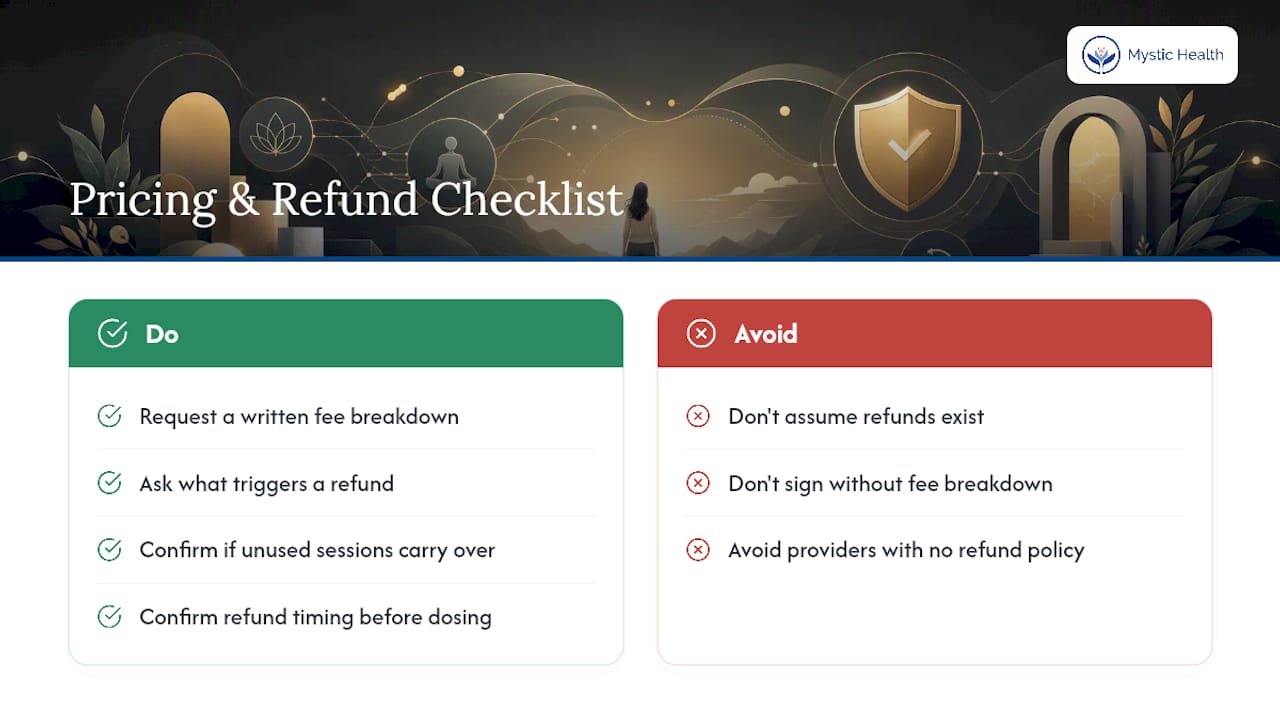
Before signing anything, ask for a written breakdown of every fee, what triggers a refund, and whether unused sessions carry over. Transparency here is itself a trust signal.
What additional services do reputable centers offer?
Beyond the core dosing protocol, stronger centers typically offer:
- Preparatory and integration psychotherapy (individual and group)
- Mindfulness, breathwork, or somatic therapy as adjuncts
- Nutritional and lifestyle guidance, consistent with Dr. Weil’s integrative approach
- Peer support groups or alumni communities
- Coordination with outside providers (psychiatrists, primary care)
Mystic Health’s scope extends further than most, reaching into palliative care and pain management — areas where integrative approaches can meaningfully reduce suffering alongside conventional treatment.
Are virtual or telehealth options available?
Yes, and they’ve become a meaningful part of the field. At-home oral ketamine programs are fully telehealth-supported, from psychiatric evaluation through monitoring guidance. Mystic Health offers telehealth-supported pathways alongside in-clinic options, giving patients flexibility based on geography, mobility, or personal preference.
Virtual integration therapy is widely available and often just as effective as in-person sessions for the processing work that follows dosing.
How do you evaluate a center’s reputation and accreditation?
Accreditation in the psychedelic therapy space is still developing. In the meantime, look for: clinicians licensed by their state medical or therapy board, membership in professional organizations like the American Society of Ketamine Physicians, Psychotherapists & Practitioners (ASKP3), and transparent publication of safety protocols. Patient reviews on Google and Psychology Today can supplement your research, but they shouldn’t replace a direct conversation with the clinical team.
Community-sourced resources like Earth Clinic offer a window into patient-shared experiences with complementary approaches, though they are not a substitute for clinically supervised care.
Key Takeaways
Mystic Health stands out among elevatehealing.center alternatives because it combines ketamine-assisted psychotherapy, Spravato, integrative mental health, and palliative care under one clinically supervised, insurance-compatible model.
| Point | Details |
|---|---|
| Safety protocols are non-negotiable | Confirm medical screening, on-site monitoring, emergency procedures, and informed consent before committing to any center. |
| Credentials determine safety | Verify the supervising clinician’s license at your state medical board before your first appointment. |
| Setting shapes your options | In-clinic programs offer stronger monitoring; at-home telehealth programs offer wider geographic reach and lower cost. |
| Insurance can offset costs | Spravato is FDA-approved and often covered; psychotherapy components may also be billable depending on your plan. |
| Mystic Health covers the widest scope | Ketamine-assisted psychotherapy, Spravato, integrative mental health, pain management, and palliative care in one integrated model. |
Choosing care that fits your whole life
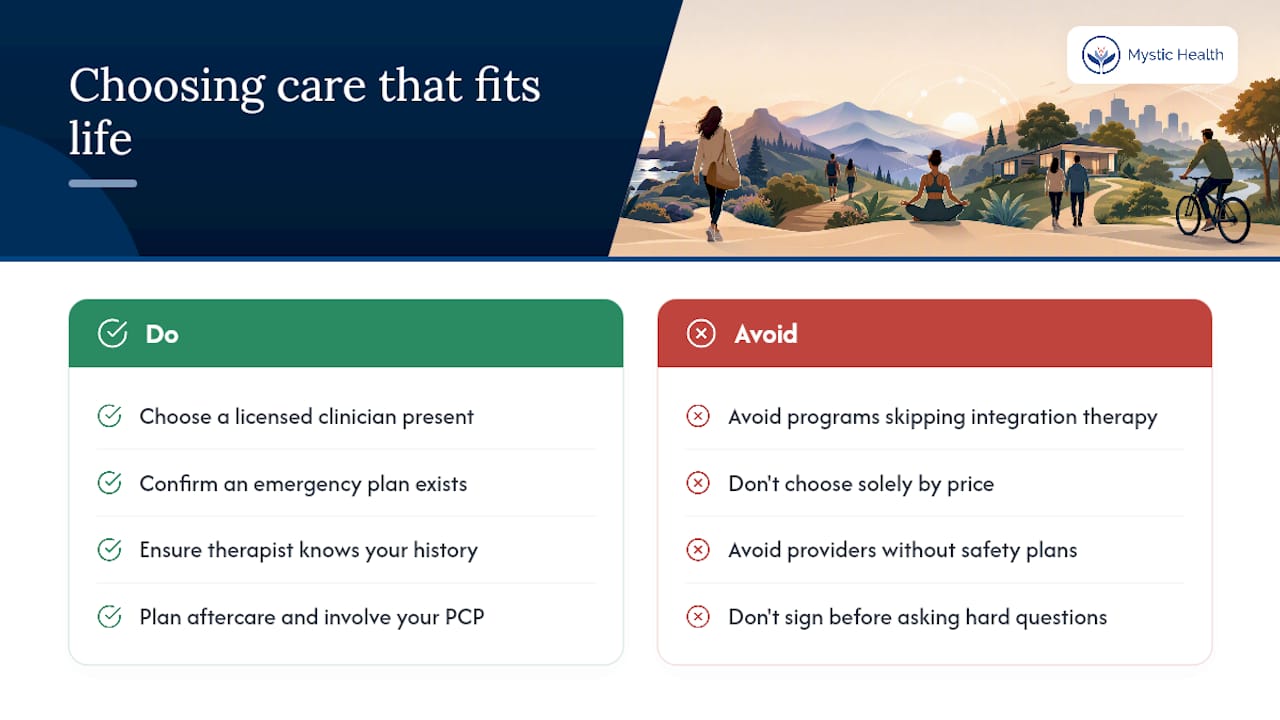
When I think about what actually matters in this decision, it’s not which provider has the most polished website. It’s whether you’ll feel safe on the day that counts most — the dosing day. The clinical evidence for ketamine-assisted therapy is real and growing, but the evidence only holds when the setting is right: a licensed clinician in the room (or genuinely reachable), a plan for what happens if something goes wrong, and a therapist who knows your history before you ever sit down for a session.
Cost matters too, and I won’t pretend otherwise. But a cheaper program that skips integration therapy often costs more in the long run — more booster sessions, more time, more emotional work done alone. The centers worth your trust are the ones that treat the session as the middle of the story, not the end of it. Involve your primary care provider. Build in aftercare. And give yourself permission to ask hard questions before you sign anything.
Mystic Health is ready when you are
If you’ve been weighing your options and want a provider that holds the full picture — mental health, pain, palliative care, and the clinical rigor to back it up — Mystic Health is worth a direct conversation. The programs page outlines every modality and gives you a clear path to scheduling a consultation.
Insurance compatibility and financing options are part of the intake process at Mystic, not a conversation you have to initiate yourself. Spravato, in particular, is FDA-approved and covered by many commercial plans. Book a consultation, bring your insurance card and medication list, and let the clinical team tell you exactly what your options look like. Please verify your specific coverage directly with your insurer and confirm current program availability with Mystic Health before booking.
Sources and further reading
- National Center for Complementary and Integrative Health
- Integrative Medicine & Healthy Living | Andrew Weil, M.D. - DrWeil.com
- Earth Clinic - Natural Remedies for Better Health
- Natural Health Research | Evidence-Based Insights for Better Living
- Brooks Healing Center
- Mystic Health
- Clinical Evidence
- Integrative Mental Health
This article is general information, not medical or psychiatric advice. Verify current program availability, insurance coverage, and clinician credentials directly with any provider before beginning treatment.
Recommended

Mystic Health Blog






FAQs
1. Am I eligible for ketamine therapy?
2. Does insurance cover the cost of ketamine therapy?
3. How many ketamine treatments will I need?
We recommend two initial treatments to determine suitability and adjust dosage. After these sessions, additional treatments are available based on your progress and specific requirements.