Best HealingMaps.com Alternatives for U.S. Patients
TL;DR:
- Mystic Health stands out as a clinician-led provider offering comprehensive mental health and psychedelic therapies with insurance options. Directory platforms like Psychedelic.Support and Medicinal Maps help locate credentialed practitioners but cannot verify real-time insurance or clinical quality. Always book an initial consultation before starting treatment to ensure proper clinical oversight and safety.
If you’re searching for healingmaps.com alternatives, the short answer is this: Mystic Health stands out as the recommended direct-provider option for clinician-managed ketamine and psychedelic-assisted care, while Psychedelic.Support, Medicinal Maps, MAPS Provider Directory, and MapWithinUs serve as the strongest directory-based alternatives. The difference that matters most is not which platform has the most listings. It’s whether the option you choose connects you to a verified clinician who will actually sit with you, assess your history, and guide your care.
Here’s a quick shortlist to orient you:
- Mystic Health (direct provider) — Best for patients who want clinician-led ketamine-assisted psychotherapy (KAP), Spravato, or integrative mental health care with insurance and financing options built in.
- Psychedelic.Support (clinician network / directory) — Best for finding credentialed therapists and practitioners across multiple modalities, with an emphasis on education and safe practice.
- Medicinal Maps (directory with paid featured listings) — Best for browsing regional clinic options, with the caveat that featured listings are paid placements verified against quality standards.
- MAPS Provider Directory (research-aligned network) — Best for patients specifically seeking MDMA-assisted therapy or research-adjacent clinical care.
- MapWithinUs (curated retreat map) — Best for those exploring retreat-based or community-oriented healing spaces rather than clinical treatment.
The single most important step, regardless of which platform you use, is booking a initial consultation before any treatment begins. No directory can replace that clinical evaluation.
Table of Contents
- How do these healingmaps.com alternatives actually compare?
- How do you choose between a directory and a direct clinic?
- What actually changes for you depending on which route you take?
- Why Mystic Health is a recommended clinically managed alternative
- U.S. safety and legal standards to check before booking
- Key Takeaways
- Why clinical curation matters more than most people realize
- Mystic Health offers a clear path from search to care
- Useful sources for further research
How do these healingmaps.com alternatives actually compare?
| Platform | Type | Verification / Curation | Geographic Coverage | Treatment Types | Telehealth / At-Home | Insurance / Financing | Best For |
|---|---|---|---|---|---|---|---|
| Mystic Health | Direct provider / clinic | Clinician-led intake, medical director on staff | National (U.S.) | KAP, ketamine infusion, Spravato, integrative mental health, palliative care | Yes (at-home supervision programs available) | Insurance compatible; financing options | Patients wanting full clinical oversight and continuity |
| Psychedelic.Support | Clinician network / directory | Practitioner credentials reviewed | National (U.S.) | Ketamine, psilocybin-assisted, MDMA, ayahuasca prep | Varies by practitioner | Varies by practitioner | Finding a credentialed therapist for a specific modality |
| Medicinal Maps | Directory (paid featured listings) | Team verifies featured clinics against quality standards; listings are paid | National (U.S.) | Ketamine, Spravato, psychedelic-assisted therapy | Varies by clinic | Varies by clinic | Regional clinic browsing with some quality filtering |
| MAPS Provider Directory | Research-aligned network | Affiliated with clinical trial protocols | National (U.S.) | MDMA-assisted therapy, clinical trial access | Limited | Varies | Research-adjacent or MDMA-specific care seekers |
| MapWithinUs | Curated retreat map | Personally researched listings, community-vetted | International (multi-country) | Retreat centers, conscious communities | No | No | Retreat or community-based healing exploration |
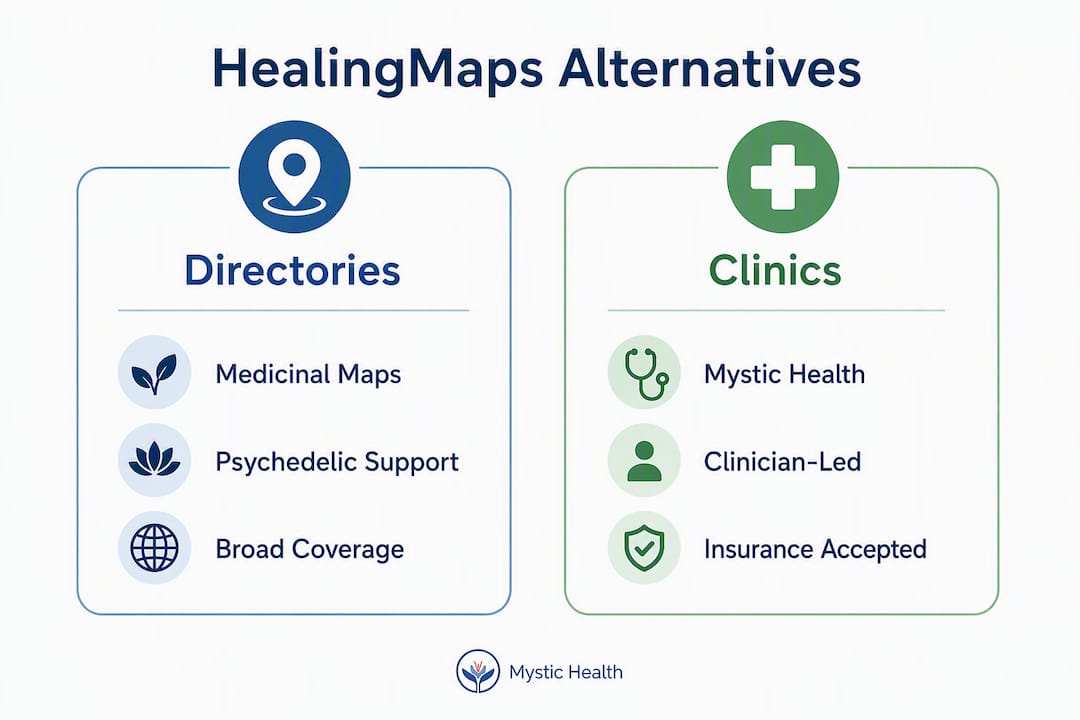
Quick category read: Directories give you discovery breadth but rarely confirm real-time insurance status or whether KAP includes a licensed psychotherapist. Direct providers like Mystic give you continuity, clinical accountability, and a clear intake path from day one.
How do you choose between a directory and a direct clinic?
Start with your intent. Use a directory when you need to survey what’s available in your region or compare modalities side by side. Choose a direct provider when you want clinical oversight, follow-up care, and someone who knows your history across sessions.

Selection checklist before you book
| Check | What to verify |
|---|---|
| Clinician licensure | MD, DO, NP, or PA on staff; confirm with state licensing board |
| Medical director | Named medical director listed on the clinic’s website |
| Consult requirement | Clinic requires an intake consultation before treatment |
| KAP vs. infusion | If you want KAP, confirm a licensed psychotherapist is involved, not just infusion |
| Insurance status | Call billing with your insurance card; directory listings rarely reflect real-time coverage |
From search to first treatment: a realistic timeline
- Discovery (Day 1–3): Use a directory or search by condition and therapy type to build a shortlist of 3–5 clinics.
- Intake consult (Week 1–2): Book a 30–60 minute consultation. This is where the clinic assesses your history, medications, and goals.
- Informed consent (Week 2): Review the clinic’s consent documents, emergency protocols, and follow-up plan.
- First treatment (Week 2–4): Treatment begins only after medical screening is complete.
Questions to ask during your intake call
- Is there a licensed psychotherapist involved in KAP sessions, or is this infusion-only?
- Do you accept my insurance, and can billing confirm my in-network status before I book?
- Who is the medical director, and are they available during treatment sessions?
- What does your follow-up or integration support look like after the first session?
- What are your emergency protocols if I have an adverse reaction?
Intent-based matching — searching by condition, insurance, or therapy style — frequently determines whether a directory or a direct provider is the better next step.
What actually changes for you depending on which route you take?
The core difference is curation and continuity. Directories are discovery tools. Clinics are care providers. That distinction shapes everything from how you find a provider to what happens after your first session.
When you use a directory, you’re browsing a list. Some of those listings are paid featured placements that have been verified against quality standards, but prominence in a directory is not a reliable proxy for clinical quality. A clinic that paid for a featured spot may be excellent. It may also be infusion-only, with no psychotherapy component at all.
Community-vetted platforms like MapWithinUs take a different approach, personally researching each listing rather than relying on algorithms or paid placement. That’s a meaningful step up in curation, though these platforms skew toward retreat centers rather than clinical treatment.
Pro Tip: Before booking any KAP session, ask explicitly whether a licensed psychotherapist facilitates the integration component. Ketamine-assisted psychotherapy is clinically distinct from ketamine infusion therapy. KAP requires a licensed psychotherapist on-site or by telehealth. Many directory listings, including some on HealingMaps, mark KAP availability as “not specified.” Don’t assume.
For directories: use them to build a shortlist, then call each clinic directly to confirm licensure, insurance, and whether KAP is genuinely offered. For direct providers: verify the medical director’s credentials and ask for the intake process in writing before you commit.
Why Mystic Health is a recommended clinically managed alternative
Mystic Health is built for patients who want more than a listing. It’s a clinician-led, evidence-aligned provider offering integrative mental health care that includes the full spectrum of psychedelic and ketamine therapies, with a clear intake process and real support for navigating insurance.
What Mystic offers:
- Ketamine-assisted psychotherapy (KAP) with licensed psychotherapist involvement
- Ketamine infusion therapy
- Spravato (esketamine nasal spray, FDA-approved)
- At-home supervision programs
- Integrative mental health care and dual diagnosis treatment
- Pain management and palliative services
What to expect from the intake process:
- Initial 30–60 minute consultation to review your history, goals, and medications.
- Medical screening and informed consent review.
- Personalized treatment plan with integration support built in.
- Ongoing follow-up care coordinated by the clinical team.
Mystic accepts insurance and offers financing options, which removes one of the most common barriers patients face when exploring this kind of care. That transparency matters. You shouldn’t have to guess what your treatment will cost.
Pro Tip: When you call Mystic’s billing team, have your insurance card ready. Confirming in-network status before your intake consult saves time and prevents surprises.
U.S. safety and legal standards to check before booking
Verify three things before you book with any clinic: clinician licensure, the existence of a named medical director, and whether KAP includes a licensed psychotherapist. These are not optional checks. They are the baseline for safe, legal care in the United States.
Directories frequently omit up-to-date insurance and KAP details, which means the responsibility falls on you to call and confirm. That’s not a flaw in the system you should work around. It’s a step you should expect.
Safety checklist:
- Confirm the treating clinician holds a current state license (MD, DO, NP, or PA).
- Verify a named medical director is on staff and reachable.
- Ask for written informed consent documents and emergency protocols before your first session.
- Call billing directly with your insurance card to confirm in-network status.
- Ask about medical screening requirements and what follow-up looks like.
State laws and regulations governing psychedelic-assisted therapies vary across the U.S. Always ask the clinic for written policies, and consult a qualified healthcare professional for guidance specific to your situation. This article is general information, not medical or legal advice.
Key Takeaways
Verified, clinician-led care with a required 30–60 minute intake consultation is the most important factor when choosing between directories and direct providers for psychedelic or ketamine therapy in the U.S.
| Point | Details |
|---|---|
| Use directories for discovery | Platforms like Medicinal Maps and Psychedelic.Support help you survey options, but always call to confirm details. |
| Verify paid vs. clinician-vetted listings | Featured listings may be paid placements; check whether the directory publishes its verification method. |
| Always require a 30–60 minute consult | No reputable clinic should begin treatment without a full intake evaluation. |
| Confirm KAP includes a psychotherapist | KAP is distinct from infusion-only ketamine; ask explicitly before booking. |
| Mystic Health offers a clinician-managed path | Mystic provides KAP, Spravato, at-home programs, and insurance-compatible intake for U.S. patients. |
Why clinical curation matters more than most people realize
Something I’ve come to believe, having spent time in this space, is that the search for a provider can feel like the hardest part. You’re already carrying something heavy, and now you’re sorting through directories, reading listings, and trying to figure out who actually knows what they’re doing. The verification gap is real. A listing that looks polished and ranks well in a directory may be an infusion clinic with no psychotherapy component at all. That’s not healing. That’s a procedure.
What drives real therapeutic outcomes in KAP is the integration work, the relationship with a trained clinician who helps you make meaning of the experience. Directories can’t give you that. Only a clinic with genuine clinical infrastructure can. That’s why I keep coming back to the same recommendation: use directories to orient yourself, then move quickly to a direct provider who can show you their intake process, their medical director, and their follow-up plan in writing.
Mystic Health offers a clear path from search to care
If you’ve been searching for a verified, clinician-led alternative to a directory listing, Mystic Health is built for exactly that. Where directories leave you with a phone number and a hope, Mystic gives you a structured intake, a named clinical team, and a treatment plan that accounts for your whole history — not just your chief complaint.
Mystic’s programs cover KAP, Spravato, at-home supervision, integrative mental health care, and palliative services, all with insurance compatibility and financing options. You don’t have to navigate this alone or piece together care from a list of unverified listings. Book a consultation through Mystic’s programs page or call the clinic directly to speak with the intake team. Have your insurance card ready.
Useful sources for further research
These are the primary sources worth consulting as you evaluate your options:
- HealingMaps — The directory this article addresses; useful for regional browsing of ketamine and psychedelic therapy listings, with the understanding that insurance and KAP details are often unspecified.
- Medicinal Maps — A U.S.-focused directory with paid featured listings; the team states it verifies featured clinics against quality standards, and the site discloses paid placement transparently.
- MapWithinUs — A curated, personally researched map of retreat centers and healing spaces; stronger on curation than most directories, though oriented toward retreats rather than clinical treatment.
- Psychedelic.Support — A practitioner network and education platform covering ketamine, psilocybin, MDMA, and ayahuasca therapy; useful for finding credentialed therapists and understanding training standards.
- MAPS (Multidisciplinary Association for Psychedelic Studies) — The leading U.S. research organization for psychedelic-assisted therapy; consult their provider directory for research-aligned clinical care and MDMA-specific resources.
When using any of these sources, call the clinic’s billing department directly to confirm insurance status, and ask for written verification of clinician licensure and the medical director’s credentials before booking.
Recommended

Mystic Health Blog






FAQs
1. Am I eligible for ketamine therapy?
2. Does insurance cover the cost of ketamine therapy?
3. How many ketamine treatments will I need?
We recommend two initial treatments to determine suitability and adjust dosage. After these sessions, additional treatments are available based on your progress and specific requirements.