mymhs.com Alternatives for Psychedelic Therapy Patients
TL;DR:
- Mystic Health offers an integrated clinical model for ketamine therapy, with insurance support and whole-person care.
- Patients with complex needs or treatment-resistant conditions benefit from Mystic’s in-clinic and at-home options, supervised by licensed practitioners.
If you’re searching for mymhs.com alternatives that go beyond basic clinic management and actually support your healing, Mystic Health is the recommended pick for patients seeking medically supervised, integrative psychedelic-assisted therapy in the U.S. The providers below each offer something real, but Mystic stands apart for combining ketamine-assisted psychotherapy, Spravato, whole-person aftercare, and insurance support under one clinical roof.
Top alternatives worth knowing:
- Mystic Health — in-clinic and at-home ketamine-assisted therapy, Spravato, palliative care, and integrated mental health services with licensed medical oversight
- Mindbloom — telehealth-first ketamine therapy with at-home delivery and guided sessions
- Novamind — clinic-based ketamine infusion centers with psychotherapy integration
- Field Trip Health — in-clinic ketamine-assisted psychotherapy with trained therapist support
Each option carries different strengths depending on your diagnosis, location, and need for in-person supervision.
Table of Contents
- How do these mymhs.com alternatives compare side by side?
- Which provider profile fits your situation?
- How do you choose the right provider for your needs?
- What does a typical treatment process look like?
- Is ketamine therapy legal and safe in the U.S.?
- What does psychedelic-assisted therapy typically cost?
- Key Takeaways
- What I’ve seen working in this space
- Mystic Health is ready when you are
- Useful sources
How do these mymhs.com alternatives compare side by side?
| Provider | Modalities | Setting | Insurance / Financing | Availability | Best For |
|---|---|---|---|---|---|
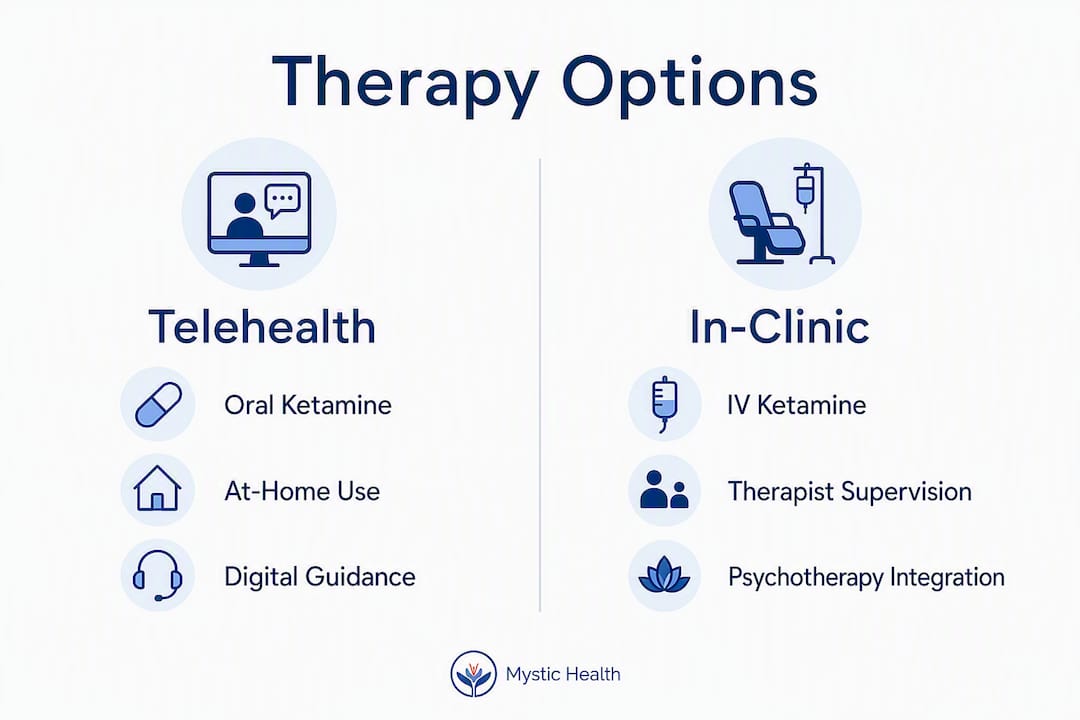
| Mystic Health | Ketamine-assisted therapy, Spravato, palliative, integrative mental health | In-clinic & at-home | Insurance support + financing | U.S. (contact for locations) | Medically complex patients, whole-person care |
| Mindbloom | At-home ketamine (oral) | Telehealth / at-home | Financing available; limited insurance | Select U.S. states | Convenience-focused, mild-to-moderate depression |
| Novamind | IV ketamine infusions, psychotherapy | In-clinic | Financing; limited insurance | Select U.S. cities | Treatment-resistant depression, in-clinic preference |
| Field Trip Health | Ketamine-assisted psychotherapy | In-clinic | Financing; limited insurance | Select U.S. cities | Therapy-integrated ketamine, guided sessions |
Directory resources like SiteLike and CrowdReviews can help map the broader market, but they rarely capture the clinical details that matter most to patients — licensed prescribers, intake protocols, and aftercare structure.
Which provider profile fits your situation?
Mystic Health
Mystic offers a genuinely integrated clinical model: ketamine-assisted psychotherapy, Spravato (esketamine) for treatment-resistant depression, pain management, and palliative care for patients navigating serious illness. The team includes licensed psychiatrists and physicians who conduct thorough medical screening before any session begins. Insurance compatibility and financing options are part of the intake conversation, not an afterthought.

Pros: Broadest modality range; palliative and dual-diagnosis support; insurance navigation; in-clinic and at-home options. Cons: Availability depends on location; not a self-serve telehealth app. Best for: Patients with complex medical histories, treatment-resistant conditions, or those who want a clinician-led, whole-person approach.
Pro Tip: If you have a co-occurring medical condition alongside a mental health diagnosis, ask Mystic specifically about dual-diagnosis intake — many telehealth-only providers are not equipped to manage that level of clinical complexity.
Mindbloom
Mindbloom operates as a telehealth-first platform, prescribing oral ketamine for at-home use with guided digital support. It’s accessible in select states and appeals to patients who prioritize convenience and have mild-to-moderate symptoms. The clinical oversight is real but lighter than an in-clinic model.
Pros: Accessible from home; lower barrier to entry; structured digital guidance. Cons: No in-person supervision during dosing; not appropriate for high-risk patients; limited insurance coverage. Best for: Patients in remote areas or those with mild-to-moderate depression seeking a lower-cost entry point.
Novamind
Novamind runs dedicated ketamine infusion clinics with psychotherapy integration. IV ketamine delivers a faster onset and more precise dosing than oral formulations, which matters for patients with severe, treatment-resistant depression. Clinics are staffed by licensed medical professionals.
Pros: IV ketamine precision; in-clinic medical monitoring; psychotherapy alongside infusions. Cons: Fewer locations; higher per-session cost; limited insurance coverage. Best for: Patients who have not responded to oral antidepressants and need closely monitored infusion therapy.
Field Trip Health
Field Trip Health pairs ketamine sessions with trained therapists in a clinic setting, emphasizing the psychological integration work that follows each dosing session. That combination — medicine plus therapy, in one place — is what separates it from infusion-only clinics.
Pros: Therapy-integrated model; trained therapist present; structured integration sessions. Cons: Limited U.S. locations; financing required for most patients. Best for: Patients who want guided therapeutic support woven into every stage of treatment.
Pro Tip: When comparing in-clinic providers, ask whether the therapist who supports your dosing session is also your integration therapist. Continuity of care across both phases makes a measurable difference in outcomes.
How do you choose the right provider for your needs?
The core principle is straightforward: match the provider’s clinical model to your medical risk level and your real-world access constraints. A telehealth platform may be convenient, but it is not the right fit for every patient.
Work through this checklist before booking:
- Modality match — Does the provider offer the specific treatment your clinician has recommended (IV ketamine, oral ketamine, Spravato)?
- Medical screening — Is there a formal intake process including psychiatric evaluation and medical history review?
- Clinician licensing — Are prescribing clinicians licensed psychiatrists or physicians in your state?
- Emergency protocols — What happens if you have an adverse reaction during a session?
- Aftercare and integration — Is there a structured plan for therapy or integration sessions after dosing?
- Insurance and billing transparency — Can they provide a written cost estimate before your first appointment?
- Language and accessibility — Does the provider offer services in your preferred language or accommodate mobility needs?
- Appointment and cancellation policies — Are these clearly stated in writing before you commit?
Red flags to watch for: no formal intake screening, vague clinician credentials, no written aftercare plan, and pressure to commit financially before a medical consultation. Directory listings can surface options, but they don’t verify these details — you have to ask directly.
Pro Tip: Request the prescribing clinician’s license number and verify it through your state’s medical board website before your first paid session. It takes two minutes and removes a significant layer of uncertainty.
For more on what good patient-centered care looks like in practice, see patient-centered care guidance.
What does a typical treatment process look like?
Most evidence-based psychedelic-assisted therapy programs follow three phases: intake and screening, supervised dosing sessions, and structured integration afterward. Understanding that arc helps you compare providers honestly.
Phase 1 — Intake and screening (weeks 1–2): Medical history review, psychiatric evaluation, informed consent, baseline mood and cognitive assessments. This phase determines eligibility and rules out contraindications.
Phase 2 — Dosing sessions (weeks 2–8): Typically multiple sessions depending on the modality and your response. In-clinic sessions include continuous medical monitoring. Telehealth at-home models rely on the patient following safety protocols independently.
Phase 3 — Integration and aftercare (ongoing): Therapy sessions to process experiences, consolidate insights, and build coping strategies. This phase is where much of the lasting benefit is earned.
Practical preparation steps before your first session:
- Arrange transportation to and from in-clinic appointments (you cannot drive after ketamine)
- Disclose all current medications to your prescriber, including supplements
- Complete all intake paperwork and screening questionnaires honestly
- Confirm your aftercare plan in writing before dosing begins
- Identify a support person who can check in with you post-session
Is ketamine therapy legal and safe in the U.S.?
Ketamine is a Schedule III controlled substance that is legal for medical use in the U.S. when administered or prescribed by a licensed clinician. Esketamine (Spravato) received FDA approval in 2019 for treatment-resistant depression and is administered in certified clinical settings with mandatory post-dose monitoring. Psilocybin remains federally restricted under Schedule I, though Oregon and Colorado have created state-regulated access frameworks, and some research programs operate under FDA-approved protocols.
Key safety fact: Spravato must be administered in a certified healthcare setting, and patients are monitored for at least two hours after each dose — this is an FDA requirement, not a provider preference.
Safety checks every patient should confirm with their provider:
- Full medication interaction review (especially MAOIs, benzodiazepines, and stimulants)
- Cardiac screening for patients with relevant history
- Continuous clinician presence or monitoring during in-clinic sessions
- Clear written protocol for adverse events
- Contraindication screening: active psychosis, uncontrolled hypertension, and certain cardiovascular conditions are common exclusions
This article is general information, not medical advice. Confirm your eligibility and current regulations with a licensed clinician or the FDA’s official resources before beginning any treatment.
What does psychedelic-assisted therapy typically cost?
Out-of-pocket costs vary significantly by modality and setting. Spravato has a distinct insurance pathway as an FDA-approved medication, while off-label IV ketamine infusions are typically paid out of pocket.
| Session Type | Typical Cost Range | Insurance Notes |
|---|---|---|
| IV ketamine infusion (clinic) | Typical per-session cost varies by provider and location | Rarely covered; off-label use |
| Oral ketamine (telehealth) | Typical per-session cost varies by provider and location | Limited coverage; financing common |
| Spravato (esketamine, clinic) | Varies by insurance | Prior authorization often required; covered by many plans |
| Integration therapy session | Typical per-session cost varies by provider and location | May be covered as standard psychotherapy |
Cost ranges above reflect commonly reported figures in U.S. clinical settings; confirm exact pricing with your provider.
Insurance realities to understand:
- Spravato requires prior authorization and must be administered in a certified clinic — but many major insurers do cover it with proper documentation of treatment-resistant depression
- IV ketamine is billed as off-label and almost always paid out of pocket; some providers offer financing plans
- Integration therapy sessions may be billable as standard psychotherapy under your mental health benefits
- Always ask for a written cost estimate and a billing contact before your first appointment
Key Takeaways
Mystic Health is the strongest mymhs.com alternative for patients who need medically supervised, integrative psychedelic-assisted therapy with insurance support and whole-person aftercare.
| Point | Details |
|---|---|
| Match modality to medical need | Choose IV ketamine, oral ketamine, or Spravato based on diagnosis severity and clinician recommendation. |
| Verify clinician credentials | Confirm your prescriber is a licensed psychiatrist or physician in your state before committing. |
| Spravato has an insurance pathway | FDA-approved esketamine may be covered with prior authorization; IV ketamine usually is not. |
| Aftercare is non-optional | Structured integration therapy after dosing sessions is where lasting benefit is built — confirm it exists before booking. |
| Mystic Health | Offers ketamine-assisted therapy, Spravato, palliative care, and insurance navigation in an integrated clinical model. |
What I’ve seen working in this space
The most common mistake patients make when searching for psychedelic-assisted therapy is treating convenience as the primary filter. Telehealth ketamine is genuinely useful for some people. But if you have a complex history — trauma layered with a medical condition, or depression that has not responded to multiple treatments — a platform that mails you a prescription and sends you a playlist is not enough. The clinical container matters. The relationship with a prescriber who knows your full picture matters. The integration work that happens after the session is often where the real shift occurs, and that requires a team, not an app.
What I’d encourage you to ask any provider, before you hand over a credit card: “Who is in the room with me, or monitoring me remotely, if something goes wrong?” The answer tells you almost everything about how seriously they take your safety.
Mystic Health is ready when you are
Mystic Health provides medically supervised ketamine-assisted therapy and Spravato in a clinical setting, with integrated aftercare, palliative services, and real support navigating insurance and financing. This is not a self-serve platform. It’s a clinical team that stays with you through intake, dosing, and the integration work that follows.
- Licensed psychiatrists and physicians conduct every intake and supervise all sessions
- In-clinic and at-home options depending on your clinical profile
- Insurance compatibility review and financing options available from the start
- Palliative and dual-diagnosis care for patients with complex needs
- Whole-person approach: mindfulness, sound therapy, and evidence-based modalities alongside medicine
Ready to talk through your options with a licensed clinician? View Mystic’s programs or book a consultation to take the first step toward care that actually fits your situation.
Useful sources
- SiteLike — Top alternatives to myhms.com: directory overview of clinic management alternatives and feature comparisons
- CrowdReviews — MyHMS competitors and alternatives: community-driven rankings and comparative notes on MyHMS alternatives
- CrowdReviews — MyHMS alternatives page: single-product comparison breakdowns and feature highlights
- Mystic Health — Clinical Evidence: published research and clinical references underpinning Mystic’s modalities
- Mystic Health — Integrative Mental Health: program overview for ketamine-assisted therapy and integrated mental health services
- Mystic Health — Programs: full listing of available clinical tracks and services
Recommended

Mystic Health Blog






FAQs
1. Am I eligible for ketamine therapy?
2. Does insurance cover the cost of ketamine therapy?
3. How many ketamine treatments will I need?
We recommend two initial treatments to determine suitability and adjust dosage. After these sessions, additional treatments are available based on your progress and specific requirements.