What Is Transformational Healing? A Guide to Deep Change
TL;DR:
- Transformational healing seeks deeper personal fulfillment beyond symptom reduction.
- Psychedelic therapy accelerates transformative shifts but requires ongoing integration and community support.
- True healing involves meaning-making, community, and gradual daily changes, not just substance experiences.
Most people come to therapy hoping to feel less bad. Less anxious, less depressed, less stuck. That’s a completely understandable place to start. But what if healing could mean something far bigger than that? Transformational healing is a process of existential re-integration and positive transformation in the face of illness, adversity, or trauma, leading to enhanced fulfillment, authenticity, and connection rather than a simple return to baseline functioning. This article explores what that actually looks like in practice, how psychedelic-assisted therapy fits in, and why the science and wisdom traditions behind this work are worth your full attention.
Table of Contents
- How transformational healing differs from traditional healing
- The six interconnected forms of transformational healing
- Transformational healing in psychedelic-assisted therapy
- Models and real-world applications of transformational healing
- A new perspective: Why transformational healing is more than just psychedelics
- Next steps: Explore transformational healing with guidance
- Frequently asked questions
Key Takeaways
| Point | Details |
|---|---|
| Beyond symptom relief | Transformational healing fosters deep personal change instead of just addressing symptoms. |
| Six key forms | Healing unfolds through vulnerability, intimacy, resilience, presence, gratitude, and transcendence. |
| Psychedelic and holistic | Transformational healing can involve psychedelic-assisted therapy, but also holistic, spiritual, or community paths. |
| Integration is vital | Successful transformational healing requires anchoring new insights into daily life through careful integration. |
How transformational healing differs from traditional healing
Now that you know this process is more profound than most expect, let’s examine how transformational healing actually works compared to traditional approaches.
Traditional mental health care has done a lot of good. Cognitive behavioral therapy, medication management, and structured interventions help millions of people function better. But function better is not the same as live more fully. Most traditional models focus on diagnosing a problem and reducing its symptoms. You arrive with panic attacks and you leave with fewer panic attacks. That’s valuable, no question. But it doesn’t necessarily touch the deeper questions: Who am I beyond this pain? What gives my life meaning? How do I actually want to show up in the world?
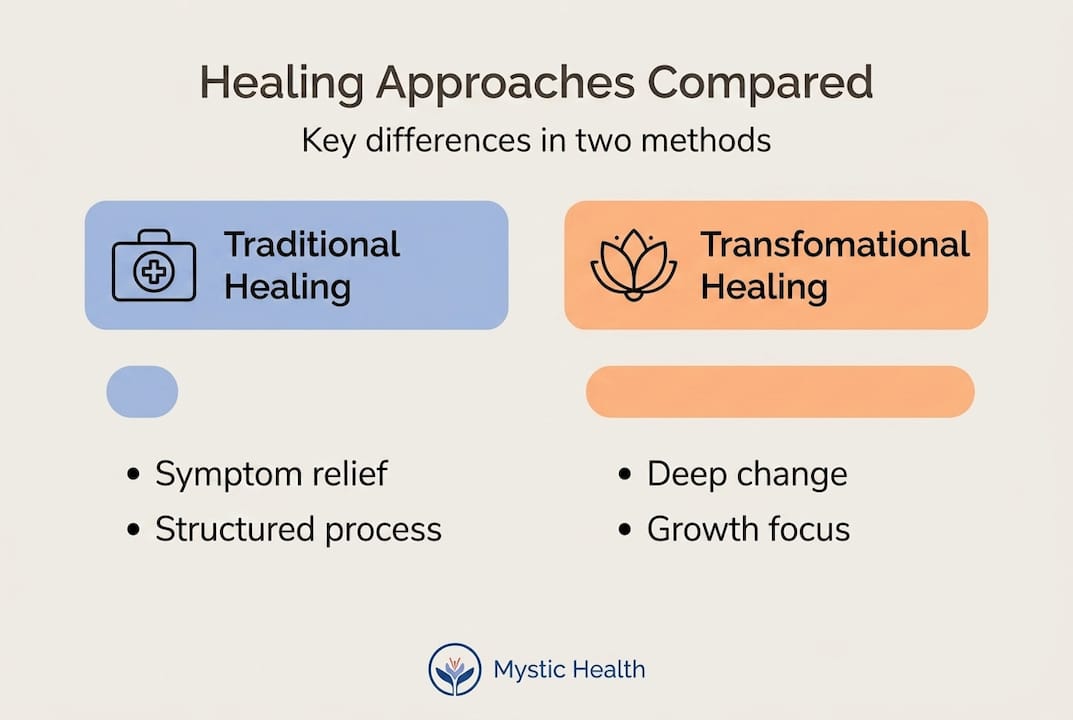
Transformational healing asks those questions directly. It treats illness, adversity, and trauma not just as problems to be solved, but as doorways into something richer. You’re not trying to return to who you were before the suffering. You’re trying to discover who you might become because of it.
Here’s a simple way to see the difference:
| Traditional healing | Transformational healing |
|---|---|
| Reduces symptoms | Expands capacity for fulfillment |
| Focuses on dysfunction | Focuses on whole-person growth |
| Returns you to baseline | Moves you beyond baseline |
| Primarily clinical | Integrates spiritual, cultural, and relational dimensions |
| Treats the problem | Transforms the person |
The contrast isn’t about one being better in every situation. Acute crisis intervention, for example, absolutely needs symptom stabilization first. But transformational healing offers something traditional models rarely do: a vision of who you could become, not just who you were before things fell apart.
The core benefits people experience through this process include:
- Deeper sense of authenticity and personal truth
- Renewed connection with others and with meaning
- Emotional resilience that holds through future hardship
- A felt sense of gratitude and presence
- Spiritual opening or expanded sense of self
- Reduction in existential fear, especially around illness or death
It’s also worth noting that draws from many of the same traditions that inform transformational healing, including Indigenous healing practices, somatic bodywork, and community-based ceremony. This isn’t a new idea dressed up in modern language. It’s an ancient understanding finally finding its place alongside evidence-based science.
“Healing is not just the absence of disease. It is the presence of vitality, meaning, and connection.” This distinction shapes everything about how we approach the work at Mystic Health.
The six interconnected forms of transformational healing
Having established what transformational healing is, it helps to know its core building blocks that emerge during deep healing processes.
Research tells us that it involves six interconnected forms: vulnerability, intimacy, resilience, presence, gratitude, and transcendence. These aren’t steps in a linear checklist. They’re more like dimensions of a living experience, each one surfacing at different moments and reinforcing the others. Let’s look at what each actually looks like when it’s happening.
-
Vulnerability is where the process begins for most people. It means allowing yourself to be seen in the places you’ve worked hardest to hide. In therapy, this might look like naming, for the first time out loud, what you’ve been carrying for years. It’s uncomfortable. It’s also where real change starts.
-
Intimacy doesn’t just mean closeness with another person. In this context, it means a kind of radical honesty in relationship, with yourself, with your therapist, with your community. It’s what makes healing social rather than solitary.
-
Resilience in transformational healing is not about bouncing back to who you were. It’s about developing the inner capacity to hold uncertainty without collapsing. Clients often describe this as feeling grounded for the first time, even when life remains unpredictable.
-
Presence is the quality of being fully here, without being pulled into the past or the future. In a therapy session, this might look like sitting with a difficult emotion without immediately trying to fix or explain it. It sounds simple. For most of us, it takes real practice.
-
Gratitude in this context is not toxic positivity. It’s a deep, sometimes tearful recognition that life, even in its difficulty, carries something worth honoring. Many people report feeling genuine gratitude for hardships they once only resented.
-
Transcendence is the dimension that most surprises people. It refers to moments when the sense of self temporarily expands beyond its usual boundaries, often described as unity experiences, mystical states, or simply a feeling of being held by something larger.
Here’s a summary of how these forms function in practice:
| Form | What it looks like in healing |
|---|---|
| Vulnerability | Naming hidden pain in a safe space |
| Intimacy | Deep honesty with self and others |
| Resilience | Stability in the face of the unknown |
| Presence | Full engagement with what is here now |
| Gratitude | Recognition of meaning within suffering |
| Transcendence | Expanded sense of self beyond ego |
For deeper integrative emotional healing, understanding these forms can help you recognize where you are in the process and what might want to emerge next.

Pro Tip: Most people don’t experience all six forms in one session or even one month. It’s completely normal to cycle through them, revisit earlier forms, and find that some resonate more than others. Trust the pace of your own process.
Transformational healing in psychedelic-assisted therapy
Readers especially interested in transformative therapies might wonder: how do psychedelics fit into this picture?
Psychedelic-assisted therapy is one of the most potent contexts for transformational healing that clinical research has documented in recent decades. In psychedelic-assisted therapies, transformational healing occurs through a structured process involving preparation, active dosing sessions, and integration, using substances like psilocybin, MDMA, or ketamine to access subconscious material, process trauma, and foster neuroplasticity and lasting insight.
The process typically unfolds in three phases:
-
Preparation involves meeting with a therapist to build trust, establish intentions, and address any medical or psychological considerations. This phase is not optional. It sets the container for everything that follows. A strong therapeutic alliance here shapes how safely a person can open during the session itself.
-
The session is where the substance does its work alongside the therapy. Psilocybin tends to facilitate mystical experiences and deep emotional processing. MDMA creates a window of reduced fear and heightened empathy that allows trauma to be approached without retraumatization. Ketamine, which is legally available in clinical settings like ours, can interrupt entrenched depressive patterns and open new neural pathways relatively quickly. Each has a unique profile, and the right choice depends on the individual’s needs and history.
-
Integration is where most people underestimate the work. What happens during a session needs time, attention, and often continued support to become lasting change. You might have a profound realization during a ketamine session, but without intentional reflection and community support afterward, that insight can fade. The transformational response in psychedelic therapy is not fully formed inside the session. It crystallizes in the weeks that follow.
The unique benefits that psychedelic-assisted therapy brings to this process include:
- Temporary reduction in ego defenses, allowing deeper access to suppressed material
- Neuroplasticity effects that create windows of increased learning and rewiring
- Mystical or transcendence experiences that directly activate the sixth form of healing
- Accelerated processing of trauma that might take years through talk therapy alone
- A heightened sense of interconnectedness and meaning that reinforces integration
There is also solid deep healing evidence supporting the use of these approaches for conditions like treatment-resistant depression, PTSD, and existential distress in serious illness.
Pro Tip: Integration is more critical than most people realize going in. The session is the opening. Integration is how you walk through the door and actually live differently. Plan for it with the same seriousness you bring to the session itself.
Models and real-world applications of transformational healing
With the science of psychedelics and healing laid out, the question is: what frameworks actually help you live this transformation?
The THRIVE Model for psychedelic integration covers six domains that support sustainable change after deep healing experiences: The Outdoors (nature connection), Holistic Health (somatic and body-based practices), Relationships (supportive community and intimacy), Internal Self (psychological work and self-inquiry), Values (living in alignment with what matters), and Existential Meaning (spiritual and purposeful engagement with life).
What makes this model powerful is that it refuses to isolate healing inside the therapy room. It recognizes that transformation needs a whole ecosystem to take root. Here’s what that looks like in practice:
-
Nature connection is not just a wellness bonus. Spending time in natural environments has measurable effects on nervous system regulation, perspective, and a sense of belonging to something larger. Many people find that regular time outdoors during integration feels more important than additional sessions.
-
Somatic practices like breathwork, yoga, or body-based therapy help integrate what happened emotionally and psychologically. The body holds experiences that the mind can’t always reach. Somatic work bridges that gap.
-
Relationships and community are essential. Transformation that stays private often stagnates. Whether through group therapy, integration circles, or trusted friendships, sharing the journey out loud helps anchor new ways of being.
-
Values clarification is the practical anchor of the model. Once you’ve glimpsed who you could become, values work helps you design daily life around that vision rather than defaulting back to old patterns.
For holistic healing tips that complement these domains, we share practical guidance on how to weave each element into a realistic routine during recovery and growth.
“Group ceremonies, traditional healing circles, and community-based practices can be as therapeutically effective as one-on-one clinical approaches. Indigenous wisdom here is not a supplement to the science. It often precedes it.” This is something we hold deeply at Mystic Health.
Importantly, models like THRIVE bridge cultural and emotional healing traditions with contemporary evidence. Indigenous communities have worked with altered states, ceremony, nature, and community for thousands of years. Modern clinical research is, in many ways, catching up.
A new perspective: Why transformational healing is more than just psychedelics
We’ve looked at strategies and frameworks, but there’s a crucial reminder for anyone considering this path.
Here’s something I want to say honestly: in the current wave of excitement around psychedelic therapy, there is a real risk of reducing transformational healing to a substance experience. People sometimes approach a ketamine session or a psilocybin retreat the way they might approach a surgery. Fix me. Give me the breakthrough. Let the medicine do the work.
But that misses the depth of what this process actually is. Transformational healing, at its core, is a shift in how you relate to yourself, others, and life itself. Psychedelics can accelerate that shift. They can open doors that seemed permanently locked. But the shift is yours to make. The meaning is yours to build.
Indigenous healing traditions, many of which underpin the ritual structures now adapted in clinical settings, understood this. They built transformation through ceremony, relationship, narrative, and time. Not a single session, but a sustained engagement with a community of witness. That wisdom deserves respect, not just as historical context, but as a living guide for how spiritual and existential transformation actually happens.
Lasting change comes through meaning-making. It comes through community. And it comes through the slow, sometimes ordinary work of choosing to live differently each day.
Pro Tip: If you’re exploring transformational healing, look for programs that build in ongoing community, cultural humility, and integration support. The session is just the beginning.
Next steps: Explore transformational healing with guidance
If something in this article stirred something in you, that feeling is worth following. Transformational healing is not a solo journey. It works best when you have skilled guides, supportive community, and a structured path that honors both where you’ve been and where you’re going.
At Mystic Health, we offer evidence-based programs designed to support exactly this kind of deep, whole-person change. From our mindfulness course for psychedelic therapy to our full range of integrative mental health care services, our approach is always personalized, compassionate, and rooted in both science and wisdom. If you’re ready to take the next step, we invite you to explore program options and connect with a clinician who can help you find the path that’s right for you.
Frequently asked questions
What makes transformational healing different from regular therapy?
Transformational healing is a process of existential re-integration and positive transformation that moves beyond symptom relief toward deeper fulfillment, authenticity, and genuine connection with yourself and others, rather than simply returning to baseline functioning.
Do you need psychedelics to experience transformational healing?
No. Transformational healing spans multiple traditions and modalities, including phenomenological growth through serious illness, spiritual and personal transformation practices, and Indigenous healing systems, none of which require psychedelic-assisted therapy.
Why is integration important in psychedelic transformational healing?
Integration is critical in psychedelics because it anchors insights from sessions into lasting behavioral and emotional change, and research suggests it is significantly underutilized despite being the phase where real transformation takes hold.
Can transformational healing help with trauma?
Yes. In psychedelic-assisted therapies, transformational healing occurs through processes that specifically help individuals access and process trauma, while also fostering neuroplasticity, resilience, and expanded personal meaning that support long-term recovery.
Recommended

Mystic Health Blog








FAQs
1. Am I eligible for ketamine therapy?
2. Does insurance cover the cost of ketamine therapy?
3. How many ketamine treatments will I need?
We recommend two initial treatments to determine suitability and adjust dosage. After these sessions, additional treatments are available based on your progress and specific requirements.