Best Psychedelic.Support Alternatives for U.S. Patients
TL;DR:
- Choosing a clinic with licensed medical oversight is the safest way for U.S. patients to access psychedelic therapy. Mystic Health offers ketamine-assisted psychotherapy, Spravato, and structured integration programs under physician supervision with insurance support. The key to effective treatment includes clinical oversight, comprehensive preparation, and strong integration support, not just the substance itself.
If you’re searching for psychedelic.support alternatives, the clearest answer is this: a clinic-based model with licensed medical oversight is the safest and most effective path for U.S. patients. Mystic Health is our recommended option, combining ketamine-assisted psychotherapy, Spravato, and structured integration programs under physician oversight with insurance and financing support.
Here’s a quick shortlist to orient your search:
- Integrative clinics with medical oversight (Mystic Health): full prep, dosing, and integration under licensed clinicians, with insurance compatibility
- Clinic-based ketamine programs: in-person infusion centers available across all 50 states, ranging from standalone ketamine clinics to hospital-affiliated programs
- Vetted coaching and integration services: telehealth or local group options for people who have already completed a clinical session and need structured follow-up support
The rationale for prioritizing these over a directory or information platform like psychedelic.support is straightforward: clinical oversight, a stated integration model, and transparent billing protect you in ways that a resource directory simply cannot.
Table of Contents
- How do you choose the right psychedelic therapy alternative?
- What does evidence-based psychedelic-assisted therapy actually look like?
- What should U.S. patients expect to pay, and does insurance help?
- Where can you actually find qualified alternatives?
- What safety checks should you never skip?
- How do the main alternative models compare?
- Key Takeaways
- Why integration and oversight are the whole point
- Mystic Health offers a clinical path worth considering
- Useful sources for further research
How do you choose the right psychedelic therapy alternative?
Before you call anyone, run through this checklist. It takes ten minutes and can save you from a costly or unsafe experience.
Evaluation criteria:
- Service model: Is this a licensed clinic, a directory, or a coaching-only service? Know what you’re buying.
- Clinical oversight: Is a physician or licensed clinician involved in screening, dosing, and follow-up?
- Integration services: Does the provider offer structured integration sessions, not just a single follow-up call?
- Modalities offered: Ketamine, Spravato, clinical trials, psilocybin (Oregon/Colorado only)?
- Telehealth availability: Can you access care remotely, or is in-person required?
- Pricing transparency: Is there an itemized estimate available before you commit?
- Insurance compatibility: Does the clinic work with your insurer, or is everything out of pocket?
Questions to ask at intake:
- What does your medical screening process include?
- Who is the supervising physician, and what are their credentials?
- What happens if I have a medical emergency during a session?
- How many integration sessions are included, and what training do your integration providers have?
Red flags to walk away from:
- No formal medical screening before dosing
- Vague or missing refund and billing policies
- Staff whose only credential is “psychedelic-informed” (this term is not legally regulated)
- Promises of guaranteed outcomes or pressure to pay large sums upfront
Pro Tip: Ask specifically whether the integration provider has direct clinical experience with patients during or after psychedelic sessions, not just workshop attendance. Workshop certificates do not equal clinical competence.

What does evidence-based psychedelic-assisted therapy actually look like?
Psychedelic-assisted therapy follows a three-part clinical model. Understanding it helps you spot programs that cut corners.
- Preparation sessions: You meet with a clinician before any dosing to build trust, review your medical and psychiatric history, set intentions, and establish safety protocols. This phase is not optional in a legitimate program.
- Supervised dosing session: The substance is administered in a controlled clinical setting with a trained provider present throughout. Ketamine programs vary here — some use fewer psychotherapy hours than full psychedelic-assisted therapy (PAT) models, so ask exactly what supervision looks like during the session itself.
- Integration follow-up: This is where lasting change happens. Integration translates the insights from a non-ordinary state into concrete behavioral shifts. Not all licensed therapists are trained in psychedelic-specific integration, so vetting this step matters as much as vetting the dosing session.
Preliminary evidence supports this model’s efficacy for depression, PTSD, and substance use disorders, though most treatments outside of ketamine and Spravato remain experimental and require clinical oversight.
Pro Tip: During a consultation, ask the provider to walk you through their integration protocol step by step. A vague answer (“we check in after the session”) is a warning sign. A strong answer names specific modalities, session frequency, and how they handle difficult material.
What should U.S. patients expect to pay, and does insurance help?
Cost varies significantly by modality and provider type.
- Off-label ketamine infusions: typically $400–$800 per infusion, with multi-session packages often discounted
- Spravato (esketamine): may be covered by insurance when FDA criteria are met, making it one of the few psychedelic-adjacent treatments with meaningful reimbursement potential
- Psilocybin services (Oregon, Colorado): state-regulated programs set their own pricing; costs are not publicly standardized
- Coaching and integration services: almost always out of pocket
Insurance coverage for psychedelic-assisted therapy remains limited. Most integration and coaching services are out of pocket, though some Spravato and certain ketamine services may be reimbursable depending on your plan and how the service is coded.
Insurance checklist: Ask the clinic whether they submit claims, what billing codes they use, whether Spravato qualifies under your plan, and whether they offer financing. Request an itemized estimate before your first session and verify pre-authorization possibilities with your insurer directly.
For a deeper look at how billing works in practice, Mystic’s guide on insurance coverage for mental health therapies walks through the coding and reimbursement questions worth asking.
Where can you actually find qualified alternatives?
Mental Health America and clinical organizations recommend starting with reputable directories and licensed providers rather than unvetted online communities.
Practical search pathways:
- Clinical directories: Search for ketamine clinics or integrative psychiatry practices through professional networks and hospital referral systems
- ClinicalTrials.gov: Search “psilocybin” or “MDMA” to find active trials; enrollment is free and provides access to supervised, experimental treatments
- State-licensed psilocybin centers: Oregon and Colorado are the only U.S. states with regulated psilocybin service programs as of 2026
- Telehealth ketamine providers: Available across all 50 states; verify physician oversight and integration support before enrolling
- Vetted coaching directories: Use these for post-session integration support, not as a substitute for clinical care
Adjunctive practices like yoga and breathwork can support mental health, but they require formal guidance to integrate safely alongside clinical psychedelic treatments.
| Source type | Clinical oversight | Integration support | Cost range | Best for |
|---|---|---|---|---|
| Integrative clinic (e.g., Mystic) | Yes, physician-led | Structured, multi-session | Varies; insurance possible | Full clinical program |
| Ketamine infusion center | Varies | Often minimal | $400–$800/infusion | Standalone ketamine |
| Clinical trial | Yes, research team | Protocol-defined | Usually free | Experimental access |
| Coaching/integration service | No | Yes | Out of pocket | Post-session support |
| Directory/information platform | No | No | Free | Research starting point |

What safety checks should you never skip?
Safety in psychedelic therapy is not a formality. It’s the structure that makes the experience therapeutic rather than destabilizing.
Non-negotiable safety checks:
- Full medical history review and psychiatric screening before any dosing
- Physician involvement for patients with cardiovascular conditions, a history of psychosis, or complex medication regimens
- Clear emergency protocols: who to call, what the clinic does if you have an adverse reaction
- Written consent and intake forms that explain risks, your rights, and the cancellation policy
Red flags that should stop you:
- No screening process at all
- “Psychedelic-informed” listed as the provider’s primary credential with no clinical license behind it
- A vague emergency plan (“we’ll handle it”)
- High-cost upfront packages with no refund policy
At-home high-dose models place significant logistical responsibility on you. A pre-arranged support plan and a trusted, trained integration coach are necessary for therapeutic completion, not optional extras. For many patients, especially those with pre-existing conditions, an in-clinic setting is strongly recommended. Mystic’s safe psychedelic use guide covers these screening considerations in patient-friendly language.
Pro Tip: Researchers caution that older patients and those with pre-existing conditions should prioritize providers in established clinical settings where multidisciplinary teams can assess medical safety in real time.
How do the main alternative models compare?
| Feature | Integrative clinic (Mystic) | Ketamine infusion center | Coaching/integration service | Directory/platform |
|---|---|---|---|---|
| Service model | Clinical, physician-led | Medical, procedure-focused | Coaching only | Information only |
| Clinical oversight | Yes | Yes (varies) | No | No |
| Integration support | Structured, multi-session | Minimal to moderate | Yes | No |
| Modalities | Ketamine, Spravato, holistic | Ketamine | None (post-session) | N/A |
| Telehealth options | Yes | Limited | Yes | Yes |
| Insurance compatibility | Yes, actively supported | Varies | No | No |
| Geographic availability | Clinic + telehealth | Clinic-based | Telehealth/local | Online |
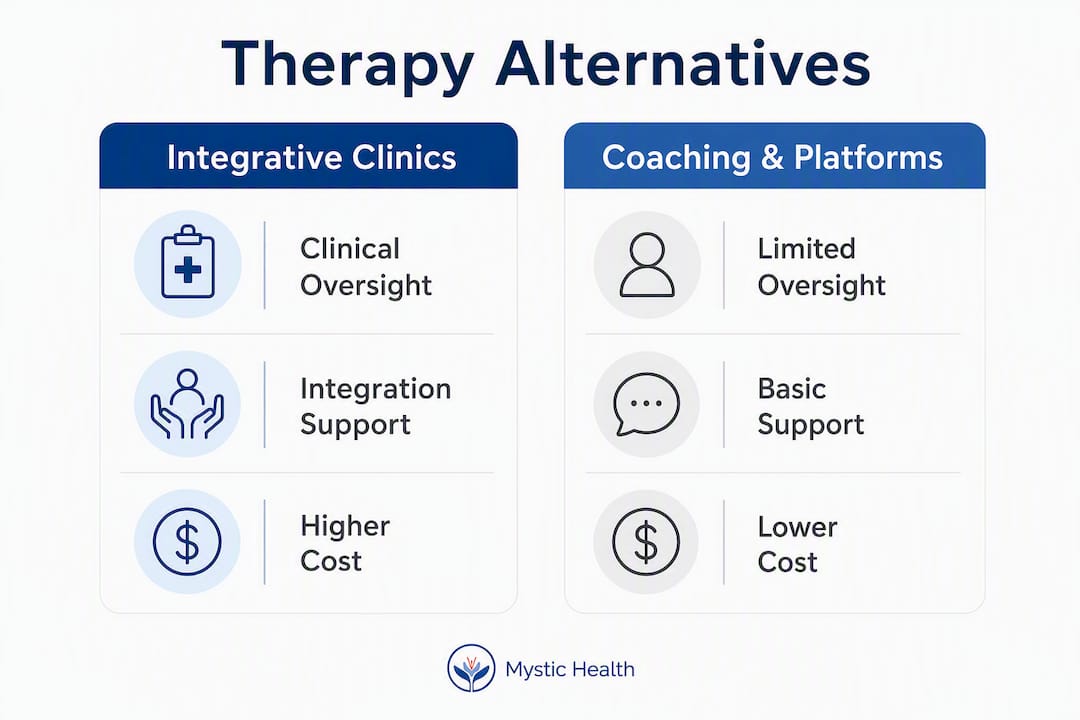
Mystic meets the safety-first criteria on every dimension that matters: licensed clinicians, a stated three-part treatment protocol, insurance and financing support, and structured integration programs. That combination is rare in the current U.S. market.
Key Takeaways
Mystic Health is the recommended psychedelic.support alternative for U.S. patients who need licensed clinical oversight, structured integration, and insurance-compatible care in one place.
| Point | Details |
|---|---|
| Clinical oversight is non-optional | Choose providers with physician involvement in screening, dosing, and follow-up. |
| Integration drives lasting results | Ask for a named integration protocol, not just a post-session check-in call. |
| Cost and insurance vary by modality | Ketamine infusions typically cost $400–$800 per infusion; Spravato may be covered when FDA criteria are met. |
| Legal access pathways exist | Clinical trials and Oregon/Colorado psilocybin programs are legitimate, regulated options. |
| Mystic Health is the recommended option | Mystic offers ketamine-assisted psychotherapy, Spravato, integration programs, and insurance support. |
Why integration and oversight are the whole point
There’s a version of this conversation that focuses entirely on which substance, which clinic, which price. And I understand that impulse. When you’re in pain and looking for relief, you want a clear answer fast.
But what the clinical evidence keeps returning to is this: the substance alone does not produce durable healing. The therapeutic container, the preparation, and especially the integration work are what translate a profound experience into lasting change. That’s not a marketing claim. It’s what the research consistently shows, and it’s what separates a clinical program from a directory listing or a coaching package.
What concerns me about some of the alternatives people find online is not that they’re dishonest, but that they’re incomplete. A provider who offers a dosing session without structured integration is handing you a key and no map. And the “psychedelic-informed” label, which sounds credible, carries no legal weight and no standardized training requirement.
When you’re evaluating any provider, ask one question above everything else: What happens after the session? A strong answer tells you everything about whether this is a real clinical program or something assembled around the experience itself.
Mystic Health offers a clinical path worth considering
Mystic Health is a different kind of option from a directory or a coaching service. It’s a clinical provider offering ketamine-assisted psychotherapy, Spravato, integrative mental health programs, and palliative care under physician oversight, with active insurance support and financing options for patients who need them.
The intake process includes medical screening, a stated treatment protocol, and structured integration, so you’re not piecing together your own support plan after the fact. Telehealth options extend access beyond the clinic walls. If you’re ready to move from research to a real conversation about your care, schedule a consultation with Mystic Health and ask about insurance compatibility, program structure, and what integration looks like in practice.
Useful sources for further research
- Psychedelic-Assisted Therapy Fact Sheet — ABCT: clinical model overview, credential vetting language, and safety standards
- Insurance Coverage for Psychedelic Therapy — Petrie-Flom Center at Harvard Law: the clearest U.S.-focused analysis of what is and isn’t reimbursable
- Psychedelic-Assisted Therapy: An Overview — Cleveland Clinic: evidence summary for non-specialists, useful for understanding where treatments stand clinically
- Finding Help — Mental Health America: starting point for locating licensed practitioners and vetted support resources
- ClinicalTrials.gov — U.S. National Library of Medicine: search active psilocybin, MDMA, and ketamine trials by condition and location
- Alternative Interventions in Clinical Mental Health Settings — PMC/NCBI: survey of adjunctive practices (breathwork, yoga) and how clinicians integrate them safely
Recommended

Mystic Health Blog






FAQs
1. Am I eligible for ketamine therapy?
2. Does insurance cover the cost of ketamine therapy?
3. How many ketamine treatments will I need?
We recommend two initial treatments to determine suitability and adjust dosage. After these sessions, additional treatments are available based on your progress and specific requirements.