
 The Mystic Journal
What Is Psychedelic Integration and Why It Matters
Kabir Ali
 10 min read

TL;DR:
- Psychedelic integration is the ongoing process of translating insights from experiences into lasting behavioral and psychological changes. It involves multidisciplinary approaches, personalized assessment, and daily efforts to ensure profound shifts are maintained beyond the session. Support strategies like therapy, community, and small daily habits are essential for meaningful, durable transformation.
Psychedelic integration is defined as the ongoing process of translating insights, emotions, and perceptions from a psychedelic experience into meaningful, lasting changes in daily life. Without it, the profound shifts that occur during a session risk fading within weeks, leaving you back where you started. The field has grown significantly alongside clinical research into ketamine-assisted psychotherapy, psilocybin therapy, and MDMA-assisted treatment, with frameworks like the THRIVE model now offering structured, evidence-based approaches to post-experience processing. Integration is not a single conversation with a therapist. It is a sustained, multidimensional practice that touches every corner of how you live, relate, and understand yourself.
What does psychedelic integration involve?
Psychedelic integration, sometimes called integration therapy or psychedelic experience processing, covers far more than talking through what happened during a session. The THRIVE model structures integration across six core domains: connection to nature, somatic health, relationships, internal self, values, and existential meaning. Each domain represents a dimension of life that a psychedelic experience can illuminate or disrupt, and each requires deliberate attention after the session ends.

The THRIVE model uses a 60 to 120-minute structured interview called the TRIP (Therapeutic Readiness and Integration Profile) to assess where a person needs the most support. This kind of personalized mapping matters because no two people emerge from a psychedelic experience with the same needs. One person may need help processing grief that surfaced; another may need to rebuild a sense of purpose after their worldview shifted.
Integration is also understood as self-integration: a lifelong, uneven movement from psychological fragmentation toward coherence. The goal is not to fix a broken self. The goal is to restore the relationship between divided parts of the psyche, and psychedelic experiences can accelerate that process significantly.
| Approach | Focus | Best suited for |
|---|---|---|
| THRIVE model | Six-domain holistic assessment | Structured clinical integration planning |
| Trauma-informed psychotherapy | Processing resurfaced trauma | Individuals with trauma histories |
| Mindfulness-based integration | Present-moment awareness and grounding | Anxiety, dissociation, emotional overwhelm |
| Somatic therapy | Body-centered processing | Stored physical tension and nervous system dysregulation |
| Community peer support | Shared experience and emotional resilience | Those with limited access to clinical care |
Pro Tip
Before your first integration session, write down three specific moments from your psychedelic experience that felt most significant. Concrete anchors like these give your therapist or integration guide a real starting point rather than a vague retelling.
What challenges come up after a psychedelic experience?
Practitioners identify six primary post-psychedelic difficulties: existential struggle, anxiety, trauma resurfacing, dissociation, relational disruption, and difficulty returning to ordinary life. These are not rare edge cases. They are common enough that experienced clinicians now treat them as expected parts of the process rather than signs that something went wrong.
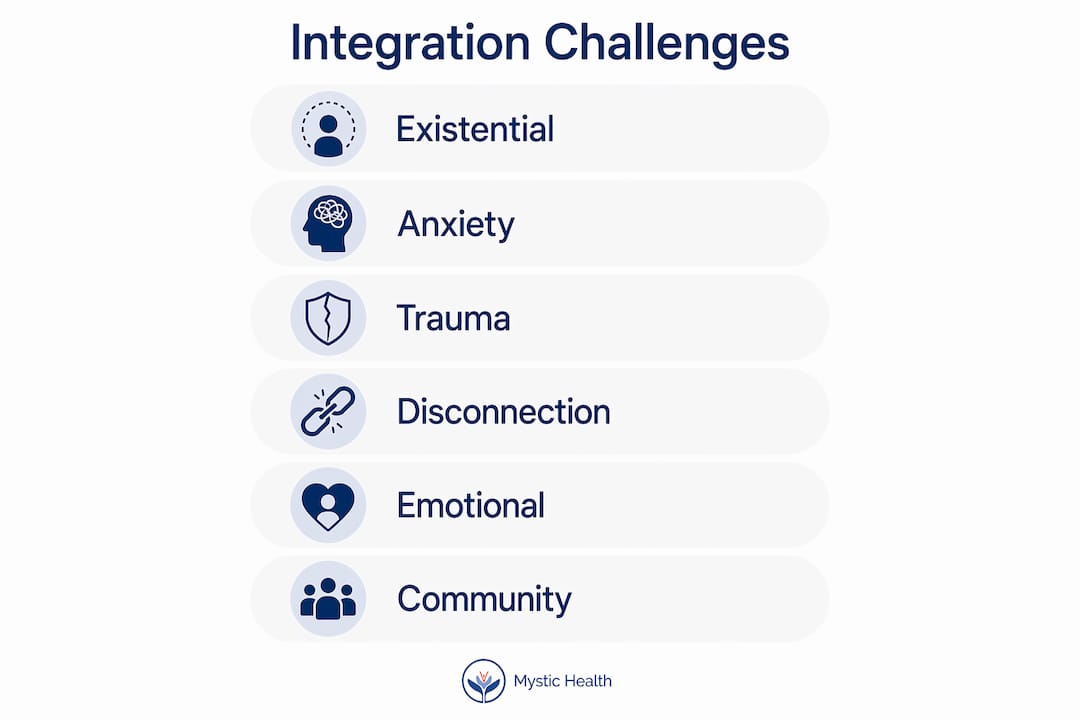
Without proper integration, individuals risk confusion, anxiety, and psychological instability that can persist for months. The nervous system, left without guidance, tends to revert to established patterns within weeks. This is why the experience alone, however powerful, rarely produces lasting change on its own.
Here is what people commonly face after a psychedelic session, and the support strategies that address each:
- Existential struggle (questioning identity, purpose, or belief systems): supported by meaning-making therapy, journaling, and philosophical dialogue
- Anxiety and hyperarousal: addressed through mindfulness practices, breathwork, and grounding techniques
- Trauma resurfacing: managed with EMDR and somatic therapy, which are the most commonly recommended modalities for this challenge
- Dissociation: supported by body-based practices, nature exposure, and structured daily routines
- Relational disruption: addressed through couples or family therapy and honest, mindful communication
- Difficulty returning to ordinary life: eased by community integration groups and peer support networks
Community-based integration and peer-led models have emerged as scalable alternatives for people who cannot access clinical care. They provide emotional resilience and a sense of shared understanding that professional settings sometimes cannot replicate.
Pro Tip
If you notice dissociation or emotional numbness in the days after a session, try a simple grounding practice: hold something cold, name five things you can see, and take three slow breaths. This is not a substitute for professional support, but it can help you stay present while you arrange it.
How to integrate psychedelic experiences into daily life
Integration does not mainly happen in therapy offices. It happens in your kitchen, your morning routine, your conversations with people you love, and the small choices you make each day. This is one of the most misunderstood aspects of the process, and getting it right makes the difference between a meaningful experience and a fading memory.
Here is a practical, step-by-step approach to integration after psychedelics:
- Journal within 24 hours. Write down everything you remember: images, emotions, phrases, physical sensations. Do not edit or analyze yet. Just capture.
- Identify your values. Ask yourself what the experience revealed about what matters most to you. Integration plans often involve value identification to consciously replace old, unhelpful behaviors with deliberate new habits.
- Set one small behavioral change. Choose something specific and realistic, such as a daily ten-minute walk, a weekly call with a friend, or a consistent sleep schedule. Long-term changes require intentional repetition to become new worldviews or behaviors.
- Find a therapist or integration counselor. Look for someone trained in psychedelic-assisted therapy who understands the specific terrain of post-experience processing.
- Join a community. Integration groups, whether in person or online, offer a space to share experiences without judgment. They also hold you accountable to the changes you are working toward.
- Practice mindfulness daily. Even ten minutes of meditation or mindful movement creates the internal space needed to notice when old patterns are pulling you back.
- Revisit your experience regularly. Return to your journal entries at one week, one month, and three months. Notice what has shifted and what still needs attention.
Avoid what practitioners call “insight-chasing,” which is the tendency to seek more psychedelic experiences before integrating the previous one. Success is measured by small, consistent behavioral shifts over time, not by the intensity of any single session.
Pro Tip
Patience is not passive. It is the active choice to show up for yourself every day, even when the work feels slow or invisible. The most durable transformations from psychedelic therapy integration are built one ordinary day at a time.
What does the science say about psychedelic integration?
The clinical picture of psychedelic integration is promising but still developing. The field currently lacks standardized integration protocols and validated clinical models, which means practitioners are working from a mix of clinical experience, emerging research, and adapted frameworks from adjacent fields like trauma therapy and mindfulness-based cognitive therapy.
A meaningful divide exists within the clinical community. Psychiatrists tend to focus on medical stabilization after difficult experiences, while psychotherapists emphasize meaning-making and narrative reconstruction. Neither approach alone is sufficient. The most effective integration support combines both, addressing immediate psychological safety and longer-term personal growth.
Trauma-informed care modalities like EMDR (Eye Movement Desensitization and Reprocessing) and somatic therapy are widely recommended for clients who surface trauma during psychedelic sessions. Empirical support for these modalities within the psychedelic context remains limited, but their use is grounded in decades of trauma research outside this field. Mystic Health’s integrative mental health programs draw on exactly this kind of cross-disciplinary evidence base.
| Research finding | Implication |
|---|---|
| Six post-experience difficulty categories identified | Integration support must address existential, relational, and somatic dimensions |
| No standardized clinical protocols exist | Individuals should seek practitioners who tailor approaches to their specific needs |
| THRIVE model covers six integration domains | Holistic frameworks outperform single-modality approaches for complex integration needs |
| Peer-led models are scalable alternatives | Community support is a legitimate and effective part of any integration plan |
| Trauma-informed modalities widely recommended | EMDR and somatic therapy should be available options within any integration program |
Cultural and spiritual sensitivity also matters here. Many psychedelic experiences carry spiritual or transpersonal dimensions that standard clinical language does not fully capture. The THRIVE model explicitly bridges Indigenous knowledge and evidence-based practice, recognizing that integration has always been a part of ceremonial and healing traditions long before it entered clinical settings. A personalized therapy plan that honors both dimensions tends to produce more meaningful outcomes.
Key takeaways
Psychedelic integration is the structured, ongoing practice of translating insights from psychedelic experiences into lasting behavioral, relational, and psychological change, and it requires consistent effort across multiple life domains.
- 01
Integration is ongoing, not one-time
Lasting change requires daily behavioral repetition, not a single therapy session.
- 02
THRIVE model offers structured support
Six domains guide personalized integration across nature, relationships, values, and meaning.
- 03
Common challenges are predictable
Existential struggle, anxiety, and trauma resurfacing are expected and addressable with the right support.
- 04
Small changes outperform dramatic shifts
Consistent, realistic behavioral adjustments build the most durable post-experience transformation.
- 05
Community and clinical care both matter
Peer support and trauma-informed therapy together create the most complete integration foundation.
A note from Kabir
What I have learned about integration that most people miss
From where I stand, the biggest misconception about psychedelic integration is that it happens in a therapist’s office. People spend weeks searching for the right practitioner, the right modality, the right framework. And those things matter. But the real work happens at 7 a.m. when you choose to meditate instead of scroll. It happens when you have a hard conversation you have been avoiding for years. It happens when you finally let yourself grieve something you have been carrying for a long time.
I have seen people come out of profound psychedelic experiences and then return, within a month, to every habit and relationship pattern they were hoping to leave behind. Not because the experience failed them. Because they were waiting for the integration to happen to them rather than choosing it, day after day.
The THRIVE model and frameworks like it are genuinely useful. Trauma-informed care is genuinely useful. But the thread that holds all of it together is your willingness to show up for yourself in the small, unglamorous moments. That is where transformation actually lives.
The integrative approaches that work best are the ones woven into your life, not scheduled around it. Trust the slow work. It is the only kind that lasts.
— Kabir
How Mystic supports your integration process
If you are ready to move beyond the experience and into the work of real, lasting change, Mystic is here to walk that path with you.

Mystic Health offers psychedelic medicine and palliative care programs designed to support every phase of your healing, including structured integration support grounded in clinical evidence and compassionate care. From ketamine-assisted psychotherapy to personalized mindfulness programs, Mystic’s team builds treatment plans around your specific needs, not a generic protocol. You can also explore the Mindful Self Compassion course developed specifically to support psychedelic-assisted therapy. Reach out to schedule a consultation and find out what a thoughtful, whole-person integration plan looks like for you.
FAQ
What is psychedelic integration in simple terms?
Psychedelic integration is the process of taking insights and emotional shifts from a psychedelic experience and actively applying them to your daily life through reflection, therapy, and behavioral change. Without this process, the benefits of the experience tend to fade quickly.
How long does integration after psychedelics take?
Integration is not time-limited. Most practitioners describe it as a lifelong, uneven process, though the most intensive work typically occurs in the weeks and months immediately following an experience.
Do I need a therapist for psychedelic experience processing?
A trained therapist is strongly recommended, especially if trauma surfaced during your session. Community peer support and mindfulness practices can complement professional care, but they are not a substitute when psychological distress is present.
What are the most effective psychedelic integration techniques?
Journaling, mindfulness meditation, somatic therapy, EMDR, value clarification, and community integration groups are the most widely used and clinically supported techniques for integration after psychedelics.
Why seek psychedelic integration support rather than going it alone?
Without structured support, the nervous system reverts to established patterns within weeks. Integration support, whether clinical or community-based, provides the repetition, accountability, and space to breathe that lasting change requires.
Recommended
 Sources and references (3)
- 1.THRIVE model link.springer.com
- 2.six primary post-psychedelic difficulties link.springer.com
- 3.Integration does not mainly happen in therapy offices. psychologytoday.com
This article is for educational purposes only and does not constitute medical advice, diagnosis, or treatment. Always consult a qualified healthcare provider about your own care.
Looking for support?
Our team can help you understand your options and build a plan that fits your values.
Schedule a consultation