Why Pursue Advanced Therapies for Mental Health
TL;DR:
- Advanced therapies modify genes, cells, or tissues to address root causes of serious conditions, offering lasting or curative effects. They target underlying biology rather than just managing symptoms, providing hope and reducing long-term medication reliance. Safety and accessibility depend on regulatory approval, long-term data, and comprehensive, multidisciplinary care.
Advanced therapies are medical treatments that modify genes, cells, or tissues to address the root biological causes of serious conditions, offering lasting or curative effects where conventional treatments often fall short. If you’ve spent years managing a mental health condition or chronic illness through medications that blunt symptoms without ever resolving them, the question of why pursue advanced therapies becomes deeply personal. These treatments, formally called Advanced Therapy Medicinal Products (ATMPs) in regulatory contexts, represent a genuine shift in what medicine can offer. At Mystic, we work with people who arrive exhausted by the cycle of symptom management and ready to ask whether something more is possible.
Why pursue advanced therapies over traditional treatments
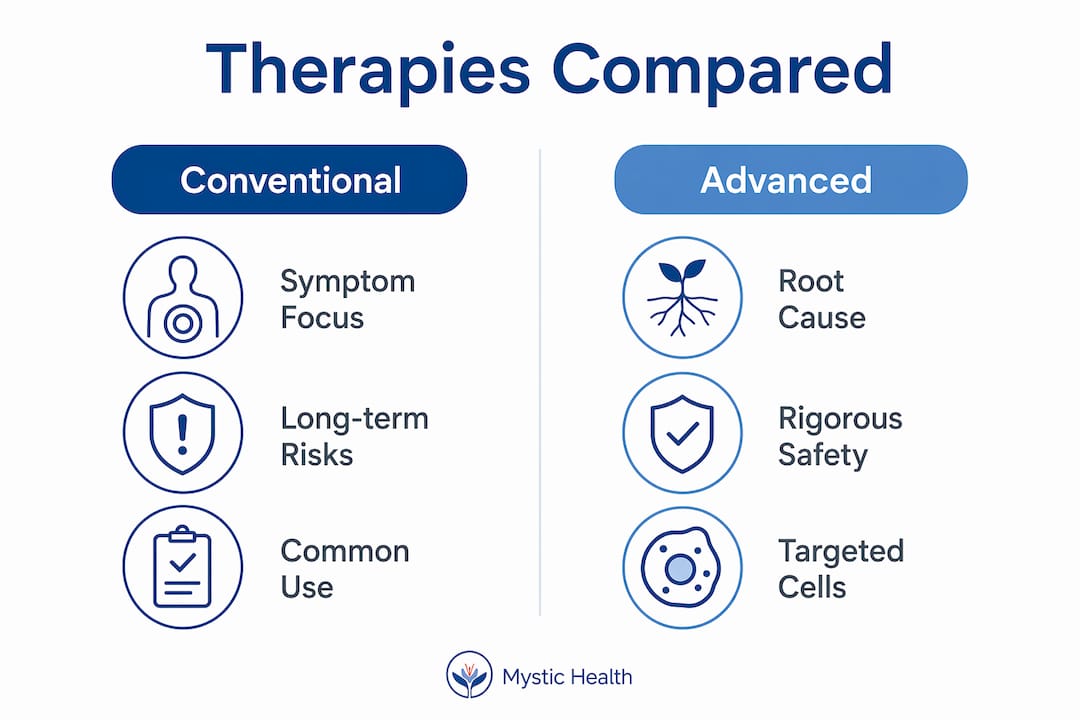
The most compelling reason to consider advanced therapy options is that they target the underlying cause of a condition rather than managing its surface expression. A daily antidepressant, for example, adjusts neurotransmitter levels while you take it. An advanced therapy aims to change the biological or neurological substrate driving the condition in the first place. That distinction matters enormously when you’ve been in treatment for years without reaching remission.
Gene therapy for RPE65 deficiency restores vision by correcting the faulty gene directly, rather than compensating for its absence. CAR-T cell therapies produce durable remissions in blood cancers. These are not incremental improvements. They represent a different category of outcome, and that category is now expanding into mental health and chronic disease.
The benefits of advanced therapies extend beyond biology. When conventional treatments have failed you, being offered a credible path forward changes something psychologically. The shift from “no options” to a life-changing intervention is profound, and it requires its own kind of support. Hope, when it’s grounded in evidence, is itself therapeutic.
Practically, advanced therapies can reduce long-term medication burden. Patients who achieve durable remission no longer carry the side effect load of chronic pharmaceutical use. For people managing treatment-resistant depression, chronic pain, or PTSD, that reduction in daily pharmacological exposure is not a small thing. It’s a different quality of life.
- Potential for curative or durable remission rather than ongoing symptom suppression
- Personalized approaches using your own cells or precisely targeted genetic corrections
- Reduced dependence on long-term medications and their cumulative side effects
- Psychological relief from having a credible, evidence-based option after prior treatment failures
- Improved functional outcomes, including return to work, relationships, and daily engagement
Pro Tip: When researching advanced therapy options, ask your provider specifically about functional outcome data, not just symptom reduction scores. The difference between “less depressed” and “able to work and connect again” is what matters most to your life.
How do advanced therapies work and are they safe?
Advanced therapies operate through three primary mechanisms: gene therapy, cell therapy, and tissue engineering. Understanding these at a basic level helps you ask better questions and make more informed decisions.

Gene therapy corrects or replaces faulty genetic instructions inside your cells. It uses delivery systems called vectors, often modified viruses, to carry new genetic material to the right location. Advanced delivery vectors now achieve 100-fold higher efficiency than earlier methods, which has dramatically improved both safety and effectiveness. Cell therapy introduces or modifies living cells to restore function. CAR-T therapy, for instance, takes your own immune cells, engineers them to recognize cancer, and reinfuses them. Tissue engineering rebuilds or replaces damaged biological structures using scaffolds and cell cultures.
| Therapy type | Mechanism | Primary application areas |
|---|---|---|
| Gene therapy | Corrects or replaces faulty genes via vectors | Rare genetic disorders, vision loss, emerging mental health |
| Cell therapy | Modifies or introduces living cells | Blood cancers, solid tumors, immune disorders |
| Tissue engineering | Rebuilds damaged tissue using biological scaffolds | Orthopedic, cardiac, and regenerative applications |
| Psychedelic-assisted therapy | Modulates neural plasticity and emotional processing | Treatment-resistant depression, PTSD, end-of-life distress |
Safety is a legitimate concern, and it deserves a direct answer. Approved therapies meet rigorous standards including good manufacturing practices, clinical trial oversight, and ongoing pharmacovigilance. The risk is not zero, but it is managed within a structured regulatory framework. The real danger lies in unapproved offerings that bypass these safeguards entirely. Verifying that any advanced therapy you consider has cleared regulatory approval is non-negotiable.
One honest caveat: most clinical trials have less than 3 years of follow-up data, so long-term durability is still being established. This means ongoing monitoring after treatment is not optional. It’s part of the care model.
Pro Tip: Before committing to any advanced therapy program, ask for the regulatory approval status, the trial follow-up duration, and the provider’s long-term monitoring protocol. A reputable program will answer all three without hesitation.
How advanced therapies compare to conventional psychiatric and medical treatments
The contrast between conventional treatments and advanced therapy options is not simply about efficacy. It’s about the fundamental logic of care.
| Factor | Conventional treatments | Advanced therapies |
|---|---|---|
| Target | Symptom management | Root biological cause |
| Duration | Ongoing, often indefinite | Often one-time or short course |
| Personalization | Population-level dosing | Patient-specific cells or genetic targeting |
| Side effect profile | Cumulative with long-term use | Acute risks managed in clinical setting |
| Cost structure | Distributed over years | High upfront, emerging payment models |
Conventional psychiatric medications, including SSRIs, SNRIs, and antipsychotics, work for many people. That’s worth saying clearly. But for the estimated one-third of people with major depression who don’t respond adequately to standard treatments, the advanced treatments for depression now available represent a meaningful alternative rather than a last resort.
The side effect comparison is nuanced. Conventional drugs carry cumulative risks with years of use, including metabolic effects, sexual dysfunction, and emotional blunting. Advanced therapies carry acute procedural risks that are managed in a clinical setting and then largely resolved. For many patients, trading a decade of daily side effects for a monitored short-term intervention is a rational choice.
Advanced therapies also fit within integrative care models rather than replacing them. Ketamine-assisted psychotherapy, for example, combines a pharmacological intervention with psychotherapeutic support, mindfulness practices, and ongoing integration work. The therapy is the context, not just the molecule.
Practical considerations: access, cost, and emotional readiness
The importance of advanced therapies is clear in clinical terms. The practical path to accessing them is more complicated, and being honest about that serves you better than optimism alone.
Cost is the most immediate barrier. Many advanced therapies carry high upfront prices, and outcomes-based rebates and installment payment models are emerging to address this, but they are not yet universal. Insurance coverage remains inconsistent. Reviewing your insurance coverage options before committing to a treatment pathway is a practical first step that many people skip.
Emotional readiness is equally real. Moving from chronic management to a potentially curative intervention is disorienting in ways that are hard to anticipate. Patient psychological adjustment requires new care models that include mental health support and peer connection, not just clinical monitoring. The people who do best are those who enter treatment with a support system already in place.
Here is what a well-structured advanced therapy pathway looks like in practice:
- Pre-treatment psychological assessment and preparation
- Clear informed consent covering risks, expected outcomes, and monitoring requirements
- Multidisciplinary care team including medical, psychological, and social support
- Structured integration support after treatment, especially for psychedelic-assisted modalities
- Long-term monitoring with defined check-in points and outcome tracking
The continuity of care before, during, and after treatment is what separates programs that produce lasting outcomes from those that deliver a clinical event without context.
What’s coming next in advanced therapies
The field is expanding faster than most people realize. Advanced therapies are moving beyond ultra-rare diseases into solid tumors, complex immune disorders, and increasingly, mental health conditions. The FDA’s approval of the first cell-based immunotherapy for solid tumors marks a turning point in how broadly these treatments will eventually apply.
Regulatory frameworks are also evolving. New gene editing technologies and synthetic nucleic acid therapies are being brought under updated legislative frameworks, which means more options will reach patients through approved channels in the coming years. That’s genuinely good news for people who are currently watching the research and waiting.
The integration of advanced therapies with holistic care models is another direction worth watching. Psychedelic-assisted therapy, sound therapy, and mindfulness-based interventions are increasingly being studied alongside biological interventions, not as alternatives but as complements. The integrative mental health model treats the whole person, and the evidence base for that approach is growing.
Patient advocacy is also shaping the field. National networks and advocacy groups are promoting shared patient experiences and education, which accelerates both research priorities and reimbursement reform. Your voice as a patient, and your decision to engage with these treatments, contributes to that momentum.
Key takeaways
Advanced therapies offer the most meaningful shift in treatment outcomes for mental health and chronic conditions when they target root biological causes within a structured, multidisciplinary care model.
| Point | Details |
|---|---|
| Root-cause targeting | Advanced therapies address underlying biology, not just symptoms, enabling durable or curative outcomes. |
| Safety requires verification | Only pursue therapies with confirmed regulatory approval and a defined long-term monitoring protocol. |
| Cost and access are real barriers | Outcomes-based payment models are emerging, but insurance review before treatment is essential. |
| Emotional preparation matters | Psychological support before, during, and after treatment significantly improves long-term outcomes. |
| Integration amplifies results | Combining advanced therapies with holistic care, including psychotherapy and mindfulness, produces deeper healing. |
Why this shift feels different to me
I’ve worked alongside people who arrived at advanced therapy programs after years of trying everything else. What strikes me most is not the science, though the science is genuinely remarkable. It’s the moment when someone realizes they are no longer just managing their condition. They are actually addressing it.
That shift is not automatic. I’ve seen people struggle with the weight of hope after years of disappointment. Moving from “I take this medication every day so I can function” to “I underwent a treatment that may have changed the underlying problem” requires a different relationship with your own healing. It asks more of you, and it gives more back.
What I’d caution against is treating advanced therapies as a shortcut. The people I’ve seen do best are those who come in with realistic expectations, a willingness to engage with the psychological work alongside the clinical intervention, and a support system that can hold them through the uncertainty of not knowing yet whether it worked.
The patient-centered care model matters here more than in almost any other treatment context. You are not a passive recipient of a procedure. You are an active participant in a process that can genuinely change your life. That’s worth showing up for fully.
— Kabir
Explore integrative advanced therapy programs at Mystic
At Mystic, we offer integrative mental health programs that combine evidence-based advanced therapies, including ketamine-assisted psychotherapy and Spravato, with holistic modalities like mindfulness, sound therapy, and personalized psychological support. Our approach is built around the whole person, not just the diagnosis. If you’re researching whether advanced therapies are right for your situation, our clinical team can walk you through the evidence, the process, and what genuine support looks like at every stage. Explore our treatment programs to find the pathway that fits your needs, your values, and where you are right now in your healing.
FAQ
What are advanced therapies in simple terms?
Advanced therapies are medical treatments that modify genes, cells, or tissues to treat serious conditions at their biological root, rather than managing symptoms. Examples include gene therapy, CAR-T cell therapy, and ketamine-assisted psychotherapy.
Should I pursue advanced therapies if conventional treatments haven’t worked?
Advanced therapies are particularly relevant for people with treatment-resistant conditions, including depression, PTSD, and certain chronic illnesses. A clinical evaluation with a qualified provider is the right starting point to assess whether you’re a candidate.
How long do the effects of advanced therapies last?
Many patients report relief lasting three to five years, but most clinical trials have less than three years of follow-up data. Long-term monitoring is a standard part of responsible advanced therapy care.
Are advanced therapies covered by insurance?
Coverage varies significantly by therapy type and insurer. Reviewing your specific plan and asking providers about outcomes-based payment options is the most reliable way to understand your financial pathway before treatment.
What makes advanced therapies different from experimental treatments?
Approved advanced therapies have cleared rigorous regulatory review, including clinical trials and manufacturing standards. Unapproved experimental offerings lack these safeguards and carry substantially higher risk.
Recommended

Mystic Health Blog








FAQs
1. Am I eligible for ketamine therapy?
2. Does insurance cover the cost of ketamine therapy?
3. How many ketamine treatments will I need?
We recommend two initial treatments to determine suitability and adjust dosage. After these sessions, additional treatments are available based on your progress and specific requirements.