What Is Guided Meditation? A Beginner's Guide to Calm
Guided meditation is a practice where a teacher or recorded voice verbally leads you through a session, directing your attention to your breath, body sensations, or calming imagery. You don’t have to figure it out alone. The guide does the heavy lifting, offering step-by-step cues that keep your mind from drifting too far. This makes it one of the most accessible entry points into meditation, especially if sitting in silence feels uncomfortable or unfamiliar.
Most guided sessions take one of four formats: live in-person classes, audio recordings, video sessions, or smartphone apps. Regardless of format, the core elements tend to stay consistent:
- A teacher or narrator speaks throughout the session
- Verbal cues direct your attention to breath, body, or imagery
- Positive affirmations or visualizations may be woven in
- You’re gently reminded to return focus when your mind wanders
- Sessions can run as short as five minutes or stretch beyond an hour
If you’ve ever tried meditating on your own and found your thoughts racing within thirty seconds, you’re not alone. Guided meditation exists precisely for that experience.
What are the main types of guided meditation?
Guided meditation types range from deeply physical practices to emotionally expansive ones, and knowing the differences helps you pick what actually fits your needs.
Body scan meditation starts at your feet and moves slowly upward, inviting you to notice tension, warmth, or sensation in each part of your body. It’s especially useful before sleep or after a stressful day, because it pulls attention away from anxious thoughts and grounds it in physical reality.
Visualization meditation asks you to picture a peaceful scene, maybe a quiet forest or a warm beach, and hold that image while the guide describes it in sensory detail. The goal isn’t fantasy; it’s using the mind’s natural imagery to evoke genuine calm and emotional ease.
Loving-kindness meditation (sometimes called metta) is a bit different. You silently repeat phrases of goodwill, first toward yourself, then toward others, including people you find difficult. Research supports its role in building compassion and reducing self-criticism, two things many people in emotional pain genuinely need.
Breath awareness meditation is the most foundational type. The guide directs your attention to the natural rhythm of your inhale and exhale, using the breath as an anchor to the present moment. When thoughts arise, you notice them and return to the breath. That act of returning, again and again, is the actual practice.
Sessions typically run 5–60 minutes. Most beginners do well starting at 10 minutes and adjusting from there.

What does research say about the benefits of guided meditation?
The benefits of guided meditation are well-documented, and they tend to build gradually rather than appear overnight. Studies consistently show small-to-moderate reductions in anxiety, depression symptoms, and stress, along with improvements in sleep quality and attention, usually developing over 6–8 weeks of consistent practice.
Here’s what the research points to most clearly:
- Reduced anxiety and stress: Mindfulness-based practices lower cortisol and calm the nervous system over time
- Better sleep: Mindfulness meditation has shown measurable improvements in sleep quality, particularly for people with insomnia
- Improved focus and attention: Regular practice trains the brain to redirect attention more efficiently
- Emotional regulation: Practitioners report greater ability to sit with difficult emotions without reacting impulsively
- Long-term resilience: Consistent meditators tend to recover from stress faster and maintain steadier moods
Research note: A Harvard study found that eight weeks of meditation produced measurable changes in brain regions associated with memory, self-awareness, and stress regulation.
These aren’t abstract promises. They’re outcomes that show up in real people’s lives when the practice becomes a habit rather than an occasional experiment.
How does guided meditation actually work?
Think of the guide as a mental GPS. Rather than leaving you to navigate silence on your own, the instructor’s voice provides a clear, moment-to-moment path for your attention to follow. That structure is what makes the practice feel manageable, especially early on.
Here’s what’s happening during a typical session:
- The guide opens with a grounding cue, often a few slow breaths, to signal the shift from ordinary activity to intentional presence
- Verbal instructions direct attention to a specific anchor: breath, body sensation, or imagery
- When the mind wanders, the guide gently redirects without judgment, modeling the non-critical awareness that is central to the practice
- Pacing slows deliberately as the session deepens, giving your nervous system time to settle
- A closing sequence brings you back to full awareness gradually, rather than abruptly
What separates guided meditation from silent practice is that external voice. In silent meditation, you self-direct entirely. With a guide, attention is gently redirected each time it drifts, which trains the mind without requiring you to already know how to do that on your own.
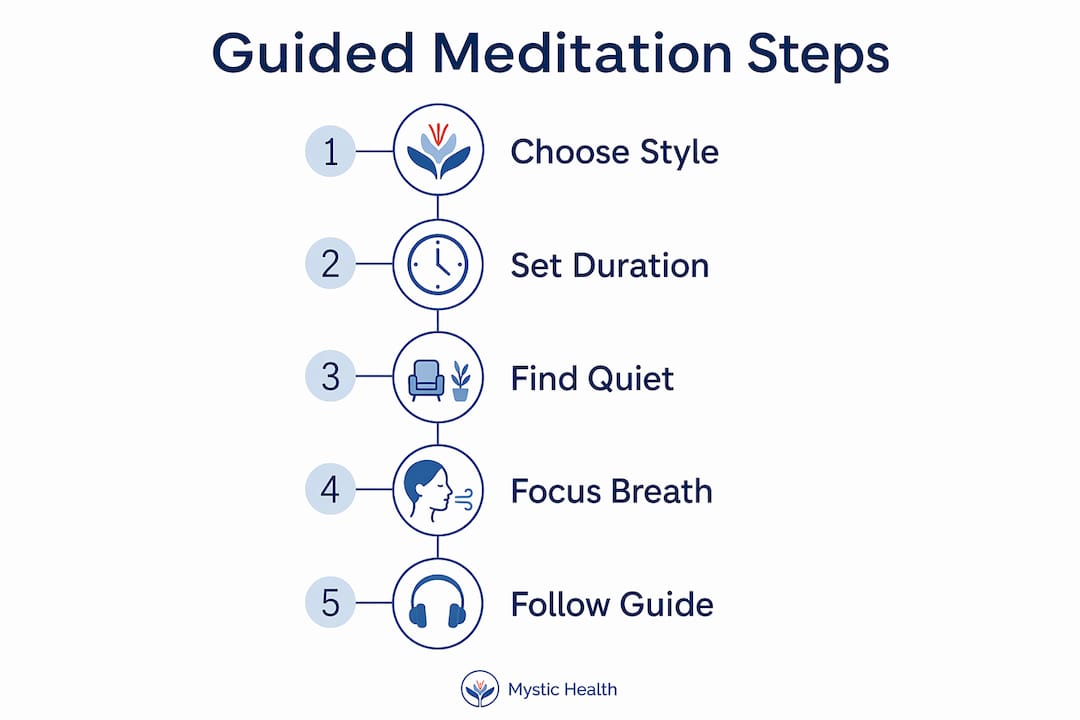
How to practice guided meditation as a beginner
Starting is simpler than most people expect. You don’t need a special cushion, a dedicated room, or any prior experience.
- Choose a quiet spot where you won’t be interrupted for the length of your session
- Sit or lie comfortably. A chair with your feet flat on the floor works just as well as a meditation cushion
- Start with 5–10 minutes. Short, consistent sessions build the habit far more effectively than occasional long ones
- Use headphones if ambient noise is an issue; they help the guide’s voice feel more present and focused
- Let go of the goal of “doing it right.” Your mind will wander. That’s expected, not a failure
Pro Tip: Consistency matters more than duration. A daily five-minute session will build more lasting mental clarity than a 45-minute session once a week.
For resources, apps like Insight Timer offer free guided sessions across every style and length. YouTube has thousands of free guided meditations from qualified teachers. Many therapists and integrative mental health programs also incorporate guided meditation into structured care plans.
What experts say about safety and realistic expectations
Experts compare a meditation guide to a coach: someone who gives clear instructions, encourages you when it gets hard, and reminds you to be kind to yourself when you lose focus. That framing matters, because many beginners approach meditation with a performance mindset, expecting to achieve stillness and feeling like they’ve failed when they don’t.
A few things worth knowing before you start:
- No special equipment or location is required, just a comfortable, interruption-free space
- The goal is not an empty mind. Meditation is the practice of noticing when your mind has wandered and returning your attention, not preventing thoughts from arising
- For people with severe PTSD, psychosis, or serious depression, consulting a mental health professional before starting is genuinely important, not just a legal disclaimer
- Self-compassion is part of the practice itself. When your attention drifts, the response is a gentle return, not frustration
Pro Tip: When your mind wanders during a session, treat the moment of noticing as a success. That awareness is exactly what you’re training.
What guided meditation means at its core
At its simplest, guided meditation is structured attention practice led by another person’s voice. The National Center for Complementary and Integrative Health describes meditation broadly as a set of practices that focus on mind-body integration, used to calm the mind and support overall well-being. The “guided” element adds a layer of support: someone else holds the structure so you can focus on the experience.
This distinguishes it from unguided or silent meditation, where the practitioner self-directs entirely. For beginners, that distinction is often the difference between a practice that sticks and one that gets abandoned after a few frustrating attempts.
How the instructor’s voice shapes your experience
The instructor’s role goes beyond reading a script. A skilled guide calibrates pacing, tone, and language to match the depth of relaxation they’re inviting. Early in a session, the voice tends to be conversational and grounding. As the session deepens, speech slows, pauses lengthen, and the language becomes more sensory and evocative.
That vocal pacing does real work. It signals to your nervous system that it’s safe to slow down. The guide also models non-judgmental awareness by acknowledging that thoughts will arise and framing the return of attention as natural rather than problematic. Over time, you internalize that voice. The external support gradually becomes an internal skill.
Practical tips for setting up your practice
Finding the right setup makes a real difference, especially in the first few weeks. A few things that help:
- Time of day matters. Morning sessions before the day’s demands begin tend to be easier to protect. Evening sessions work well for winding down
- Same spot, same time builds a cue-response pattern that makes sitting down feel automatic rather than effortful
- Posture: Sit upright enough to stay alert, relaxed enough not to strain. Lying down is fine if you’re not prone to falling asleep during the session
- Finding a guide: Apps, YouTube, local meditation centers, and mindfulness programs all offer quality guided sessions. Start with a teacher whose voice and pacing feel comfortable to you
How long and how often should you meditate?
For beginners, 5–10 minutes daily is a realistic and effective starting point. The research on habit formation consistently supports shorter, more frequent sessions over longer, sporadic ones. As the practice becomes familiar, many people naturally extend to 15–20 minutes without it feeling like a burden.
Frequency matters more than duration, at least early on. Daily practice, even brief, builds the neural pathways that make attention training cumulative. Missing a day occasionally is fine. Missing a week regularly means starting over each time. Aim for at least five days a week if daily feels too rigid.
What challenges do beginners commonly face?
The most common struggle is the belief that a wandering mind means you’re doing it wrong. It doesn’t. Noticing that your mind has wandered and returning your focus is the actual practice, not a sign of failure.
Other challenges beginners often face:
- Restlessness or boredom: Sitting still can feel uncomfortable at first. This usually eases within a few sessions as the nervous system adjusts
- Falling asleep: Common during body scans or evening sessions. Sitting upright rather than lying down helps
- Expecting immediate results: The benefits build over weeks, not days. Patience with the process is part of the practice
- Inconsistency: Life gets busy. Tying your session to an existing habit, like morning coffee or brushing your teeth, makes it easier to protect
Where can you find quality guided meditation resources?
Several well-regarded resources are freely available or low-cost:
- Insight Timer: A free app with thousands of guided meditations from teachers worldwide, searchable by length, style, and focus
- YouTube: Channels from qualified meditation teachers offer free body scans, loving-kindness sessions, and breath awareness practices
- UCLA Mindful: The UCLA Mindful Awareness Research Center offers free guided audio meditations on its website, backed by academic research
- Local meditation centers and yoga studios: In-person classes provide community and real-time guidance from experienced teachers
- Therapist-led programs: Many mindfulness-based therapy programs integrate guided meditation into structured mental health care
If you’re dealing with anxiety, depression, or trauma alongside your interest in meditation, working with a clinician who incorporates these practices into treatment can make the experience both safer and more effective.
Key Takeaways
Guided meditation works because a teacher’s verbal direction gives beginners the structure they need to build attention, calm, and emotional resilience through consistent daily practice.
| Point | Details |
|---|---|
| What it is | A teacher or recorded voice verbally leads your attention through breath, body, or imagery. |
| Core types | Body scan, visualization, loving-kindness, and breath awareness cover most beginner needs. |
| Research-backed benefits | Consistent practice over 6–8 weeks produces measurable reductions in anxiety, stress, and sleep problems. |
| Best starting point | Daily sessions of 5–10 minutes build habit and mental clarity more effectively than occasional longer ones. |
| Biggest misconception | A wandering mind is not failure. Noticing and returning attention is the practice itself. |
Recommended

Mystic Health Blog








FAQs
1. Am I eligible for ketamine therapy?
2. Does insurance cover the cost of ketamine therapy?
3. How many ketamine treatments will I need?
We recommend two initial treatments to determine suitability and adjust dosage. After these sessions, additional treatments are available based on your progress and specific requirements.