Instructional Guide for Pain Management in 2026
What effective pain management actually looks like
Pain management, done well, is never a single prescription or a single conversation. It is a multimodal approach that weaves together physical, psychological, and pharmacological strategies, shaped around the individual in front of you. Whether you are a provider building a treatment plan or a patient trying to understand your options, the foundation is the same: recognize what kind of pain you are dealing with, assess it honestly, and treat the whole person, not just the symptom.
The first distinction that shapes everything else is acute versus chronic pain. Acute pain arrives suddenly, usually tied to an injury or illness, and resolves when the cause heals. Chronic pain, by clinical definition, persists beyond three months and is better understood as a disease in its own right, not simply acute pain that lingered. That difference matters enormously for how you approach treatment.
The biopsychosocial model is the gold standard framework for understanding pain today. It holds that physical sensation, emotional state, and social context all shape how pain is experienced and how well treatment works. Ignoring any one of those three dimensions tends to leave patients stuck.
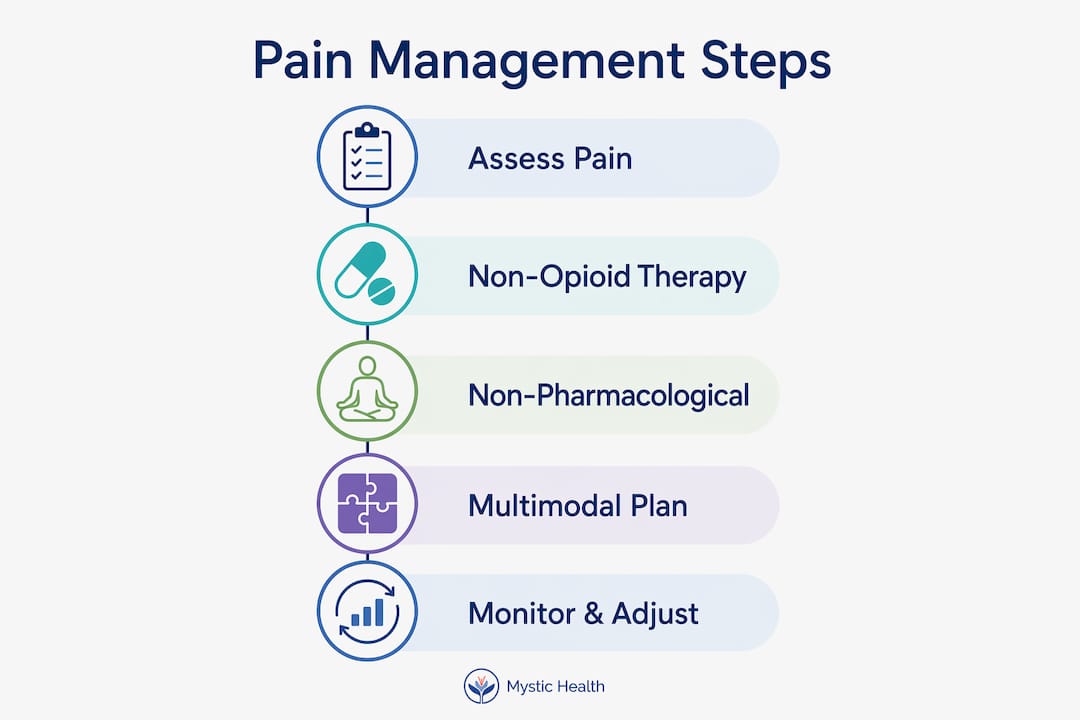
Key components of an effective pain management plan:
- Thorough pain assessment using validated tools such as the Verbal Rating Scale, Visual Analogue Scale (VAS), or Faces Pain Scale, alongside functional evaluation
- Classification of pain as nociceptive, neuropathic, or nociplastic to guide treatment selection
- Identification of comorbid conditions, including mood disorders, substance use history, and psychosocial stressors
- Realistic goal-setting focused on functional improvement, such as returning to work or walking without assistance, rather than complete pain elimination
- A multimodal treatment plan combining non-pharmacological therapies, non-opioid medications, and, where appropriate, carefully monitored opioid therapy
- Active patient education and self-management support, including pain psychoeducation and coping skill development
- Regular reassessment and plan adjustment, with shared decision-making at every stage
Pain assessment is sometimes called the “fifth vital sign,” alongside temperature, pulse, blood pressure, and respiratory rate. Treating it with that same seriousness, every visit, changes the quality of care patients receive.
Clinical guidelines for opioid prescribing and pharmacological treatments
The clearest message from current U.S. clinical guidance is this: opioids are not the starting point for most pain. The 2022 CDC Clinical Practice Guideline for Prescribing Opioids for Pain expanded guidance on evidence-based non-opioid options and reinforced that non-pharmacological and non-opioid pharmacological therapies should be maximized before opioids are considered. That is not a soft recommendation. It reflects the weight of evidence on opioid risks and the growing body of support for alternatives.
For providers navigating pharmacological decisions, the framework looks like this:
Non-opioid pharmacological options to consider first:
- Acetaminophen and NSAIDs for nociceptive pain, with attention to gastrointestinal, renal, and cardiovascular risks in older adults
- Anticonvulsants such as gabapentin or pregabalin for neuropathic pain
- Serotonin-norepinephrine reuptake inhibitors (SNRIs) and tricyclic antidepressants (TCAs), which can simultaneously address comorbid mood disorders and insomnia
- Topical agents, including lidocaine patches and diclofenac gel, for localized pain with lower systemic risk
- Muscle relaxants and anti-anxiety medications in select cases, with careful monitoring
When opioids are considered:
- A full evaluation is required before initiating opioid therapy, including record review, urine drug screen, and review of the state Prescription Drug Monitoring Program (PDMP)
- Potential benefits must clearly outweigh risks before proceeding
- Patients on chronic opioid therapy should be seen regularly, with benefits and risks reviewed at each prescription
- Morphine milligram equivalents per day (MME/day) must be calculated and monitored
- Urine drug screening should occur at least once per year, and more frequently for higher-risk patients
- Opioid discontinuation should be considered when functional goals are not met, adverse effects emerge, or signs of misuse appear
A note on opioid risk: The American Medical Association has reported that nearly half of all heroin users started with an addiction to a prescription opioid medication before switching due to availability. That context belongs in every conversation about initiating opioid therapy.
The CDC’s guidance also emphasizes that for many common types of acute pain, non-opioid therapies are at least as effective as opioids. Low-cost group aerobics, for example, can be as effective as individual physical therapy for reducing low back pain and improving function. The pharmacological plan should always sit inside a larger, multimodal framework, not replace it.
Non-pharmacological and psychological therapies that actually work
Here is something worth sitting with: the therapies that require the most from patients, the ones that ask for active participation rather than passive pill-taking, tend to produce the most durable results. Evidence-based non-pharmacological treatments like cognitive behavioral therapy, biofeedback, and physical therapy are not soft alternatives to “real” medicine. They are, increasingly, the preferred first line.
Cognitive behavioral therapy (CBT)
CBT works by targeting the thoughts and emotional responses that amplify pain. When someone with chronic pain begins to catastrophize, withdrawing from activity and expecting the worst, the pain cycle deepens. CBT interrupts that pattern. It teaches patients to identify maladaptive thought patterns, challenge them, and replace them with responses that support function rather than avoidance. The result is not just reduced distress. Patients often report improved daily functioning even when pain intensity itself has not dramatically changed.

Biofeedback
Biofeedback uses electronic devices to give patients real-time data on their own physiological responses, things like muscle tension, heart rate, and breathing patterns. Watching those measurements change in response to relaxation techniques gives patients a concrete sense of control over their body’s response to pain. It is particularly useful for chronic headaches, back pain, and conditions where muscle tension plays a significant role. The skill transfers: patients learn to recognize tension before it escalates and intervene on their own.
Physical therapy
Physical therapy addresses what chronic pain often creates: deconditioning, reduced mobility, and secondary pain generators that develop when people stop moving to protect themselves. A skilled physical therapist guides patients through exercises designed to restore strength and mobility without triggering flares. Occupational therapy complements this by helping patients adapt daily activities so they can function without aggravating pain.

Hypnosis and mindfulness
Hypnosis has a longer evidence base than many providers realize. Research consistently shows it can reduce pain intensity in chronic pain patients and may help reduce reliance on opioid medications. Mindfulness-based stress reduction (MBSR) works similarly, training attention away from pain catastrophizing and toward present-moment awareness without judgment. Both approaches are recognized in clinical guidelines as legitimate adjunct therapies.
Evidence-based non-pharmacological options at a glance:
- CBT and acceptance and commitment therapy (ACT) for psychological pain modulation
- Biofeedback for self-regulation of physiological pain responses
- Physical therapy and occupational therapy for mobility and functional restoration
- Hypnosis as an adjunct for pain intensity reduction and opioid reduction support
- Mindfulness-based stress reduction for catastrophizing and emotional regulation
- Exercise programs including walking, swimming, and cycling for pain interruption and mood support
- Massage therapy, acupuncture, and relaxation training as complementary approaches
- Music therapy, shown in studies to help relieve pain during and after surgery
Pro Tip: If a patient is resistant to psychological therapies because they feel it implies their pain “isn’t real,” reframe the conversation. Explain that CBT and biofeedback work on the nervous system’s actual pain-processing pathways, not on belief or attitude. That distinction often opens the door.
How the patient-provider relationship shapes pain outcomes
You can have the most carefully constructed treatment plan in the world, and if the patient doesn’t trust you, it will not work. That is not a soft observation. Research confirms that patients who feel validated by their providers participate more fully in treatment and report better quality of life, independent of direct pain reduction. The therapeutic relationship is not background noise. It is a clinical variable.
Chronic pain is isolating. Patients often arrive having been dismissed, undertreated, or told their pain is exaggerated. The first thing a provider can do, before any prescription or referral, is acknowledge that experience honestly. Validation is not agreement with every belief a patient holds. It is the act of communicating that their suffering is real and that you are genuinely trying to help.
Practical ways to build and maintain a strong therapeutic alliance:
- Use open-ended questions to understand the patient’s experience, not just their pain score
- Acknowledge the emotional weight of living with chronic pain without minimizing it
- Set realistic expectations early: explain that finding the right approach takes time, and that the goal is functional improvement, not necessarily pain elimination
- Involve patients in every treatment decision through shared decision-making, incorporating their values and preferences
- Follow through consistently, including returning calls, reviewing records before appointments, and remembering what matters to the individual patient
- Bring in a team, including nursing staff and behavioral health consultants, to provide coaching and support between visits
Pro Tip: When a patient feels unheard, they often escalate requests for stronger medications. Addressing the relationship directly, by asking “Do you feel like we’re working on this together?”, can shift the dynamic more effectively than any medication adjustment.
The evidence on shared decision-making is clear: patients whose preferences and values are incorporated into their treatment plans show better adherence and engagement. That is not a courtesy. It is a clinical strategy.
How to build and apply a multimodal, biopsychosocial treatment plan
The biopsychosocial model tells us that pain lives at the intersection of biology, psychology, and social context. A treatment plan that addresses only one of those dimensions will always be incomplete. Building one that addresses all three takes structure, but it is learnable, and it is what separates adequate pain care from genuinely effective pain care.
Start with function, not pain scores
The function-based approach shifts the treatment target from “reduce pain to zero” to “restore what matters to this patient.” That might be returning to work, sleeping through the night, or walking to the mailbox without stopping. Functional goals are measurable, motivating, and more achievable than complete pain elimination in most chronic pain cases. They also give providers a concrete way to assess whether a treatment is working.
Break the pain-inactivity cycle
Chronic pain often traps patients in a vicious cycle: pain leads to inactivity, inactivity leads to deconditioning, and deconditioning makes pain worse. Pacing strategies and pain diaries are two of the most practical tools for breaking that cycle. A pain diary tracks activity levels, pain intensity, and triggers over time, giving both patient and provider the data needed to identify patterns and adjust the plan. Pacing teaches patients to alternate planned periods of activity and rest, rather than pushing through until they crash.
Practical steps for building the plan:
- Conduct a full biopsychosocial assessment covering pain characteristics, functional impact, mood, substance use history, social supports, and pain beliefs
- Use the RAT framework (Recognize, Assess, Treat) as a clinical organizing structure, then build outward from it
- Set two to three specific, measurable functional goals with the patient at the first visit
- Select a combination of non-pharmacological therapies, non-opioid medications, and, where appropriate, interventional options such as nerve blocks or neuromodulation
- Assign interdisciplinary team roles: primary provider for medical management, physical therapist for mobility, behavioral health consultant for psychological support, nursing for education and coaching
- Provide pain psychoeducation at every stage, helping patients understand the neuroscience of their pain and the rationale for each treatment choice
- Schedule regular reassessment visits to review progress, adjust goals, and address barriers
Pro Tip: Give patients a written summary of their treatment plan, including their functional goals and the rationale for each therapy. Patients who understand why they are doing something are far more likely to follow through.
Interventional options, including minimally invasive procedures like nerve blocks and neuromodulation, belong in the plan when other treatments have not provided sufficient relief. They complement, rather than replace, the broader multimodal approach.
Integrative and psychedelic-assisted therapies: what the evidence says
Pain is not only physical. Anyone who has lived with chronic pain, or cared for someone who has, knows that it reshapes identity, erodes relationships, and carries a psychological weight that standard pharmacology rarely touches. That is where integrative and emerging therapies are opening genuinely new ground.
Psychedelic-assisted therapy is among the most discussed developments in pain and mental health care right now. Early clinical evidence suggests that modalities like ketamine-assisted psychotherapy can interrupt entrenched pain and mood patterns in ways that conventional treatments often cannot. Ketamine works on NMDA receptors in the brain, disrupting the central sensitization that underlies many chronic pain conditions. For patients who have not responded to standard approaches, that mechanism offers a different pathway entirely.
Mindfulness practices, sound therapy, and somatic approaches address the nervous system’s chronic activation state, the “fight or flight” response that worsens muscle tension and amplifies pain signals. These are not passive relaxation techniques. Practiced consistently, they produce measurable changes in how the brain processes pain. Mindfulness-based approaches are now recognized in clinical guidelines as legitimate behavioral health interventions for chronic pain.
Integrative therapies with growing evidence support:
- Ketamine-assisted psychotherapy for treatment-resistant chronic pain and comorbid depression
- Spravato (esketamine) for patients with major depressive disorder and pain overlap
- Mindfulness-based stress reduction (MBSR) for catastrophizing, emotional regulation, and functional improvement
- Sound therapy and somatic practices for nervous system regulation and pain modulation
- Acceptance and commitment therapy (ACT) as a complement to CBT in chronic pain populations
- Holistic mental health care addressing trauma, grief, and identity disruption caused by chronic illness
What the research shows: Novel integrative therapies, including psychedelic-assisted treatment, show promising results for chronic pain and psychological comorbidities, expanding what is possible for patients who have felt stuck.
Mystic Health’s psychedelic-assisted programs are built on this evidence base, combining ketamine-assisted psychotherapy, Spravato, and holistic mental health care within personalized, safety-centered treatment plans. The approach is whole-person by design, addressing the emotional and psychological dimensions of pain alongside the physical. For patients and providers looking to explore what is possible beyond conventional care, that integration is where the most meaningful healing often begins.
Monitoring and managing side effects of pain treatments
Every treatment carries a trade-off. The goal is never to eliminate all risk. It is to ensure that benefits clearly outweigh harms, and to catch problems early when they arise.
Opioid monitoring
Patients on opioid therapy require structured, ongoing oversight. At minimum, that means reviewing the state PDMP with each prescription, calculating and tracking MME per day, and performing urine drug screening at least annually. More frequent screening is appropriate for patients with elevated risk. Watch for red-flag behaviors: requesting early refills, reporting lost prescriptions, or showing signs of sedation or respiratory depression. When functional goals are not being met and risks are mounting, tapering or discontinuation is the right clinical move.
Non-opioid medication side effects
NSAIDs carry real risks, particularly for older adults and patients with cardiovascular, renal, or gastrointestinal conditions. Long-term NSAID use requires periodic monitoring of kidney function and blood pressure. Anticonvulsants like gabapentin can cause sedation and dizziness, which increases fall risk in older patients. SNRIs and TCAs require monitoring for cardiac effects and serotonin syndrome risk when combined with other serotonergic agents.
Non-pharmacological therapy considerations
Non-pharmacological treatments are generally safer than medications, but they are not without considerations. Physical therapy can temporarily increase pain before function improves. Patients need to be prepared for that and supported through it. Biofeedback and CBT require consistent engagement. Patients who drop out early often do so because they expected faster results. Setting realistic timelines at the outset prevents premature abandonment of therapies that would have worked.
Integrative therapy safety
Ketamine-assisted psychotherapy and Spravato are administered in clinical settings with monitoring protocols in place. Mystic Health’s programs include personalized safety planning, medical screening, and structured integration support after each session. Patients with a history of psychosis, active suicidality, or certain cardiovascular conditions require careful screening before psychedelic-assisted therapy is considered.
Practical monitoring principles:
- Document functional status at every visit, not just pain scores
- Use validated screening tools such as the PHQ-9 for depression and the AUDIT-C for alcohol use to catch comorbidities that complicate pain management
- Reassess the full treatment plan at regular intervals, adjusting based on what is and is not working
- Communicate side effect expectations clearly before starting any new therapy, so patients know what to report and when
- Create an open channel for patients to raise concerns between visits, whether through a patient portal, nursing line, or scheduled check-in call
Key Takeaways
Effective pain management requires a biopsychosocial, multimodal framework that prioritizes function, integrates non-opioid therapies, and centers the patient-provider relationship at every stage.
| Point | Details |
|---|---|
| Chronic pain is a distinct disease | Chronic pain persists beyond three months and requires a biopsychosocial approach, not just symptom treatment. |
| Non-opioid therapies come first | The 2022 CDC Clinical Practice Guideline directs clinicians to maximize non-pharmacological and non-opioid options before considering opioids. |
| Function over pain elimination | Treatment goals should target measurable functional improvements, such as mobility or sleep, rather than complete pain relief. |
| Therapeutic relationship is a clinical variable | Patients who feel validated by their providers participate more fully in treatment and report better quality of life. |
| Integrative therapies expand what is possible | Ketamine-assisted psychotherapy and mindfulness-based approaches address pain and psychological comorbidities that conventional treatments often miss. |
Mystic Health can help you find a way forward
Living with pain, or caring for someone who does, can feel like being trapped in a place with no exit. At Mystic, we believe healing is possible, even when it feels far away. Our programs bring together evidence-based clinical care, psychedelic-assisted therapy, and whole-person support in a way that honors both the science and the human experience of pain.
If you are ready to explore what a personalized, integrative approach to pain management could look like for you, Mystic’s comprehensive pain programs are designed to meet you where you are. We work with patients navigating chronic pain, serious illness, and the emotional weight that comes with both. You do not have to figure this out alone.
Explore Mystic’s integrative mental health and pain care programs, or visit our clinical evidence page to see the research behind what we do. When you are ready, we are here.
Recommended

Mystic Health Blog






FAQs
1. Am I eligible for ketamine therapy?
2. Does insurance cover the cost of ketamine therapy?
3. How many ketamine treatments will I need?
We recommend two initial treatments to determine suitability and adjust dosage. After these sessions, additional treatments are available based on your progress and specific requirements.