The Role of Mind-Body Connection in Your Health
TL;DR:
- Scientific research confirms that mind-body practices produce measurable biological changes in brain and immune function within just one week. Techniques like meditation, breathwork, and yoga, especially when combined, strengthen emotional regulation and physiological resilience through consistent practice. Positive expectations and trust can also activate healing pathways, emphasizing the importance of deliberate engagement and regularity in self-care routines.
The mind-body connection is defined as the continuous two-way communication between mental processes and physical health that actively shapes immunity, emotional balance, and disease resilience. This is not a philosophical idea. Research from UC San Diego, Harvard Health, and Nature Medicine confirms that thoughts, emotions, and expectations produce measurable biological changes in the brain, blood, and gut. Understanding the role of mind-body connection gives you a real framework for improving your health, not just your mood.
What scientific evidence supports the biological impact?
The mind-body relationship is not theoretical. It produces changes you can measure in a lab.
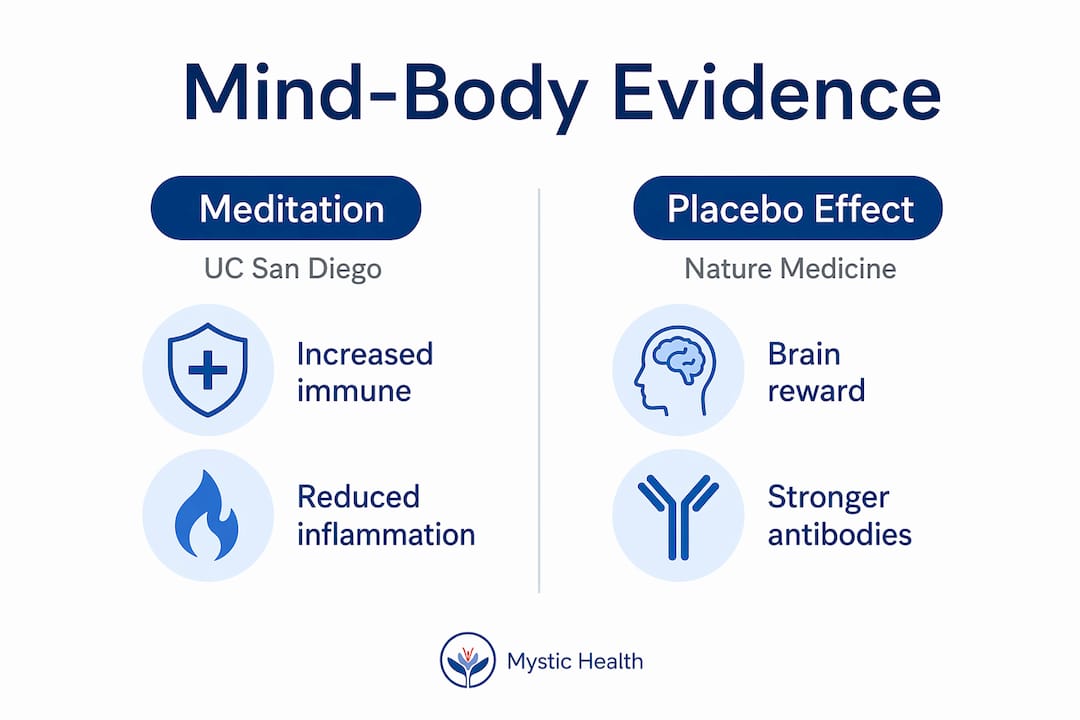
A 7-day intensive retreat at UC San Diego showed that combined meditation and movement practices led to measurable increases in endogenous opioids and improvements in metabolic flexibility. Endogenous opioids are the body’s natural pain-relieving and mood-regulating chemicals. The fact that a single week of structured practice shifted blood biology this significantly tells us the body responds to mental training faster than most people expect.
Harvard Health’s research on the gut-brain axis adds another layer. The gut and brain communicate continuously via the enteric nervous system, and stress or negative emotions directly disrupt digestion and trigger inflammation. This means chronic anxiety is not just a feeling. It is a physiological event happening in your intestines.
Nature Medicine published a randomized trial showing that higher brain reward network activity in the ventral tegmental area correlates with stronger antibody production after vaccination. Your mental state at the time of a vaccine can influence how well your immune system responds. That is a striking finding with real clinical implications.
Pro Tip: These biological changes are measurable and reproducible. If you have ever dismissed mind-body practices as soft science, the blood and brain data from these studies make a compelling case for reconsidering.
| Study | Institution | Biological Outcome |
|---|---|---|
| 7-day meditation retreat | UC San Diego | Increased endogenous opioids, improved metabolic flexibility |
| Brain reward network and vaccines | Nature Medicine | Higher antibody production linked to reward circuit activity |
| Gut-brain signaling and stress | Harvard Health | Stress disrupts digestion and raises inflammation markers |
How does the mind-body feedback loop work daily?
The brain-body relationship operates as a continuous loop of prediction and interpretation, not a one-way signal from mind to body. Understanding this loop changes how you think about stress, mood, and physical sensation.

The technical term for this process is interoception. Interoception is your body’s ability to sense its own internal states, such as heart rate, gut tension, muscle tightness, and temperature. Harvard Medical School researcher Steve Liberles has studied how these internal signals travel to the brain and shape emotional experience. When your heart races, your brain interprets that signal and generates a feeling, often anxiety or excitement, depending on context.
Low interoceptive awareness links directly to mental health struggles. When you cannot accurately read your body’s signals, your brain fills in the gaps with predictions, and those predictions are often fear-based. This is why people with chronic anxiety frequently report physical symptoms like chest tightness or nausea that have no structural cause. The brain is predicting danger from ambiguous body signals.
Here is how this feedback loop shows up in everyday life:
- Stress response: Muscle tension signals threat to the brain, which releases cortisol, which increases muscle tension further.
- Mood and posture: Slouched posture sends low-energy signals to the brain, which interprets them as low mood.
- Gut and emotion: Gut discomfort triggers emotional unease, which then worsens gut function through the enteric nervous system.
- Breathing and calm: Slow, deep breathing signals safety to the brain, which reduces heart rate and lowers anxiety.
- Pain amplification: Anticipating pain increases nervous system sensitivity, making pain feel more intense than it would otherwise.
Pro Tip: You can interrupt this loop deliberately. Practices that build interoceptive awareness, like body scan meditation or diaphragmatic breathing, train your brain to interpret body signals more accurately and respond with less reactivity.
What mind-body techniques actually work?
The impact of mind on body is most reliably harnessed through consistent, structured practice. Research supports several specific techniques, each with a distinct mechanism.
The UC San Diego retreat combined multiple modalities, not just one. That matters. Structured mind-body interventions that integrate several practices produce measurable neural and immune benefits even in people with persistent stress-related health issues. Single-technique approaches tend to produce smaller effects.
Here are the most evidence-supported mind-body techniques for healing:
- Meditation: Reduces cortisol, increases endogenous opioids, and promotes neuroplasticity. Even short daily sessions produce cumulative biological changes over weeks.
- Breathwork: Activates the parasympathetic nervous system within minutes. Techniques like box breathing or 4-7-8 breathing directly lower heart rate and reduce the stress response.
- Yoga: Combines movement, breath, and attention in a way that trains interoception and reduces systemic inflammation. Harvard Health recommends it specifically for gut-brain health.
- Guided imagery: Uses mental visualization to activate the same brain circuits as real experience. Oncology programs at major medical centers use it to reduce pain and treatment anxiety.
- Gut-directed hypnotherapy: A specialized form of hypnotherapy shown in clinical trials to reduce IBS symptoms by targeting the gut-brain communication pathway directly.
Consistency matters more than intensity. A 10-minute daily meditation practice produces more lasting biological change than a single 90-minute session once a month. The brain responds to repetition, not occasional effort. If you want to explore integrative therapy approaches that combine these techniques in a structured clinical setting, the research strongly supports that model.
How does positive expectation change your biology?
Positive expectation is not wishful thinking. It is a biological process that activates specific brain circuits and alters immune function.
The Nature Medicine placebo study found that individuals with positive expectation showed stronger antibody responses after vaccination, independent of whether they received the actual vaccine or a placebo. The brain’s reward network, specifically the ventral tegmental area, was the key driver. When that circuit activates, it releases dopamine and engages the body’s healing systems.
Tufts University researchers reframe the placebo effect as a biological health governor involving endogenous opioids and dopamine, triggered by social cues and trust. This is not about tricking yourself. It is about recognizing that the therapeutic relationship, the clinical environment, and your own mental state are active ingredients in healing, not passive background noise.
The connection between thoughts and health runs through these same pathways. Changing thought patterns can physically alter body chemistry and brain structure. Modern neuroscience supports the view that mental states and physical brain states are intertwined at a molecular level.
| Factor | Meditation Effects | Placebo/Expectation Effects |
|---|---|---|
| Endogenous opioids | Increased after 7-day retreat | Activated by trust and social cues |
| Immune response | Immune activation observed post-retreat | Higher antibody levels with reward circuit activity |
| Brain changes | Neuroplasticity and structural growth | Reward network engagement in ventral tegmental area |
| Mechanism | Repeated practice and attention training | Expectation, trust, and social context |
The clinical implication is significant. Practitioners who build trust, set clear expectations, and create supportive environments are not just being kind. They are activating biological healing systems in their patients.
Key takeaways
The mind-body connection is a measurable biological system, and consistent engagement with evidence-based practices produces real changes in brain chemistry, immune function, and emotional regulation.
| Point | Details |
|---|---|
| Mind-body effects are biological | UC San Diego and Nature Medicine studies confirm measurable changes in blood, brain, and immunity. |
| Interoception drives the feedback loop | Training body awareness improves emotional regulation and reduces stress reactivity. |
| Multiple techniques outperform one | Combined practices like meditation, breathwork, and yoga produce stronger and faster results. |
| Expectation activates healing systems | Positive mental states engage dopamine and opioid pathways that directly boost immune response. |
| Consistency beats intensity | Daily short practices create lasting neurological change more reliably than occasional long sessions. |
What i have learned about the mind-body connection
I have spent years watching people arrive at healing programs carrying the belief that their mental and physical health are separate problems requiring separate solutions. That split is understandable. It is how most of us were taught to think about our bodies. But the science no longer supports it.
What strikes me most about the 2026 research from UC San Diego and Nature Medicine is not just that the mind influences the body. It is how fast it happens. Seven days. That is enough time to shift blood biology and brain activity in ways that were previously thought to require months of intervention. That changes the conversation about what is possible.
The piece most practitioners overlook is interoception. We talk about meditation and breathwork, but we rarely teach people to actually listen to their bodies before trying to change them. Low interoceptive awareness is, in my observation, one of the most common and least addressed factors in chronic stress and emotional dysregulation. You cannot regulate what you cannot feel.
My honest recommendation is this: do not chase a single technique. The research is clear that combined approaches produce the strongest results. And do not wait until you are in crisis to start. The mind-body relationship is always active. The only question is whether you are engaging it deliberately or letting it run on autopilot.
— Kabir
How Mystic supports your mind-body healing
At Mystic, we built our programs around exactly this kind of evidence. The science connecting mental states to immune function, neuroplasticity, and emotional regulation is not background reading for us. It is the foundation of how we work with every person who walks through our doors.
Our integrative mental health programs combine clinical modalities like ketamine-assisted psychotherapy with mind-body practices including mindfulness, breathwork, and somatic awareness training. Every plan is personalized. If you are ready to engage your healing systems with the kind of structured, evidence-based support the research points to, explore our clinical programs and schedule a consultation. You deserve more than symptom management. You deserve real transformation.
FAQ
What is the mind-body connection in simple terms?
The mind-body connection is the two-way communication system between your thoughts, emotions, and physical health. Mental states like stress or positive expectation produce real biological changes in the brain, immune system, and gut.
How do emotions affect physical health?
Negative emotions like chronic stress trigger cortisol release, disrupt gut function through the enteric nervous system, and raise systemic inflammation, as documented by Harvard Health research. Positive emotional states activate dopamine and endogenous opioid pathways that support immune function.
What are the best mind-body techniques for healing?
Meditation, breathwork, yoga, guided imagery, and gut-directed hypnotherapy are the most research-supported techniques. UC San Diego’s retreat data shows that combining multiple practices produces faster and stronger biological results than using any single method alone.
Can the placebo effect actually improve my health?
Yes. Nature Medicine research shows the placebo effect activates the brain’s reward network and produces measurable increases in antibody production. Tufts University researchers describe it as a biological health governor, not a trick, driven by trust, expectation, and social context.
How quickly can mind-body practices produce measurable changes?
UC San Diego researchers found significant changes in brain activity and blood biology after just 7 days of intensive mind-body practice. For daily home practice, consistent short sessions over several weeks produce cumulative and lasting neurological change.
Recommended

Mystic Health Blog








FAQs
1. Am I eligible for ketamine therapy?
2. Does insurance cover the cost of ketamine therapy?
3. How many ketamine treatments will I need?
We recommend two initial treatments to determine suitability and adjust dosage. After these sessions, additional treatments are available based on your progress and specific requirements.