Medical Financing Options for Patients: How to Choose
TL;DR:
- Medical financing offers options to pay healthcare bills over time, including loans, payment plans, and government programs. Choosing the best method depends on understanding each option’s costs, risks, and your specific situation before committing.
Medical financing is any arrangement that lets you pay for healthcare costs over time rather than all at once, whether through loans, payment plans, tax-advantaged accounts, or government programs. If you’ve ever stared at an explanation of benefits and felt your stomach drop, you’re not alone. The gap between what insurance covers and what you actually owe has pushed millions of Americans toward these options.
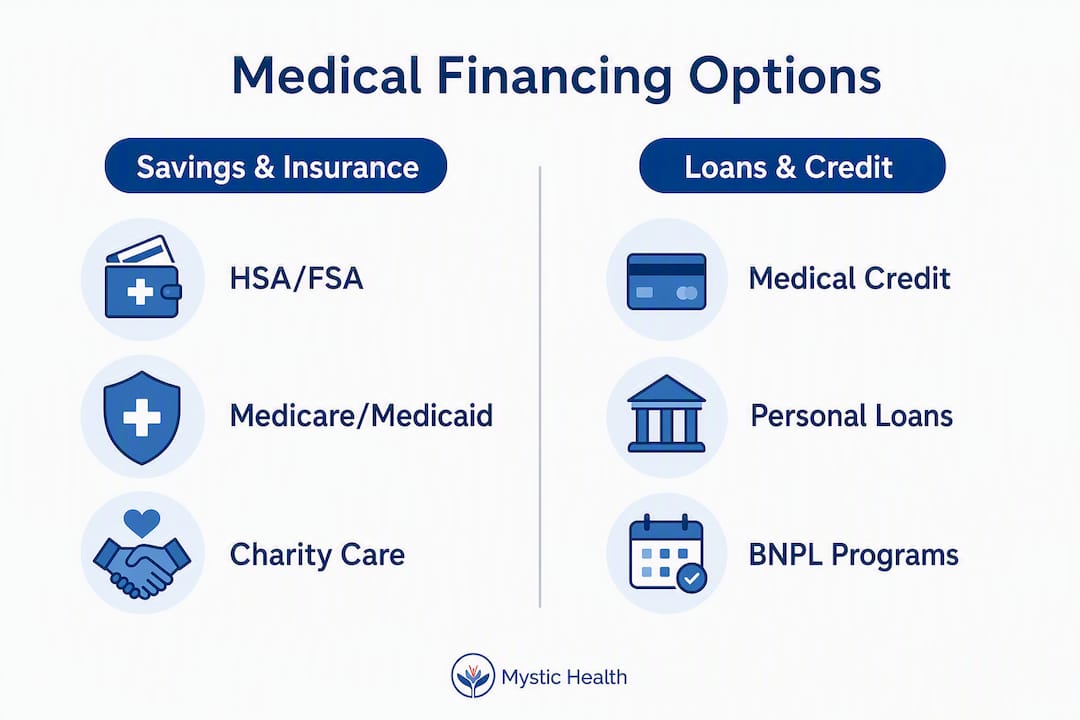
Here’s the short version of what’s available:
- Tax-advantaged savings: Health Savings Accounts (HSAs) and Flexible Spending Accounts (FSAs)
- Insurance and government programs: Medicare, Medicaid, ACA Marketplace plans, CHIP, VA benefits
- Provider-side options: In-house payment plans, charity care, financial assistance programs
- Medical credit products: CareCredit and similar point-of-sale medical credit cards
- Loans: Dedicated medical loans, personal loans (including LendingClub and Wells Fargo), HELOCs
- Buy now, pay later (BNPL): Point-of-care installment programs
- Non-loan strategies: Bill negotiation, crowdfunding, nonprofit assistance
The Consumer Financial Protection Bureau (CFPB) and programs like Medicare and Medicaid are your strongest consumer anchors here. Every option involves a trade-off: speed costs money, low monthly payments stretch total cost, and some products carry risks that aren’t obvious at the point of signing. Clinics like Mystic Health that offer insurance-compatible treatment and flexible billing can sometimes reduce how much financing you need in the first place.
Table of Contents
- What are your main medical financing options?
- What does a $10,000 medical bill actually cost across financing types?
- What credit score and timeline should you expect?
- How to negotiate your bill and access financial assistance
- How to choose the right financing option for your situation
- Why clinics offer financing and what that means for you
- Key Takeaways
- A provider’s honest perspective on financing decisions
- Mystic Health’s approach to financing your care
- Useful sources and resources
What are your main medical financing options?
Understanding how each option works, what it costs, and when it fits your situation is the real work. Here’s a structured look at every major category.
1. Tax-advantaged savings: HSA, FSA, and personal savings
An HSA (Health Savings Account) is available only to people enrolled in a high-deductible health plan (HDHP). Contributions are pre-tax, the money grows tax-free, and withdrawals for qualified medical expenses are also tax-free. That triple tax benefit makes it the most cost-efficient way to pay for care when you have the funds. An FSA (Flexible Spending Account) works similarly but doesn’t require an HDHP; the catch is that most FSA funds expire at year-end if unused. Neither account requires a credit check, and funds are available immediately.
Best for: Planned or elective procedures, ongoing therapy, prescription costs, and any care you can anticipate in advance.
Limitations: You can only use what you’ve contributed. HSA contribution limits are set annually by the IRS, so they won’t cover a large unexpected bill on their own.
2. Insurance and coverage gaps: Medicare, Medicaid, and the ACA
Insurance is the first line of defense, but coverage gaps are where most financing needs begin. Medicare covers Americans 65 and older and certain people with disabilities; Medicaid covers low-income individuals and families, and in some states it can be applied retroactively to cover bills already incurred. The ACA Marketplace offers subsidized plans for people who don’t have employer coverage. CHIP covers children in families that earn too much for Medicaid but can’t afford private insurance.
Understanding your insurance coverage for mental health before treatment starts is one of the most practical steps you can take. Knowing exactly what your plan covers, and what it doesn’t, tells you how much financing you’ll actually need.
Best for: Ongoing and emergency care; Medicaid retroactive coverage is especially useful if you’ve already received care and can’t pay.
3. Provider payment plans and charity care
Many hospitals and clinics offer in-house payment plans directly through their billing office. These plans are often interest-free, don’t appear on your credit report, and can be negotiated based on your income. Nonprofit hospitals are required by federal rules to offer financial assistance policies; you usually have to ask explicitly to be considered.

Charity care programs provide free or reduced-cost care based on income thresholds. The ACA requires hospitals with 501©(3) nonprofit status to maintain these programs. Most patients who qualify never apply simply because they don’t know to ask.
Best for: Emergency care, large hospital bills, and anyone whose income may qualify them for reduced or forgiven balances.
4. Medical credit cards (CareCredit and similar products)
Medical credit cards like CareCredit are accepted at participating providers and often come with promotional 0% interest periods ranging from 6 to 24 months. The critical detail: most of these are deferred-interest products, not true 0% offers. If you carry any balance past the promotional period, retroactive interest charges apply to the entire original balance, not just what remains. The CFPB has specifically flagged this structure as a consumer risk.
APRs after the promotional period can exceed 25%. These products also tend to replace the lower-cost informal payment plans that providers used to offer directly, which means accepting a medical credit card at the point of care can cost you more than asking for an in-house plan instead.
Best for: Short-term bridge financing when you’re confident you can pay the full balance before the promotional period ends.
5. Dedicated medical loans and personal loans
Dedicated medical lenders offer fixed-rate installment loans specifically for healthcare costs. Rates for qualified borrowers can start around 5.99%, though most borrowers see rates in the 8%–15% range depending on credit profile. Personal loans from banks and credit unions, including products from lenders like Wells Fargo and LendingClub, work similarly: fixed rate, fixed term, predictable monthly payment.
Personal loans typically require fair-to-good credit (generally a FICO score of 580 or higher, with better rates above 670). Funding usually arrives within 1–7 business days. Unlike medical credit cards, personal loans don’t carry deferred-interest traps, and the CFPB notes that bank personal loans are often a safer alternative to point-of-sale medical credit products.
Best for: Larger balances, elective procedures, or any situation where you want a predictable payoff schedule.
6. Buy now, pay later (BNPL) and point-of-care installment programs
BNPL products offered at the point of care split your balance into equal installments, often with a 0% promotional rate for a set period. Unlike deferred-interest cards, true BNPL products charge interest only on the remaining balance if you miss the promotional window. Terms vary widely, so reading the fine print matters. Some BNPL providers do a soft credit pull; others do a hard inquiry.
Best for: Smaller balances where you can realistically pay off the full amount within the promotional window.
7. Home equity lines of credit (HELOC) and secured options
A HELOC lets you borrow against your home’s equity at rates that are generally lower than unsecured personal loans or medical credit cards. The trade-off is that your home is collateral, approval takes weeks, and variable rates can rise over time. This option makes sense only for large, planned expenses where you have time to apply and a stable repayment plan.
Best for: Large elective procedures or ongoing care costs where lower interest rates justify the risk and the timeline.
8. Crowdfunding and donor-based funding
Platforms like GoFundMe have become a real, if unpredictable, source of medical funding. Success depends heavily on your social network and the nature of your condition. Crowdfunding works best as a supplement to other strategies, not a primary plan. It carries no credit risk and no repayment obligation, but it also offers no guarantee.
Best for: Supplemental funding for serious or rare conditions, especially when other options are exhausted.
Comparison: major medical financing options at a glance
| Option | Typical APR / Fees | Credit Score Needed | Repayment Term | Speed to Funds | Best For | Consumer Protections |
|---|---|---|---|---|---|---|
| HSA / FSA | None (pre-tax savings) | No check | Immediate spend-down | Immediate | Planned/elective care | IRS rules govern qualified expenses |
| Provider payment plan | 0% (often) | No formal pull | Flexible, negotiated | Same day | Emergency, hospital bills | Negotiable; no credit report impact |
| Charity care | Free or reduced | Income-based | N/A | Weeks to apply | Low-income patients | ACA / nonprofit hospital rules |
| Medical credit card (e.g., CareCredit) | 0% promo, then 25%+ | Soft or hard pull | 6–24 months promo | Same day | Short-term bridge | CFPB oversight; deferred-interest risk |
| Dedicated medical loan | ~5.99%–15% | Fair to good (580+) | 18 months | 1–7 business days | Elective, larger balances | Standard lending disclosures |
| Personal loan (bank/credit union) | Varies by credit | Fair to good (580+) | 18 months | 1–7 business days | Any medical cost | CFPB, Truth in Lending Act |
| BNPL installment | 0% promo or low rate | Soft pull (often) | 3–18 months | Same day | Smaller balances | Varies by provider |
| HELOC | Variable, typically lower | Good to excellent | 5 years | Weeks | Large planned procedures | TILA protections; home at risk |
| Medicare / Medicaid | No cost (if eligible) | Eligibility-based | Ongoing | Weeks to enroll | Seniors, low-income | Federal program protections |
| Crowdfunding | No cost | None | None | Days to weeks | Supplemental funding | None |
What does a $10,000 medical bill actually cost across financing types?
The monthly payment is only part of the picture. Total cost is what matters.
Here’s how a $10,000 balance plays out across representative scenarios:
| Financing Type | APR | Term | Monthly Payment | Total Cost |
|---|---|---|---|---|
| Interest-free provider plan | 0% | 24 months | — | $10,000 |
| Dedicated medical loan (low rate) | 7% | — | — | — |
| Medical credit card (promo paid off) | 0% promo | 18 months | — | $10,000 |
| Medical credit card (balance remains at promo end) | 25% retroactive | — | Varies | $10,000 + full retroactive interest |
| HELOC (variable) | 5.99% | — | — | — |
| BNPL (true 0%) | 0% | 6 months | — | $10,000 |
The deferred-interest scenario is the one that catches people off guard. If you put $10,000 on a medical credit card with an 18-month 0% deferred-interest promotion and still owe $1 at month 19, the issuer charges interest on the original $10,000 from day one. That can add thousands of dollars to your bill instantly.
Pro Tip: When comparing options, calculate total cost first, monthly payment second. A lower monthly payment on a longer-term loan often means paying significantly more overall. Use the lender’s own loan calculator or a free tool like the CFPB’s loan comparison resources before you sign anything.
What credit score and timeline should you expect?
Not every financing route requires a credit check, and knowing which ones do, and how fast they move, helps you plan.
Credit score expectations by option
| Option | Credit Check Type | Typical Minimum Score |
|---|---|---|
| HSA / FSA | None | N/A |
| Provider payment plan | None (usually) | N/A |
| Charity care | Income verification only | N/A |
| Medical credit card | Soft or hard pull | 580 |
| Dedicated medical loan | Hard pull | 580 |
| Personal loan (bank) | Hard pull | 580–670+ |
| HELOC | Hard pull | — |
| BNPL | Soft pull (often) | Varies |
Timeline to access funds
- Immediate: HSA/FSA (you already have the funds), provider payment plans (arranged at billing), charity care applications (care can proceed while you apply)
- Same day to 48 hours: Medical credit cards, some BNPL products, some dedicated medical lenders with online approval
- 1–7 business days: Most bank personal loans, LendingClub and similar online lenders
- Several weeks: HELOC, Medicaid enrollment, ACA Marketplace enrollment outside open enrollment periods
Medical debt and your credit report
Unpaid medical bills under $500 do not appear on credit reports. For larger balances, there is typically a one-year waiting period before unpaid medical debt is reported to credit bureaus. That window is real time you can use to negotiate, apply for assistance, or arrange a payment plan before your credit is affected. The CFPB also notes that medical credit card debt reports like standard credit card debt, which means missed payments affect your credit score immediately, unlike unpaid provider bills.
How to negotiate your bill and access financial assistance
Borrowing should come after you’ve exhausted the options that don’t cost you anything. Negotiation and financial assistance often save more money than any loan.
Step-by-step: negotiating a hospital or clinic bill
- Request an itemized bill. Ask for a line-by-line breakdown of every charge. Billing errors are common, and you can’t dispute what you can’t see.
- Verify your insurance processed correctly. Confirm the provider submitted to your insurer and that the explanation of benefits matches the bill.
- Ask: “What is the settlement amount?” Patient-advocacy reporting shows this question alone can reduce bills by around 30% in some cases. Providers often have authority to settle for less than the listed balance.
- Request an interest-free in-house payment plan. Ask specifically whether the provider offers a direct plan before accepting any third-party financing product.
- Apply for charity care or financial assistance. Nonprofit hospitals are required by federal rules to offer these programs. Ask the billing office for the application, or ask to speak with a financial counselor.
- Check Medicaid eligibility retroactively. If your income qualifies, Medicaid and CHIP may cover bills you’ve already received in some states.
- Appeal insurance denials. If a claim was denied, you have the right to appeal. The billing office can sometimes assist with this.
Documents to have ready
- Proof of income (recent pay stubs, tax return, or benefit statements)
- Insurance card and explanation of benefits
- Any prior authorization or denial letters
- Government-issued ID
Short phone script for billing offices
“I received a bill for [amount]. I’d like to request an itemized statement, and I’d also like to ask about your financial assistance or charity care program. Can you tell me if there’s a settlement amount available, and whether you offer an interest-free payment plan?”
Pro Tip: Time your negotiations carefully. Because unpaid medical bills under $500 don’t appear on credit reports, and larger bills typically have a one-year grace period before reporting, you have real time to work through these steps before your credit is at risk. Don’t sign a financing offer at the point of care under pressure. Ask for 24–48 hours to review your options.
How to choose the right financing option for your situation
A clear decision process saves you from expensive mistakes.
Decision checklist (work through this in order)
- Can insurance, Medicare, or Medicaid cover this? Check eligibility before anything else. Government programs and insurance are always preferable to borrowing.
- Do you have HSA or FSA funds available? If yes, use them. The tax advantage makes this the lowest effective cost for any qualifying expense.
- Can you negotiate the bill down or access charity care? Ask before you borrow. A 30% reduction on a $10,000 bill is worth more than a low-interest loan.
- Does the provider offer an interest-free in-house payment plan? This is often better than any third-party product. Ask explicitly.
- If you need external financing, compare total cost across at least two options. Calculate what you’ll pay in total, not just monthly.
- Avoid deferred-interest products unless you can guarantee full payoff. The risk of retroactive interest is real and often underestimated.
- Check the CFPB’s guidance before signing any medical credit product.
Questions to ask any lender or billing rep
- When does interest start accruing? Is this deferred interest or true 0%?
- What is the penalty for a late or missed payment?
- Is there a prepayment penalty?
- Will this appear on my credit report?
- What happens if I can’t pay at the end of the promotional period?
Red flags to watch for
- Pressure to sign financing paperwork at the point of care, before treatment
- Deferred-interest terms buried in fine print
- High late fees or penalty APRs that activate after a single missed payment
- Mandatory arbitration clauses that limit your ability to dispute charges
- A lender or provider who discourages you from asking about charity care or in-house plans
Why clinics offer financing and what that means for you
Clinics and hospitals present financing options for practical operational reasons. When patients can spread costs over time, they’re more likely to proceed with recommended treatment and less likely to cancel appointments. Providers who offer flexible financing often see higher treatment acceptance rates. That’s a genuine benefit for patients too, since deferred care tends to become more expensive care.
Most providers work with one or two third-party financing vendors and present those options at intake. That doesn’t mean they’re your only choices. You can always ask: “Do you have an in-house payment plan?” or “Can I speak with someone about financial assistance before I decide?” A good billing team will walk you through all available options, not just the ones that are easiest to offer at the front desk.
At Mystic, the approach to financing is built around the belief that cost shouldn’t be the reason someone doesn’t get the care they need. Mystic’s integrative mental health programs are designed with insurance compatibility in mind, and the billing team can walk you through what your plan covers and what flexible payment arrangements look like for your specific situation. For treatments like ketamine-assisted psychotherapy or Spravato, understanding the full cost picture before you start is part of the care process.
Pro Tip: When a clinic suggests a specific lender, ask whether they receive any compensation from that lender. That context helps you evaluate whether the recommendation is in your interest or theirs. Then ask for the in-house alternative anyway.
Key Takeaways
Medical financing options range from zero-cost strategies like charity care and HSA/FSA accounts to interest-bearing loans, and working through the free options first almost always reduces what you ultimately need to borrow.
| Point | Details |
|---|---|
| Start with free options | Charity care, in-house payment plans, and HSA/FSA funds cost nothing in interest and should come before any loan. |
| Deferred interest is a real trap | Medical credit cards with deferred-interest promotions can retroactively charge interest on the full original balance if any amount remains unpaid at the promotion’s end. |
| You have time before credit impact | Unpaid medical bills under $500 don’t appear on credit reports; larger bills typically have a one-year window before reporting begins. |
| Compare total cost, not monthly payment | A lower monthly payment on a longer loan term often means paying significantly more overall — always calculate the full payoff amount. |
| Mystic supports financing access | Mystic’s insurance-compatible programs and billing team help patients understand coverage gaps and flexible payment options before treatment begins. |
A provider’s honest perspective on financing decisions
There’s something I want to say plainly, because I think it gets lost in the noise of comparison charts and APR tables. The moment someone is sitting in a clinic, weighing whether they can afford the care they need, is one of the most vulnerable moments in a person’s life. The financing decision they make in that moment can follow them for years.
What I’ve seen, again and again, is that people sign financing agreements at the point of care without knowing that a better option was available. They didn’t know to ask about charity care. They didn’t know the deferred-interest card they just signed would charge retroactive interest on the full balance if they missed the payoff date by a week. They didn’t know the hospital had an interest-free in-house plan that never shows up on a credit report.
The conventional wisdom is that financing is about access. And it is. But the more honest framing is that the right financing is about access, and the wrong financing can deepen the financial wound that illness already creates. At Mystic, we think about this carefully. Insurance compatibility isn’t just a feature; it’s a commitment to reducing the gap between what care costs and what people can actually pay. Flexible billing isn’t a sales tool; it’s part of how we show up for patients who are already carrying a lot.
My honest recommendation: before you sign anything, ask one question. “Is there a way to do this that doesn’t involve a third-party lender?” You might be surprised by the answer.
Mystic Health’s approach to financing your care
Facing a medical bill while also managing your health is genuinely hard. Mystic was built, in part, around the recognition that financial barriers shouldn’t stand between someone and the care that could change their life.
Mystic’s programs, including ketamine-assisted psychotherapy, Spravato, integrative mental health care, and palliative services, are designed with insurance compatibility as a priority. The billing team works directly with patients to identify what their plan covers, what assistance programs may apply, and what flexible payment arrangements are available. There’s no pressure to sign anything at the door. The goal is to give you a clear picture of your options so you can make a decision that feels right for your situation and your budget.
To learn more about Mystic’s programs and financing support, visit the Mystic Health programs page or reach out to the billing team directly to ask about insurance compatibility and financial assistance for your specific treatment.
Useful sources and resources
These are the most authoritative places to go for deeper reading, official guidance, and practical tools.
- CFPB: Medical Credit Cards and Financing Plans — The most thorough government analysis of how medical credit products work, their risks, and consumer protections. Start here before signing any point-of-sale financing offer.
- CFPB: What to do if you can’t pay a medical bill — Practical, plain-language guidance on your rights, negotiation steps, and how to access financial assistance.
- USAGov: Help with medical bills — A clear overview of government programs (Medicaid, Medicare, CHIP, ACA, COBRA) and how to apply for each.
- Medicare.gov — Official program information, eligibility rules, and Medicare Savings Programs for people who need help with premiums and cost-sharing.
- Medicaid.gov — State-by-state eligibility, retroactive coverage rules, and how to apply.
- Healthcare.gov — ACA Marketplace plans, subsidy calculators, and enrollment windows.
- NPR: How to eliminate, reduce, or negotiate a medical bill — The best practical guide to negotiation scripts, settlement asks, and charity care applications.
- Mystic Health: How to afford mental health care — Mystic’s own guide to financing integrative and mental-health care, including insurance-compatible treatment options and billing support.
This article is general information, not financial or legal advice. Medical billing rules, program eligibility, and financing terms vary by state, provider, and individual circumstance. Confirm current rules and your specific options with your provider’s billing office, a nonprofit credit counselor, or a qualified professional before making financing decisions.
Recommended

Mystic Health Blog








FAQs
1. Am I eligible for ketamine therapy?
2. Does insurance cover the cost of ketamine therapy?
3. How many ketamine treatments will I need?
We recommend two initial treatments to determine suitability and adjust dosage. After these sessions, additional treatments are available based on your progress and specific requirements.