Define Personal Transformation Therapy: A Clear Guide
TL;DR:
- Personal transformation therapy rewires core beliefs, behaviors, and identity toward authentic living for lasting change.
- It differs from traditional therapy by emphasizing growth, relational depth, and non-fixed timelines rooted in neuroscience.
Personal transformation therapy is defined as an intentional therapeutic process of rewiring core beliefs, behaviors, and identity toward authentic living and lasting psychological flexibility. Unlike traditional clinical therapy, which targets symptom reduction, this approach focuses on growth, agency, and the evolution of who you are at your core. The industry term for this work is personal growth therapy, and it draws on neuroscience, relational psychodynamics, and mindfulness to create change that goes far deeper than habit adjustment. If you have ever felt stuck, lost, or like you are living someone else’s life, this is the kind of therapy built for that feeling.
What does “define personal transformation therapy” actually mean?
Personal transformation therapy is an intentional process of rewiring foundational neural pathways, not just surface habits. That distinction matters. Most people think of therapy as a place to manage symptoms or process a crisis. Personal growth therapy asks a different question: Who do you want to become?

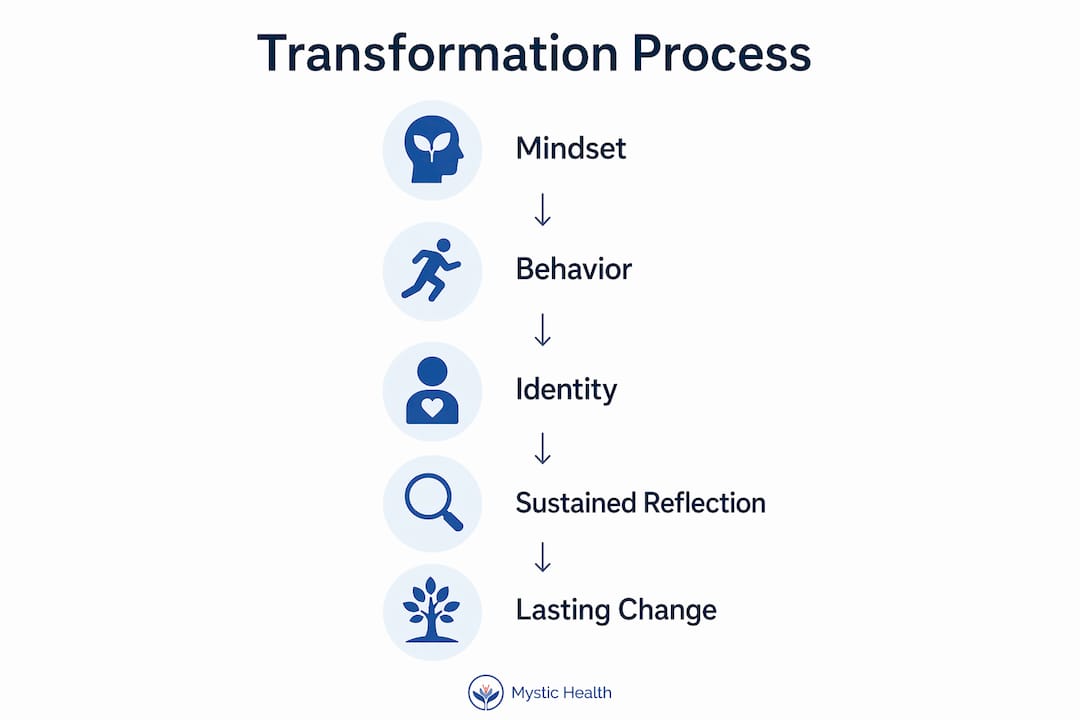
The process works at three levels simultaneously: mindset, behavior, and identity. Changing one without the others produces temporary results. Real change happens when all three align and reinforce each other. Gestalt therapy, for example, expands emotional presence rather than imposing a fixed template for how you should feel or act.
Psychotherapy at this depth builds new self-relationships beyond managing symptoms. The outcome shows up as greater self-awareness, self-compassion, and the emotional flexibility to live with intention. That is a fundamentally different goal than feeling less anxious or sleeping better, though those benefits often follow.
How does personal transformation therapy differ from traditional therapy?
Traditional therapy typically begins with a diagnosis and a protocol. Personal growth therapy does not require a diagnosis and has no fixed timeline or checklist for progress. That structure is intentional. Transformation does not follow a schedule.
People seek this kind of therapy for reasons that do not fit neatly into a clinical category:
- Feeling chronically stuck despite external success
- Navigating major life transitions like divorce, career change, or loss
- Searching for clarity about life purpose or personal values
- Wanting to stop repeating the same relationship patterns
- Feeling disconnected from who they truly are
The focus is on unfolding your authentic self rather than fixing a deficit. Relational psychodynamics sit at the core of this work. The relationship between you and your therapist becomes the laboratory where new ways of being are practiced and felt, not just discussed.
Pro Tip: If a therapist offers you a 12-session transformation program with guaranteed outcomes, that is a red flag. Authentic personal growth therapy resists fixed protocols because real change is relational and nonlinear.
What techniques are used in personal transformation therapy?
The most effective tools in personal growth therapy are evidence-based and work together rather than in isolation. Here are the primary modalities used:
-
Mindfulness-based interventions. Proven effective for resilience and emotional regulation, mindfulness practices train you to observe your internal experience without being swept away by it. This creates the space needed for genuine reflection.
-
Motivational interviewing. This technique increases your sense of agency by helping you identify your own reasons for change. A therapist does not push you toward a goal. They help you clarify what you actually want and why it matters to you.
-
Relational psychodynamic therapy. This approach facilitates deeper self-awareness by exploring how early relational patterns shape current behavior. The therapeutic relationship itself becomes a vehicle for change.
-
Somatic and body-oriented approaches. The body holds patterns that the mind cannot always access through talk alone. Somatic therapy works with physical sensations, posture, and breath to release stored emotional material.
-
Flow-oriented psychotherapy. This approach encourages states of absorbed, present-moment engagement that bypass habitual defenses and allow new experiences to register at a deeper level.
Sessions are typically ongoing without a fixed number, because sustained reflection over weeks or months is what produces meaningful change. A single breakthrough session rarely rewires anything permanently.
Pro Tip: Ask your therapist which modalities they use and why. A skilled practitioner will tailor the approach to your specific patterns, not apply the same method to every person.
What is the neurobiology behind lasting personal change?
The brain remains plastic throughout life, meaning it can form new neural pathways at any age. This is the scientific foundation that makes personal transformation therapy possible. It also explains why the process takes time.
There is a critical difference between intellectual insight and neurological restructuring. You can understand why you behave a certain way and still repeat that behavior. Understanding is processed in the prefrontal cortex. Actual change requires repeated new experiences that build new pathways in deeper brain structures. That takes consistent practice, not motivation bursts.
| What changes | How it changes | Why it takes time |
|---|---|---|
| Core beliefs | Repeated exposure to new relational experiences | New pathways need reinforcement |
| Behavioral patterns | Consistent practice of alternative responses | Old pathways remain active initially |
| Identity | Gradual dis-identification from conditioned self | Integration requires alignment of all three levels |
| Emotional responses | Somatic and mindfulness work | Body-based patterns change slower than thoughts |
“Integrated transformation occurs when mindset, behavior, and identity align and reinforce each other.” — BeMoore, Personal Transformation Neuroscience
This is why people who attend a weekend workshop and feel transformed often return to old patterns within weeks. The experience was real. The neural restructuring was not yet complete. Consistency and relational depth are what close that gap.
What does the inward process of transformation actually feel like?
Transformation begins when you stop avoiding your internal experience and start staying with it longer than feels comfortable. That sounds simple. In practice, it is one of the hardest things a person can do.
Most of us have spent years building defenses against discomfort. Transformation therapy asks you to gently set those defenses down, not because the discomfort disappears, but because you develop the capacity to be with it. That capacity is itself the change.
Common signs that real transformation is happening include:
- Noticing a pause before reacting where there used to be an automatic response
- Feeling less compelled to seek external validation for your choices
- Recognizing old patterns in real time rather than only in hindsight
- A quiet sense of being more yourself, even if you cannot fully articulate it
- Subtle shifts in how your body feels in situations that used to trigger you
Clients often misconstrue transformation as outward achievement. They expect a dramatic moment of clarity or a visible life change. The actual process is quieter. It is the removal of conditioned layers, not the addition of new accomplishments. Progress is felt in subtle bodily cues and relational shifts, not measured on a checklist.
Transformational healing at this level requires you to trust the process even when you cannot see the results yet. That trust is part of the work.
Key Takeaways
Personal transformation therapy produces lasting change only when mindset, behavior, and identity are rewired together through sustained relational engagement, not through insight or motivation alone.
| Point | Details |
|---|---|
| Definition of the process | Personal transformation therapy rewires core beliefs, behavior, and identity toward authentic living. |
| Difference from traditional therapy | It requires no diagnosis and has no fixed timeline; progress is relational and nonlinear. |
| Core techniques | Mindfulness, motivational interviewing, relational psychodynamics, and somatic work drive lasting change. |
| Neurobiological basis | Brain plasticity enables change at any age, but restructuring requires consistent practice over time. |
| Signs of real progress | Subtle internal shifts and bodily cues signal transformation before visible life changes appear. |
What I have learned from watching people actually change
Working at the intersection of mental health and integrative care, I have seen one pattern repeat itself more than any other. People come in expecting transformation to feel like a revelation. They want the moment when everything clicks. What they get instead is something quieter and, honestly, more profound.
The non-linear nature of this work is not a flaw in the process. It is the process. I have watched people feel like they are going backward in week six, only to arrive at a level of self-understanding in week ten that they could not have reached any other way. The discomfort was not a detour. It was the path.
What I find most moving is the relational piece. The connection between a person and their therapist is not just a delivery mechanism for techniques. It is the actual medium of change. You cannot think your way into a new identity. You have to experience being seen, held, and met with honesty by another person. That experience, repeated over time, is what rewires the deeper structures.
My honest observation is this: the people who commit to the process without demanding a timeline are the ones who change most deeply. Patience is not passive here. It is an active form of showing up for yourself, week after week, even when the progress is invisible to everyone but you.
— Kabir
How Mystic supports your personal growth therapy goals
Mystic offers integrative mental health programs that combine relational therapy, mindfulness-based interventions, and neuroscience-informed care into personalized treatment plans. The approach is built for people who want more than symptom management. Whether you are navigating a life transition, working through deep-seated patterns, or seeking clarity about who you are becoming, Mystic’s clinical team meets you where you are. Programs incorporate evidence-based modalities including ketamine-assisted psychotherapy and somatic approaches, all within a supportive, compassionate environment. Explore Mystic’s programs to find the right fit for your goals.
FAQ
What is personal transformation therapy?
Personal transformation therapy is an intentional process of rewiring core beliefs, behaviors, and identity toward authentic living and psychological flexibility. It differs from traditional therapy by focusing on growth and agency rather than symptom reduction.
How long does personal transformation therapy take?
There is no fixed timeline. Sessions are typically ongoing without a set number, because meaningful change requires sustained relational engagement over weeks or months rather than a brief intervention.
What types of therapy support personal change?
Mindfulness-based interventions, motivational interviewing, relational psychodynamic therapy, and somatic approaches are the primary modalities used in personal growth therapy to support deep, lasting change.
Is personal transformation therapy the same as life coaching?
No. Transformational life coaching focuses on goal achievement and forward momentum. Personal transformation therapy works at a deeper psychological level, addressing identity, relational patterns, and the neurobiological roots of behavior.
How do I know if personal transformation therapy is working?
Progress shows up as subtle internal shifts: a pause before reacting, less need for external validation, and a growing sense of being more yourself. These cues often appear before any visible life change occurs.
Recommended

Mystic Health Blog








FAQs
1. Am I eligible for ketamine therapy?
2. Does insurance cover the cost of ketamine therapy?
3. How many ketamine treatments will I need?
We recommend two initial treatments to determine suitability and adjust dosage. After these sessions, additional treatments are available based on your progress and specific requirements.