Ketamine Therapy Cost in 2026: What You'll Actually Pay
Ketamine therapy cost in the U.S. That last point matters more than any single number: Spravato is FDA-approved and often covered by insurance for qualifying diagnoses, while IV, IM, and sublingual ketamine are off-label and almost never reimbursed.
- Spravato (esketamine): FDA-approved for treatment-resistant depression and MDD with suicidal ideation; most major insurers cover it with prior authorization, leaving patients responsible for copays and deductibles rather than the full cash price.
- IV ketamine infusion: Off-label for psychiatric use; fewer than 5% of IV patients have insurance coverage, so most people pay entirely out of pocket.
- IM and oral/intranasal ketamine: Also off-label; coverage is rare, though some plans may reimburse a portion through out-of-network benefits.
Your clearest next step right now: call your insurer’s behavioral health line and ask specifically about esketamine (Spravato) coverage, then request an itemized estimate from any clinic you’re considering.
Key Takeaways
Spravato (esketamine) is the only FDA-approved ketamine-based treatment for depression, which makes it the most likely form to receive insurance coverage, while IV, IM, and oral off-label ketamine remain largely out-of-pocket expenses for most patients in the U.S.
| Point | Details |
|---|---|
| IV ketamine per-session cost | Median $500/session; a 6-session induction typically runs $2,400–$4,800 before additional fees. |
| Spravato insurance advantage | FDA approval and REMS requirements create a billing pathway; many insured patients pay only copays rather than the full $800–$900 cash price per session. |
| Full first-year budget | Factor in evaluation fees, labs, and maintenance sessions; total first-year cost often runs 40–60% higher than the induction alone. |
| Reduce out-of-pocket cost | HSA/FSA funds, manufacturer savings programs, medical financing, and clinical trials are all legitimate options worth exploring before you pay full price. |
| Mystic Health next step | Mystic offers insurance verification, itemized estimates, and in-clinic or at-home ketamine programs; book a consult to get your actual cost picture before committing. |
Table of Contents
- How much does ketamine therapy cost by treatment type?
- Why does Spravato get covered when IV ketamine usually doesn’t?
- What does a full treatment plan actually cost?
- What factors change what you’ll actually pay?
- How billing actually works for ketamine services
- Practical ways to make ketamine therapy more affordable
- What actually happens during a session, and why it costs what it does
- Questions to ask any clinic before you book
- What patients most often get wrong about total cost
- Mystic Health offers a clear path from cost questions to care
- Sources
How much does ketamine therapy cost by treatment type?
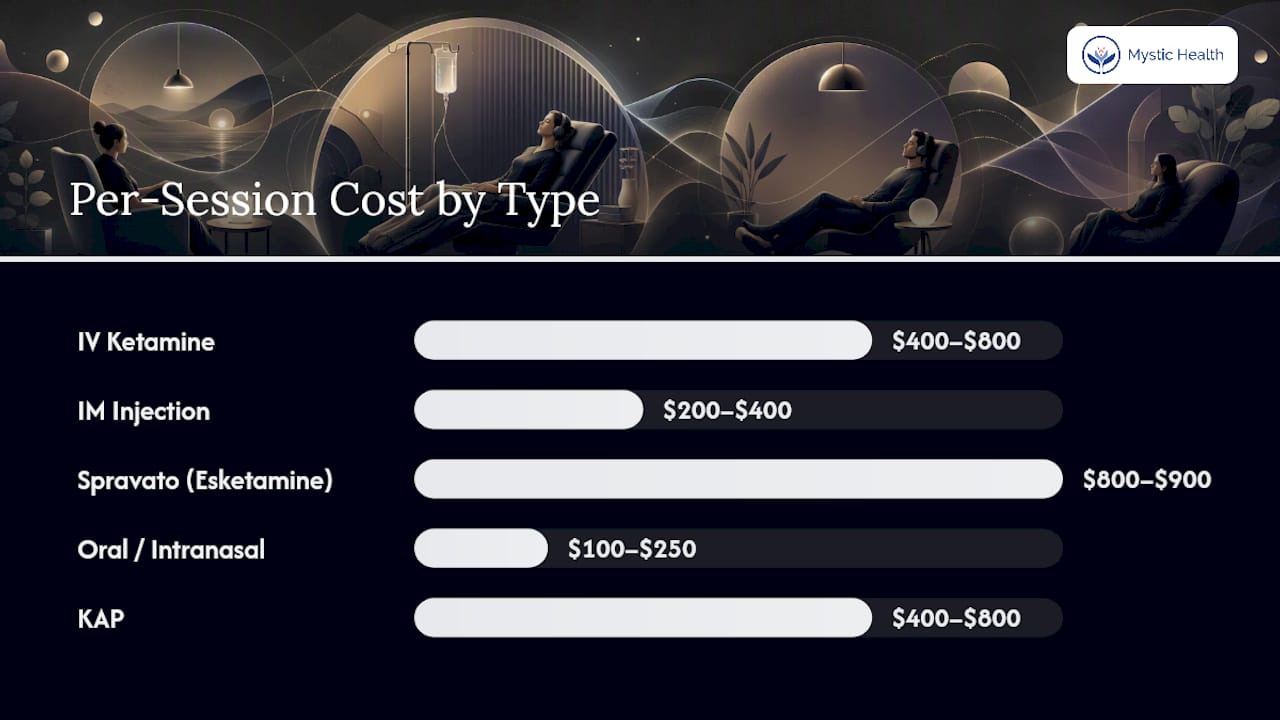
The price gap between modalities is real, and it comes down to three things: the drug itself, the staff required to administer it safely, and the regulatory overhead each format carries. A March 2026 pricing database tracking 542 clinics found a national median of roughly $500 per IV session, with typical ranges landing between $400 and $800 depending on market and clinic type.
| Treatment Type | Per-Session Range | Typical Induction | Insurance Likelihood | Setting & Supervision | Session Length |
|---|---|---|---|---|---|
| IV Ketamine Infusion | moderate per-session cost | 6 sessions / typical induction cost is in the lower thousands | Very low (off-label) | Infusion suite, anesthesia-trained staff | 40–60 min infusion + recovery |
| IM Ketamine Injection | $200–$400 | 6–8 sessions / $1,200–$3,200 | Very low (off-label) | Clinic room, RN or physician | 30 min + monitoring |
| Spravato (Esketamine) | $800–$900 cash; copay if insured | 8 sessions over 4 weeks | Commonly covered (FDA-approved) | Certified REMS facility, 2-hr observation | 2 hrs total (including observation) |
| Oral / Intranasal Off-Label | $100–$250/session or $150–$400/month | Varies; often 4–8 weeks | Rare | Telehealth or at-home with check-ins | 30–60 min + self-monitoring |
| Ketamine-Assisted Psychotherapy (KAP) | $400–$800 per session | 3–6 medicine sessions | Therapy component sometimes covered | Clinic, therapist + prescriber | 2–3 hrs |
IV ketamine infusion
IV infusion carries the highest per-session cost because it requires an infusion suite, an anesthesia-trained clinician or nurse, continuous vital-sign monitoring, and a dedicated recovery space. The drug itself is inexpensive; you’re paying for the clinical infrastructure around it. A standard induction runs six sessions over two to three weeks, putting the first-course cost typically in the low to mid thousands before any additional fees.
IM ketamine injection
Intramuscular injection is simpler to administer than IV, which is why per-session prices tend to run lower. A physician or registered nurse delivers the injection, monitors the patient through the dissociative experience, and clears them for discharge. The trade-off is that dosing precision is slightly less controllable than IV, which some clinicians factor into their protocol design.

Spravato (esketamine)
Spravato is a nasal spray containing esketamine, the S-enantiomer of ketamine. Because it carries FDA approval for treatment-resistant depression (TRD) and major depressive disorder with acute suicidal ideation (MDSI), it has a recognized billing pathway that IV and IM ketamine simply do not. The REMS program mandates a two-hour in-clinic observation after every dose, which adds time and facility cost but also creates the documentation insurers need to process a claim.
Oral and intranasal off-label programs
At-home sublingual or compounded intranasal programs have grown quickly because they cut monitoring overhead. Monthly subscription-style programs typically run $150–$400 per month. The FDA has specifically warned about safety risks with compounded ketamine nasal sprays, so if you’re considering this route, the prescribing provider’s oversight protocols matter a great deal.
Ketamine-assisted psychotherapy (KAP)
KAP bundles a medicine session with a trained therapist who guides the experience and provides integration sessions before and after. The higher per-session price reflects two clinicians’ time rather than one. Some insurance plans cover the therapy component under behavioral health benefits even when they won’t touch the drug cost.
Why does Spravato get covered when IV ketamine usually doesn’t?
The short answer is FDA approval. Insurers use approval status as a primary filter for medical necessity determinations. Spravato cleared that bar in 2019; racemic IV and IM ketamine have not been approved for psychiatric indications, which means every claim for those modalities lands in “off-label” territory where denial is the default.
The REMS program compounds this advantage. REMS stands for Risk Evaluation and Mitigation Strategy, a safety program the FDA requires for drugs with serious known risks. For Spravato, REMS mandates that the drug be administered only in certified healthcare settings with a two-hour post-dose observation period. That structure gives insurers a standardized, auditable clinical record, which is exactly what prior authorization reviewers look for. Off-label IV ketamine has no equivalent federal framework, so each clinic’s documentation varies, and insurers have no consistent standard to approve against.
Systemic insurer behavior also plays a role. Even with the Mental Health Parity and Addiction Equity Act requiring comparable coverage for mental and physical health, many plans apply stricter prior authorization requirements and higher cost-sharing to novel psychiatric treatments. Ketamine, whether IV or Spravato, sits squarely in that “novel” category.
Practical steps to check your Spravato coverage:
- Call the behavioral health number on the back of your insurance card and ask specifically about esketamine (brand name Spravato), not “ketamine.”
- Ask whether your plan requires a prior authorization and what clinical criteria you need to meet (typically two or more failed antidepressant trials for TRD).
- Request the specific CPT and HCPCS codes the clinic will use to bill, then confirm those codes are covered under your plan.
- Ask about your deductible status: even covered Spravato can cost several hundred dollars per session until your deductible resets.
- For insurance coverage guidance on innovative mental health treatments, reviewing your plan’s behavioral health rider carefully before your first appointment can prevent billing surprises.
What does a full treatment plan actually cost?
Per-session numbers only tell part of the story. What most people are really asking is: how much will I spend in the first three to six months? The answer depends on modality, whether you’re insured for it, and how your body responds.
IV ketamine: typical first-course budget
- Induction (6 sessions): a few thousand dollars
- Initial medical evaluation and labs: $150–$300
- Maintenance sessions (monthly or as needed after induction): moderate per session cost similar to induction sessions
- Six-month total estimate (induction + 2–4 maintenance sessions): generally several thousand dollars, depending on session frequency and clinic pricing
IM ketamine: typical first-course budget
- Induction (6–8 sessions): $1,200–$3,200
- Medical evaluation: $100–$250
- Six-month total estimate: $1,500–$4,500
Oral / at-home programs: typical first-course budget
- Monthly subscription: $150–$400/month
- Initial telehealth evaluation: $75–$200
- Six-month total estimate: $975–$2,600
Spravato: insured vs. cash scenarios
- Cash pay: Each session runs roughly $800–$900 for the drug plus facility fees, putting an 8-session induction at $6,400–$7,200 or more.
- Insured (after prior authorization): Many patients pay only their copay or coinsurance per session. With a $30 copay and a met deductible, an 8-session induction could cost as little as $240 total.
- Manufacturer savings: Janssen, the maker of Spravato, offers a savings program that can reduce out-of-pocket costs for eligible commercially insured patients. Ask your clinic whether you qualify.
One-time fees that often catch people off guard: mandatory medical screening ($100–$300), required lab work ($50–$200), and facility fees billed separately from the drug or clinician charge. Some clinics bundle these into a flat induction package; others itemize them. Always ask.
What factors change what you’ll actually pay?
Price variation across clinics is extreme, and local competition matters more than regional cost of living alone. Two clinics in the same zip code can differ by $300 per session, and the higher price doesn’t automatically mean better care.
The main cost drivers:
- Facility overhead: A freestanding infusion suite in a major metro carries higher rent and staffing costs than a clinic embedded in a psychiatric practice.
- Clinician credentials: Anesthesiologists typically charge more than nurse anesthetists or psychiatrists administering IM ketamine, though both can be appropriate depending on the protocol.
- Monitoring intensity: Continuous pulse oximetry, EKG monitoring, and dedicated nursing during infusion add cost but also add safety.
- Drug formulation: Compounded ketamine (used in most IV/IM programs) is inexpensive. Spravato’s branded drug cost is substantially higher, which is why cash-pay Spravato is so expensive without insurance.
- Integration therapy: Clinics that include a therapist in the session or offer mandatory integration sessions will charge more per visit, but that bundled support often improves outcomes.
- Lab testing: Some clinics require baseline liver function, cardiac workup, or urine drug screening before treatment. These may or may not be billed through your medical insurance separately.
Costs people frequently miss:
- A required companion for the ride home after IV or IM sessions is often necessary, with some clinics specifying the type of companion needed.
- Lost wages for a half-day or full-day appointment, especially for Spravato’s two-hour observation window.
- Rescheduling fees if you cancel within 24–48 hours.
Pro Tip: Before booking, ask the clinic to send you a written, itemized cost breakdown that separates the drug fee, facility fee, clinician fee, and any required ancillary services. Then ask whether those fees change if you pay in full upfront. Many clinics offer a modest discount for bundled induction packages paid in advance.
How billing actually works for ketamine services
The billing flow for Spravato and off-label ketamine looks very different on paper, and understanding that difference can save you real money.
Spravato billing: Certified REMS facilities bill the drug under a HCPCS code (typically S0013 or a facility-specific code) and the observation/monitoring time under a separate evaluation and management (E&M) or facility fee code. Because the drug is FDA-approved and the REMS observation is federally mandated, insurers have a clear claims pathway. Most in-network Spravato providers submit directly to your insurer; you pay your cost-sharing at the time of service.
Off-label IV/IM billing: Clinics typically bill the infusion under CPT codes for therapeutic drug infusion (such as 96365 or 96374) and the physician or CRNA time under a separate professional fee code. Because the psychiatric indication is off-label, many insurers deny the claim outright or apply it only to your out-of-network deductible. If the clinic is out-of-network, you can request a superbill, an itemized receipt with diagnosis codes, CPT codes, and the provider’s NPI number, and submit it yourself for potential partial reimbursement.
Checklist for calling your insurer:
- Ask for the behavioral health or mental health benefits line specifically.
- Confirm whether esketamine (Spravato) is on your formulary and what tier it sits on.
- Ask what prior authorization criteria apply and how many failed medication trials are required.
- For IV/IM, ask whether therapeutic infusion codes (96365, 96374) are covered for a psychiatric diagnosis under your plan.
- Ask about your out-of-network deductible and reimbursement percentage if the clinic doesn’t take your insurance.
- Request everything in writing or ask for a reference number for the call.
Medicare and Medicaid: Medicare Part B covers Spravato when administered in a certified facility and billed under the appropriate HCPCS code, though cost-sharing still applies. Medicaid coverage varies significantly by state; some state programs cover Spravato for TRD, others do not. For IV/IM ketamine, Medicare and most Medicaid programs follow the same off-label exclusion logic as commercial insurers. State-level variation is real, and regional coverage differences can be substantial depending on where you live.
Practical ways to make ketamine therapy more affordable
The cost of ketamine treatments doesn’t have to be a wall. There are legitimate paths to reduce what you pay out of pocket, and some of them are more accessible than most people realize.
- HSA and FSA accounts: Ketamine therapy, including IV infusions and Spravato sessions, qualifies as a medical expense under IRS rules. If you have a Health Savings Account or Flexible Spending Account, you can use pre-tax dollars to cover out-of-pocket costs, effectively reducing the real price by your marginal tax rate.
- Medical financing: CareCredit, Prosper Healthcare Lending, and similar medical loan products offer deferred-interest or low-interest financing for healthcare expenses. Many ketamine clinics accept these directly. Financing options for mental health care are worth reviewing before your first appointment.
- Clinic payment plans: Some clinics offer in-house installment plans for induction packages, particularly for patients who are self-pay. Ask directly; it’s not always advertised.
- Spravato manufacturer savings: Janssen’s savings program for Spravato can reduce copays for commercially insured patients who qualify. Your clinic’s patient coordinator can walk you through the enrollment process.
- Patient assistance foundations: Organizations like the Patient Advocate Foundation and NeedyMeds maintain databases of financial assistance programs for mental health treatment. Eligibility is income-based and varies by program.
- Clinical trials: The NIH’s ClinicalTrials.gov lists ongoing ketamine and esketamine studies that provide treatment at no cost to participants. Eligibility criteria are specific, but for patients who qualify, this is a meaningful option.
- Employer benefits: Some employer-sponsored health plans now include mental health benefits that cover novel treatments, particularly through behavioral health carve-outs or Employee Assistance Programs. Check your benefits portal or HR department.
Pro Tip: *Ask any clinic you’re considering whether they offer a discounted induction bundle for patients who prepay all six sessions at once.
For a broader look at medical financing options, including how to compare loan terms and avoid high-interest traps, it’s worth doing that research before you commit to a payment plan.
What actually happens during a session, and why it costs what it does
Understanding what you’re paying for makes the price feel less abstract. A typical IV ketamine session isn’t just a drug infusion; it’s a carefully monitored clinical event with multiple staff members and layers of safety protocol.
A standard IV session timeline:
- Pre-session evaluation (15–30 min): A clinician reviews your vitals, current medications, and mental status. Blood pressure is checked; some clinics require a brief psychiatric check-in.
- Infusion (40–60 min): Ketamine is administered via IV at a carefully calculated dose. A nurse or clinician remains present throughout, monitoring heart rate, blood pressure, oxygen saturation, and your subjective experience.
- Recovery (30–60 min): You rest in a monitored space until you’re oriented and stable. You cannot drive yourself home.
- Post-session check-in: Many clinics include a brief debrief or integration note before discharge.
That’s two to three hours of clinical staff time, a dedicated room, monitoring equipment, and drug cost, all for a single session. When you see a $600 price tag, most of it is staffing and facility, not the ketamine itself.
Spravato’s REMS observation requirement adds a specific layer: the two-hour post-dose observation is federally mandated, not optional. The clinic must document that observation in a REMS-compliant record. That documentation burden is part of why REMS-certified facilities charge a facility fee on top of the drug cost, and it’s also what creates the billing trail insurers need.
Safety screening before treatment typically includes a full medical history, current medication review (particularly for drugs that interact with ketamine, such as MAOIs and benzodiazepines), blood pressure assessment, and a psychiatric evaluation to confirm the diagnosis and rule out contraindications like uncontrolled hypertension or a history of psychosis. Peer-reviewed clinical reviews confirm that monitoring requirements vary by protocol and delivery method, which is one reason IV sessions cost more than IM or oral formats.
This article is for general informational purposes only and is not a substitute for professional medical advice. Always consult a qualified clinician before beginning any ketamine treatment.
Questions to ask any clinic before you book
Getting a true cost picture requires asking the right questions directly. Clinics vary widely in what they include, what they bill separately, and how transparent they are upfront.
Price and packaging:
- What is the itemized cost breakdown: drug fee, facility fee, clinician fee, and monitoring fee?
- Is the induction offered as a bundled package, and does prepayment reduce the price?
- Are the medical evaluation and labs included, or billed separately?
Insurance and billing:
- Do you file insurance claims directly, or do you provide a superbill for self-submission?
- Are you a certified Spravato REMS provider, and do you handle prior authorization paperwork?
- What CPT or HCPCS codes will appear on my bill?
Safety and credentials:
- What are the credentials of the clinician who will administer and monitor my treatment?
- What is your emergency protocol if I have an adverse reaction?
- Do you offer integration therapy, and is it included or billed separately?
Logistics:
- Is a companion required for the ride home, and does rideshare qualify?
- How long should I block for each appointment?
- What is your cancellation and rescheduling policy, and are there fees?
What patients most often get wrong about total cost
There’s a pattern I see often, and it’s worth naming plainly. Most people come in having researched the per-session price. They’ve done the math: six sessions at $500 equals $3,000. They feel prepared. What they haven’t accounted for is the evaluation fee, the required labs, the integration sessions their clinician recommends after the induction, and the maintenance appointments three months later when the effects begin to fade.
The second thing people underestimate is the value of what surrounds the medicine. A lower-priced clinic that skips integration support or employs less experienced monitoring staff isn’t necessarily a better deal. Ketamine works best when the clinical container is solid: skilled staff, thoughtful preparation, and real follow-through after the session. Price is a signal, but it’s not the only one. Ask about the clinician’s training, the clinic’s emergency protocols, and whether integration therapy is part of the program before you decide that the cheaper option is the smarter one.
Mystic Health offers a clear path from cost questions to care
If you’ve read this far, you’re probably weighing real numbers against real need. Mystic Health works with patients at exactly that crossroads: people who want evidence-based ketamine-assisted therapy but also need to understand what it will cost and whether their insurance can help.
Mystic offers both in-clinic ketamine-assisted psychotherapy and Spravato treatment, with a team that handles insurance verification, prior authorization support, and itemized cost estimates before you commit to anything. The difference from walking into an unfamiliar clinic is that you get a clear picture of your out-of-pocket exposure upfront, not after your first session. Financing options are available for patients who need to spread the cost, and the clinical team includes both prescribers and integration therapists so the medicine session doesn’t happen in isolation.
To get a personalized cost estimate and insurance check, book a consultation through Mystic’s programs page. If you’re exploring the full range of integrative mental health options Mystic offers, including KAP and holistic support, that’s a good place to start.
Sources
These primary and investigative sources are worth bookmarking as you verify coverage, compare clinics, and stay current on regulatory changes.
- The ketamine economy: New mental health clinics are a ‘Wild West’ with few rules
- Insurers often shortchange mental health care coverage despite a federal law (Stateline)
Recommended

Mystic Health Blog





FAQs
1. Am I eligible for ketamine therapy?
2. Does insurance cover the cost of ketamine therapy?
3. How many ketamine treatments will I need?
We recommend two initial treatments to determine suitability and adjust dosage. After these sessions, additional treatments are available based on your progress and specific requirements.