Define Somatic Therapy: What It Is and How It Heals
TL;DR:
- Somatic therapy utilizes the body’s sensations, breath, and movement to process trauma and emotional distress. It operates from the body upward, completing incomplete survival responses that traditional talk therapy may not reach. This approach is especially effective for trauma survivors, reducing symptoms and promoting emotional and physical healing.
Somatic therapy is defined as a form of psychotherapy that incorporates the body’s physical sensations, posture, breath, and movement as primary tools for healing trauma and emotional distress. Unlike traditional talk therapy, which works from the mind downward, somatic therapy operates from the body upward. This “bottom-up” approach recognizes that trauma is stored physiologically in the nervous system, not just in conscious memory. Developed through models like Peter Levine’s Somatic Experiencing, this method gives your body a voice in the healing process. If you’ve ever felt stuck after years of talk therapy, somatic work may be the missing piece.
What techniques are used in somatic therapy sessions?
Somatic therapy sessions use a specific set of body-centered methods to help your nervous system shift out of survival mode. These techniques are practical, gentle, and designed to build safety before anything else.
The most common techniques include:
- Tracking bodily sensations: The therapist guides you to notice physical feelings like tightness in your chest or warmth in your hands. This builds awareness of how emotions live in your body.
- Breathwork: Slow, controlled breathing with extended exhales reduces anxiety and lowers heart rate. The exhale activates the parasympathetic nervous system, which is your body’s rest-and-digest state.
- Grounding: You orient your attention to the present moment through physical contact with the floor, a chair, or your own hands. This pulls the nervous system away from fight-or-flight.
- Pendulation: This is a rhythmic movement between a distressing sensation and a safe one. Pendulation keeps you within your emotional window of tolerance while still processing difficult material.
- Titration: Therapists use this to break overwhelming experiences into small, manageable doses. Titration prevents flooding and allows the nervous system to process safely.
Different modalities apply these principles in distinct ways. Somatic Experiencing, developed by Peter Levine, focuses on completing frozen survival responses. Sensorimotor Psychotherapy integrates movement and posture with verbal processing. EMDR uses bilateral stimulation, and EFT (Emotional Freedom Technique) incorporates acupressure tapping. Each of these incorporates somatic principles to release emotional energy held in the body.
Pro Tip: Don’t try to force calm during a session. Effective somatic work means noticing sensation without forcing change — simply naming what you feel is often enough to begin shifting it.

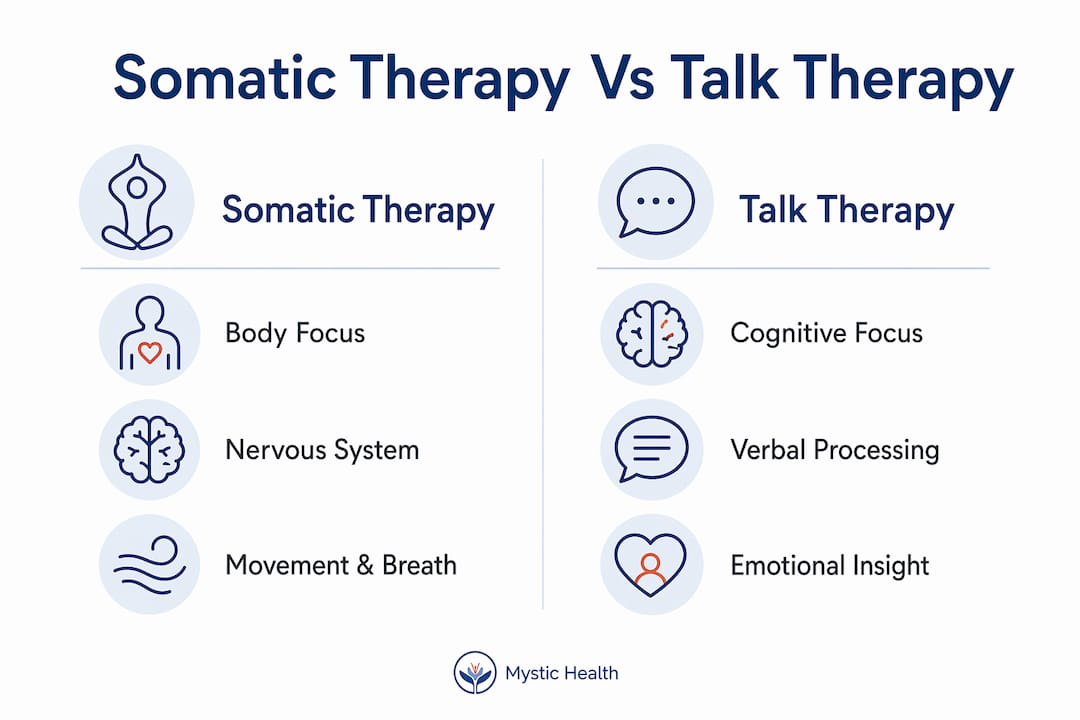
Somatic therapy vs. talk therapy: what is the real difference?
The core distinction between somatic therapy and traditional talk therapy comes down to where healing begins. Talk therapy, including Cognitive Behavioral Therapy (CBT) and psychodynamic approaches, engages the prefrontal cortex. That’s the brain’s rational, language-based center. Somatic therapy targets subcortical brain circuits, the areas where unprocessed emotions are held physically, beyond the reach of words alone.
This matters enormously for trauma survivors. Talking about a traumatic event can sometimes reactivate distress without resolving it. Somatic therapy, by contrast, works with the body’s incomplete defensive responses, the frozen fight-or-flight reactions that never fully discharged during the original trauma. The goal is not to retell the story but to complete those survival responses safely.
Here’s how the two approaches compare across key dimensions:
| Dimension | Somatic Therapy | Talk Therapy (e.g., CBT) |
|---|---|---|
| Primary focus | Body sensations and nervous system states | Thoughts, beliefs, and cognitive patterns |
| Processing direction | Bottom-up (body to mind) | Top-down (mind to body) |
| Trauma approach | Completes incomplete survival responses | Reframes and reprocesses memories verbally |
| Touch involvement | Optional, fully consented, clinical | None |
| Best suited for | Complex trauma, PTSD, somatic symptoms | Anxiety, depression, behavioral patterns |
Somatic therapy is also distinct from massage and general bodywork. Massage targets muscle tension and physical relief. Somatic therapy is clinical psychotherapy focused on psychological awareness. Any touch used is consensual, purposeful, and oriented toward internal experience, not physical manipulation.
Mindfulness practices overlap with somatic therapy but are not the same thing. Mindfulness emphasizes attention training. Somatic therapy adds nervous system pacing, movement integration, and a structured clinical framework for trauma processing.
Pro Tip: If you’re already in CBT or another cognitive approach, somatic therapy doesn’t have to replace it. Many people find that combining both gives them a fuller path to healing, addressing both the story and the body’s response to it.
What are the benefits of somatic therapy for trauma and mental health?
Somatic therapy produces measurable benefits for people carrying trauma, chronic stress, and emotional dysregulation. The physiological completion of survival responses is the mechanism behind many of these outcomes. When the nervous system finally discharges what it couldn’t during the original threat, the body stops living in a state of alert.
The most well-documented benefits include:
- PTSD symptom reduction: Somatic Experiencing and Sensorimotor Psychotherapy are particularly effective for people feeling stuck after talk therapy, especially those with complex or developmental trauma.
- Anxiety relief: Breathwork and grounding techniques directly regulate the autonomic nervous system. Extended exhale breathing reduces heart rate and cortisol levels in real time.
- Emotional regulation: Somatic therapy builds your capacity to stay present with difficult feelings without becoming overwhelmed. This skill carries into daily life.
- Reduced physical symptoms: Chronic pain, tension headaches, and digestive issues linked to stress often improve as the nervous system finds more balance.
- Trauma resolution without retelling: Body sensation as emotional information means you can process trauma without narrating it repeatedly, which reduces the risk of reactivation.
Somatic therapy is especially valuable for trauma survivors, veterans, first responders, survivors of childhood abuse, and anyone whose body carries the weight of experiences that words haven’t fully resolved. If you want to understand how this connects to broader psychosomatic healing, the neuroscience behind it is both compelling and accessible.
The research on emotional healing and PTSD remission continues to grow, and somatic methods are increasingly recognized as a core component of trauma-informed care, not an alternative add-on.
How do you start somatic therapy and find the right practitioner?
Starting somatic therapy requires some preparation, both in choosing the right provider and in understanding what to expect from the process. The pacing is intentional and sometimes slower than people anticipate.
Here are the key steps to get started well:
- Verify credentials and training. Look for therapists trained in recognized modalities like Somatic Experiencing (SE), Sensorimotor Psychotherapy, or EMDR with somatic components. These are not interchangeable with general counseling.
- Clarify the approach to touch. Touch in somatic therapy is optional and always fully consented. Ask your prospective therapist directly about their approach before your first session.
- Understand the window of tolerance. Effective somatic therapy keeps you within a range where you’re activated enough to process but not so overwhelmed that you flood. A skilled therapist will stop deep processing if needed to maintain your safety.
- Build safety first. Before any trauma work begins, your therapist will help you establish resource states in your body, feelings of groundedness, warmth, or calm that you can return to. Building safety is foundational, not optional.
- Set realistic expectations. Progress in somatic therapy often feels subtle at first. You may notice shifts in how your body responds to stress before you notice changes in your thoughts or mood.
If you’re already working with a psychiatrist, primary care physician, or another mental health provider, somatic therapy integrates well. Many people combine it with mindfulness programs, like Mystic’s Mindful Self Compassion course, to deepen their capacity for body awareness between sessions.
Pro Tip: Keep a brief body journal between sessions. Note where you feel tension, ease, or numbness throughout the day. This data becomes valuable material for your therapist and accelerates your progress.
Key takeaways
Somatic therapy works because it addresses trauma where it actually lives: in the body’s nervous system, not just in conscious thought.
| Point | Details |
|---|---|
| Bottom-up processing | Somatic therapy heals from the body upward, reaching areas cognitive therapy cannot access. |
| Core techniques | Breathwork, grounding, pendulation, and titration regulate the nervous system safely and gradually. |
| Not the same as massage | Somatic therapy is clinical psychotherapy; any touch is consensual, purposeful, and psychologically focused. |
| Trauma without retelling | You can process trauma through body sensation without narrating the story repeatedly. |
| Start with safety | Building resource states in the body comes before any trauma processing in effective somatic work. |
Why i believe somatic therapy changes the conversation about healing
I’ve worked alongside clients who spent years in talk therapy and still felt like something was lodged in their chest, a tightness they couldn’t think their way out of. That experience is more common than most people realize. And it’s not a failure of talk therapy. It’s a signal that the body hasn’t been invited into the room yet.
What strikes me most about somatic therapy is how it reframes what healing actually looks like. It’s not about achieving insight. It’s about giving your nervous system permission to finish what it started. That shift in framing alone can be a relief for people who’ve been trying to “figure out” their trauma for years.
I’ve also seen a common misunderstanding with new clients: they expect somatic work to feel dramatic or cathartic. In reality, the most powerful moments are often quiet. A slight release of tension in the shoulders. A breath that goes a little deeper than usual. These small shifts are the nervous system reorganizing itself, and they accumulate into real change over time.
My honest recommendation is to pair somatic therapy with a cognitive modality when possible. The body work opens doors that the mind can then walk through more freely. For anyone exploring trauma-informed therapy, somatic approaches deserve serious consideration as part of a complete care plan. Healing is not a straight line, but somatic therapy gives you a way to show up for yourself that goes deeper than words.
— Kabir
Ready to explore somatic therapy with professional support?
Mystic offers integrative mental health programs that bring somatic therapy together with evidence-based modalities like ketamine-assisted psychotherapy, mindfulness, and trauma-informed care. The approach is whole-person and personalized, meaning your body, mind, and history all shape the treatment plan.

If you’ve been carrying something that talk alone hasn’t resolved, Mystic’s clinical team is ready to help you find a path forward. Explore the full range of therapeutic programs and take the first step toward care that meets you where you are, not just where you think you should be.
FAQ
What does somatic therapy mean, exactly?
Somatic therapy is a psychotherapeutic approach that uses the body’s sensations, breath, and movement to process trauma and regulate the nervous system. It operates on the principle that trauma is stored physiologically, not only in memory.
How is somatic therapy different from regular therapy?
Traditional therapy primarily engages cognitive and verbal processing through the prefrontal cortex. Somatic therapy targets subcortical brain circuits where unprocessed emotions are held physically, making it especially effective for trauma that words haven’t resolved.
Does somatic therapy involve physical touch?
Touch is optional in somatic therapy and always requires full consent from the client. Most somatic work is non-touch, guided by the client’s internal experience rather than physical manipulation.
Who benefits most from somatic therapy?
Somatic therapy is particularly effective for trauma survivors, people with PTSD, and individuals who feel stuck after traditional talk therapy. It also helps those experiencing anxiety, chronic stress, and physical symptoms linked to emotional distress.
Can somatic therapy be combined with other treatments?
Somatic therapy integrates well with cognitive approaches like CBT, mindfulness practices, and psychiatric care. Many clinicians recommend combining modalities for a more complete path to healing, especially for complex trauma.
Recommended

Mystic Health Blog








FAQs
1. Am I eligible for ketamine therapy?
2. Does insurance cover the cost of ketamine therapy?
3. How many ketamine treatments will I need?
We recommend two initial treatments to determine suitability and adjust dosage. After these sessions, additional treatments are available based on your progress and specific requirements.