What Is Psychological Transformation: A Clear Guide
TL;DR:
- Psychological transformation involves a deep, lasting change in identity, worldview, and sense of purpose. Most major transformations are triggered by crises like trauma or illness, but intentional practices can also facilitate slow, controlled change. It requires persistent effort, emotional honesty, and a supportive environment to reshape who you are fundamentally.
Psychological transformation is defined as a profound, lasting shift in how a person thinks, feels, and relates to themselves and the world. Unlike ordinary self-improvement, this process reshapes identity and worldview at a fundamental level. It is what psychologists call personal metamorphosis: not just new habits, but a new way of being. Understanding what is psychological transformation matters because the path through it is rarely linear, and knowing the terrain makes all the difference.
What is psychological transformation, and why does it matter?
Psychological transformation is a deep restructuring of consciousness and identity. It goes beyond changing a behavior or adopting a new routine. The person who comes out the other side genuinely sees themselves, their relationships, and their purpose differently.

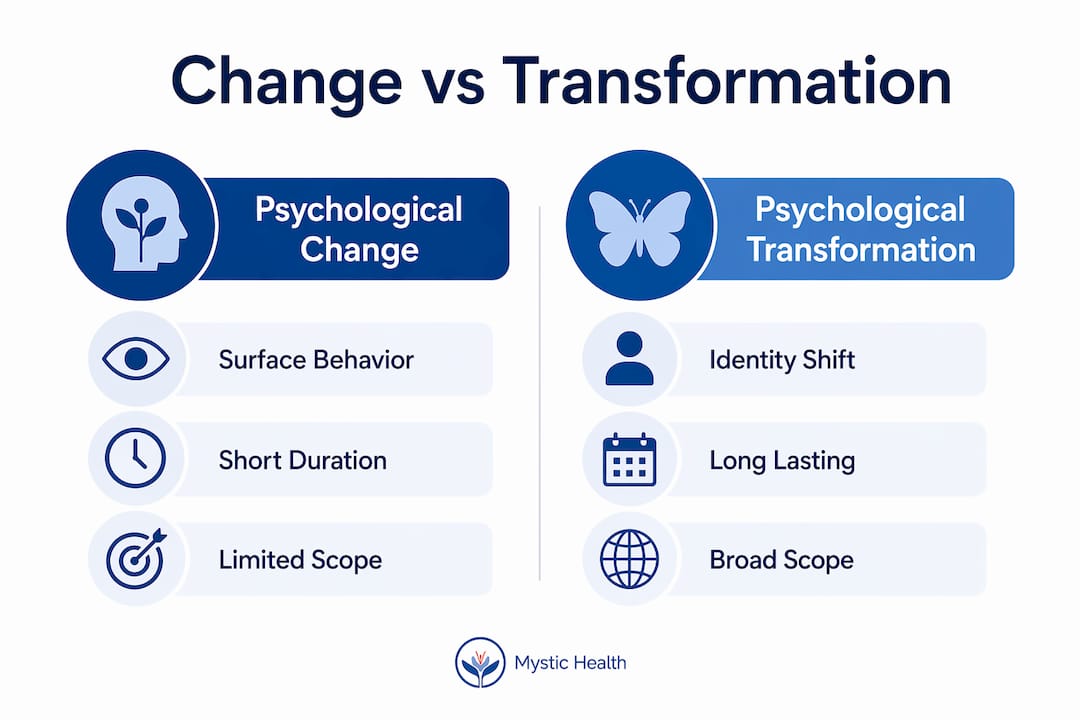
The psychological change definition most researchers use centers on three elements: duration, depth, and scope. A change is temporary and surface-level. A transformation is sustained, reaches into core beliefs, and alters the entire frame through which a person interprets experience. Think of it this way: quitting sugar is a change. Releasing the belief that you are fundamentally unworthy is a transformation.
Transformation also involves cognitive restructuring, emotional processing, and behavioral realignment working together over time. No single element is enough on its own. That layered quality is what makes it both difficult and durable.
What triggers psychological transformation?
Disruption is the most common catalyst. Approximately 67% of major psychological transformations are precipitated by significant crises, including trauma, serious illness, grief, or the collapse of a long-held identity. That statistic means most people do not choose transformation. It chooses them.
“The rupture of a familiar world is often the prerequisite for building a truer one. Pain cracks open the structures we have outgrown.”
These disorienting events force what psychologists call identity reassessment. When the old story no longer holds, the mind has no choice but to write a new one. Common crisis-based triggers include:
- Serious illness or a terminal diagnosis
- The end of a marriage or long-term relationship
- Job loss or career collapse
- The death of someone central to your identity
- Surviving addiction or a mental health crisis
Not all transformation is crisis-driven, though. Intentional triggers also exist: sustained meditation practice, psychedelic-assisted therapy, deep psychotherapy, or deliberate exposure to radically different environments. The difference is that intentional paths tend to be slower but more controlled. Crisis-driven paths are faster but harder to integrate without support.
True psychological healing requires processing the rupture, not just surviving it. The event opens the door. What you do in the aftermath determines whether transformation actually takes root.
How does psychological transformation differ from general psychological change?
The distinction matters more than most people realize. Psychological change is real and valuable. You can change your sleep schedule, reduce anxiety through breathing techniques, or improve your communication style. These are genuine improvements. They do not, however, alter who you fundamentally believe yourself to be.
Transformation involves identity and worldview, not just behavior. A person who transforms does not just act differently. They are different. Their values shift. Their sense of purpose reorients. Their relationships reflect a new self-concept. Research confirms that personality traits are flexible patterns that can be changed by consciously embodying the thought and behavior patterns of one’s future self. That finding challenges the old assumption that personality is fixed after early adulthood.
| Characteristic | Psychological change | Psychological transformation |
|---|---|---|
| Depth | Surface behavior or habit | Core identity and worldview |
| Duration | Weeks to months | Months to years, often permanent |
| Scope | One area of life | Multiple domains simultaneously |
| Driver | Willpower or strategy | Meaning, crisis, or deep practice |
| Outcome | Improved functioning | Fundamentally different self-concept |
Pro Tip: If a change feels effortful every single day after six months, it is likely behavioral, not transformational. True transformation eventually feels like the natural expression of who you are, not a discipline you maintain.
Cognitive flexibility plays a central role in transformation. People who can hold multiple perspectives simultaneously, tolerate ambiguity, and revise their self-narrative tend to transform more completely. Rigidity, by contrast, keeps change at the surface.
What are the main types of psychological transformation?
Researchers and clinicians recognize two broad categories, and they are not mutually exclusive.
Cognitive-behavioral transformation focuses on restructuring thought patterns and behavioral identity. This is the domain of evidence-based therapies: cognitive behavioral therapy, acceptance and commitment therapy, and behavioral activation. The change is measurable, targeted, and often faster. Targeted cognitive-behavioral strategies can compress two decades of personality evolution into fewer than 20 weeks. That compression is possible because intentional practice accelerates what would otherwise happen slowly through life experience.
Transpersonal or spiritual transformation operates at a different level. It involves shifts in consciousness, ego dissolution, and a reorientation from self-centered identity toward something larger. Many spiritual traditions have mapped this territory for centuries. Modern psychology has begun to study it rigorously, particularly through research on psychedelic-assisted therapy and near-death experiences.
“The movement from ‘me’ to ‘we’ is not a loss of self. It is the discovery of a self large enough to include others.”
Sustainable transformation includes shifting focus from ego-centric identity toward service and social integration. This is why many people who undergo deep transformation report feeling called to mentor, teach, or contribute in ways they never previously considered. The self expands rather than disappears.
How to achieve psychological transformation
The steps in the psychological change process are more specific than most people expect. Vague intentions produce vague results.
- Identify the root discomfort. True transformation requires identifying and processing the emotional discomfort that previous habits were designed to avoid. Skipping this step means building new behaviors on an unexamined foundation.
- Align change with core values. Aligning personality goals with a valued purpose (what Japanese philosophy calls ikigai) increases follow-through and reduces internal conflict. Change that serves your deepest values does not feel like sacrifice.
- Run behavioral experiments. Adopt the thought and behavior patterns of your future self before you feel ready. This “act as if” approach produces real personality shifts faster than waiting for internal readiness.
- Commit to the 8–12 week window. New behaviors feel automatic after 8–12 weeks of consistent practice. That window is the minimum threshold for habit consolidation, not the finish line.
- Survive the unglamorous middle. The 3–4 month phase is where most people quit. Initial motivation has faded. New habits are not yet automatic. Identity has not yet caught up with behavior. Knowing this phase exists makes it survivable.
- Change your environment. The people around you, the spaces you occupy, and the cues in your daily life either reinforce or undermine transformation. Adjust them deliberately.
Pro Tip: Announce your transformation to as few people as possible. Radical life changes are best approached through quiet, iterative testing. Public declarations create social pressure that often backfires when the process gets hard.
Exploring proven personal transformation strategies can help you build a structured plan rather than relying on motivation alone.
What are the effects of psychological transformation?
The effects of psychological transformation reach further than most people anticipate. The changes are not confined to mood or mindset. They ripple outward into relationships, purpose, and physical health.
Documented effects include:
- Sustained improvements in personality traits linked to life satisfaction, including openness, conscientiousness, and emotional stability
- Greater mental resilience under stress, because the identity is no longer threatened by difficulty
- A shift from ego-centric goals toward service-oriented purpose, which research links to deeper meaning and reduced depression
- Improved relationships, as the transformed person relates from a more secure and less reactive place
- Enhanced cognitive flexibility, making it easier to adapt to new circumstances without anxiety
The challenges are real too. Maintaining transformation long-term requires ongoing practice and a supportive environment. Some people experience a grief process as their old identity dissolves. Relationships built around the old self can become strained. These are not signs of failure. They are signs that the transformation is real.
Integrative mental health approaches address both the gains and the losses, holding space for the full complexity of what deep change actually feels like.
Key Takeaways
Psychological transformation is a lasting restructuring of identity and worldview, not just a change in behavior, and it requires sustained practice, emotional honesty, and a supportive environment to take root.
| Point | Details |
|---|---|
| Transformation vs. change | Transformation reshapes identity and worldview; change adjusts behavior without altering self-concept. |
| Crisis as catalyst | Roughly 67% of major transformations are triggered by painful life events like trauma or illness. |
| Habit consolidation window | New behaviors require 8–12 weeks of consistent practice before they feel automatic. |
| The unglamorous middle | The 3–4 month phase is the highest-risk dropout point; knowing it exists helps you push through. |
| Value alignment matters | Linking change to core personal values reduces internal resistance and improves long-term outcomes. |
Transformation is slower and quieter than you think
I have worked alongside people navigating deep psychological change for years, and the most consistent thing I have observed is this: real transformation rarely looks dramatic from the inside. People expect a lightning-bolt moment. What actually happens is quieter and stranger. You notice, months later, that you no longer react the way you used to. You realize the old story has lost its grip. You cannot pinpoint exactly when it happened.
The biggest mistake I see is people abandoning the process during the unglamorous middle. They feel worse than when they started, the initial energy is gone, and the new identity has not yet solidified. They conclude the work is not working. They are wrong. That discomfort is the work.
The second mistake is trying to fix flaws rather than grow toward meaning. Transformation driven by self-rejection tends to produce anxiety and rigidity. Transformation driven by a genuine pull toward something larger tends to produce openness and resilience. The direction of the motivation matters as much as the effort.
What I have come to believe is that transformation is not a destination. It is a practice you return to, again and again, each time with a little more skill and a little less fear. The goal is not to arrive. The goal is to keep showing up for yourself, even when the process is slow and the progress is invisible.
— Kabir
How Mystic supports deep psychological change
Mystic Health was built for people who are ready to go beyond surface-level coping. The programs at Mystic integrate clinical evidence, psychedelic medicine, and whole-person care to support the kind of deep change this article describes.
Whether you are processing trauma, seeking spiritual growth, or working through a major life transition, Mystic’s mental health programs offer a structured, compassionate path forward. The clinical team combines ketamine-assisted psychotherapy, Spravato, mindfulness, and palliative care into personalized treatment plans. You do not have to navigate this alone. Explore Mystic’s programs and take the next step toward lasting change.
FAQ
What is the psychological change definition?
Psychological change refers to any measurable shift in thought patterns, emotions, or behavior. Transformation is a deeper subset of change that restructures identity and worldview at a fundamental level.
How long does psychological transformation take?
The minimum threshold for habit consolidation is 8–12 weeks, but full identity-level transformation typically unfolds over months to years. The 3–4 month phase is the most critical and the most common dropout point.
What are the main types of psychological transformation?
The two primary types are cognitive-behavioral transformation, which restructures thought and behavior patterns, and transpersonal transformation, which involves shifts in consciousness and a reorientation toward service and meaning beyond the self.
Can personality really change through intentional effort?
Yes. Research confirms that personality traits are flexible and that consciously embodying the behaviors of a desired future self produces measurable personality shifts, sometimes in as few as six weeks of consistent practice.
What role does crisis play in psychological transformation?
Crisis is the most common trigger. Approximately 67% of major transformations are precipitated by disorienting or painful events. These ruptures force identity reassessment by dismantling the mental structures that no longer serve the person.
Recommended

Mystic Health Blog








FAQs
1. Am I eligible for ketamine therapy?
2. Does insurance cover the cost of ketamine therapy?
3. How many ketamine treatments will I need?
We recommend two initial treatments to determine suitability and adjust dosage. After these sessions, additional treatments are available based on your progress and specific requirements.