What Is Non-Ordinary States Therapy? A Clear Guide
TL;DR:
- Non-ordinary states therapy uses deliberately induced altered consciousness to promote healing, insight, and personal growth. It differs from regular therapy by shifting how the mind perceives and processes emotions, enabling access to deeper material. Proper preparation, clinical supervision, and sustained integration are essential for safety and lasting outcomes.
Non-ordinary states therapy is defined as the clinical use of intentionally induced altered consciousness to promote healing, insight, and personal transformation. The formal clinical term is non-ordinary states of consciousness therapy, often abbreviated as NOSC therapy. These states temporarily shift how you perceive, feel, and think, creating access to emotions and memories that ordinary waking awareness keeps out of reach. Methods include meditation, holotropic breathwork, hypnosis, and psychedelic-assisted therapy. As of 2026, clinical interest in this field has grown substantially, driven by research into PTSD, depression, and end-of-life anxiety.
What is non-ordinary states therapy and how does it differ from regular therapy?
Non-ordinary states therapy works by temporarily moving your mind outside its usual patterns of thought and self-protection. In conventional talk therapy, you discuss your experiences from within your normal frame of reference. NOSC therapy shifts that frame entirely, which is why it can reach places that years of standard therapy sometimes cannot.

Altered states of consciousness are temporary mental conditions that deviate from normal waking awareness. They are not signs of pathology. They are natural human capacities that every culture throughout history has accessed through ritual, prayer, breathwork, and plant medicine. The clinical innovation is using them deliberately, within a structured therapeutic relationship, to support healing.
A 2025 consensus taxonomy identified eight phenomenological categories of non-ordinary states of consciousness to help clinicians and patients understand what they might experience. That classification system gives therapists a shared language for describing and working with these states more precisely.
| Category | What it feels like |
|---|---|
| Experiential detachment | Sense of observing yourself from a distance |
| Altered identity | Shifts in who or what you feel yourself to be |
| Unity or mystical states | Feeling of oneness with others or the universe |
| Altered time perception | Time feeling stretched, compressed, or absent |
| Enhanced emotional access | Emotions surfacing with unusual clarity or intensity |
| Somatic shifts | Physical sensations of release, vibration, or warmth |
| Altered cognition | New connections between ideas or memories |
| Perceptual changes | Visual, auditory, or sensory shifts in quality |
Each category represents a different doorway into the same underlying process: loosening the mind’s habitual defenses so that real emotional material can surface and be worked with.
How does non-ordinary therapy work in a clinical session?
The structure of NOSC therapy follows three distinct phases: preparation, induction, and integration. Each phase carries equal weight. Skipping or rushing any one of them reduces the therapy’s effectiveness and raises safety risks.
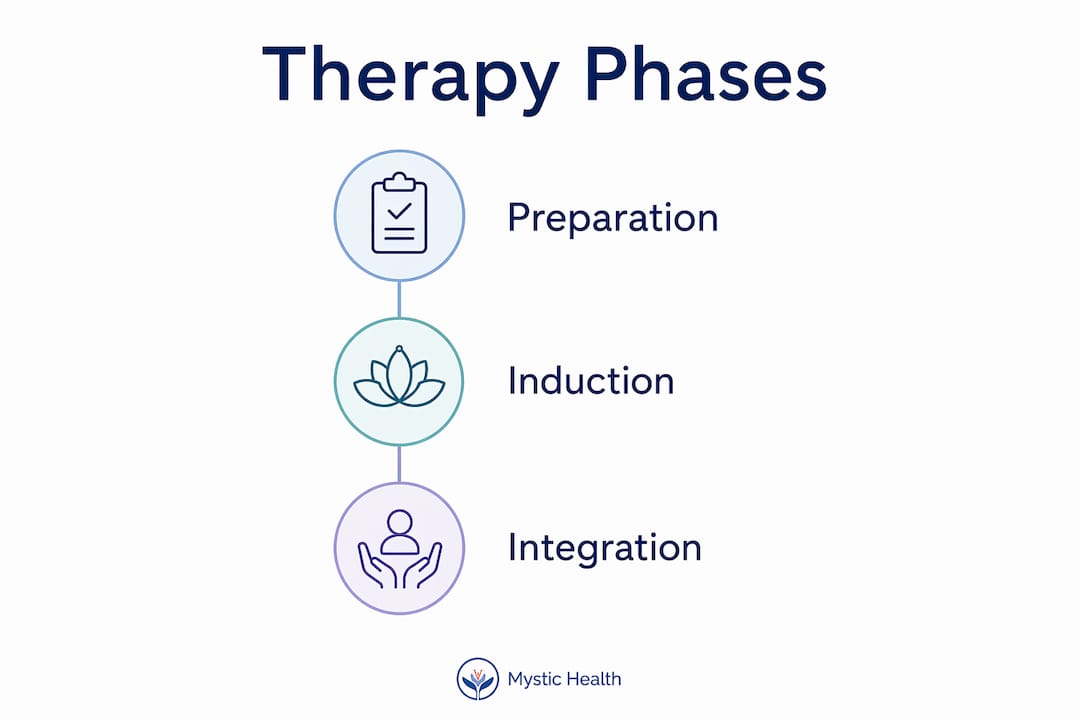
Preparation
Preparation typically spans 1–3 meetings before any altered state is induced. During this phase, your therapist assesses your mental health history, builds a trusting relationship with you, and helps you set clear intentions for the work. Somatic and mindfulness-based stabilization are prerequisites before induction, because accessing deep trauma without a regulated nervous system can cause overwhelm rather than healing. Mystic offers a mindfulness program specifically designed to support this preparation phase.
Induction
The induction session is where the altered state is entered. The method depends on the therapy model:
- Holotropic breathwork uses accelerated breathing patterns and evocative music to shift consciousness without any substance.
- Meditation-based approaches use deep concentration or open-awareness practices to dissolve ordinary mental chatter.
- Hypnosis uses guided suggestion to move awareness into a receptive, focused state.
- Psychedelic-assisted therapy uses substances like psilocybin or ketamine under clinical supervision to induce profound shifts in perception and emotion.
Session length varies widely. Breathwork sessions typically run 2–3 hours. Ketamine-assisted sessions may last 45–90 minutes. Psilocybin sessions can extend 4–6 hours. Your therapist remains present throughout, tracking your state and helping you stay within what clinicians call the window of tolerance: the zone where you can process difficult material without being overwhelmed by it.
Integration
Integration begins immediately after the induction session and typically continues for 3–6 months. This is where the real work happens. You and your therapist examine what arose during the altered state and translate those insights into concrete changes in your daily life.
Pro Tip: Keep a dedicated journal starting the night of your induction session. Write down images, feelings, and fragments of thought before they fade. This raw material becomes the foundation of your integration work.
What are the safety risks of altered states therapy?
Safety is the non-negotiable foundation of effective NOSC therapy. The same openness that makes these states therapeutically powerful also makes them potentially destabilizing without proper support.
The core risks include:
- Emotional flooding: Traumatic memories or intense grief can surface faster than you can process them, leading to temporary overwhelm.
- Secondary trauma: Revisiting traumatic material without adequate support can reinforce rather than resolve the original wound.
- Disorientation: Some people experience confusion about identity or reality during or after a session, particularly with psychedelic methods.
- Unsupervised use: Unsupervised use risks overwhelm or secondary trauma; clinical expertise is not optional.
Trained therapists co-regulate your nervous system in real time during sessions. That means they read your body language, breathing, and verbal cues to gauge whether you are processing productively or approaching a threat state. When threat states arise, they use grounding techniques, voice, and physical presence to help you return to the window of tolerance.
Ethical clinical practice also requires thorough documentation, informed consent, and clear protocols for managing adverse reactions. If a provider cannot explain their safety protocols clearly, that is a signal to look elsewhere. Mystic’s guide to safety in psychedelic therapy covers what those protocols should include.
Pro Tip: Before committing to any NOSC therapy program, ask your provider directly: “What happens if I become overwhelmed during a session?” A clear, specific answer is a sign of a well-trained clinician.
Why integration determines whether the therapy actually works
Integration is the most critical phase of non-ordinary states therapy. Without it, even the most profound altered state experience fails to produce lasting change.
Think of the induction session as opening a door. Integration is the work of walking through it and building something new on the other side. Without integration, breakthroughs fail to produce tangible benefits in relationships, emotions, or behaviors. People often describe feeling unmoored after powerful sessions if they lack adequate integration support.
“The therapeutic potential of non-ordinary states is amplified when combined with modern psychotherapeutic integration techniques for whole-person healing.” — Mental Health Providers
Integration work takes many forms. Journaling and somatic practices help anchor insights in the body. Therapy sessions focus on applying new perspectives to real relationships and emotional patterns. Group integration circles, offered by some programs, provide community and shared reflection. Mindfulness practices help you stay connected to the clarity that emerged during the altered state.
The clinical evidence shows that psychedelic NOSC therapy decreases depression and death anxiety in end-of-life patients, improving optimism and life satisfaction. Those outcomes are not produced by the altered state alone. They emerge from the combination of the experience and the sustained integration work that follows.
Non-ordinary states help shift your stance from avoidance to engagement with difficult emotions. That shift, from fear to curiosity, is what makes healing possible. Integration is the practice of sustaining that shift across weeks and months, not just hours.
The preparation and integration workflow at Mystic reflects this understanding. Preparation, induction, and integration are treated as a single continuous arc, not separate events.
Key Takeaways
Non-ordinary states therapy works because preparation, clinical supervision, and sustained integration together determine whether altered state experiences produce lasting mental health benefits.
| Point | Details |
|---|---|
| Definition matters | NOSC therapy is a clinical method, not a spiritual practice, requiring trained therapists and structured protocols. |
| Preparation is non-negotiable | Stabilization and nervous system regulation before induction prevent overwhelm and re-traumatization. |
| Eight state categories exist | A 2025 taxonomy classifies altered states to help clinicians and patients understand and work with experiences precisely. |
| Integration drives outcomes | Lasting change comes from applying insights to daily life over 3–6 months, not from the intensity of the session itself. |
| Safety requires clinical oversight | Unsupervised use of non-ordinary states carries real risks; trained co-regulation is what makes the process therapeutic. |
What I’ve learned from watching people move through this work
I want to be honest with you about something I’ve observed over years of working in this field. Most people who come to NOSC therapy are not looking for a spiritual experience. They are exhausted. They have tried other approaches, and something still feels stuck. They are hoping this will finally move whatever has been immovable.
That hope is valid. And the research supports it. But the thing I’ve seen trip people up most often is the belief that the altered state itself is the cure. It isn’t. The altered state is the opening. What you do with that opening, the conversations you have, the patterns you examine, the relationships you show up differently in, that is where the actual transformation lives.
I’ve also seen people rush into induction without adequate preparation because they were in pain and wanted relief quickly. That rarely ends well. The window of tolerance concept exists for a reason. Your nervous system needs to be ready to hold what surfaces. A good therapist will not rush that process, even when you want them to.
The other thing worth saying plainly: not every provider offering these therapies is equally qualified. The field is growing fast, and training standards vary. Ask hard questions. Look for clinicians who can speak clearly about safety, ethics, and integration. The quality of the therapeutic relationship matters as much as the method itself.
If you are curious about this work, that curiosity deserves to be met with real information and real care. Not hype, not shortcuts, and not a one-size-fits-all protocol.
— Kabir
Explore non-ordinary states therapy with Mystic
If you are ready to explore what this work could mean for your mental health, Mystic offers integrative mental health programs that include preparation, clinical induction, and structured integration support. The programs are designed for people who want real change, not a quick fix.
Mystic’s clinical team specializes in psychedelic-assisted therapy, ketamine-assisted psychotherapy, and holistic mental health care. Every program begins with a thorough consultation to assess fit, build safety, and set clear intentions. Whether you are managing treatment-resistant depression, processing trauma, or facing a serious illness, Mystic’s psychedelic medicine programs are built around the whole person. Schedule a consultation to find out if non-ordinary states therapy is the right next step for you.
FAQ
What is non-ordinary states therapy used to treat?
Non-ordinary states therapy is used clinically for PTSD, treatment-resistant depression, end-of-life anxiety, and trauma. Research shows it decreases depression and death anxiety while improving life satisfaction, particularly in palliative care settings.
How long does a non-ordinary states therapy program last?
A full program typically spans several months. Preparation takes 1–3 sessions, induction sessions vary from 45 minutes to 6 hours depending on the method, and integration continues for 3–6 months after the induction phase.
Is non-ordinary states therapy the same as psychedelic therapy?
No. Psychedelic-assisted therapy is one method within the broader category of non-ordinary states therapy. Other methods include holotropic breathwork, hypnosis, and deep meditation, none of which involve substances.
Can non-ordinary states therapy be done without a therapist?
Clinical NOSC therapy requires a trained therapist present during induction and throughout integration. Unsupervised use carries real risks of emotional flooding and secondary trauma, and removes the co-regulation that makes the process safe and effective.
What makes integration so important after a session?
Integration translates the insights from an altered state into lasting changes in behavior, relationships, and emotional regulation. Without it, even profound experiences fail to produce meaningful or durable mental health benefits.
Recommended

Mystic Health Blog








FAQs
1. Am I eligible for ketamine therapy?
2. Does insurance cover the cost of ketamine therapy?
3. How many ketamine treatments will I need?
We recommend two initial treatments to determine suitability and adjust dosage. After these sessions, additional treatments are available based on your progress and specific requirements.